博客

  • Mespo resident becomes 3rd man gunned down in SVG in 3 weeks

    Mespo resident becomes 3rd man gunned down in SVG in 3 weeks

    The small Eastern Caribbean nation of St. Vincent and the Grenadines is confronting a troubling surge in violent crime following the fatal shooting of Kevin Richards, marking the third homicide within a three-week period. The incident occurred Friday evening in the modest village of Montaque, according to reports from iWitness News.

    Initial reports indicate that Richards, a resident of Mesopotamia also known by the alias ‘Masicka’, was standing near a roadside when a vehicle approached his location. The automobile came to a halt, and an occupant inside opened fire, fatally wounding the young man believed to be in his twenties. Emergency responders were summoned to the scene, but Richards succumbed to his injuries.

    This tragic event follows two previous shootings that shocked the community. On January 16, 26-year-old Anil Greaves and Quinn Greaves (also known as ‘Huncho’) were ambushed and shot while socializing at a local shop in Georgie Gutter, Belair. Anil Greaves died immediately at the scene, while Quinn Greaves later passed away in a medical facility.

    Law enforcement authorities have acknowledged the gravity of the situation by establishing a specialized investigative team to address these connected killings. The unit is being led by Assistant Commissioner of Police Trevor ‘Buju’ Bailey, who oversees crime-fighting initiatives nationwide. In an official press statement, police leadership emphasized their commitment: ‘This investigation will be conducted without distraction, without delay, and without compromise.’

    Despite these assurances, investigators have not yet made any arrests in connection with the January homicides. The latest shooting brings the official homicide count in St. Vincent and the Grenadines to four recorded deaths since the beginning of the year, raising concerns among citizens about community safety and violent crime prevention.


  • Operation against electric skateboard scooters in SFM; mayor urges a halt to sales of these vehicles

    Operation against electric skateboard scooters in SFM; mayor urges a halt to sales of these vehicles

    Authorities in San Francisco de Macorís have launched a comprehensive operation targeting the proliferation of electric skateboard scooters following growing public safety concerns. The National Police initiative responds to widespread complaints about aggressive riding behavior and unauthorized commercial operations involving these vehicles.

    The crackdown comes after numerous citizens and parents expressed alarm over the predominant use of these scooters by minors and the absence of proper permits among businesses renting or selling them. Mayor Alex Díaz has publicly endorsed the police action, characterizing the situation as ‘a headache for parents and the community.’

    Díaz issued stern warnings to both merchants and parents involved in the scooter trade. He emphasized that businesses operating without municipal authorization must immediately cease operations or face compulsory closure. The mayor specifically highlighted the danger these unregulated vehicles pose to children and the community at large.

    Furthermore, Díaz addressed parental responsibility, stating that adults who purchase or rent these scooters for minors would be held fully accountable under extended liability provisions. He characterized such actions as irresponsible and warned that both vehicle owners and facilitating parents would face legal consequences.

    The municipal government insists that proper planning and regulatory order must be established, noting that the current situation developed without coordination with local authorities. The administration has made clear that businesses operating without proper permits will be forcibly closed if they fail to comply voluntarily.

  • Lahore viert heropleving van Basant festival na verbod van 18 jaar

    Lahore viert heropleving van Basant festival na verbod van 18 jaar

    The skies above Lahore, Pakistan, were transformed into a vibrant tapestry of color on Friday as the historic Basant kite festival returned after an 18-year prohibition. The traditional spring celebration marked its triumphant revival with thousands of participants flooding rooftops throughout the city’s historic Walled City and surrounding neighborhoods.

    The festival, banned in 2008 following fatal accidents caused by metal-coated kite strings, resumed following substantial public pressure and government intervention. Punjab’s Information Minister Azma Bukhari officially inaugurated the three-day event by launching the first kite at midnight, signaling the restoration of this cultural tradition.

    Enthusiastic crowds gathered on rooftops, beating drums and chanting the traditional victory cry ‘bo-kata!’ whenever a competitor’s string was severed. Abdul Aziz, 57, expressed profound fulfillment at the festival’s return, while Sharmeen Mehmood, 55, noted the nighttime activities represented the celebration’s peak moments.

    Authorities implemented stringent safety protocols including a complete ban on metal or chemically-coated strings, mandatory QR codes on all kites and strings for traceability, and safety poles required for motorcyclists. Over 4,600 manufacturers have registered to legally sell festival materials, and rooftops hosting more than 30 celebrants must obtain official registration, with dozens already closed following inspections.

    The festivities were somewhat overshadowed by a suicide bombing in Islamabad that claimed at least 31 lives, prompting the cancellation of a concert scheduled as part of Basant celebrations.

    Economically, the festival has generated significant activity, with hotels at full capacity and families enjoying elaborate meals. According to district government spokesperson Haris Ali, kite sales had already exceeded 3 billion rupees (approximately $10 million) by Thursday evening. Demand for poultry reached levels comparable to the major Muslim festival of Eid-ul-Fitr.

    At Mochi Gate, Pakistan’s largest kite and string market, supplies were rapidly depleted. Kite enthusiast Zubair Ahmed reported selling his entire stock within two days, noting unprecedented customer demand despite higher prices.

  • Tragic accident leaves one dead and two injured in Sosúa

    Tragic accident leaves one dead and two injured in Sosúa

    PUERTO PLATA – A devastating multi-vehicle collision erupted Friday evening along the Montellano-Sosúa highway, adjacent to General Gregorio Luperón International Airport, resulting in one fatality and multiple injuries. The deceased has been identified as Luis Maldonado, 49, a Dominican-born U.S. citizen who perished at the scene from traumatic impact injuries.

    Emergency responders transported two injured women, Jessica María Núñez and Daliza Mercedes Espinal, to medical facilities for urgent treatment. Authorities confirmed both survivors received immediate attention following the crash.

    The accident involved three vehicles: a Grand Cherokee SUV (license plate G557313) carrying Maldonado, a Honda CR-V (G724999), and a Hyundai sedan (A755895). Notably, Hyundai driver Samuel Jiménez Zapete emerged physically unscathed from the wreckage.

    According to the General Directorate of Traffic Safety and Land Transportation (DIGESETT), investigators are actively reconstructing the sequence of events that led to this high-impact triple collision. The crash has reignited urgent concerns about roadway safety measures along this perpetually congested transit corridor in Puerto Plata province, where traffic volumes consistently challenge infrastructure capabilities.

  • Former top GECOM official now Data Commissioner

    Former top GECOM official now Data Commissioner

    In a significant governmental development, Guyana has named Aneal Giddings, former Deputy Chief Elections Officer of the Guyana Elections Commission (GECOM), as the nation’s first Data Protection Commissioner. Prime Minister Mark Phillips formally announced the appointment on Friday evening, confirming to Demerara Waves Online News that Giddings assumed the pivotal role on January 2, 2026.

    Giddings, an established Information Technology specialist, resigned from his electoral position in December 2025 to assume this groundbreaking role under the recently enacted Data Protection Act. The appointment signals Guyana’s commitment to implementing robust data governance frameworks as the country advances its digital transformation initiatives.

    Prime Minister Phillips emphasized the critical nature of this appointment, particularly in relation to the ongoing collection of personal information for electronic identification cards. “We have established the independent oversight necessary to ensure that every byte of data collected meets the highest international standards of privacy and security,” Phillips declared during a National Assembly address.

    The Prime Minister further revealed that the government would shortly issue an order to fully activate the 2023 Data Protection Act, moving beyond the current voluntary registration phase for electronic identification. While acknowledging the present pilot program remains optional, Phillips indicated that registration would eventually become compulsory, though the existing legislation does not specify penalties for non-compliance.

    Addressing privacy concerns, Phillips clarified that the data being collected already exists across multiple government registries including the Guyana Revenue Authority, General Register’s Office, and the Immigration Department. He characterized the new system as “simply a consolidation of existing legal records into a more secure format,” emphasizing the enhanced protection mechanisms now under Giddings’ supervision.

  • WIN’s Mohamed says played major role in gold, foreign exchange markets

    WIN’s Mohamed says played major role in gold, foreign exchange markets

    In a contentious parliamentary session during Guyana’s 2026 National Budget debate, Opposition Leader Azruddin Mohamed asserted his former enterprises played a vital role in stabilizing the nation’s gold and foreign exchange markets prior to U.S. sanctions imposed in 2024. Mohamed, who leads the We Invest in Nationhood (WIN) party, claimed his operations previously supplied commercial banks with millions of U.S. dollars nightly, contrasting sharply with current shortages causing extended wire transfer delays and a depreciating Guyana dollar.

    The opposition leader faced frequent interruptions from ruling party officials, including Public Affairs Minister Kwame McCoy who labeled him an ‘alleged transnational criminal.’ Mohamed maintained his innocence regarding U.S. charges of wire fraud, mail fraud, and money laundering linked to gold trading, suggesting the sanctions resulted from his refusal to abstain from the 2025 elections.

    Mohamed presented data indicating a 21.5% decline in licensed gold declarations to 121,000 ounces since his exit from the market, questioning Natural Resources Minister Vickram Bharrat about the whereabouts of unaccounted gold. He simultaneously advocated for improved security measures for small-scale miners and increased access to viable mining lands.

    The WIN leader outlined alternative economic policies including temporary subsidies for utilities, established food banks, VAT reductions, and community agricultural projects. Finance Minister Dr. Ashni Singh challenged Mohamed to prove his innocence in court rather than ‘ensnare innocent Guyanese,’ while Attorney General officials pressed for answers regarding ongoing financial crime investigations.

  • CBvS-verslag 2025: Economie groeit beperkt; druk overheidsfinanciën en inflatie neemt toe

    CBvS-verslag 2025: Economie groeit beperkt; druk overheidsfinanciën en inflatie neemt toe

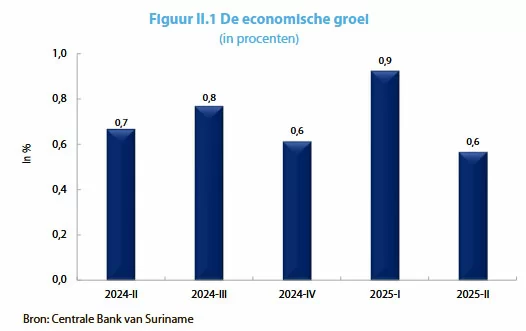
    Suriname’s economy demonstrated modest expansion during the second quarter of 2025, though significant vulnerabilities persist due to mounting inflationary pressures, deteriorating fiscal balances, and an increasingly precarious debt situation. According to the Quarterly Report 2025 released by the Central Bank of Suriname (CBvS), the economy grew by 0.6%, representing a slight deceleration compared to the same period in 2024.

    The growth was primarily driven by performance in trade, transportation, and hospitality sectors. Conversely, industrial production, mining operations, and agricultural activities contributed negatively to economic output. This decline was largely attributable to reduced gold production and diminished round timber harvesting during the period.

    Inflationary pressures reemerged as a critical concern, with quarter-end inflation reaching 3.6% while average inflation stood at 2.4%. The depreciation of the Surinamese dollar, coupled with increased costs for food, transportation, water, and cooking gas, served as primary drivers of price increases. Adverse weather conditions, including persistent rainfall, further exacerbated food price inflation. The central bank anticipates continued inflationary pressure throughout the third quarter of 2025, with recent data indicating a rise from approximately 10% at end-December to 11.4%.

    Fiscal metrics revealed concerning developments as government revenues totaled SRD 12.8 billion against expenditures of SRD 15.2 billion, resulting in an overall budget deficit of SRD 2.4 billion. The primary deficit reached SRD 782.5 million. While revenue generation improved through enhanced tax collections, expenditure growth outpaced revenue increases—primarily fueled by personnel costs, subsidy programs, and election-related spending. Temporary purchasing power measures for civil servants and pensioners significantly contributed to this expenditure growth.

    The national debt burden escalated to SRD 140.6 billion, equivalent to 95.8% of GDP according to national definitions. Notably, over 80% of this debt is denominated in foreign currencies, creating substantial exposure to exchange rate fluctuations.

    In response to these challenges, the CBvS implemented significant interest rate reductions during the quarter to manage high financing costs. While OMO rates declined substantially, the transmission to lower commercial lending rates remained limited. Simultaneously, excess liquidity within the banking system increased markedly, complicating monetary policy implementation.

    The central bank’s outlook remains cautious, emphasizing that without structural reforms and improved expenditure management, inflationary pressures, debt accumulation, and budgetary constraints will persist through subsequent quarters. CBvS officials underscored the critical importance of fiscal discipline and economic stability, particularly as the country approaches the post-IMF program period.

  • Ebu Jones: wetsvoorstellen noodzakelijk voor herstel vertrouwen in rechtsstaat

    Ebu Jones: wetsvoorstellen noodzakelijk voor herstel vertrouwen in rechtsstaat

    In a comprehensive address to the National Assembly on Friday, Surinamese lawmaker Ebu Jones of the National Democratic Party (NDP) presented a compelling case for fundamental judicial reform, arguing that the current system’s structural vulnerabilities demand immediate institutional reinforcement rather than representing any political whim or power struggle.

    Jones emphasized that the debate surrounding proposed legislative changes must transcend emotional reactions, isolated incidents, or personal considerations, focusing instead on institutional principles and legal protections. “Laws are not crafted for today’s officeholders,” he asserted, “but for the system that must function tomorrow, regardless of who holds positions of authority.”

    The parliamentarian identified several critical areas requiring transformation, beginning with the concept that the right to a fair trial commences well before courtroom proceedings—during investigation and prosecution phases where the Public Prosecutor’s Office (OM) wields concentrated power. Jones highlighted the OM’s extensive authority in deciding whom to prosecute, detain, keep incarcerated, or whose cases to dismiss, noting this power demands clearer legal safeguards, transparency, and checks and balances.

    A central pillar of Jones’ argument focused on Suriname’s exceptional regional position as lacking a third judicial instance. Following appeals, legal pathways in criminal and civil cases become essentially exhausted, creating compliance concerns with international treaties like the International Covenant on Civil and Political Rights (ICCPR). Jones clarified that a third instance wouldn’t constitute relitigating facts but would ensure proper review of legal rules, procedural diligence, and reasoning—thereby enhancing legal certainty, jurisprudence development, and judicial uniformity.

    Regarding proposed structural changes within the OM, Jones advocated for either multiple attorneys-general or a collegiate model, framing this not as an attack on current leadership but as institutional strengthening against arbitrariness, political pressure, and excessive individual burden. Such models, already commonplace in other legal systems according to Jones, would create more balanced decision-making, enhance internal controls, and prevent excessive power concentration.

    Jones addressed societal complaints about slow procedures, unequal treatment, and prolonged pretrial detention as symptoms of systemic strain rather than isolated incidents. He referenced previous administration practices where individuals were detained without judicial review under so-called ‘gag laws,’ only released after offering apologies days later.

    The reform advocate called for an integrated approach encompassing judicial strengthening, OM modernization, capacity expansion, improved training, and clearer legislation. Jones emphasized that proposed constitutional amendments aim primarily to create constitutional space for reform, with specific implementation details—whether establishing a domestic cassation instance, joining the Caribbean Court of Justice, or developing a hybrid model—to be carefully elaborated subsequently.

    “This debate isn’t about today,” Jones concluded, “but about the rule of law we wish to leave as our legacy.” He positioned judicial reform as essential for restoring public trust, deepening legal protections, and better preparing Suriname for future societal and economic developments.

  • Restored more than 20,000 clients: Edeeste reports dismantling nearly 3,000 direct connections in January 2026

    Restored more than 20,000 clients: Edeeste reports dismantling nearly 3,000 direct connections in January 2026

    SANTO DOMINGO – In a significant push to combat energy theft and improve system reliability, the Eastern Electricity Distribution Company (Edeeste) has announced the normalization of service for 20,950 customers and the elimination of 2,888 illegal direct connections within its service area during January.

    The utility’s Loss Management Directorate was central to this effort, executing a sweeping operational campaign that included 34,524 technical and commercial inspections. These targeted actions were designed to regularize power supplies and reclaim lost energy, forming a core part of Edeeste’s broader strategy to enhance the integrity of its distribution network.

    Complementing these internal efforts, the company also successfully normalized service for an additional 1,635 customers through mini-projects funded with support from international cooperation organizations.

    The comprehensive January initiative significantly bolstered the technical and commercial oversight of the entire distribution system. Key activities addressed a spectrum of irregularities, from the elimination of sub-metering (under-registration of consumption) to the direct correction of unauthorized power supplies.

    The crackdown also saw a robust legal response, with 7,057 formal reports of irregularities filed. This procedural step was crucial for strengthening the legal foundation required to correct consumption patterns and recover revenue from unregistered energy use.

    The operational blitz yielded substantial financial and operational benefits. Edeeste estimates that the inspections facilitated the recovery of 593,232 kWh of energy, a critical gain that directly supports the company’s financial sustainability and its ability to invest in reliable service.

    Reiterating its commitment to operational efficiency and legality, Edeeste emphasized that these actions are fundamental to providing a reliable and equitable electricity service for all its users. The company issued a public appeal, urging communities to shun illegal connections, which jeopardize system stability, pose serious public safety risks, and hinder national development.

    Looking ahead, Edeeste pledged to continue its collaborative work with government authorities, community leaders, and consumers to foster a culture of responsible energy consumption, legal connections, and efficiency—cornerstones of a modern and sustainable electrical system for the Dominican Republic.

  • Confrontation Operation in Los Frailes: ‘Tulile Palomería’ killed in exchange of gunfire with authorities

    Confrontation Operation in Los Frailes: ‘Tulile Palomería’ killed in exchange of gunfire with authorities

    SANTO DOMINGO EAST — A high-profile criminal suspect wanted for multiple homicides and violent crimes was fatally wounded during an armed confrontation with specialized police units in the Los Frailes sector. The incident occurred during a targeted operation conducted by the Central Directorate of Criminal Investigation (DICRIM) to apprehend the individual known by the alias “Tulile Palomería.”

    The suspect, who had been evading authorities through multiple arrest warrants, succumbed to gunshot injuries while receiving emergency medical treatment at Dr. Darío Contreras Traumatological Hospital. Preliminary reports indicate the confrontation erupted when DICRIM patrol units were conducting investigative operations to locate the wanted individual.

    Court documents reveal Palomería faced three outstanding arrest warrants: Case No. 2025-AJ00502698 (August 11, 2025) for firearm assault against a civilian; Case No. 2025-AJ0058460 (September 1, 2025) for homicide; and Case No. 2026-AJ0002783 (January 13, 2026) for an additional murder in Pedro Brand municipality.

    According to official police reports, the incident unfolded along José Francisco Peña Gómez Street near Progreso Street. The suspect allegedly initiated gunfire upon recognizing police presence, forcing officers to return fire in self-defense. The exchange resulted in critical injuries to Palomería, who was subsequently transported to medical facilities where he was pronounced dead.

    Forensic teams from the Scientific Police secured substantial evidence from the scene, including a 9mm Model 75 pistol (serial F9225), two spent cartridge casings, a National Police-issued ballistic vest, and three mobile devices. The investigation remains ongoing as authorities continue to process evidence and witness statements.