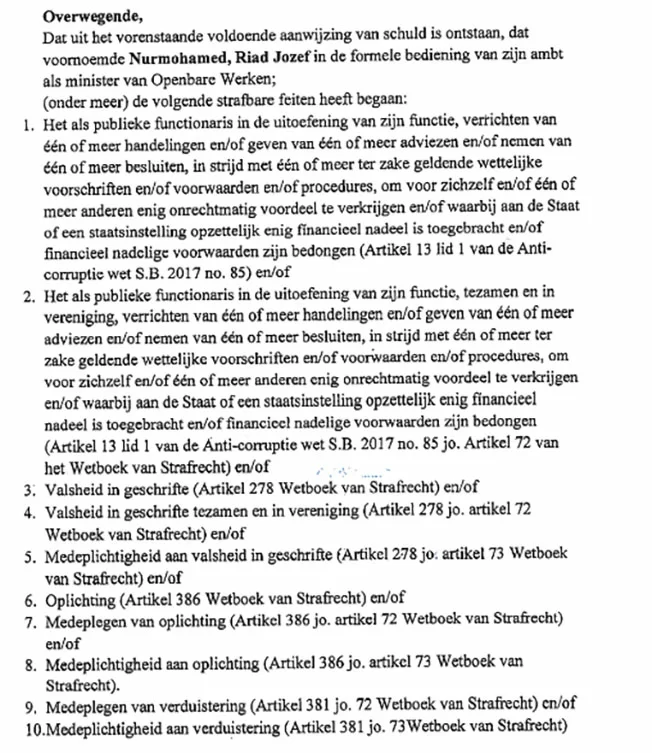
Across democracies globally, elected lawmakers routinely anchor their rhetoric in the will of the people, repeatedly emphasizing that they hold office as public representatives, and that transparency and open governance are non-negotiable pillars of democratic rule. Yet when Suriname’s National Assembly was called to make a critical high-stakes decision on behalf of voters—whether to allow criminal prosecution of three former ministers tied to ongoing corruption investigations—the legislative body failed to uphold the standard of maximum openness it claims to defend. On May 22, the assembly convened three separate closed and open hearings for the ex-officials: Bronto Somohardjo, former Minister of Internal Affairs; Riad Nurmohamed, former Minister of Public Works; and Gillmore Hoefdraad, former Minister of Finance. The country’s prosecutor general has filed a motion against the trio under the country’s 2003 Act on the Institution of Prosecution of Political Office Holders (WIPA), the legal framework that governs parliamentary process for cases involving current or former ministers. Under WIPA rules, parliament must first cast a political vote to determine whether there is sufficient credible evidence to move forward with criminal prosecution and investigation. Importantly, this initial vote does not judge guilt or innocence; it only clears the path for formal legal proceedings to proceed. In this process, parliament acts as a representative of the broader Surinamese public, not partisan or private interests. Of the three former ministers facing scrutiny, Hoefdraad is currently a fugitive, so public and legislative attention has centered on Nurmohamed and Somohardjo, both of whom served in the 2020–2025 Santokhi cabinet. A striking contrast has emerged in how the two former officials have approached the hearings, laying bare the hypocrisy at the heart of the parliament’s decision to let each official choose the openness of their proceeding. From the start of the investigation, Somohardjo has adopted a fully transparent stance. He has repeatedly stated he has nothing to hide, and even gone so far as to say he would vote in favor of opening prosecution against himself if the process required it. Most notably, he formally requested that his entire hearing be open to the public. The parliamentary hearing committee granted his request, and the assembly speaker later approved the decision. The case of Nurmohamed could not be more different. Despite his own past public comments touting governmental transparency and claiming he has nothing to conceal, he has fought to keep his hearing behind closed doors. The assembly has granted his demand, leaving the public shut out of proceedings that directly involve the management of public funds and alleged misconduct in public office. This outcome is a fundamental mistake on the part of the National Assembly. Openness in proceedings for public officials cannot be a privilege that depends on the preferences of the official being called to account. This is not a private legal matter; it is a review of conduct while holding public office, and the Surinamese public has an inalienable right to full transparency. That right is even more pressing given the serious allegations that prompted the prosecutor general’s request. Over the past several years, the Ministry of Public Works, which Nurmohamed led until 2025, has been the center of fierce public debate over rigged contracting, mismanaged infrastructure projects, and widespread corruption allegations. Nearly 10 months after Nurmohamed left the ministry, evidence of widespread mismanagement and misconduct has continued to emerge. His time in office was also marked by unpopular, polarizing comments that many Surinamese viewed as arrogant and out of touch, including a notorious remark that “society needs to be punished.” The prosecutor general’s formal motion accuses Nurmohamed of multiple violations of Suriname’s criminal code, including forgery, fraud, and embezzlement. The filing also notes that the alleged offenses are suspected to have been carried out in collaboration with other unidentified co-conspirators, who could face their own criminal proceedings if the case moves forward. Given the gravity of these allegations, the public unquestionably has a right to observe how Nurmohamed defends his conduct to the elected representatives who will decide the next steps of the case. Transparency is not a punishment for public officials—it is a core requirement of public accountability. Any person who has exercised public power, managed taxpayer funds, and made decisions that impact the entire nation owes the public a transparent accounting of their actions. The argument that closed-door hearings are necessary to protect the procedural rights of the accused holds little weight at this stage of the process. The WIPA process is not a criminal trial that results in conviction; it is a preliminary political decision on whether prosecution should be allowed to move forward. Precisely because parliament is making this decision on behalf of the people, the entire deliberation must be open and visible for the public to monitor. Somohardjo, unlike many of Suriname’s sitting lawmakers, understands this basic democratic principle. His choice to embrace open hearings demonstrates a level of political maturity and commitment to accountability that should be the baseline for all public officials. Anyone who claims to have nothing to hide has no reason to hide behind closed doors, and Somohardjo’s choice should have been the standard applied to all three hearings, not the exception. The hearing committee and National Assembly leadership should have adopted one clear, unwavering rule: all hearings must be open to the public, regardless of personal preference, political sensitivity, or strategic partisan calculation. Once openness becomes a negotiable concession rather than a non-negotiable democratic standard, the public is left with the unavoidable impression that transparency will be applied selectively to protect political interests. That perception erodes public trust in democratic institutions at a time when trust in Suriname’s government is already fragile. The decision to let Nurmohamed bar the public from his hearing does not just violate the public’s right to know—it betrays the core commitment to transparency that lawmakers claim to uphold.
博客
-
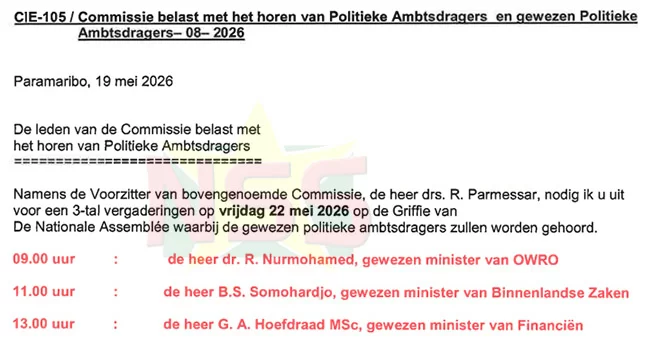
Nurmohamed wil achter gesloten deuren gehoord worden; Somohardjo niet
On May 22, a high-stakes parliamentary hearing process kicked off in Suriname for three former senior political officials, who face criminal investigation over allegations of misconduct during their time in government. A key development emerged on the opening day: the hearing for Riad Nurmohamed, the country’s former Minister of Public Works, will proceed behind closed doors, after the former official personally requested that the session not be open to the public.
Rabin Parmessar, chair of the special parliamentary committee tasked with overseeing these hearings for political officeholders, confirmed the decision in an interview with local outlet Starnieuws, emphasizing that the panel respects Nurmohamed’s choice. “We cannot force him to proceed with an open hearing if he does not want one,” Parmessar noted, adding that National Assembly hearings are closed to the public by default, with exceptions granted only under specific circumstances.
This closed-door arrangement stands in contrast to the hearing for a second former minister, Bronto Somohardjo, ex-Minister of the Interior. In that case, the committee voted by majority to grant the former official’s request for an open hearing, departing from the standard rule. Four committee members supported holding the public hearing, two opposed the move, and one abstained from the vote, clearing the way for an open session for Somohardjo.
The entire series of hearings is rooted in a request from Suriname’s Public Prosecutor General, launched under the country’s Prosecution of Political Officeholders Act. Prosecutors at the Public Ministry (OM) say they have accumulated sufficient evidence to justify moving forward with criminal proceedings against all three former cabinet members. Under Suriname’s law, the National Assembly must grant formal approval before any criminal prosecution of former political officeholders can proceed.
The allegations against each former official center on distinct cases of alleged misconduct:
The case against Gillmore Hoefdraad, the country’s former Finance Minister, focuses on potential irregularities linked to state funds and the management of assets at the Surinamese Postal Savings Bank. Prosecutors have flagged suspected fraud, abuse of official authority, and circumvention of regulatory oversight as key areas of investigation.
Nurmohamed, the first former minister scheduled for hearing on May 22, is tied to alleged irregularities in the Pan American Real Estate affordable housing construction project. Investigators are probing financial agreements, contractor payments, and the execution of infrastructure works for the initiative, with prosecutors citing reasonable suspicion of forgery, fraud, and abuse of official power.
For Somohardjo, investigators are examining allegations that he misused the Ministry of Interior’s personnel, equipment, and public funds for partisan political activities and personal gain. Prosecutors also claim he provided preferential treatment to a connected construction company for government contracts and improper payments from the ministry’s budget.
Per the published hearing schedule, Nurmohamed’s closed hearing was set to begin at 9:00 a.m. local time, followed by Somohardjo’s open hearing at 11:00 a.m., and Hoefdraad’s hearing scheduled for 1:00 p.m. The outcome and logistics of Hoefdraad’s hearing remain uncertain, however, as the former Finance Minister has been a fugitive from justice for years.
-

COMMENTARY: Featuring growth and inclusion, sustaining tea, and supporting communities
As a beverage embedded in the daily routines of billions across the globe, tea is far more than a simple hot drink—its 5,000-year history has woven it into the cultural, economic and social fabric of nearly every region on Earth. Every year on May 21, the United Nations observes International Tea Day to honor tea’s far-reaching contributions, and the 2026 observation centers on two official themes: “Fostering Growth and Inclusion” and “Sustaining Tea, Supporting Communities”, which shine a spotlight on empowering smallholder producers, advancing inclusive economic development, and scaling eco-friendly production practices. Today, tea holds the title of one of the world’s most widely consumed beverages, with cultivation taking place across diverse climates and geographies worldwide. More than 13 million people—most of them small-scale farmers and their household members in low- and middle-income nations—depend entirely on the tea sector for their income and food security. For the global economy, tea drives export earnings, rural development, and job creation, aligning the entire industry with the United Nations 2030 Agenda for Sustainable Development, which aims to cut extreme poverty, end hunger, and protect natural resources. Beyond its socioeconomic impact, tea carries deep cultural meaning that varies sharply from region to region. In India, a steaming cup of spiced chai is the universal starting point for nearly every morning, whether enjoyed at home, at street-side stalls, or in office canteens. Invitations to share tea act as a core social ritual, opening conversations and building communal bonds before the workday even begins. In the Caribbean, a distinct local tea culture has evolved around what locals call “bush teas”, herbal infusions harvested from native plants rather than the traditional Camellia sinensis plant that forms the base of conventional black, green and oolong teas. While imported Camellia sinensis tea remains popular, often served with condensed milk or warm spices, the Caribbean’s herbal tea sector has grown into a profitable, export-focused industry. For generations, Caribbean communities have relied on these local infusions for wellness: ginger tea eases upset stomachs, chamomile tea soothes insomnia, and cinnamon tea is traditionally used to support healthy blood glucose levels. Modern scientific research has backed up many of tea’s long-touted health benefits, regardless of variety. All true teas from Camellia sinensis are packed with naturally occurring polyphenols and antioxidants such as catechins, which fight oxidative stress and reduce chronic inflammation in the body. When consumed without excessive added sugar, tea has been linked to improved digestion, better metabolic regulation, and reduced stress levels, though researchers note that impacts on iron absorption and digestion can vary based on tea type, strength, serving size and the timing of consumption. Sustainable production is at the core of 2026’s International Tea Day agenda. Sustainable tea cultivation encompasses a range of practices: organic farming that cuts synthetic pesticide use, water conservation to protect critical freshwater resources in growing regions, fair and ethical labor standards for farm and processing workers, and eco-friendly packaging that reduces plastic waste. The rising global demand for specialty and ready-to-drink (RTD) tea has also shifted market dynamics, particularly in tourism-dependent regions like the Caribbean, where resorts and local supermarkets report surging demand for portable, premium tea products to meet the needs of visitors. From the terraced tea gardens of China and Sri Lanka to the street chai stalls of India and the backyard herbal plots of the Caribbean, tea acts as a universal thread connecting generations, traditions and communities across borders. It is a moment of quiet comfort amid busy days, a centerpiece of social gathering, and a lifeline for millions of families that rely on its production for survival. This International Tea Day, the global tea community invites people everywhere to explore new tea varieties, celebrate the cultural heritage behind every cup, and recognize the critical role the sector plays in building a more sustainable and inclusive global economy.
-
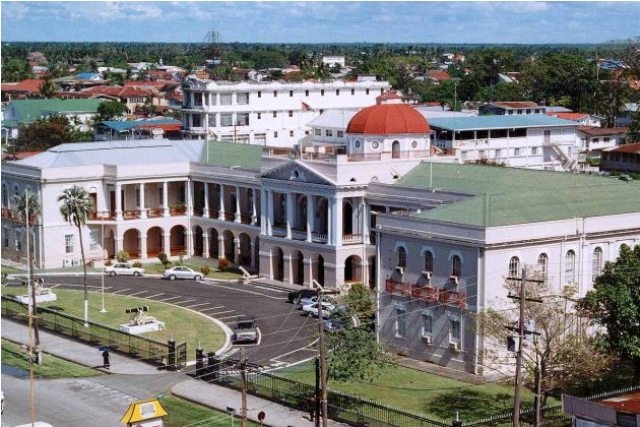
After absence of more than 3 months, National Assembly meets on June 5
After months of public pressure to reconvene the country’s 65-seat National Assembly, which had not held a formal sitting for roughly 110 days, the Guyanese government confirmed on Thursday that the legislative body will return to session on June 5. The announcement was made via a social media statement from Minister of Parliamentary Affairs and Governance Gail Teixeira, who offered no formal explanation for the extended gap between parliamentary sittings.
The confirmation comes amid growing cross-sector criticism of the prolonged adjournment, including recent public comments from members of Guyana’s diplomatic community that questioned the absence of legislative activity. Teixeira pushed back against these public remarks, noting that it was regrettable that foreign ambassadors, embassies and high commissions opted to share their concerns publicly rather than first reaching out to the governing party to request clarity on the parliamentary schedule.
According to the minister, if diplomatic representatives had pursued direct consultation with the government ahead of making public statements, they would have already learned that a June 5 sitting had been finalized long before their comments. Teixeira emphasized that Guyana remains committed to maintaining its close, constructive friendships and partnerships with the global diplomatic community. However, she underscored that engagement on domestic matters tied to the country’s legislative agenda and parliamentary operations must follow appropriate, respectful protocols.
The minister made clear that the government hopes unprompted public commentary from diplomatic missions on internal parliamentary affairs does not become a standard practice going forward. She added that the administration expects future discussions related to parliamentary business will be conducted through more in-depth, mutually respectful channels that align with Guyana’s sovereign processes.
The government’s announcement also came just 24 hours after a small opposition political grouping, the Forward Guyana Movement, submitted a formal petition decrying the extended absence of parliamentary sittings. In the petition, the opposition group argued that the prolonged halt to legislative operations was actively eroding core democratic principles in Guyana, including government transparency, accountability to the public, and freedom of expression. The move from the opposition added to growing domestic pressure on the administration to set a firm date for the reconvening of the National Assembly.
-

Detailed conditions for micro-loans from development bank
On Thursday, May 21, 2026, Guyana’s Minister of Government Efficiency Zulfikar Ally publicly laid out eligibility and procedural requirements for small and medium-sized businesses seeking interest-free, collateral-free loans of up to 3 million Guyanese dollars from the soon-to-launch Guyana Development Bank, during a business luncheon hosted by the Guyana Manufacturing and Services Association (GMSA).
Ally confirmed that the state-backed bank is on track to open its doors to borrowers before the end of 2026, and detailed the core documentation and checks applicants will need to complete. To qualify for financing, business owners must provide a verifiable credit score, proof of compliance with both the National Insurance Scheme and Guyana Revenue Authority regulations, official proof of address, a comprehensive business plan, updated financial statements where applicable, and official government identification — a digital ID is preferred, but traditional physical identification cards will still be accepted. All applications will also undergo a rigorous background check focused on the applicant’s history of debt repayment, Ally added.
To ensure full public accountability, the minister announced that all of the development bank’s financial activities will be audited annually by the Office of the Auditor General, and all government capital injections into the institution will be formally presented to and reviewed by Guyana’s Parliament. Currently, the government has not implemented any upper cap on total annual loan disbursements, Ally confirmed.
Financing from the new bank will prioritize four key high-growth sectors: agriculture and agro-processing, tourism and hospitality, trade, and the emerging creative and digital industries. When pressed for details on intellectual property protections for digital and creative sector borrowers, Ally noted that the government is still developing policy frameworks for this fast-growing new segment, with more details to come at a later date. The bank’s long-term structure is designed to support growing businesses as their capital needs expand, Ally explained: for businesses that successfully grow past the 3 million GYD loan cap and need additional financing, the development bank will partner with local commercial banks to facilitate larger lending, while also providing pre-screening, business training, and referral support to connect qualified borrowers with additional capital.
Beyond lending, the institution will offer non-financial support to borrowers, including mandatory financial literacy training, one-on-one mentorship from experienced industry professionals, targeted business development guidance, and technical assistance to help small business owners strengthen their management capabilities, improve long-term operational sustainability, and scale their operations.
Repeated questions were raised at the event about the long-term fiscal sustainability of the bank’s model of zero-interest, no-collateral lending, with attendees asking whether the government would cap lending after disbursing several billion Guyanese dollars. Ally rejected the prospect of an early cap, confirming that the government will commit sustained capital to the initiative, which is designed to unlock economic potential for under-served entrepreneurs across the country who have strong business ideas but lack access to traditional financing.
Ally added that Guyana’s policy team has drawn lessons from decades of successful experience with similar microcredit and development bank models in South Asia, specifically studying the Grameen Bank of Bangladesh, the pioneering microfinance institution that built its model on no-collateral lending to reduce poverty and empower low-income entrepreneurs, as well as established development bank models in India.
-

Reconstruction : The State comes to the aid of infrastructure in the Southeast
As Haiti prepares for the upcoming 2026 Atlantic hurricane season, the country’s Ministry of Public Works has ramped up on-site infrastructure assessments and reconstruction work across the Southeast department, focusing on critical energy and flood mitigation projects that address long-standing vulnerabilities in the region.
Following a recent strategic inspection tour of the Palmes region, Minister of Public Works Joseph Almathe Pierre Louis led a ministerial delegation to the Southeast this week, kicking off the visit with a stop at the Gaillard hydroelectric power plant in Cayes-Jacmel. The facility, a key contributor to local energy supply, has been completely shut down for roughly 12 months, creating widespread disruptions to power access for surrounding communities. Minister Pierre Louis emphasized that restoring the plant aligns directly with the Haitian government’s top priority of expanding domestic energy independence, noting that engineering teams will quickly conduct full technical evaluations to launch rehabilitation work and bring the plant back online as soon as possible.
After wrapping up the inspection at the hydropower plant, the delegation traveled to Bassin Caïman, a geographically critical hydrological hub where three major Haitian waterways — the Rivière Gauche, Rivière Gosseline, and Grande Rivière — converge. The site suffered severe damage during Haiti’s last major cyclone, which washed out a large stretch of the country’s national highway that runs through the area. During the visit, the minister reviewed ongoing gabion construction projects designed to reinforce damaged infrastructure and reduce future flood risk.
Against a backdrop of increasing climate-related extreme weather events hitting the Caribbean, Haiti’s public works ministry — backed by the Prime Minister’s Office — has rejected short-term, superficial fixes that fail to address the root of the country’s infrastructure vulnerabilities. With the official hurricane season set to begin on June 1, immediate action is the top priority right now: the ministry will launch intensive operations to correct at-risk riverbeds across the Southeast, including embankment reinforcement, dredging of accumulated sediment, and bank protection work designed to lower the risk of catastrophic flooding as storm activity ramps up.
Over the medium term, the government plans to shift focus to long-term structural improvements for regional watersheds, implementing comprehensive upgrades that will protect both residential communities and critical infrastructure for decades to come. Beyond infrastructure assessments, this cross-country tour of Haiti’s administrative departments has allowed Minister Pierre Louis and his team to gain on-the-ground insight into local infrastructure needs and engage directly with residents to understand their top concerns as the country works toward widespread reconstruction.
-
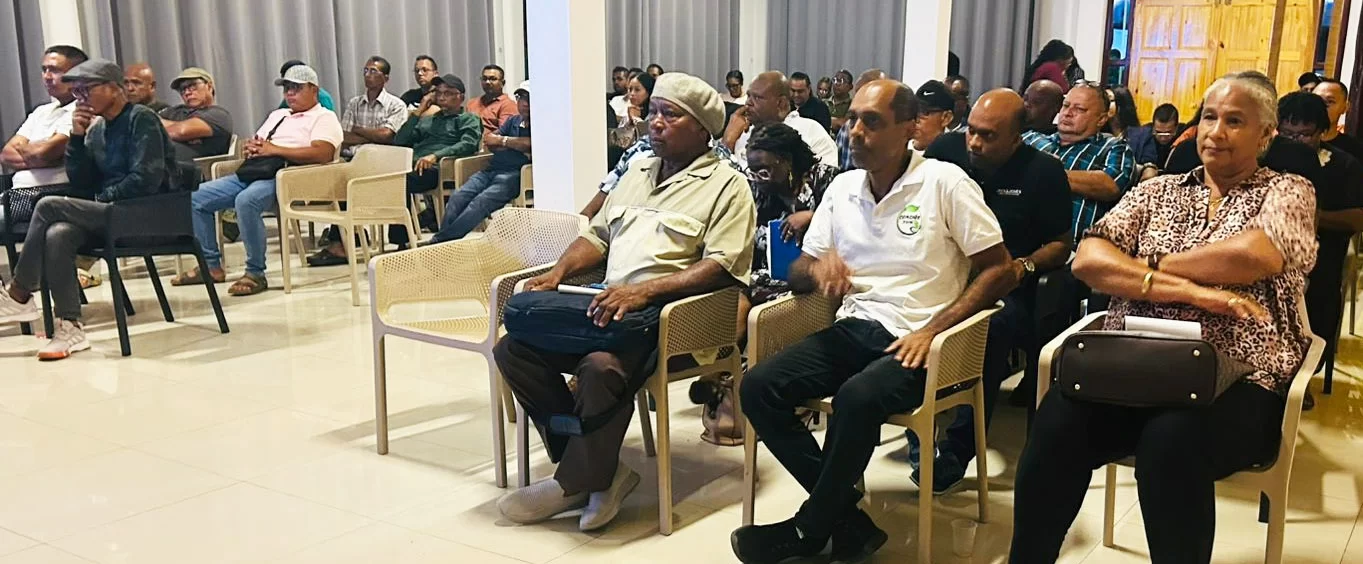
Toerismeoverleg: Bigi Pan moet gericht aangepakt worden
Suriname’s presidential working group focused on national tourism development held a key stakeholder consultation in the western district of Nickerie on Wednesday, part of a countrywide outreach initiative ordered by the nation’s president to shape a updated national tourism strategy. The session brought together a cross-section of relevant stakeholders: tourism industry representatives from both Nickerie and neighboring Coronie district, the top administrative commissioners of both regions, and the director of tourism from Suriname’s Ministry of Transport, Communication and Tourism.
During the in-depth discussions, Bigi Pan emerged as a top priority for the country’s tourism sector. The vast natural wetland reserve has earned international acclaim as a one-of-a-kind nature tourism destination, drawing visitors eager for birdwatching, eco-tourism and immersive wilderness experiences. For years, however, the site has grappled with persistent challenges related to cross-agency coordination, sustainable management, conservation protections and long-term structural development. Participants stressed that Bigi Pan holds unmatched strategic value for western Suriname, not only as a anchor for nature-focused tourism but also as a driver of local economic growth and a key asset to position the region as a competitive international tourist destination.
Beyond the specific issues facing Bigi Pan, stakeholders laid out a series of broader bottlenecks holding back tourism expansion across Nickerie and Coronie. Top among these concerns were poor conditions of local infrastructure and road networks, limited accessibility to remote tourism sites, inadequate public and commercial transport connections, prohibitively high air ticket prices for domestic and international travelers, and growing competitive pressure from the neighboring tourism sector in Guyana. Attendees emphasized that these challenges directly weaken the region’s competitive standing and block planned expansion of the local tourism industry, according to official statements from Suriname’s Communication Service.
The presidential working group confirmed that all insights, feedback and recommendations gathered during the Nickerie consultation will be integrated into ongoing policy analysis, which will ultimately be presented to the Surinamese president for consideration. Participants also underlined that the untapped tourism potential of Nickerie and Coronie deserves targeted, sustained national attention in the coming years, particularly amid Suriname’s broader shifting economic landscape driven by the emerging oil and gas sector. Attendees agreed that a well-developed sustainable tourism sector can serve as a critical complementary economic pillar for western Suriname, supporting balanced regional development and generating much-needed new local employment opportunities.
-

FLASH : The FAd’H will launch a massive recruitment drive in all 10 departments
Haiti’s Ministry of Defense has formally announced that the Haitian Armed Forces (FAd’H) will soon roll out a large-scale recruitment campaign across all 10 of the country’s administrative departments, in a move aligned with the institution’s 2026-2027 strategic plan to steadily expand and strengthen its military workforce.
Unveiled via an official press release on Thursday, May 21, 2026, the initiative aims to bring 1,000 new service members into the force, filling ranks across all tiers: enlisted soldiers, non-commissioned officers, and commissioned officers. Unlike targeted recruitment drives limited to specific regions, this campaign will open applications to eligible young men and women across the entire country, expanding access for interested candidates regardless of where they reside.
In addition to the longstanding mandatory eligibility checks covering physical fitness, cognitive aptitude, and medical clearance, the FAd’H has introduced a new set of alternative social profile criteria to vet candidates. This update is designed to embed core Haitian national values — including civic responsibility, patriotism, and collective mutual support — into the force’s membership.
Candidates only need to meet one of the 10 listed social criteria to qualify, rather than satisfying all requirements. The eligible criteria include: being an active blood donor registered with the National Transfusion Safety Program; demonstrating consistent eco-citizenship practices; participating in community-led projects that boost local public well-being; contributing to support networks for socially isolated patients; holding membership in a youth educational movement such as Scouting, MEJ, or Junior Achievement; working with mutual aid groups supporting vulnerable adults facing mental, cognitive, or social disabilities, as well as elderly adults; taking part in local or national reforestation initiatives; leading or participating in civic, artistic, or athletic training programs for underserved teens and young adults; serving as a recognized role model for positive masculinity within one’s community; and actively advancing a culture of peace among local residents.
Official documentation from social or institutional partners confirming a candidate’s participation in one of these activities will be required during the application and vetting process. The expanded criteria mark a notable shift in how the FAd’H evaluates candidates, prioritizing community commitment alongside traditional service qualifications as the force works to build a military that reflects and supports national social priorities.
-
Thousands back petition to reinstate death penalty In Saint Lucia
A grassroots push to revive active use of capital punishment in Saint Lucia has rapidly gathered massive public support, just hours after a high-profile killing that has shaken the small Caribbean nation. The campaign, launched just one day after 24-year-old community leader and young mother Joy St Omer was fatally shot, has already drawn nearly 4,500 signatures as of late Thursday, tapping into a groundswell of public anger over a sustained surge in violent crime.
St Omer, a resident of Anse La Raye and serving Treasurer of the Anse La Raye Youth and Sports Council, was found dead in the driver’s seat of her vehicle Wednesday evening, with multiple gunshot wounds to her body. Police confirmed that St Omer’s estranged husband has since surrendered to authorities to face questioning over the killing. The brutal slaying of a well-regarded young community figure has amplified long-simmering public frustration over soaring rates of gun violence and homicide across the island.
Hosted on the Change.org platform and addressed to Saint Lucia’s Prime Minister, Attorney General, and all sitting members of parliament, the petition calls on national authorities to actively enforce existing death penalty statutes for convicted individuals charged with capital murder and other extraordinarily violent offenses. Its authors argue that the country’s worsening public safety crisis demands far harsher legal consequences to deter further bloodshed.
“Our nation is currently gripped by an unprecedented wave of violent crime, gun violence, and cold-blooded homicide,” the petition text reads. “We, the citizens, residents, and diaspora of Saint Lucia, submit this formal petition out of a profound sense of urgency, grief, and duty to our country.”
Though capital punishment remains codified as a legal sentence under Saint Lucia’s Criminal Code, the country has observed an unofficial de facto moratorium on executions for nearly four decades. The petition attributes this longstanding pause to external judicial rulings and sustained pressure from international bodies, which has left the existing death penalty law unenforced and effectively powerless as a deterrent.
Supporters of the petition argue that active enforcement of capital punishment is a critical tool to combat rising violent crime, particularly gang-related homicides and repeat offenses. They contend that the absence of actual executions has eroded any fear of legal consequences among would-be offenders, and that formally ending the moratorium would send an unambiguous message that perpetrators who take innocent lives in Saint Lucia put their own lives at risk.
Beyond deterrence, the petition argues that carrying out death sentences for the most serious crimes would deliver long-awaited justice and emotional closure for families of murder victims, while permanently removing the most dangerous violent offenders from community spaces to protect the public. The document also draws a connection between skyrocketing homicide rates and potential long-term economic harm, warning that persistent violent crime could damage the island’s vital tourism sector and discourage new business investment.
In addition to reinstating active executions, the petition calls for a comprehensive government review of existing national laws and constitutional provisions that currently block the implementation of death sentences. It also urges lawmakers to formally abolish the decades-long unofficial moratorium, update judicial protocols to speed up the processing of capital cases, and allocate new, increased funding for the national judiciary and forensic services to ensure faster trials and more reliable convictions.
“We do not make this request lightly. We make it out of love for Saint Lucia and a desire to see our communities thrive in peace once again,” the petition concludes. “By signing this petition, we declare that enough is enough.”
As of late Thursday, the petition had accumulated just under 4,500 signatures from supporters both in Saint Lucia and across the global Saint Lucian diaspora, reflecting the deep public discontent over the country’s ongoing public safety emergency.
-

Fuel Prices Creep Up; Drivers Feel the Weekly Squeeze
As of May 21, 2026, Belize is grappling with two interconnected crises shaking its fuel sector: consecutive weekly price hikes have placed unprecedented financial pressure on ordinary motorists across the country, while fuel dealers are locked in a high-stakes dispute with the national government over a sudden rollback of a decades-old pricing framework.
Across Belize’s largest urban center, Belize City, the strain of rising fuel costs is visible at every gas pump. What was once a routine, predictable expense to keep vehicles on the road has ballooned into a major monthly budget burden, forcing thousands of drivers to rearrange their daily routines, cut back on non-essential travel, and rethink personal finances. In an on-the-ground, non-scientific survey of local motorists, reporter Paul Lopez from News Five documents how the steady climb in prices has upended household budgeting for commuters that rely on their vehicles for work and daily life.
Interviews with more than a dozen local residents reveal consistent stories of growing financial strain. One long-time commuter who travels daily from Orange Walk to Belize City for work explained that a $50 weekly fuel budget that once covered all his trips now only lasts 48 hours. “It really hurts me,” he shared, calling on national leaders to cut fuel taxes to ease the burden. Another mobile worker, who operates as a locksmith and must respond to emergency calls across the city, noted that what once cost $50 every two to three days now must be purchased every 36 hours on average. Even motorcyclists, who typically enjoy lower fuel costs, have seen their weekly expenses jump by $10 on average.
The scale of the increases varies by usage, but all drivers report double-digit weekly jumps in fuel spending. One vehicle owner who previously spent $80 per week on fuel for his car and $20 for his motorcycle now pays $110 for the car and $30 for the motorcycle, a 25% total increase. For a mother who makes daily trips to transport her children from the Belama neighborhood to schools across Belize City, weekly fuel costs have surged from $80 to $150 – a $70 jump that puts massive strain on her household budget. A commercial pickup driver who travels for work reports even starker growth, with his weekly bill climbing from $300 to more than $400. Across the board, drivers are frustrated: many note that even a $10 fill-up now barely moves the needle on their gas tank, leaving them constantly budgeting for refuels.
A quirk of the current pricing landscape has seen a surprising shift in consumer behavior: for the first time in many years, premium fuel now costs less than regular fuel at Belize’s pumps, leading most motorists to opt for the higher-grade option even as overall costs rise. Regardless of the grade they choose, the end result is the same: eroded purchasing power that leaves less money for other essential household expenses.
Beyond the strain on drivers, a separate conflict is brewing between fuel retailers and the Briceño administration. The Belize Service Dealers Association is demanding that the government address its concerns within seven days, after policymakers unilaterally scrapped a pricing formula that had governed dealer margins for more than 20 years.
Under the 2004 pricing agreement, service stations were guaranteed a 10% margin on fuel based on its landed import cost. This framework was replaced abruptly by a flat-rate margin system, a change that dealers argue threatens the financial viability of their businesses. Dealers note that they raised formal objections to the proposed change during initial public consultations, but claim the government moved forward with the new system anyway, ignoring their input.
Dealers warn that the new flat-rate structure will squeeze their already thin profits, making it far harder to cover fixed operating costs including commercial rent for station properties and employee wages. They also emphasize that the original 2004 agreement requires mutual consent from both the government and dealer association to make changes to the pricing framework, a requirement they say the government has violated. As tensions escalate, the association has confirmed it has already retained legal counsel and is weighing formal legal action to reverse the policy change.