博客

  • Bartica boathouse commissioned

    Bartica boathouse commissioned

    On Wednesday, April 22, 2026, the Guyana Police Force formally opened its purpose-built Bartica Police Boat House in Region 7, a major infrastructure investment designed to upgrade law enforcement reach and responsiveness across the country’s water-accessed riverine and remote hinterland communities.

    The official commissioning ceremony, held between 10 a.m. and 12:30 p.m. in Bartica, drew roughly 350 attendees and concluded without any disruptions, kicking off official operations at the strategically located facility. The event opened with multi-faith prayers and a recitation of Guyana’s National Pledge, chaired by Superintendent D. Handy, Deputy Commander of Regional Division 7.

    In his opening welcome, Assistant Commissioner Dion Moore, Commander of Regional Division 7, greeted Home Affairs Minister Oneidge Walrond and her delegation. He extended public gratitude to the minister and the Guyanese government for consistent support to the division, highlighting not only the new boat house but also the recently completed Ekereku Police Station, and the provision of new patrol vehicles and all-terrain vehicles for frontline work.

    Speaking on behalf of Commissioner of Police Clifton Hicken, Deputy Commissioner of Police (Operations) Errol Watts also addressed attendees, thanking the government for its sustained, substantial investment in the Guyana Police Force. Watts emphasized that this targeted resourcing allows law enforcement to carry out public safety duties in a more proactive, effective manner, closing gaps in coverage for remote communities.

    The ceremony included cultural programming highlighting local community engagement with policing, featuring a vocal performance from Celena Pollydore of the Mora Camp High Flyers Police Youth Group and a spoken word poem from the Agatash United Police Youth Group.

    Permanent Secretary of the Ministry of Home Affairs Andre Ally shared details of the project’s financing, revealing the boat house was completed at an estimated total cost of 33 million Guyanese dollars. Ally urged police leadership to prioritize regular maintenance and careful stewardship of the new public infrastructure to extend its service life for the community.

    In her keynote address, Minister Walrond highlighted a key recent win for Guyanese law enforcement: a 25% nationwide reduction in serious crimes. She framed the new boat house as a critical continuation of government investment in public safety infrastructure, noting that the facility will cut response times for emergency calls and crime reports across vast riverine areas that were previously hard for officers to access quickly.

    Bartica’s unique position as the primary gateway to Guyana’s hinterland makes the boat house a strategically vital asset, the minister added. She called on officers to use the facility with discipline and integrity, and reaffirmed the Guyanese government’s long-term commitment to providing the police force with all necessary resources to reduce crime and raise public safety standards across every region of the country.

    Following the formal program, Chief Inspector K. Gordon, Officer in Charge of the Bartica Police Station and Sub-Division 1, delivered the vote of thanks. Attendees then moved to the boat house for a ribbon-cutting ceremony led by Zahir Rahaman, after which Minister Walrond led an official walkthrough and inspection of the completed facility.

    The commissioning of the Bartica Police Boat House stands as a landmark milestone in the ongoing expansion and modernization of the Guyana Police Force. The project directly advances government efforts to improve police mobility, service delivery, and operational efficiency for remote communities that rely on water transport, bringing enhanced public safety coverage to long underserved regions of the country.

  • Vakbondsleider Dwarka reageert op betaling van US$ 5000 bij Canawaima

    Vakbondsleider Dwarka reageert op betaling van US$ 5000 bij Canawaima

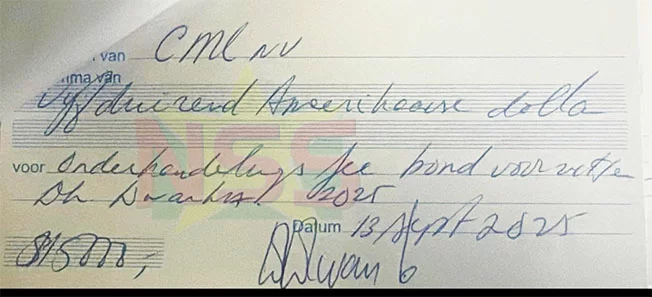
    Fresh controversy has emerged at Suriname’s Canawaima Management Company (CMC), a state-owned enterprise, after a whistleblower leaked a receipt to local outlet Starnieuws confirming that union chair Dayanand Dwarka received a $5,000 payment labeled as a negotiation fee.

    When contacted for comment on the undisclosed payment, Dwarka did not deny receiving the funds. Instead, he defended the transaction, arguing that such reimbursements are a standard practice during collective labor agreement negotiations.

    The union leader explained that the specific negotiations required repeated trips from his home base in Paramaribo to Nieuw-Nickerie, all of which he completed using his personal vehicle and covered travel expenses out of his own pocket upfront. “I used my private car and paid all travel costs out of my own pocket to carry out these negotiations,” Dwarka stated in his response.

    He further noted that the International Labour Organization (ILO)’s regulations explicitly allow for this type of cost contribution. Drawing a comparison, he pointed out that travel costs would be even higher if CMC board members based in Nickerie had traveled to Paramaribo via taxi for negotiations, making a cost contribution from the employer a reasonable request.

    Dwarka also emphasized his long-standing commitment to the labor movement, noting he has worked voluntarily in the sector for more than 40 years. This case was an exception, he argued, because travel expenses were unusually high: the negotiations were for the first-ever collective labor agreement in the history of the state-owned company, requiring more frequent travel than typical negotiations.

    In his closing defense, Dwarka rejected claims that accepting the negotiation fee or potential signing bonus constitutes unethical behavior, framing the payment as a legitimate reimbursement for significant out-of-pocket costs incurred during the negotiation process.

  • Liberty Caribbean Champions Women and Girls in Building Caribbean’s AI Future

    Liberty Caribbean Champions Women and Girls in Building Caribbean’s AI Future

    As the Caribbean region marks International Telecommunication Union’s (ITU) 2024 International Girls in ICT Day, which carries the theme “AI for Development: Girls Shaping the Digital Future”, leading regional telecommunications provider Liberty Caribbean has issued a urgent call for collective, accelerated action to address widespread gaps in artificial intelligence access, adoption and technical capacity across Caribbean communities.

    Organized annually by the ITU, this year’s global observance sets out a clear mandate: to inspire and equip more women and girls to build careers in information and communication technology (ICT), with a specific focus on fast-growing AI-powered emerging fields. The push for greater female representation in these sectors is rooted in a broader goal of building truly inclusive, sustainable socio-economic development across the globe, and small island regions like the Caribbean are no exception.

    In her remarks for the observance, Liberty Caribbean Chief Executive Officer Inge Smidts stressed that closing the Caribbean’s AI gap must move from a long-term planning goal to an immediate regional development priority. “AI must become a regional development priority to unlock new possibilities across our economies. This cannot be something we observe from the sidelines,” Smidts said.

    She emphasized that meaningful progress does not happen through passive interest: it demands intentional, cross-border collaborative action to move the region from casual curiosity about AI to large-scale, practical deployment across industries. “Countries that apply AI responsibly and ensure inclusive participation in their transformation efforts will be best positioned to grow and create opportunity,” she added.

    Smidts went on to note that as digital technology increasingly becomes the backbone of global economic decision-making, future prosperity for Caribbean nations will hinge on how effectively regional stakeholders turn widespread digital access into measurable productivity gains. “We must build this future intentionally, with full representation of our societies at the centre, ensuring that women, girls, and underserved communities are not only included, but empowered to lead, innovate, and shape the direction of that growth,” she said.

    As a leading regional connectivity provider, Liberty Caribbean — which operates consumer brands Flow and BTC, along with B2B service provider Liberty Business — has already laid groundwork for this regional shift through consistent, long-term investment in resilient, future-proof digital networks and cloud-based platforms. Beyond infrastructure, the company is rolling out targeted initiatives to upskill regional workforces, promote ethical, responsible AI innovation, and ensure that broader AI adoption delivers tangible, measurable benefits for residential customers, local communities, and national economies across the region.

    Internally, the company has already begun integrating AI-powered automation into its core operations, a move designed to boost back-office efficiency and deliver a more seamless, responsive experience for its customer base across more than 20 Caribbean markets.

    Sashagay Middleton, a B2B Sales Account Executive based in Antigua and Barbuda, framed the shift as a deeply local issue, noting that digital technology is no longer a distant future concept but an integral part of daily life across the Caribbean. “Technology is no longer something that belongs to a distant future, it’s part of how we live, work and connect every day in Antigua and Barbuda,” Middleton said. “As we mark International Girls in ICT Day, we are reminded of how important it is to encourage girls to see themselves as creators of technology, including AI, not just consumers. When girls are empowered digitally, the entire country benefits.”

    Through ongoing investments in universal connectivity, accessible digital skills training, and inclusive talent development pathways, Liberty Caribbean is working to ensure that future Caribbean innovation is led by homegrown talent — including the women and girls who will shape the sector’s next chapter.

    A 150-year-old regional institution, Liberty Caribbean (formerly C&W Communications, now operated by Liberty Latin America) provides broadband, mobile, video and voice services to residential customers across more than 20 Caribbean markets via its Flow and BTC brands, while its Liberty Business division delivers enterprise-grade connectivity, cloud infrastructure, cybersecurity and data center services to private businesses and government agencies across the region, supporting long-term digital economic growth.

  • Haiti mobilizes its international partners

    Haiti mobilizes its international partners

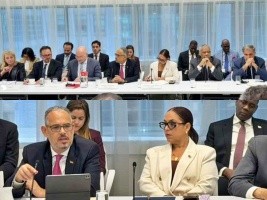
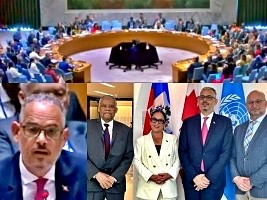
    In a high-profile gathering on the margins of a UN Security Council session focused on the UN Secretary-General’s quarterly report on the UN Integrated Office in Haiti (BINUH), Haiti’s top diplomatic and governmental leaders have made an urgent appeal for stepped-up global support to address the country’s escalating challenges. Held on Thursday, April 23, 2026, the side event was co-hosted by Haiti and Canada through their permanent missions to the United Nations, drawing an unprecedented cross-section of global stakeholders to coordinate action on Haiti’s crisis.

    More than 60 UN member states took part in the event, with major global and regional powers including the United States, France, Germany, China, Brazil, Kenya, El Salvador, and the Dominican Republic sending representatives. Multiple leading international institutions also joined the deliberations, alongside senior officials heading key missions in Haiti. Attendees included Jack Christofides, the designated Special Representative for the Gangs Suppression Force (GSF), UNICEF Executive Director Catherine Russell, and Carlos G. Ruiz Massieu, the UN Secretary-General’s Special Representative for Haiti.

    The core mandate of the gathering was to tighten coordination across three critical groups: UN Security Council members, nations contributing personnel and resources to the Gangs Suppression Force (GSF), and all international and regional partners that collaborate directly with Haitian state institutions. With the Caribbean nation grappling with prolonged gang violence, institutional instability, and stalled democratic progress, the event served as a platform for Haiti’s leadership to lay out its most pressing priorities for global support.

    In his keynote address to attendees, Haitian Prime Minister Alix Didier Fils-Aimé pressed the international community to ramp up its collective mobilization to back the Haitian government’s two core priorities: restoring national security and advancing the restart of the country’s electoral process. The Prime Minister underlined the critical urgency of fully deploying the GSF across Haiti to counter rampant gang activity, while also stressing that enhanced international backing is required to advance key institutional reforms. Among the most critical of these reforms, he highlighted strengthening the national justice sector and expanding efforts to combat systemic impunity for violence and corruption.

    The gathering marks a key moment in global diplomatic efforts to align behind Haiti’s recovery, as international stakeholders continue to work through the UN framework to coordinate a coordinated response to the country’s deepening crisis.

  • Kooyman hosts Home Fest at Kendal Hill location this weekend

    Kooyman hosts Home Fest at Kendal Hill location this weekend

    Kooyman, Barbados’ leading one-stop destination for building supplies, hardware, and home improvement products, is gearing up to launch its most anticipated in-person consumer event of the year—Kooyman Home Fest—scheduled to take place on April 25 and 26 at the retailer’s flagship Christ Church megastore.

    Marking the company’s first in-store experiential event tailored to inspire casual homeowners, passionate do-it-yourself (DIY) hobbyists, professional contracting teams, and local families, the two-day expo is completely free for all attendees. Beyond exclusive, event-only discounts on a wide range of home goods, the gathering will pack in actionable home improvement tips, live product demonstrations, and previews of cutting-edge home product innovations.

    The 10,000+ square foot Kendal Hill location will be completely reimagined as an interactive learning hub, with dedicated zones covering every core home category: from kitchen upgrades and bathroom renovations to interior paint, custom home decor, professional-grade tools, and outdoor living essentials. Unlike traditional trade shows that focus solely on pushing product sales, Kooyman Home Fest is designed to be a go-to source for actionable, expert-led guidance for attendees at every skill level. All activities, workshops, and complimentary in-store refreshments are open to the public at no cost.

    For members of Kooyman’s loyalty program Fun Miles, the event adds extra opportunities to win big. Any member who spends $100 or more during Home Fest will be automatically entered into the event’s Shop & Win promotion, with a grand prize of a full four-piece residential sofa set. Secondary prizes include a $500 Kooyman gift card, 10,000 Fun Miles points, branded Kooyman cooler bags, portable foldable Kooyman grills, a Milwaukee wireless jobsite radio, and wellness vouchers from local partner The Chakra Spa Barbados that cover a manicure-pedicure package and a 30-minute massage. Loyalty members will also be able to earn bonus points for event purchases and spin an in-store Spin-to-Win wheel for instant small prizes. Consumers who have not yet joined the program can sign up for free either via the official Kooyman mobile app or on-site at the event to unlock these perks immediately.

    Arlene Floro, Kooyman’s Marketing Officer, highlighted the unique value the event brings to Barbados’ local home improvement industry by facilitating cross-sector collaboration between global brands and local creators. “We’ve brought together major international names including Moen, Milwaukee Tools, Rust-Oleum, Bissell, O-Cedar, and Umbra alongside our in-house expert team, top local DIY influencer and entrepreneur Christian “ByKrishtun” Gibbs, the team behind Bajan Blend Egan Layne, wellness provider The Chakra Spa Barbados, interior designer Anna-Lysa Nicholls of Annalysed Interiors, and Chef Marvin Applewhaite,” Floro explained. “This is a one-of-a-kind opportunity for both vendors and attendees—everyone gets to see how cross-industry exchange sharpens skills and drives growth, which is exactly what Barbados’ home sector needs right now.”

    Organizers project the event will draw hundreds of attendees spanning first-time homebuyers, long-time homeowners, DIY lovers, professional contractors, interior designers, and home decor enthusiasts. The packed schedule of hands-on workshops covers dozens of high-demand skills, including wall panel installation, wallpaper application, blind fitting, shelf mounting, kitchen cabinet assembly, tile laying, furniture painting, bathroom plumbing upgrades, drain maintenance, interior styling, outdoor space design, modern cleaning technology, custom closet planning, cocktail mixing, outdoor grilling techniques, and professional tool use with Milwaukee experts.

    Beyond deals, workshops, and giveaways, the weekend will also feature live music to keep the atmosphere lively for attendees. While one grand prize winner will walk away with the top sofa set prize, event organizers note that every attendee will leave with new skills, inspiration, and access to exclusive discounts, making the event a win for everyone. For a full schedule of Home Fest activities, consumers can visit the official Kooyman website at kooyman.bb or check the Kooyman Barbados page on Facebook and Instagram.

  • UN : Haiti between political hope and security emergency (video speech)

    UN : Haiti between political hope and security emergency (video speech)

    In a video address to the international community on April 23, 2026, UN Secretary-General Special Representative Ruiz Massieu outlined the stark dual reality currently defining Haiti: a rare moment of tangible institutional progress paired with an ongoing, devastating security emergency that continues to uproot millions of lives.

    Massieu framed the current moment as a striking Haitian paradox: while the country’s state institutions are slowly rebuilding their administrative function after years of collapse, large swathes of national territory remain deeply scarred by pervasive gang-related violence. He gave credit to the administration led by Prime Minister Alix Didier Fils-Aimé for successfully maintaining basic state continuity through a period of extreme instability. A key step forward highlighted by the envoy is the National Pact for Stability, signed by a broad cross-section of Haitian civil society, which signals a widespread commitment to forging a homegrown, Haitian-led solution to the years-long national crisis.

    The most significant milestone on the political path to normalcy, Massieu noted, is the successful completion of national political party registration — a process that has not been fully carried out since 2016. This foundational achievement paves the way for what the international community universally recognizes as the only legitimate end to the crisis: the holding of free, credible national elections that will restore full constitutional order to Haiti. Beyond this regulatory progress, the resumption of weekly Cabinet meetings inside Haiti’s National Palace, a practice that had been suspended for three years due to instability, marks a symbolic and practical step toward the state reclaiming control of central public spaces in the heart of Port-au-Prince.

    Coordination between Haitian national authorities and international support partners has also reached an unprecedented level of alignment, according to the UN envoy. The recent appointment of all key leadership positions at the United Nations Office for Security and Justice in Haiti, paired with strengthened operational coordination with Haiti’s national Gang Repression Force (FRG), has created a more unified front against armed groups.

    Even with these notable political gains, Massieu stressed that the overall security landscape remains deeply alarming. Recent targeted massacres in the Jean-Denis region and ongoing coordinated attacks across Haiti’s Southeast department prove that armed gangs retain both the capability and mobility to wreak widespread harm on civilian populations. As of the latest UN projections, the ongoing violence has displaced more than 1.45 million Haitians, who now live in overcrowded displacement camps or rely on host families for shelter. By the end of 2026, UN humanitarian estimates project that 6.4 million Haitians — more than half the country’s population — will require life-saving humanitarian assistance.

    To build lasting, sustainable peace in Haiti, Massieu argued that the international response cannot focus solely on security crackdowns. Reviving the country’s National Commission for Disarmament, Demobilization, and Reintegration is a critical priority, he said, as it creates a safe, viable path out of armed groups for young people who were forcibly recruited by gangs. Complementing this effort, the planned creation of specialized judicial units focused on prosecuting mass atrocities and transnational financial crime is designed to finally break the cycle of impunity that has enabled systemic violence in Haiti for decades.

    Massieu emphasized that Haiti currently stands at a critical window of opportunity that cannot be wasted. Drawing on a traditional Haitian proverb that notes shared burdens are lighter to carry, he called for sustained, unified international support to help Haitian institutions carry forward the progress they have made. The year 2026, he urged, must become the turning point where hard-won political progress finally translates to tangible, everyday security and improved living conditions for all Haitian citizens.

  • Strengthening of external security at the National Police Academy of Haiti

    Strengthening of external security at the National Police Academy of Haiti

    Against a backdrop of persistent instability and growing security challenges in Haiti, a landmark infrastructure project focused on strengthening the National Police Academy (ENP) located on Road of Frère has reached completion, with an official handover ceremony held on April 22, 2026. The event brought together key stakeholders: Vladimir Paraison, Acting Commander-in-Chief of the Haitian National Police (PNH), Japanese Ambassador to Haiti Kazuhiko Nishiuchi, and Xavier Michon, Resident Representative of the United Nations Development Programme (UNDP).

    This critical security upgrade project, made possible through full funding from the Japanese government and implemented on the ground by UNDP, was designed to address long-standing vulnerabilities at the academy, which operates in one of Haiti’s high-risk security zones. The goal of the initiative is to establish sustained protective infrastructure for the ENP’s facilities and guarantee uninterrupted training operations for new police recruits, a core priority for Haiti’s efforts to rebuild its national security capacity.

    The completed upgrades encompass a comprehensive range of improvements spanning security, utilities, and healthcare. For perimeter defense, the project delivered 1,350 linear meters of reinforced perimeter wall, topped with 850 meters of new barbed wire to block unauthorized access. The ENP’s lead security post received a full structural renovation, while a complete 360-degree video surveillance system covering the entire academy perimeter was installed, alongside a dedicated centralized surveillance room purpose-built to help security teams detect and respond to external threats proactively. In a sustainable energy upgrade, the outdated diesel-powered campus lighting was replaced with solar-powered streetlights that deliver more reliable, consistent illumination across the academy grounds. The project also included critical support for the on-site infirmary, with a donation of essential medications and new medical equipment including three fully functional X-ray machines. Finally, the ENP’s aging water supply network was fully repaired, eliminating long-standing service interruptions that have disrupted training activities in the past.

    Beyond the completed security upgrades, the ceremony brought announcements of upcoming development projects to expand PNH training capacity across the country. Michon confirmed that UNDP will soon break ground on a new facility that will add multiple classrooms and purpose-built dormitory space specifically for future female police recruits, a step designed to boost gender diversity within Haiti’s national police force. Additionally, two new regional PNH training centers are planned, one in northern Haiti and one in the south, to allow new recruits to complete training closer to their home communities, removing barriers to entry for candidates from remote areas.

    In his remarks at the ceremony, Ambassador Nishiuchi reaffirmed Japan’s unwavering solidarity with the Haitian people and government as the country works toward long-term political and social stability. He emphasized that Japan’s partnership with Haiti is rooted in a steady, incremental approach, advancing progress “one step at a time” through consistent, collaborative development and security support.

    Paraison extended formal gratitude to UNDP for the expert execution of the project and to the government and people of Japan for their critical financial investment, which he described as a powerful demonstration of international solidarity with Haiti’s security efforts. He also used the occasion to outline the PNH’s most pressing unmet needs, including the development of a specialized national trauma center for first responders, the reconstruction of multiple damaged police stations across the country—most notably the station in Miragoâne, which requires rebuilding of a rear dock, the acquisition of 500 new patrol vehicles to ensure sustained police presence in hard-to-reach rural areas, particularly ahead of upcoming national election periods.

    Following the formal handover, the delegation conducted an on-site visit to the pre-construction sites for the upcoming new dormitory and classroom facility. To mark the occasion and recognize the enduring cooperative relationship between Haiti and Japan, Paraison presented Ambassador Nishiuchi with an honorary plaque, a symbolic gesture highlighting the fraternal ties between the two nations.

  • Address by the Prime Minister of Haiti to the UN Security Council (video)

    Address by the Prime Minister of Haiti to the UN Security Council (video)

    In a high-stakes address to the United Nations Security Council on April 23, 2026, Haitian Prime Minister Alix Didier Fils-Aimé delivered an urgent appeal to the global community, calling for rapid, concrete and scaled-up support to curb the country’s spiraling insecurity crisis.

    The prime minister was joined by a senior Haitian government delegation that included Foreign Minister Raina Forbin, Minister of Planning and External Cooperation Sandra Paulemon, Special Advisor Guerly Leriche, and Erick Pierre, Haiti’s Permanent Representative to the UN headquarters in New York.

    Opening his remarks against the backdrop of one of the most severe security crises the Caribbean nation has faced in recent decades, Fils-Aimé reaffirmed that reestablishing full state authority across Haitian territory stands as his administration’s top policy priority. He stressed a foundational point for the country’s future: “Without security, there can be neither democracy nor development.”

    The prime minister acknowledged the early progress that national security forces, backed by the Gang Repression Force (FRG), have made in pushing back against armed gang control. Even so, he emphasized that the full, rapid deployment of the FRG is a critical unmet need, and that the force must be paired with sufficient funding, equipment and personnel to match the scale of the challenge at hand. Rejecting vague pledges of future support, Fils-Aimé made clear that the Haitian people require immediate action rather than empty promises, calling on all international partners to follow through on the commitments they have already made to Haiti’s stability.

  • Inheemse diaspora doet eerste stap naar structurele samenwerking

    Inheemse diaspora doet eerste stap naar structurele samenwerking

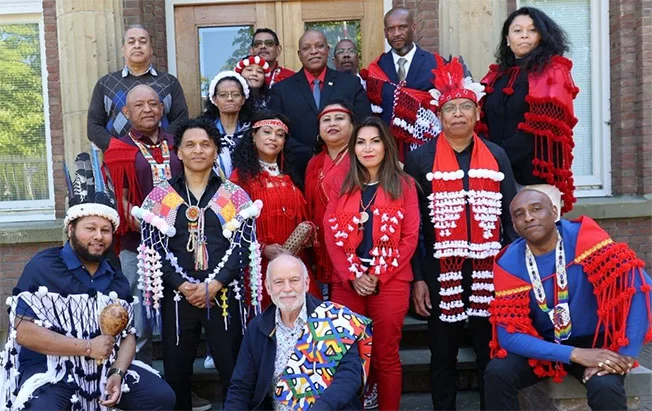
    On April 21, 2026, a landmark first consultation convened at the Embassy of the Republic of Suriname in The Hague, bringing together embassy officials and a broad coalition of Indigenous organizations from the Surinamese diaspora. Sixteen representatives spanning multiple community groups and professional disciplines gathered to share unified perspectives, long-held concerns, and actionable policy proposals, marking an unprecedented moment: for the first time, the Indigenous diaspora has intentionally presented itself as a cohesive collective in formal dialogue with Suriname’s diplomatic mission.

    The collective nature of the delegation emerged as a defining strength of the gathering, a point explicitly recognized by embassy leadership. Rejecting the historical pattern of separate, fragmented engagements, participating organizations deliberately chose to speak with one united voice. “The fact that you decided not to come individually, but as a collective, that is a powerful step forward,” embassy representatives noted during the opening session. This strategic choice reflects a growing shared awareness across the diaspora community: coordinated collaboration and aligned messaging are essential to driving meaningful policy influence.

    A clear throughline ran through all contributions from the Indigenous delegation: after decades of centering demands for formal recognition, the community is now moving toward a new priority: tangible implementation of rights. The generations-long struggle for land rights was framed in clear historical context, with delegates emphasizing, “This fight has been ongoing for more than 50 years.” The collective message was unambiguous: formal recognition alone is no longer sufficient. The community now demands concrete policy action, binding legislation, and consistent enforcement of Indigenous rights.

    Much of the discussion centered on the urgent, ongoing crisis unfolding in Suriname itself. Core topics included threatened land tenure, unregulated extractive concessions, and widespread environmental damage. Delegates highlighted the severe, immediate impacts of unregulated mining and industrial pollution as a top urgent priority, stressing, “This is not an Indigenous problem — this is a problem for all of Suriname.” The overlapping harms of environmental contamination, elevated public health risks, and limited legal protections have transformed what was once framed as a future risk into an active, ongoing crisis requiring immediate intervention.

    Beyond legal and political demands, delegates also emphasized the foundational role of cultural preservation and intergenerational knowledge transfer. Multiple participating organizations already lead active work to protect and pass down Indigenous languages, traditional music, ceremonial practices, and ecological knowledge across both Suriname and the Netherlands. The diaspora plays a unique dual role in this work: as stewards of traditional knowledge, and as a bridging force connecting Indigenous communities in Suriname with global advocacy networks and resources.

    The consultation opened with a traditional Indigenous ritual and a collective performance of the Surinamese national anthem, setting a tone distinct from standard bureaucratic negotiations: this was not only a policy meeting, but a cultural encounter rooted in mutual connection. Discussions unfolded in an atmosphere marked by radical openness, shared investment in the outcome, and reciprocal respect. The space made room for sharp substantive debate, as well as emotional reflection on centuries of struggle and displacement.

    Embassy officials affirmed that these consultations are intended to create space for listening to and centering the perspectives of the diaspora community, while also echoing the delegation’s emphasis on unity and collaborative problem-solving. “We must nurture this solidarity and bring collective solutions to the table,” embassy representatives stated. The mission has committed to consolidating all input shared during the gathering and forwarding it to policymakers in Suriname, with the explicit goal of advancing concrete follow-up actions.

    The first consultation included a diverse cross-section of Indigenous diaspora organizations and stakeholders, including Stichting Herdenking Slavernijverleden en Global Indigenous (SHS-GI), Nationale Reparatie Commissie Suriname (NRCS-NL), Platform Oorspronkelijke Rechten Suriname, Empowering Indigenous Suriname, Stichting Wasjikwa, Sociaal-Culturele Vereniging Masaraipono, Stichting Ma-Jong.net, Lottacam Studio – Indigenous music collective Yakua, Sambura-groep Anuana Maro, Arumjo Styling, and spiritual counselor Evert van der Bosch. Several additional groups, including Stichting Recht & Ontwikkeling Inheemsen (ROI), SCV Wajonong and IKC-I, shared written input ahead of the meeting, and their contributions were integrated into the collective agenda. Organizers note that the current participant list reflects only those able to join this initial gathering, and the broader Indigenous community includes many stakeholders not present for this first session.

    As such, the meeting is explicitly framed as a first step in an open, ongoing process, with intentional space reserved for additional community members and organizations to join, contribute, and shape future efforts moving forward.

    The core objectives of this initial gathering were to build introductions, share community perspectives, and lay a shared foundation for future collaboration between the Indigenous diaspora and the Surinamese embassy. Beyond the substantive exchange of policy priorities and concerns, the meeting delivered a clear signal of the diaspora community’s collective strength and shared commitment to collaboration.

    Correspondingly, high expectations for follow-up have been articulated by participating Indigenous organizations. The community hopes this consultation will evolve into structured, ongoing coordination, concrete action on the issues discussed, and sustained inclusion of the diaspora in relevant policy processes, including governance, representation, and knowledge sharing. Proposed next steps include deepening the ongoing dialogue and exploring formal, structural frameworks for long-term collaboration.

    Ultimately, the meeting marks not an endpoint, but a clear shift in the trajectory of Indigenous advocacy for Suriname. The Indigenous diaspora has now positioned itself as a visible, organized, and substantive stakeholder in national conversations about rights and policy. The question moving forward is no longer whether there will be follow-up to this historic gathering, but how this first step will translate into lasting collaboration and tangible, transformative change for Indigenous communities in Suriname and across the diaspora.

  • Senate approves first reading of real estate regulation bill in the Dominican Republic

    Senate approves first reading of real estate regulation bill in the Dominican Republic

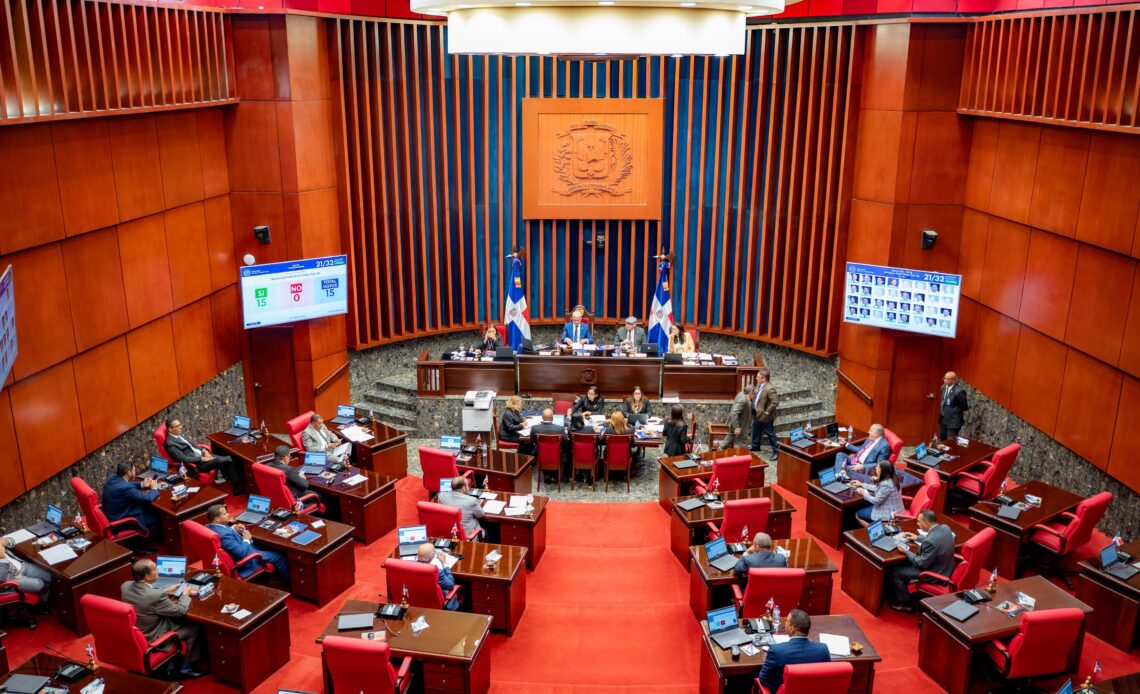
    In a key step to clean up the Dominican Republic’s property market, the national Senate has given preliminary approval to a sweeping piece of legislation designed to oversee real estate brokerage services and crack down on deceptive advertising. The reform is rooted in growing concerns over unethical practices and rising consumer fraud in the country’s booming real estate sector, with lawmakers aiming to bring clearer accountability and structure to property transactions.

    The bill was put forward by a cross-group trio of sitting senators: Rafael Barón Duluc, Félix Ramón Bautista, and Eduard Alexis Espiritusanto. At its core, the legislation sets mandatory ethical and transparency benchmarks that cover every stage of real estate activity, from initial property promotion and marketing through to the final execution of sales or rental agreements. Unlike loose existing guidelines, the new framework is built to protect all stakeholders in the sector – not just prospective home buyers and tenants, but also licensed agents and registered agencies, while fostering sustainable, orderly growth across the industry.

    To align the new rules with existing national consumer protection legislation, the bill formalizes a clear definition of misleading advertising. Any commercial messaging that misleads consumers about core property details – including structural features, unit availability, listed pricing, purchase agreement terms, or promised move-in deadlines – will be classified as a violation, matching the standards already set out in the country’s existing Law 358-05 on Consumer Protection. The legislation carves out key exceptions to avoid overreach: it does not apply to private property owners selling their personal residences directly, nor to legal professionals carrying out their standard advisory duties during property transfer processes.

    To enforce the new standards, the bill outlines a tiered system of penalties for violators. Sanctions range from temporary operational shutdowns and license suspensions to financial fines that can reach as high as 50 times the country’s current minimum wage. Oversight and enforcement of the new rules, if the bill passes its final reading, will be assigned to the Dominican Republic’s Ministry of Housing, Habitat and Buildings, which will set up a dedicated specialized department to handle agent registration, ongoing regulatory compliance, and regular monitoring of all real estate intermediation activities across the country.