博客

  • High Court Acquits Andre Arthurs in 2025 Murder Case

    High Court Acquits Andre Arthurs in 2025 Murder Case

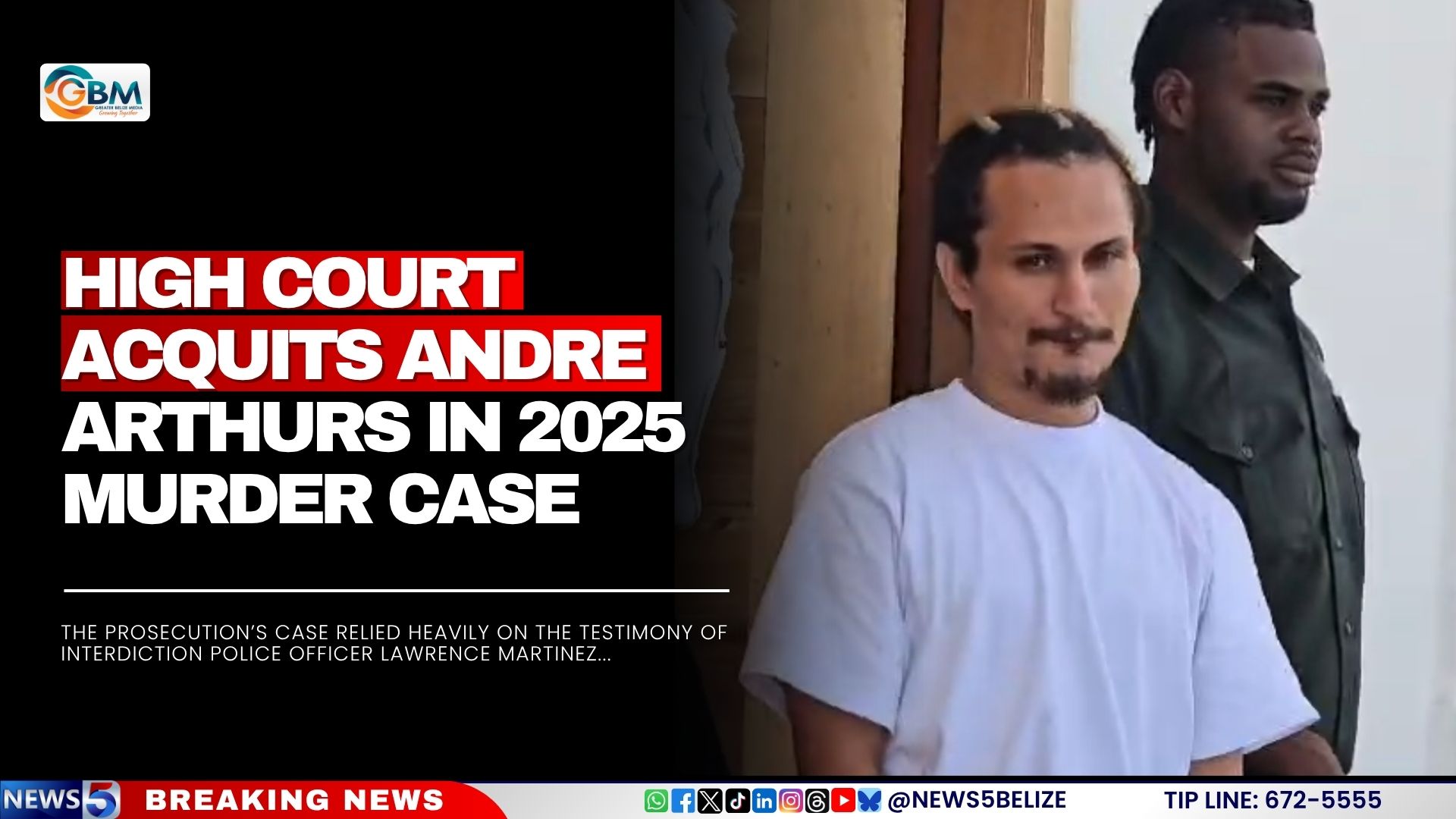
    On a Tuesday session in July 2026, a dramatic conclusion unfolded at the Belize High Court: 28-year-old construction worker Andre Arthurs walked free after being acquitted of the 2025 murder of 33-year-old Mark Usher Jr. in Belize City.

    Usher was killed in a public shooting at the intersection of Jabiru Street and Fabers Road in March 2025, a case that has dragged on for more than a year. Arthurs, a resident of the Fabers Road area, had been held in pre-trial detention after being formally charged with the fatal shooting. But the prosecution’s case quickly unraveled in court over a series of critical evidential gaps that the Crown could not resolve.

    Presiding over the case, Justice Nigel Pilgrim delivered the not-guilty verdict after ruling that the prosecution failed to meet the required legal standard of proving guilt beyond a reasonable doubt. The entire prosecution’s argument rested almost entirely on the identification testimony of Interdiction Police Officer Lawrence Martinez. Martinez told the court that moments after the shooting, he observed a man in a blue shirt riding a bicycle away from the crime scene. He later picked Arthurs out during a group identification procedure.

    While Justice Pilgrim acknowledged that Martinez appeared to be a sincere and credible witness on the stand, major procedural flaws in the identification process created unavoidable doubt. The court learned that the prosecution never provided evidence confirming that other participants in the identification lineup matched Arthurs’ core physical characteristics, including height, skin tone, age, and general build. Without that critical alignment, the court could not confirm that the identification was not a result of improper suggestion or chance.

    The evidential deficiencies extended far beyond the flawed identification process. Investigators never tested Arthurs’ hands for gunshot residue, a standard step in most shooting investigations that could have tied him to the weapon. The prosecution also failed to produce any DNA evidence linking Arthurs to the crime, never recovered the alleged firearm used in the shooting, and never obtained a search warrant to connect the reported blue shirt to Arthurs. Even the suspect’s abandoned bicycle, a key piece of physical evidence described by the officer, was never properly accounted for in the investigation, leaving a host of unanswered questions about its connection to the case.

    Justice Pilgrim emphasized in his ruling that the Crown bears the legal burden of proving every element of a criminal charge beyond a reasonable doubt. In this case, that meant confirming beyond question that the identification evidence was reliable enough to conclude Arthurs was the shooter. Without that certainty, any guilty conviction would be legally unsound.

    Throughout the entire trial, Arthurs repeatedly maintained his innocence. He told the court that at the time of the shooting, he was at his home hosting a barbecue with friends, placing him far from the crime scene. After the verdict was read, Arthurs left the courthouse surrounded by supporting relatives, a free man after more than a year of legal uncertainty. Mark Usher Jr.’s mother, who attended the ruling to hear the outcome, left the courthouse shortly after the verdict was announced. Andre Arthurs was represented throughout the proceedings by defense attorney Simeon Sampson.


  • BOA: CAC, Commonwealth Games campaign to cost $2.5 million

    BOA: CAC, Commonwealth Games campaign to cost $2.5 million

    Barbados’ Olympic governing body is bracing for a massive $2.5 million expenditure to send its national athletic delegations to two back-to-back elite international multi-sport competitions this summer, a senior association official has confirmed. Cameron Burke, vice-president of the Barbados Olympic Association (BOA), made the financial revelation this past Sunday during an official ceremony held at the Lloyd Erskine Sandiford Centre, where the organization publicly introduced the full rosters of athletes set to represent the Caribbean island nation.

    This year’s competition schedule marks a notable milestone for Barbados’ athletic program: the country is fielding one of its largest Central American and Caribbean (CAC) Games delegations in over 20 years. A total of 141 athletes are scheduled to compete across 24 different sporting disciplines at the CAC Games, hosted by the Dominican Republic, from July 24 through August 8. Following the conclusion of that event, an additional 21 Barbadian athletes will travel to Scotland to compete in six disciplines at the Commonwealth Games just weeks later.

    Burke emphasized that the unusual timing of the two premier events, falling within a narrow several-week window, has created unprecedented strain on the BOA’s operations. Beyond the steep financial burden of sending two large squads overseas for extended international competition, the organization has also had to navigate complex logistical obstacles to coordinate travel, accommodation, training, and staff support for both groups simultaneously. The BOA is now working to finalize remaining preparations to ensure its athletes can compete at their best despite these challenges.

  • Murder Case Against Dexter Scotland Dismissed After No-Case Submission

    Murder Case Against Dexter Scotland Dismissed After No-Case Submission

    In a landmark ruling that has drawn attention to the standards of evidence in criminal prosecutions, a High Court judge has dismissed the entire murder case against Dexter Scotland, after ruling in favor of a defense no-case submission. The case centered on the fatal shooting of Jahfari Isaac, with Scotland arguing from the outset that the killing was an act of legitimate self-defense.

    Justice Ann Marie Smith, who presided over the trial, delivered a clear judgment that the prosecution team led by the Crown failed to meet the legal threshold required to disprove Scotland’s self-defense claim. In her written ruling, Justice Smith emphasized that the available evidence presented in court had properly raised the question of self-defense, and the prosecution had not successfully demonstrated that the killing was an unlawful act.

    The defense’s core argument held that Scotland opened fire on Isaac only after forming a genuine reasonable belief that his life was in immediate danger: Scotland claimed Isaac appeared to be reaching for a concealed firearm, leaving him no option but to act to protect himself.

    Beyond the failure to disprove self-defense, Justice Smith also pointed to multiple critical shortcomings in the prosecution’s evidence. These gaps include the complete absence of professional ballistics analysis to link the weapon to the shooting, as well as gunshot residue test results that could not be independently verified or confirmed to meet evidentiary standards.

    Following the judge’s dismissal of the case, prosecution officials have publicly confirmed they intend to challenge the ruling through an appeal process, setting the stage for further legal proceedings over the fatal shooting.

  • “The Drums Are Silent”: Music Producer Kendoyll Simpson Dies After Cancer Battle

    “The Drums Are Silent”: Music Producer Kendoyll Simpson Dies After Cancer Battle

    The Belizean music industry is engulfed in grief this week following the passing of legendary producer and audio engineer Kendoyll Simpson, known professionally as KSBEATS, who lost his two-year private battle with cancer on Sunday. In an official public statement, Simpson’s partner Anika Perez shared new details about the producer’s final years, revealing that Simpson made the deliberate choice to keep his cancer diagnosis and treatment journey hidden from the public.

    As a deeply private individual, Simpson chose not to disclose his illness to avoid causing worry and sorrow for his loved ones, fans, and colleagues within the music community. Perez added that Simpson also rejected public attention out of concern that pity from others would erode his mental strength and disrupt his ability to keep creating the music he dedicated his life to. Throughout his illness, Simpson remained committed to his craft, continuing to write and produce music up until his body could no longer sustain his work.

    “While this news may come as a shock to many, we simply honored and respected his wishes throughout his battle,” Perez noted in her statement. Tributes to Simpson have begun to spread across Belize’s music scene, where the 20-plus year veteran built a legacy as one of the country’s most skilled and respected production talents. His discography crossed multiple musical genres and extended beyond Belize’s borders, as he collaborated with artists across the Central American region and played a foundational role in shaping the modern sound of Belizean music.

    Beyond his professional contributions, Simpson leaves behind his 10-year-old daughter, whom Perez described as the object of his deepest love. In a poignant closing to her statement, Perez paid tribute to Simpson’s enduring impact: “The drums are silent, but your rhythm lives on in every life you’ve touched.” The Belizean music community has already begun celebrating Simpson’s life and career, highlighting both his extraordinary talent as a producer and his quiet resilience in the face of his illness.

  • Spain announces visa free travel for Trinidad and Tobago

    Spain announces visa free travel for Trinidad and Tobago

    BRIDGETOWN, Barbados – In a significant policy shift aimed at boosting tourism and cross-border connections, Spain announced Wednesday it has included nine Caribbean Community (Caricom) member states among 60 global nations whose citizens can now enter the country without a visa for short-term stays.

    The Spanish Ministry of Foreign Affairs in Madrid released the official list of newly added countries, identifying the nine Caricom nations as Antigua and Barbuda, Barbados, The Bahamas, Dominica, Grenada, St Kitts and Nevis, St Lucia, Trinidad and Tobago, and St Vincent and the Grenadines. Notably, five other Caricom members – Jamaica, Guyana, Suriname, Belize, and Haiti – were left off the revised visa-free roster, their citizens still required to complete the standard Schengen visa application process.

    Beyond the Caribbean bloc, the Spanish government also extended visa-free access to ordinary passport holders from eight African countries for stays not exceeding 90 days. The African nations added to the list are Botswana, Namibia, Eswatini, Lesotho, Mauritius, Seychelles, Cape Verde, and Rwanda. Travelers from these countries are now permitted to enter not only Spain but the entire Schengen Area without prior visa approval, marking a major easing of travel restrictions.

    The new visa-free arrangement covers all short-term visits, including leisure tourism, business engagements, and personal trips, within the 90-day limit across any 180-day rolling period – the standard timeframe for Schengen Area short stays.

    The policy change leaves the status quo unchanged for most other Caribbean and African nations, whose citizens will still need to obtain a valid Schengen visa before departing for Spain or any other participating country in the border-free Schengen zone. Regional tourism officials across the Caribbean have already signaled cautious optimism that the change could drive increased visitor arrivals from the nine qualifying nations, supporting the recovery of the region’s tourism-dependent economies after years of global travel disruptions.

  • Belize: A Small Country With Its Hands on the Region’s Financial Steering Wheel

    Belize: A Small Country With Its Hands on the Region’s Financial Steering Wheel

    In a historic milestone for the small Central American nation, Belize has assumed the presidency of the Council of Ministers of Finance or Treasury of Central America, Panama and the Dominican Republic (COSEFIN) — marking the first time the country has held the top leadership role in the regional body since its founding. The handover ceremony took place during the council’s 58th ordinary session held in Guatemala City, where the Dominican Republic’s Ministry of Finance and Economy officially transferred the presidential mandate to Belize’s Ministry of Economic Transformation.

    COSEFIN serves as a critical coordinating platform that brings together finance ministers and senior economic officials from across the member states. Its core mandates span aligning regional policies on public finance governance, cross-border tax administration, disaster risk financing, and collective economic resilience. One of the council’s most impactful contributions to regional stability has been its support for establishing the Caribbean Catastrophe Risk Insurance Facility, a groundbreaking financial mechanism that delivers rapid emergency payouts to member governments in the aftermath of major hurricanes and other natural disasters. These funds often reach affected countries long before traditional international aid or development loans are disbursed, filling a critical gap in early emergency response.

    The importance of COSEFIN’s work has grown sharply in recent years, as climate change drives an increase in the frequency and severity of extreme weather events, pushing disaster-related economic losses to record highs. Regional data underscores the scale of the challenge: since 1980, nine nations across the COSEFIN membership have suffered single-disaster losses that exceeded half of their total annual gross domestic product. Meanwhile, annual average infrastructure damage across Central America alone is estimated at $4 billion, a constant drain on public budgets that slows long-term development.

    Speaking after the handover, Belize’s Minister of Economic Transformation Dr. Osmond Martinez framed the appointment as a defining moment for the country. Rejecting the idea that regional leadership is reserved for larger economies, Martinez emphasized that “Belize understands that leadership is not measured by the size of an economy but by the ability to listen, build consensus, and unite efforts around a shared purpose.”

    Over the coming six months of its presidency, Belize will steer high-priority regional discussions across four core areas: strengthening fiscal resilience in the wake of economic and climate shocks, improving standards of public financial management, modernizing cross-border tax administration systems, and expanding coordinated disaster preparedness across member states. The appointment puts one of the region’s smallest national economies at the very center of critical decision-making that will shape climate and economic resilience for more than 75 million people across Central America and the Caribbean.

  • Wetenschapper Ine Apapoe benoemd op prestigieuze Prins Claus-leerstoel

    Wetenschapper Ine Apapoe benoemd op prestigieuze Prins Claus-leerstoel

    A historic milestone in international academia has been announced: Dr. Ine Apapoe, a leading public administration scholar from Suriname, will become the first person of Surinamese origin to hold the prestigious Prince Claus Chair for Equality and Development at Utrecht University starting September 1, 2026. Her two-year appointment will run through August 31, 2028, marking a significant breakthrough for representation of Global South scholars in high-profile European academic roles.

    Established as a joint initiative between multiple academic institutions, the Prince Claus Chair is awarded annually to distinguished researchers from Asia, Africa, Latin America, the Caribbean, and Oceania. The chair is a collaborative effort between Anton de Kom University of Suriname, Utrecht University’s Institutions for Open Societies strategic research theme, and Utrecht University’s Department of Governance and Organization Studies, in partnership with the International Institute of Social Studies of Erasmus University Rotterdam. Its core mission is to advance cutting-edge research and education focused on global development, justice, and equity, and it ranks among the most respected academic appointments in this field. The chair’s patron is Queen Máxima of the Netherlands, and its curatorium is led by former Dutch minister Bert Koenders.

    During her tenure, Dr. Apapoe will center her research on inclusive governance and tribal societies, with a specific focus on Suriname’s Maroon communities, descendants of formerly enslaved Africans who escaped to form independent settlements in the country’s interior. Her work will explore a critical policy and social question: how can traditional Indigenous and tribal communities be more meaningfully included in decision-making processes that shape their own development and the governance of their traditional lands and living territories? Even after taking up the chair at Utrecht University, Dr. Apapoe will maintain her academic affiliation with Anton de Kom University of Suriname, where she will continue her existing work in teaching, research, and public service.

    Dr. Apapoe is a veteran expert in governance studies with more than 15 years of academic experience. She has been affiliated with the Faculty of Social Sciences at Anton de Kom University since 2010, where she teaches in the public administration program. She earned her PhD from Vrije Universiteit Amsterdam in 2024, completing her doctoral dissertation on the interaction between modern state governance and traditional governing structures within Suriname’s Maroon communities. Her broader research agenda covers core themes including local governance, traditional authority, land rights, livelihood security, and good governance. Most recently, she secured research funding to study the under-examined role of female Maroon captains in community decision-making processes.

  • West Indies collapse gifts New Zealand series-levelling victory

    West Indies collapse gifts New Zealand series-levelling victory

    The five-match One Day International (ODI) series between New Zealand and the West Indies has reached a 1-1 deadlock, following a tightly contested low-scoring clash at Providence Stadium in Guyana on Monday that ended with a five-wicket victory for the Black Caps. The result comes just days after the West Indies, known colloquially as the Men in Maroon, secured a comfortable opening-match win to kick off the series.

    Despite being put into bat first after Kiwi captain Mitchell Santner won the coin toss, the West Indies got off to a promising start. Openers Ackeem Auguste and John Campbell built a solid 63-run first-wicket partnership before both were dismissed in quick succession. Campbell went on to top the West Indies batting chart with 43 runs, but his dismissal triggered a dramatic collapse from the middle and lower order. One batsman after another trod out to the crease, faced only a handful of deliveries for minimal runs, and returned to the pavilion.

    In an unusual turn for the match, six of the West Indies’ 10 wickets fell to bowled dismissals. New Zealand’s left-arm spinner Jayden Lennox delivered a match-winning performance, finishing with career-best figures of 5 wickets for just 19 runs. Santner and all-rounder Michael Bracewell chipped in with two wickets apiece, bundling the West Indies out for a surprisingly low total that left the Black Caps with a manageable chase target.

    The West Indies responded strongly with their bowling attack, picking up wickets at consistent intervals to put New Zealand under pressure throughout the chase. However, the Kiwi batting line-up held firm to cross the finish line, clinching the win and pulling the series level ahead of the third fixture.

    In a post-match press interaction, West Indies skipper Shai Hope reflected on the narrow defeat, noting that an extra 60 to 70 runs from his batting unit would have likely flipped the result. “Conditions here in the Caribbean usually favor teams batting second,” Hope explained. “I’m not someone who wins the toss very often, so adapting to batting first is an area we need to improve in. We have to adjust ahead of the next match and figure out how to set a competitive total that will challenge New Zealand.”

    The third match of the five-match series is scheduled to take place at the same Providence venue this Thursday, where the West Indies will look to iron out their batting inconsistencies and retake the series lead, while New Zealand will aim to build on their momentum to go ahead.

  • Faustin hopes Newtown Youth Development initiative will inspire similar programmes across Dominica

    Faustin hopes Newtown Youth Development initiative will inspire similar programmes across Dominica

    On July 10, a landmark new initiative focused on uplifting young Dominicans officially entered its public phase: the Newtown Youth Development Program (NYDP), an ambitious non-profit movement built on decades of grassroots community work. At the official launch event, NYDP Chairman Joffre Faustin laid out the organization’s bold vision, noting that with consistent backing from community members and financial supporters, the program could set a benchmark for youth empowerment across the entire island nation.

    Faustin opened his address by emphasizing that the struggles facing Newtown’s young population are not isolated to this single community. Issues ranging from limited economic opportunity to harmful social behaviors impact neighborhoods across Dominica, he said, creating a widespread need for targeted, community-led intervention. It is this gap that NYDP aims to fill, with the long-term goal of inspiring replicated programs in every corner of the country. “It is therefore our hope that the Newtown Youth Development Program will serve as a model and an inspiration for similar initiatives across the country,” Faustin told attendees.

    To turn this vision into reality, Faustin stressed that the initiative will rely heavily on sustained partnership. Beyond one-time donations, the program needs ongoing generosity from private donors, corporate entities, and ordinary members of the public to fund its core operations and expand its reach. “We will depend greatly on the continued generosity of donors, corporate partners, and members of the public, whose financial contributions and other forms of support will be essential to our success,” he added.

    Far from being just another community organization, Faustin framed NYDP as a transformative social movement rooted in Newtown’s cultural and community identity. Its core missions include reviving the community’s historic connection to sports, shielding young people from harmful negative influences, and equipping the next generation with the tools they need to build stable, productive futures. While the official launch marked a key milestone, Faustin clarified that the bulk of the organization’s on-the-ground work is only just beginning.

    Looking ahead to the coming months, the first major initiative rolling out under the NYDP banner will be the distribution of donated supplies to young residents ahead of the new school year. Overseas partners have already contributed thousands of dollars worth of sports equipment, educational materials, and health supplies, all of which will be distributed directly to young people in the community. Parallel to this distribution effort, the NYDP team will continue fundraising to cover ongoing operational costs, roll out targeted development programming, and build broad buy-in across local communities.

    Faustin stressed that the scope of work ahead is substantial, and success cannot be achieved without widespread community commitment. Parents, local families, Newtown residents, and community members from surrounding areas all have a role to play in lifting the program and the young people it serves, he noted.

    The NYDP as it exists today was formally incorporated on August 30, 2025, but its origins stretch back more than 30 years to the 1993 founding of the Newtown Juvenile Football Academy. That early grassroots sports program expanded into the Newtown After-School Football Programme in 2017, and steady growth and community demand led organizers to expand the initiative into a full-spectrum youth development organization. A formal organizational constitution was adopted in December 2025, enshrining the group’s core mission: “the transformation of young lives through holistic development.”

    Faustin outlined the key social challenges the NYDP was created to address: drug and alcohol abuse, persistently high youth unemployment, rising rates of teenage pregnancy, growing school dropout numbers, increases in community crime and violence, and the steady decline of organized youth sports participation in Newtown. All these issues intersect to limit opportunity for young residents, and the NYDP aims to tackle them through a coordinated, holistic approach.

    Despite its formal launch only happening this month, the organization has already made significant progress on building its infrastructure. It has seated a fully functional executive committee and multiple specialized subcommittees, completed official non-profit registration, finalized governing bylaws, implemented strict financial accountability protocols, and arranged first aid certification training for active members. Most notably, it has already processed and taken delivery of more than $16,000 worth of donated sports, education, and health supplies from international partner organizations.

    Looking to the coming years, the NYDP has laid out an ambitious roadmap of projects. Key priorities include converting the former Roseau Boys’ School campus into a dedicated multi-purpose community center, upgrading underfunded local sporting facilities, securing scholarship funds and overseas training opportunities for high-potential young people, expanding structured mentorship and spiritual guidance programs, and partnering with faith-based and civic groups to deliver character development initiatives for youth of all ages.

    In his address, Faustin also took time to recognize the many individuals and organizations that made the launch possible. Longtime supporter Vivian Rene was singled out for praise, with more than 30 years of continuous support dating back to the original Newtown Juvenile Football Academy. The Roy Mason family was also recognized for their instrumental support that helped turn the small after-school football program into the full-scale NYDP initiative. Additional thanks went to the Dominica Lotteries Commission, AC Shillingford & Co. Ltd., and the dozens of other sponsors and donors whose financial backing made the official launch event possible.

    Speaking directly to the young people in attendance at the launch, Faustin issued a heartfelt call to action, urging youth to embrace the opportunities the program provides. “There are people—both here at home and abroad—who care deeply about you and are making sacrifices to ensure you can become better individuals,” he said. “Be appreciative of what is being done for you, take full advantage of the opportunities provided, and remain strong in the face of obstacles.”

    Faustin closed his address by calling for full community unity around the NYDP mission. “Let us commit ourselves to this cause. Let us work hand in hand. And let us ensure that when history looks back on this moment, it will say: This was the day Newtown began to rise again,” he said.

  • “You Touch One, You Touch All”: Why Belize’s Garinagu Took to the Streets

    “You Touch One, You Touch All”: Why Belize’s Garinagu Took to the Streets

    On a recent morning in Belize City, hundreds of Garifuna activists and community members, organized under the umbrella of the National Garifuna Council, launched a coordinated peaceful demonstration to denounce forced land dispossession of Garifuna communities in neighboring Honduras. The procession began at Marion Jones Stadium, with participants moving rhythmically to the beat of traditional Garifuna drums, lifting their voices in collective song and carrying hand-painted placards that declared unwavering solidarity with Garifuna residents of San Juan de Lempira. Their destination was the Honduran Embassy, where they aimed to deliver a clear, unified message to the Honduran government that human rights violations against indigenous Garifuna peoples will not go unchallenged.

    Recent eyewitness reports of armed state security forces entering San Juan de Lempira to forcibly remove Garifuna families from their traditional ancestral lands sparked the demonstration. Placards carried by marchers featured slogans ranging from “Justice for San Juan” and “Garifuna Rights Are Human Rights” to “Our Land is Not For Sale,” with many signs also commemorating the 1937 San Juan massacre that displaced hundreds of Garinagu nearly a century ago.

    Ifasina Efunyemi, an executive member of the National Garifuna Council, addressed the crowd outside the embassy as Honduran diplomatic officials emerged to observe the protest. “We see uniformed military and police, fully armed, turning against our people to remove us yet again from the lands that have sustained us for generations. This we cannot allow to happen,” Efunyemi stated. Echoing the core collective ethos of the transnational Garifuna community, Efunyemi added: “We are one people. So you touch one, you touch all. We are a peaceful people, but if you stir us up, we are a warrior people.”

    The demonstration carries deep historical and familial ties for Belize’s Garifuna population, whose roots can be traced directly to survivors of the 1937 San Juan massacre. Following the violent repression and mass killing of Garinagu in the Honduran community that year, hundreds of survivors fled north to Belize, where today thousands of Garifuna residents across towns including Dangriga, Hopkins, Seine Bight, Punta Gorda, Georgetown and Barranco can trace their ancestry directly to those displaced refugees.

    The current crisis marks a reversal of a decade-old legal victory for indigenous land rights: in 2015, the Inter-American Court of Human Rights issued a landmark ruling in favor of Honduran Garifuna communities, formalizing their legal claim to the San Juan lands. The National Garifuna Council warns that the 2026 deployment of military forces to the region represents a deliberate, renewed attempt to displace Garifuna communities and seize land that they have already fought a lengthy legal battle to protect.

    Efunyemi emphasized that the demonstration outside the Honduran Embassy reflects far broader support than the visible crowd in Belize City suggests, noting that millions of Garifuna people and indigenous rights allies across the region and globe stand in solidarity with the San Juan community. “Even though the numbers that you see here may seem small to you, you are not seeing the millions that stand with us right at this moment,” Efunyemi said. The protest also sends a broader message to all regional governments whose nations were built in part by Garifuna labor and contribution: that the collective fight for indigenous land rights will not be silenced.