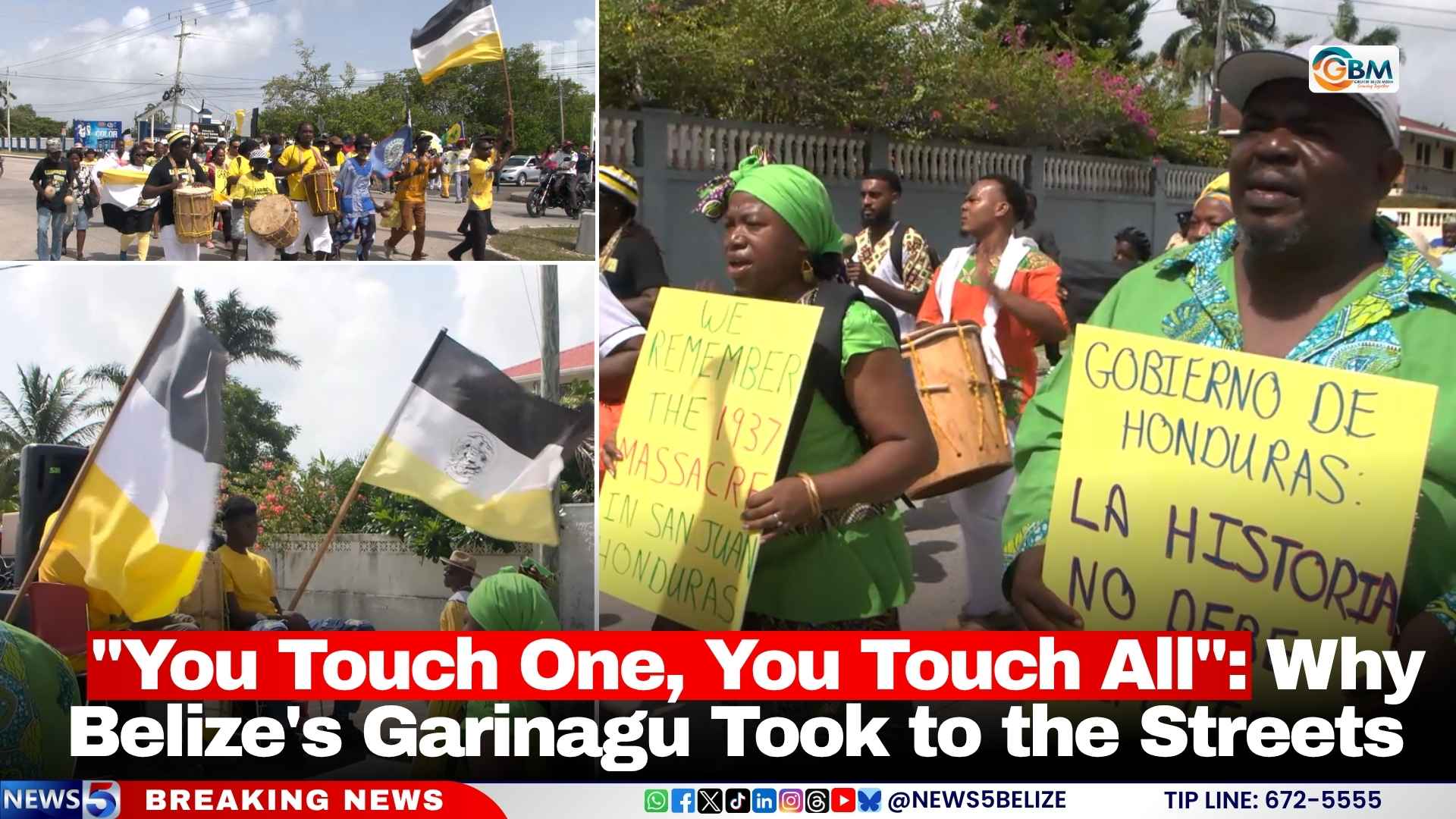
On a recent morning in Belize City, hundreds of Garifuna activists and community members, organized under the umbrella of the National Garifuna Council, launched a coordinated peaceful demonstration to denounce forced land dispossession of Garifuna communities in neighboring Honduras. The procession began at Marion Jones Stadium, with participants moving rhythmically to the beat of traditional Garifuna drums, lifting their voices in collective song and carrying hand-painted placards that declared unwavering solidarity with Garifuna residents of San Juan de Lempira. Their destination was the Honduran Embassy, where they aimed to deliver a clear, unified message to the Honduran government that human rights violations against indigenous Garifuna peoples will not go unchallenged.
Recent eyewitness reports of armed state security forces entering San Juan de Lempira to forcibly remove Garifuna families from their traditional ancestral lands sparked the demonstration. Placards carried by marchers featured slogans ranging from “Justice for San Juan” and “Garifuna Rights Are Human Rights” to “Our Land is Not For Sale,” with many signs also commemorating the 1937 San Juan massacre that displaced hundreds of Garinagu nearly a century ago.
Ifasina Efunyemi, an executive member of the National Garifuna Council, addressed the crowd outside the embassy as Honduran diplomatic officials emerged to observe the protest. “We see uniformed military and police, fully armed, turning against our people to remove us yet again from the lands that have sustained us for generations. This we cannot allow to happen,” Efunyemi stated. Echoing the core collective ethos of the transnational Garifuna community, Efunyemi added: “We are one people. So you touch one, you touch all. We are a peaceful people, but if you stir us up, we are a warrior people.”
The demonstration carries deep historical and familial ties for Belize’s Garifuna population, whose roots can be traced directly to survivors of the 1937 San Juan massacre. Following the violent repression and mass killing of Garinagu in the Honduran community that year, hundreds of survivors fled north to Belize, where today thousands of Garifuna residents across towns including Dangriga, Hopkins, Seine Bight, Punta Gorda, Georgetown and Barranco can trace their ancestry directly to those displaced refugees.
The current crisis marks a reversal of a decade-old legal victory for indigenous land rights: in 2015, the Inter-American Court of Human Rights issued a landmark ruling in favor of Honduran Garifuna communities, formalizing their legal claim to the San Juan lands. The National Garifuna Council warns that the 2026 deployment of military forces to the region represents a deliberate, renewed attempt to displace Garifuna communities and seize land that they have already fought a lengthy legal battle to protect.
Efunyemi emphasized that the demonstration outside the Honduran Embassy reflects far broader support than the visible crowd in Belize City suggests, noting that millions of Garifuna people and indigenous rights allies across the region and globe stand in solidarity with the San Juan community. “Even though the numbers that you see here may seem small to you, you are not seeing the millions that stand with us right at this moment,” Efunyemi said. The protest also sends a broader message to all regional governments whose nations were built in part by Garifuna labor and contribution: that the collective fight for indigenous land rights will not be silenced.