博客

  • Two Young Women Empowered Through 2026 MUA/NIA Scholarships

    Two Young Women Empowered Through 2026 MUA/NIA Scholarships

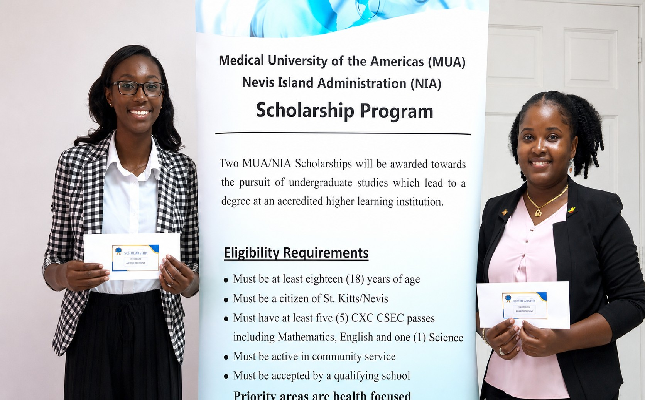
    CHARLESTOWN, Nevis – July 16, 2026 – A long-standing partnership between the Medical University of the Americas (MUA) and the Nevis Island Administration (NIA) has opened new doors for higher education on the Caribbean island, with two emerging local educators selected as the 2026 recipients of the joint full-tuition scholarship program.

    Chosen from a competitive pool of eight applicants, Michaela Maynard and Aliyah Sampson will receive full funding to complete up to four years of undergraduate study anywhere in the world, covering all core expenses including tuition, accommodation, meal plans, and additional academic costs. Unlike common misconceptions about the program, the scholarship is not restricted to medical studies at MUA; it is designed to support Nevisian students pursuing any undergraduate degree, with priority given to fields that address critical local workforce gaps.

    At the July 13 award ceremony, Honourable Senator Jahnel Nisbett, Nevis’ Minister of Health, formally congratulated the two recipients, highlighting the program’s unique value for young island residents. “Too many people misunderstand this scholarship as only for those wanting to study medicine at MUA, but this is a true collaboration between our administration and the university,” Nisbett explained. “We fund degrees in any field, as long as those fields meet Nevis’ most pressing development needs. What we ask in return is that recipients commit to returning to Nevis after graduation to use their skills to lift our community up.”

    Both scholars have selected degree programs directly aligned with local needs: Sampson will enroll in a Bachelor of Psychology program at Midwestern University, while Maynard will pursue a Bachelor of Science in Family and Child Development at Liberty University.

    Nisbett emphasized that the flexible structure of the scholarship makes it an unparalleled opportunity for Nevisian youth, noting that students can choose to study in any country and select a program that matches their career goals. She encouraged more young residents to apply for future cycles of the program, noting that the opportunity removes the financial barriers that often prevent local students from pursuing higher education abroad.

    Dr. Brenda Roman, Associate Dean at MUA, shared that the university has prioritized investing in Nevis’ local workforce through this partnership for years. To date, the program has awarded more than 30 full scholarships to eligible Nevisian students, expanding access to tertiary education for residents who might otherwise lack the financial means to attend university. “As a psychiatrist, I am especially delighted that this year’s recipients chose to study psychology and family and child development – two fields that are so critical to the long-term well-being of our island community,” Dr. Roman said. “Nevis has become a home to me, and I know these young women will return to make it an even better place to live and work.”

    Speaking after accepting the award, Maynard expressed deep gratitude for the opportunity, crediting the MUA, NIA, her family, and her friends for their unwavering support. She shared that her passion for supporting children developed at a young age, when she began mentoring younger peers in her community, and that this opportunity will allow her to turn that lifelong passion into a career supporting Nevis’ families.

    Sampson echoed that gratitude, saying she was deeply honored to be selected and committed to upholding the standards of the scholarship throughout her academic career.

    Cindy McLoud, CEO of GUS North America, also offered formal congratulations on behalf of the entire MUA institutional community, wishing the two recipients every success as they begin their studies.

    The ceremony drew a wide audience of stakeholders, including members of the joint scholarship review committee, representatives from Nevis’ Ministry of Health and Department of Education, MUA leadership, family and friends of the recipients, and other community well-wishers. As a collaborative investment in Nevis’ future, the scholarship program continues to build a pipeline of skilled local professionals to address the island’s long-term social and economic development goals.

  • Cricket and Crop Over Combine as West Indies Take on New Zealand at Kensington Oval

    Cricket and Crop Over Combine as West Indies Take on New Zealand at Kensington Oval

    As the five-match ODI series between West Indies and New Zealand reaches its closing stretch, cricket fans are gearing up for two final matches that will blend elite international sport with the vibrant cultural energy of Barbados’ annual Crop Over festival. Hosted at the historic Kensington Oval in Bridgetown, the matches will take place on July 19 and July 21, with organizers Cricket West Indies (CWI) crafting a one-of-a-kind match-day experience that goes far beyond the boundary rope.

    The series has already traveled across Caribbean venues this summer, anchored by CWI’s signature fan-focused “WI OUTSIDE!” initiative, which prioritizes integrating top-tier cricket with local music, culinary traditions, and cultural celebration. For the Barbados leg, the event aligns perfectly with Crop Over, Barbados’ most beloved annual festival, which culminates in the high-energy Kadooment Day parade – a fitting cultural anchor for the upcoming fixtures.

    Organizers have confirmed one key schedule adjustment for attendees: the July 19 fixture, originally planned as a day-night match starting in the afternoon, will now kick off at 10:00 a.m. local time, a change implemented to address unforeseen logistical constraints. The second match on July 21 will proceed as originally scheduled as a day-night contest, starting at 2:30 p.m. and carrying competition through to floodlit play under the Kensington Oval lights.

    The centerpiece of the off-field festivities is the Vida by Esquire Party Stand, a custom fan activation that will transform sections of the ground into a non-stop entertainment hub. Drawing direct inspiration from the lively spirit of Kadooment, the Party Stand will feature continuous live musical performances, a full-service bar with exclusive drink discounts, interactive fan games, free giveaways, and unannounced surprise activations designed to maintain high energy from the opening bowl to the final wicket.

    To make the celebration accessible to a wider range of fans, CWI has rolled out several special admission offers. Ladies entering the Vida by Esquire Party Stand before 1:00 p.m. on July 19 or 6:00 p.m. on July 21 will receive free entry to the activation. For family attendees, CWI is continuing its long-running commitment to growing the next generation of Caribbean cricket fans: all children aged 16 and under will be granted free entry to both ODI matches when accompanied by a ticket-paying adult.

    Dario Barthley, CWI’s Events Manager, emphasized that the Kensington Oval matches are designed to showcase the unique cultural identity of Caribbean cricket, timed perfectly to align with one of the region’s most exciting annual celebrations. “The WI OUTSIDE experience has resonated incredibly well with fans across the entire home season, and Barbados gives us the perfect backdrop to build on that momentum,” Barthley explained. “With Crop Over in full swing, we’ve partnered with the popular Kadooment band Vida by Esquire to create an atmosphere that celebrates everything that makes Caribbean sports culture special: incredible competitive cricket, great music, top-tier entertainment, and that unforgettable Caribbean vibe. Whether you’re here for the cricket, the Party Stand, or just a fun day out with family and friends, Kensington Oval is the place to be these next two matches.”

    As the West Indies Men’s national team, known colloquially as the Men in Maroon, looks to close out the series with strong performances, fans are encouraged to arrive early to take advantage of all pre-match activations. Following the conclusion of the two ODIs, the West Indies home season will shift to Port of Spain, Trinidad and Tobago, where the team will face Pakistan in a two-match Test series.

    Tickets for both Kensington Oval ODIs are available for purchase now via the official Windies Cricket ticketing portal at https://tickets.windiescricket.com/, and CWI has urged fans to secure their seats in advance to avoid missing out on what is shaping up to be two of the most memorable match days of the 2026 Caribbean home season.

  • ASPIRE Banking Exercise Gives Students a Practical Head Start on Their Financial Future

    ASPIRE Banking Exercise Gives Students a Practical Head Start on Their Financial Future

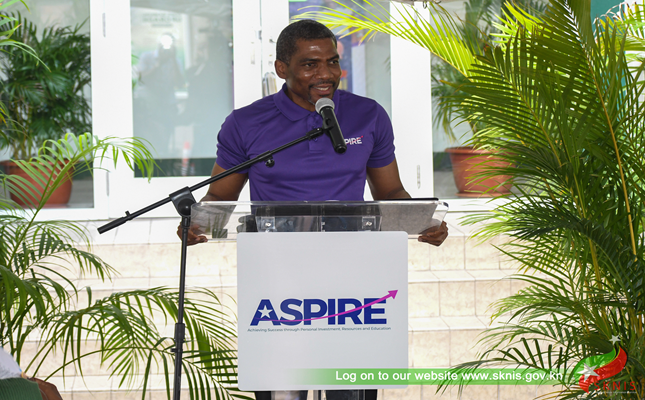
    BASSETERRE, St. Kitts – July 16, 2026 – A groundbreaking hands-on financial education initiative is giving young people across St. Kitts and Nevis an early foundation for long-term financial stability, as participants in the national ASPIRE Program completed an interactive banking exercise Wednesday at the St. Kitts-Nevis-Anguilla National Bank.

    Organized to bridge the gap between classroom financial literacy and real-world banking practice, the exercise gave participating ASPIRE students direct, practical experience with core banking processes. Under the supervision of bank staff and accompanied by their parents and guardians, students filled out official deposit slips, interacted one-on-one with bank tellers, completed deposits into their personal ASPIRE savings accounts, and reviewed their current account balances. The presence of family members throughout the activity underscored the critical role that households play in fostering healthy money management habits from childhood.

    Hon. Dr. Terrance Drew, Prime Minister of St. Kitts and Nevis and the nation’s Minister of Finance, spearheaded the initiative, which frames financial literacy as a hands-on skill rather than a purely theoretical lesson. Drew explained that the exercise was designed to let young people put core concepts of saving, strategic investing, and responsible money management into practice outside of school textbooks.

    “You may not grasp the full impact of this moment right now,” Drew told participating students. “But as you grow into adulthood, you will come to recognize how this early opportunity sets you on course for a strong, stable financial future.”

    To further amplify the impact of the exercise, Drew personally matched every deposit made by participating students, with matching contributions capped at EC$200 per student. The matching deposit initiative not only gave an immediate boost to students’ personal savings balances but also incentivized parents and guardians to continue making regular contributions to their children’s accounts as the students grow.

    Drew encouraged participating students to build ongoing positive financial habits: monitoring their account activity regularly, setting aside a portion of all funds they receive as savings, and developing the critical discipline of distinguishing between immediate discretionary wants and long-term financial needs. He also urged parents to help their children set up and access online account portals, so young savers can watch their savings grow over time and develop a tangible understanding of compound growth and long-term saving.

    The Wednesday banking exercise is a core component of the broader national ASPIRE Program, a government-led initiative designed to build intergenerational wealth and financial capability for young citizens. Under the program, every eligible citizen between the ages of 5 and 18 receives a total EC$1,000 contribution from the Government of St. Kitts and Nevis. Half of this contribution – EC$500 – is deposited into a dedicated personal savings account for the child, while the remaining EC$500 is invested in shares of locally based companies, giving young people an early stake in the nation’s economy. The program also integrates age-appropriate financial literacy education into the national school curriculum to reinforce key concepts long-term.

    To date, more than 4,000 ASPIRE savings accounts have been opened for young citizens across the country, with more than EC$4 million total invested in the future financial security of the next generation. Program organizers note that the ASPIRE initiative reflects the St. Kitts and Nevis government’s broader commitment to equipping young people with the knowledge, financial assets, and personal confidence needed to build secure, prosperous lives as adults.

  • DNA eist stevigere aanpak veiligheidsproblemen in binnenland

    DNA eist stevigere aanpak veiligheidsproblemen in binnenland

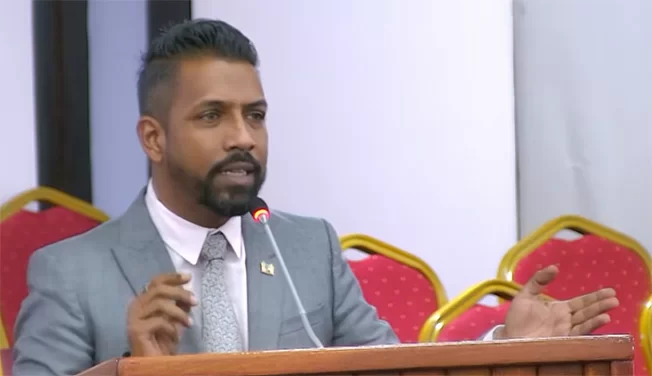
    On Thursday, a pressing debate over the deteriorating internal security situation in Suriname dominated proceedings in the country’s National Assembly, drawing sharp concerns from both coalition and opposition lawmakers over three core threats: the proliferation of heavily armed groups operating in remote interior regions, the destabilizing influence of the unregulated illegal gold sector, and critical gaps in the operational capacity of national security forces. The immediate trigger for the high-stakes discussion was the recent arrest of 16 Chinese nationals in the Sarakreek interior area, but the conversation quickly expanded to address broader systemic risks to national security and sovereignty.

    Multiple lawmakers from across party lines painted a grim picture of the status quo in Suriname’s largest district, Sipaliwini, which covers roughly 80 percent of the country’s total territory. Dew Sharman, a legislator from the ruling VHP party, warned that the unfolding crisis has now escalated to a question of national sovereignty. He pointed out that armed factions currently operate freely in swathes of the interior, while police and military forces are unable to maintain a consistent, effective presence due to chronic shortages of personnel and funding. Sharman also called for a formal investigation into historical allegations that past politicians were involved in securing mining concession areas, a role that has since been taken over by unregulated private security companies.

    Poetini Atompai, a lawmaker from the opposition NPS, offered an even more alarming assessment, stating that the armed group detained in Sarakreek is far from an isolated case. “We are only talking about one group here, but dozens of similar small armed factions are active across the interior,” Atompai told the assembly. He added that many suspects who have been wanted by police and justice authorities for years are now being protected by heavily armed foreign operatives, emphasizing that no meaningful progress can be made until policymakers acknowledge the full scale of the problem.

    Rabin Parmessar, leader of the opposition NDP faction, noted that the public is waiting for tangible security measures, not just reassuring rhetoric. As he pointed out, the Ministry of Justice and Police is already one of the largest budget items for the Surinamese government, so the public has a reasonable expectation of visible improvements to public safety. Parmessar added that public confidence in security is far lower than the picture presented by the ministry, and called for a dedicated thematic debate focused on concrete, actionable solutions.

    Fellow NDP lawmaker Raymond Sapoen argued that the recent revocation of a firearms license for the security firm linked to the Sarakreek case only addresses symptoms, not root causes. He called on the government and parliament to collaboratively develop a phased national plan to dismantle the illegal gold industry and the associated organized criminal networks. Sapoen also demanded clarity over reports that a seized low-profile vessel carrying more than 1,800 kilograms of cocaine had previously been docked at a state-owned facility.

    VHP legislator Krishna Mathoera highlighted a clear mismatch between the scale of Suriname’s security challenges and the capacity of the state institutions tasked with addressing them. She argued that the government must accelerate investments in police, military and other security agencies to actually guarantee protection for ordinary citizens. Mathoera also called on Justice Minister Harish Monorath to clarify earlier comments about the arrest of the 16 Chinese nationals, stressing that communication gaps cannot be used as a legal justification for pre-trial detention.

    VHP’s Mahinder Jogi directly pressed the government on widespread public fears that Suriname is gradually losing control over large parts of its territory. He questioned whether the minister is still fully able to carry out his statutory responsibilities, and called on President Jennifer Simons to order a full re-evaluation of the national security situation. VHP faction leader Asis Gajadien echoed these concerns, confirming that multiple armed groups currently dominate large swathes of the interior.

    ABOP legislator Edgar Sampie shifted the discussion to structural weaknesses within the Ministry of Justice and Police itself, arguing that the public cannot expect the ministry to resolve deep-rooted security problems without first fixing its own internal gaps. He described the department as weak financially, materially and organizationally, noting: “We cannot ask a mosquito to catch an elephant.” Sampie did, however, express appreciation for the ongoing efforts of Minister Monorath and frontline security personnel, who he said work to the best of their abilities despite severe resource constraints. For this reason, Sampie argued that parliament must not only demand better security outcomes, but also allocate funding to strengthen the ministry and equip security services properly.

    Responding to questions from lawmakers, Minister Monorath, who heads the Ministry of Justice and Police, pushed back against claims that Suriname is losing control of parts of its territory. “All areas of the country still remain under the authority of the Surinamese state. There is one government, one administration, and one national police force,” he emphasized. Monorath explained that the 16 Chinese detainees were originally identified as suspects due to reasonable suspicion of criminal activity, but were subsequently released after the Public Prosecution Service determined there was insufficient evidence to pursue further charges. The prosecution still plans to revoke the general firearms license of the linked security company, however, as the weapons found were being carried by individuals who did not hold valid authorization to carry them.

    The minister acknowledged that security forces face significant, growing challenges and that capacity strengthening is an urgent priority. He confirmed that thousands of ministry staff work daily to protect national security under difficult conditions, but added that expanded funding and sustained investment remain necessary to effectively counter rising criminal activity across the country.

    Following the debate, National Assembly Speaker Ashwin Adhin confirmed that lawmakers had agreed to hold a dedicated thematic session on national security. The planning process will begin with a procedural meeting next week to formally establish a new standing committee on security, which will oversee the upcoming focused discussion.

  • Column: Eén jaar later, waar zijn de contouren van ‘Kenki a systeem’

    Column: Eén jaar later, waar zijn de contouren van ‘Kenki a systeem’

    Few political slogans in recent decades have stirred as much public expectation as “Kenki a Systeem” – Change the System – the rallying cry that carried Jennifer Simons to the presidency of Suriname. More than just a campaign catchphrase, it represented a transformative promise: a fundamentally different governance culture built on greater transparency, less partisan politicking, and clearer focus on public interest. It pledged to strengthen independent institutions of the rule of law, deliver social and economic policies that restore upward mobility for ordinary citizens, and replace a culture of incremental crisis management with proactive, future-focused nation-building.

    One year after Simons took office on July 16, 2025, a fair, honest assessment of her administration’s progress must be measured against the standards the government itself set, not filtered through the partisan lens of either coalition or opposition. Last Thursday’s debate in the National Assembly unfolded exactly as political observers predicted: coalition partners offered muted criticism while highlighting the government’s progress in building a foundation for stability and calm, while the opposition focused on persistent public pain: stagnant purchasing power, rising insecurity, and continued tough economic conditions. Both takes are predictable and understandable, as partisan positioning almost always shapes the tone of political evaluation.

    One contribution stood out from the predictable back-and-forth: the address by Jerrel Pawiroredjo, parliamentary leader of the National Party of Suriname (NPS), a member of the ruling coalition. While NPS chair and Vice President Gregory Rusland has offered upbeat public assessments of the administration, Pawiroredjo rejected the temptation to deliver a celebratory speech, instead opting for an unvarnished reality check. He pointed to surging violent crime, ongoing challenges in Suriname’s interior regions, rampant illegal gold mining, thriving drug trafficking networks, and a growing public perception that the state has lost control over large swathes of the national territory. This was not opposition rhetoric; it was a recognition that after one year in office, any administration must have the courage to assess its own shortcomings critically.

    No reasonable observer expects any government to solve decades of accumulated systemic problems in just 12 months; that would be an entirely unrealistic expectation. It is also an established fact that the Simons administration inherited a deeply challenging starting point marked by severe financial and administrative dysfunction. But after a full year in office, that inherited starting point can no longer serve as the primary benchmark for evaluation. It describes the conditions the government took office with, not the policy direction it has carved out for itself. After 12 months, the Surinamese public is right to look for visible outlines of the new governing system that was promised during the campaign.

    The “Change the System” slogan promised a governance model where professional expertise would take precedence over partisan loyalty, where transparency and accountability would become default operating principles, and where development policy would be guided by clear priorities, measurable outcomes, and a long-term vision that extends beyond the next electoral cycle. But where are ordinary Surinamese citizens actually seeing this promised shift in practice?

    Recent political appointments to multiple boards of commissioners hew more closely to old patronage patterns than the promised new, principle-driven governance culture. Even within the ruling coalition, internal cohesion remains a persistent source of public tension. Coalition partner ABOP has repeatedly called publicly for the government to honor previously made agreements – but details of those agreements have not been made public, leaving citizens to question how these closed-door deals align with the promise to overhaul Suriname’s political system and governing culture.

    This critical assessment does not mean the Simons administration has failed to deliver tangible results. The government has made notable progress expanding housing stock, deepened international cooperation partnerships, and taken steps to consolidate national financial stability – all advances that deserve due recognition. But isolated policy initiatives do not add up to systemic change. A truly transformed government is measured not only by individual projects, but by how the entire state apparatus functions. Have independent institutions grown stronger? Has the rule of law been measurably reinforced? Are poverty reduction, education, and public health integrated into a single cohesive development vision? Do households and small business owners now have a clear sense of long-term economic opportunity? Is foreign policy explicitly aligned with national development priorities? Most importantly: do ordinary Surinamese actually perceive that their government operates differently today than it did 12 months ago?

    No one expects a government to check off every campaign promise in its first year. But it is reasonable to expect that the first 12 months will lay the foundational groundwork for the transformed society that was promised. That foundation consists of more than positive financial indicators or administrative calm; it requires growing public trust, consistent legal certainty, tangible social progress, and a credible long-term development outlook. The biggest challenge for the Simons administration, therefore, may not be delivering individual projects, but making clear to the public that governing culture is actually changing. When Surinamese voters judge this government at the end of its four-year term, they will not judge it by the slogan “Kenki a Systeem” – they will judge it by whether they can see that not just the people in government, but the entire system that was promised to change, is actually different.

  • Leisure : Did you know ? #41

    Leisure : Did you know ? #41

    As part of its popular biweekly general knowledge quiz series, “Did You Know?”, local online media outlet HaitiLibre has shared a fascinating new fact about one of the Caribbean island of Hispaniola’s most critical natural resources: the Artibonite River.

    Stretching roughly 320 kilometers from source to sea, the Artibonite holds the title of the longest waterway on the entire island, which it shares between the Dominican Republic and Haiti. The river begins its journey in the Dominican Republic’s Central Mountain Range, crosses the international border into Haitian territory, and eventually drains into the Gulf of Gonâve.

    Far more than just a geographic landmark, the Artibonite River serves as the foundational lifeline of Haiti’s agricultural sector. It provides consistent irrigation for the sprawling Artibonite Plain, Haiti’s top domestic rice growing region that underpins much of the country’s food production. Beyond agriculture, the river also plays a central role in Haiti’s energy sector: the Péligre Dam, constructed along the Artibonite, creates one of the nation’s largest man-made reservoirs and generates a significant share of the country’s electricity supply.

    Despite its outsized importance, the Artibonite River currently faces pressing environmental threats, including widespread siltation that reduces its water capacity and growing pollution from human and industrial waste. Because the river crosses the international border between the two nations that share Hispaniola, coordinated binational management of the waterway remains a core strategic priority for advancing sustainable development and protecting food security for both countries.

    This fun educational fact is the 41st entry in HaitiLibre’s ongoing “Did You Know?” series, which forms a core part of the outlet’s Quiz.HaitiLibre platform. Launched to help audiences build general knowledge about Haitian and global topics, the quiz platform recently completed its monthly content update on July 1, 2026, adding 31 new quiz games to its library. That brings the total number of available quizzes to 180, with new content added on a monthly basis to keep the platform fresh for returning visitors.

    Unlike many online quiz services, Quiz.HaitiLibre offers all of its exclusive games completely free of charge, with no account registration required to play. The platform is designed to accommodate learners of all ages and skill levels, with every quiz offering three distinct difficulty tiers: easy, intermediate, and hard. All content is available in both French and English to serve a broad audience across the Caribbean and the global Haitian diaspora.

    Visitors are invited to explore the full range of quiz topics, test their knowledge, and share the platform with family and friends. Feedback is also encouraged via a simple access form available at the conclusion of every quiz, helping the platform’s developers refine existing content and plan future updates. For new visitors unsure of an answer, the platform frames every incorrect guess as a learning opportunity, encouraging persistence to build new knowledge that audiences can share with their own circles.

  • Antigua and Barbuda Steps Up Census Drive, Seeks 300 Workers

    Antigua and Barbuda Steps Up Census Drive, Seeks 300 Workers

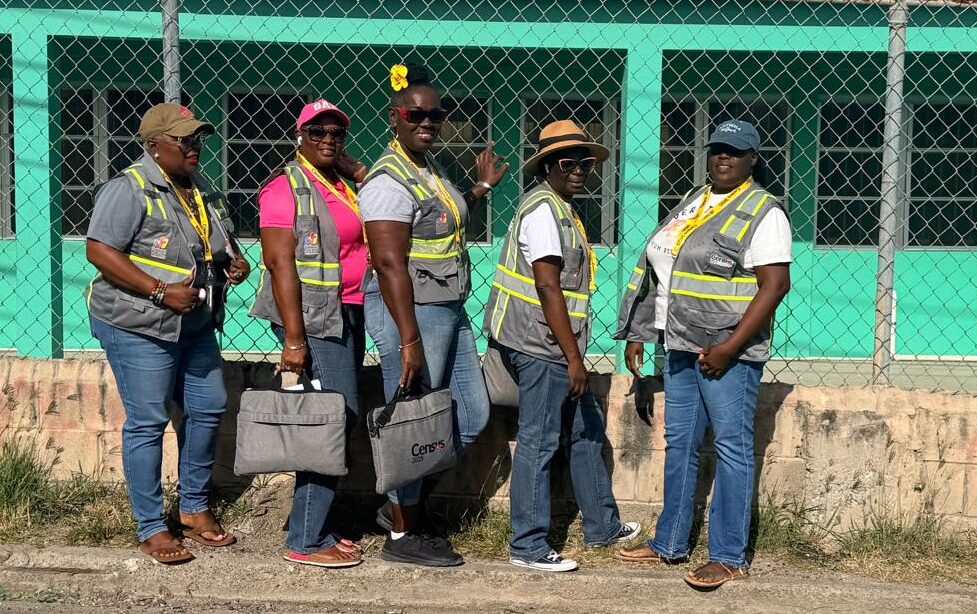
    The 2025 Population and Housing Census in Antigua and Barbuda is moving into an accelerated implementation phase, with national authorities stepping up coordinated efforts to deliver a complete, timely count of the country’s population and housing stock. A core part of this acceleration drive is an open recruitment drive for 300 additional field enumerators to support the nationwide data collection effort.

    The Census Department, which oversees the national initiative, has made application simple and accessible for all interested candidates: prospective workers can apply either by scanning a QR code published on the official census recruitment flyer or by accessing the dedicated application link posted to the department’s official census platforms. For individuals seeking additional details on role requirements, compensation, or application timelines, the department has also set up a dedicated information hotline at 562-7495.

    First launched late last year under the unifying theme “Mapping the Present, Shaping the Future,” the census operation is set to intensify significantly in the coming weeks. Officials are preparing to roll out a broad national public awareness campaign, which will be scaled up to reach maximum audiences during the upcoming Carnival season, when large gatherings and community events create unique outreach opportunities.

    The multi-channel media outreach initiative is designed to clear up common public confusion, explain the core purpose of the decennial (regular national) count, outline the responsibilities of field enumerators, and inform households of what to expect when census workers visit their residences. Officials stressed that widespread public understanding is a key foundation for a complete and accurate count.

    To help residents verify legitimate census workers and avoid potential security risks, authorities have outlined clear identification protocols: all authorized enumerators will wear official census uniforms, carry a valid photo ID card issued directly by the Census Department, and present a formal letter of authorization for their work. Officials are urging all residents to verify these credentials before granting access, and to cooperate fully with enumerators once they confirm the worker’s legitimacy.

    Addressing widespread public concerns about data privacy, the Census Department has reaffirmed that all individual information collected during the census will remain strictly confidential. All personal data will be used exclusively for aggregate statistical analysis, and will not be shared with any other government agencies or third parties for regulatory, tax, or legal purposes.

    Aggregated census data plays a foundational role in evidence-based national development planning, from the expansion of primary school access and public healthcare facilities to the development of transportation infrastructure, the design of targeted employment initiatives, and the expansion of other essential public services across Antigua and Barbuda. By highlighting the tangible impact of accurate census data on daily life, authorities are working to boost participation rates across all communities.

    As the counting phase gets underway, officials are stressing that every household has a critical role to play in the success of the initiative. A full, accurate count is the only way to ensure that Antigua and Barbuda’s long-term development plans truly align with the evolving needs of its population, they said.

  • Antigua Yacht Club to host the 2026 Caribbean Sailing Association AGM & Conference

    Antigua Yacht Club to host the 2026 Caribbean Sailing Association AGM & Conference

    The Antigua Yacht Club has been officially selected as the host venue for the 2026 Annual General Meeting (AGM) and Conference of the Caribbean Sailing Association (CSA), marking a major milestone for regional sailing collaboration and tourism in the Eastern Caribbean.

    The announcement, made by CSA leadership earlier this month, highlights Antigua’s longstanding reputation as a premier sailing destination in the Caribbean. With its deep-water harbors, world-class regatta infrastructure, and decades of experience hosting international sailing events, the Antigua Yacht Club emerged as the top candidate among several competing venues across the region.

    Industry insiders note that the 2026 gathering will bring together over 150 sailing association representatives, club managers, marine industry stakeholders, and competitive sailing coaches from more than 20 Caribbean island nations. Attendees will participate in a three-day program that includes strategic planning sessions for CSA, workshops on sustainable marine tourism development, discussions on youth sailing development programs, and updates to regional racing regulations for both amateur and professional competitions.

    Local tourism officials have praised the decision, emphasizing that the event will generate significant economic benefits for Antigua’s hospitality and marine sectors. In addition to direct spending on accommodations, venue rentals, and local services, the conference will also boost the island’s global profile as a top yachting destination, attracting more leisure sailors and competitive event organizers in the years leading up to 2026.

    CSA officials added that the selection aligns with the association’s ongoing goal of expanding sailing access across the Caribbean and strengthening collaboration between member clubs. The Antigua Yacht Club’s commitment to upgrading event facilities and supporting youth sailing initiatives was cited as a key factor in the final hosting decision.

  • All Saints West Career Fair to Connect Youth With Training and Job Opportunities

    All Saints West Career Fair to Connect Youth With Training and Job Opportunities

    Young people across All Saints West are set to gain unmatched access to personalized career guidance and diverse training opportunities at a no-cost community career fair scheduled for this Sunday, July 19. Organized to address growing youth interest in clear professional development pathways, the event will operate from 10 a.m. to 6 p.m. at the open-air parking lot directly opposite the All Saints West Branch Office in the heart of All Saints Village, offering ample space for one-on-one networking and interactive demonstrations.

    Unlike generic job events, this fair brings together a cross-border roster of experienced guest presenters hailing from Antigua and Barbuda, the United States, and Canada. This international lineup ensures attendees can connect with professionals from a wide range of industry backgrounds, gaining insights that go beyond local market perspectives. For participants, the day will include opportunities to hold direct conversations with established industry experts, get tailored advice aligned with their personal skills and interests, and map out long-term education and training plans that fit their career goals.

    The event is designed to highlight both skilled trades and white-collar professional pathways, ensuring there is relevant information for every young person regardless of their interests. Skilled technical sectors that will be featured include plumbing, electrical installation and maintenance, heavy machinery operation, barbering, cosmetology, fashion design, custom dressmaking, and construction design – all fields with consistent demand for new trained workers across the region. For those leaning toward academic professional paths, representatives will also be on hand to share details about careers in accounting, law, general medicine, and nursing. To further support attendees as they enter the job market, the fair will also include dedicated sessions and one-on-one guidance on crafting competitive résumés and building confidence for job interviews.

    Harold Lovell, the lead organizer of the fair, emphasized that the event fills a critical gap in local youth development. “This is a great mentorship opportunity for the youth in All Saints West,” Lovell noted, highlighting that the free access removes financial barriers that often prevent young people from accessing these valuable resources. Both registration for the event and general admission are completely free for all attendees, making the opportunity open to any young person looking to explore their next step. For those seeking additional details ahead of the event, organizers can be reached directly: Barbara Coates is available at 727-8617, and Collie Stevenson can be contacted at 774-6513.

  • News : Zapping…

    News : Zapping…

    As Haiti grapples with persistent political instability, gang violence, and ongoing humanitarian challenges, a series of key developments across the country have unfolded in mid-July 2026, spanning public safety, electoral preparations, healthcare support, and humanitarian relief efforts.

    The most devastating development came in the form of coordinated armed gang attacks targeting communities in the suburban areas of Kenscoff and Pétion-Ville, carried out between July 4 and July 9. According to data collected by Haitian human rights organizations and confirmed by United Nations Secretary-General spokesperson Stéphane Dujarric on July 16, the violence has claimed at least 61 lives – 14 of which are children. Most of the fatalities were recorded in the Robin neighborhood, where victims were gunned down as they attempted to flee their homes or escape along local roadways.

    This escalation of violence has also driven a sharp increase in the number of internally displaced people across Haiti’s most affected regions. In June alone, sustained attacks pushed more than 5,000 additional people from their homes in Cité Soleil, adding to growing displacement crises in Haiti’s West and Artibonite departments. In the Central department city of Hinche, humanitarian agencies have completed the relocation of 1,491 displaced people who had previously been sheltering in overcrowded, unsanitary school facilities with no privacy and inadequate basic amenities. The new transit camp, operated by the International Organization for Migration (IOM), provides significantly improved living conditions for the relocated families. The initiative was funded through support from the U.S. Embassy in Port-au-Prince and the Joint Regional Humanitarian Fund for Haiti. IOM has also received a shipment of emergency relief supplies from its regional warehouse in Panama via the global Logistics Cluster network, with enough materials to support 5,000 vulnerable families, which will be distributed by local Haitian partner organizations to ensure aid reaches the highest-need communities.

    Amid the ongoing security and humanitarian crises, Haiti’s electoral authorities have moved forward with preparations for upcoming political processes. The Provisional Electoral Council (CEP) announced an extension to the political party registration period this month, responding to formal requests from multiple political organizations across the country. Political groups now have until July 31, 2026, to submit their alliance registration documentation at the CEP’s central headquarters in Pétion-Ville, which is open to applicants weekdays and Saturdays from 8:00 a.m. to 4:00 p.m. The deadline extension has also pushed the official registration window for pre-electoral political alliances to August 10 through 14, 2026. Separately, on July 15, CEP’s Northern Departmental Electoral Office opened new voter registration operations at the Cap-Haitien Vocational School in Cité Lescot. Eligible citizens looking to register to vote are required to present their original national identification card to complete the process, and can direct questions to two dedicated local phone lines.

    In public health progress, the Pan American Health Organization (PAHO) has donated more than 10 new computing devices to Haiti’s Directorate of Family Health under the Ministry of Public Health, supported by the India-UN Development Partnership Fund in collaboration with the United Nations Office for South-South Cooperation. The computers will be distributed to local health institutions and departmental health directorates across the country, with the core goal of strengthening institutional data management capacity to support Haiti’s national public health strategy to eliminate mother-to-child transmission of HIV, syphilis, and hepatitis B. The equipment will improve monitoring and evaluation of the initiative by enabling more robust disease surveillance across all levels of the country’s health system.

    In a separate non-crisis development, the Haitian Football Federation (FHF) recently hosted a national training workshop for FIFA Connect, FIFA’s global standardized football data management platform. More than 75 stakeholders from across Haiti’s football ecosystem attended the training in-person and via virtual videoconference, where they learned to use the platform’s core features. Most notably, FIFA Connect assigns a unique, permanent FIFA ID to every player, coach, referee, administrative official, club, and youth football academy, enabling consistent, secure, and harmonized data management for Haitian football at all levels.