博客

  • Saharan dust affecting Air Quality in Antigua and the Caribbean Sea

    Saharan dust affecting Air Quality in Antigua and the Caribbean Sea

    A new wave of mineral dust carried thousands of miles from the Sahara Desert has driven air quality across the dual-island nation of Antigua and Barbuda into the moderate range, triggering official health warnings that sensitive population groups could face adverse impacts through at least Thursday night. This event marks the 10th significant Saharan dust intrusion recorded in the country this year, underscoring a recurring seasonal pattern that impacts the Caribbean region annually.

    The Antigua and Barbuda Meteorological Service confirmed that concentrations of fine particulate matter tied to the airborne dust pushed the nation’s Air Quality Index (AQI) to between 51 and 70, prompting the activation of an Air Pollution Alert Level II. While the overall air quality remains within the acceptable range for the general public, elevated dust levels create tangible risks for vulnerable groups, officials emphasized.

    Authorities have identified people living with chronic respiratory or cardiovascular conditions, senior citizens, and young children as the most vulnerable to the negative health effects of the fine dust particles. Even among the general population, a small subset of unusually sensitive people, including those with asthma, may experience moderate respiratory discomfort and related health concerns under current conditions.

    In line with public health guidance, local officials are urging active children and adults, as well as anyone with pre-existing respiratory conditions, to cut back on extended strenuous outdoor activity until dust concentrations dissipate and air quality improves. Residents are also encouraged to follow official updates from the Meteorological Service and other trusted government information channels to stay informed of changing air quality conditions and revised forecasts.

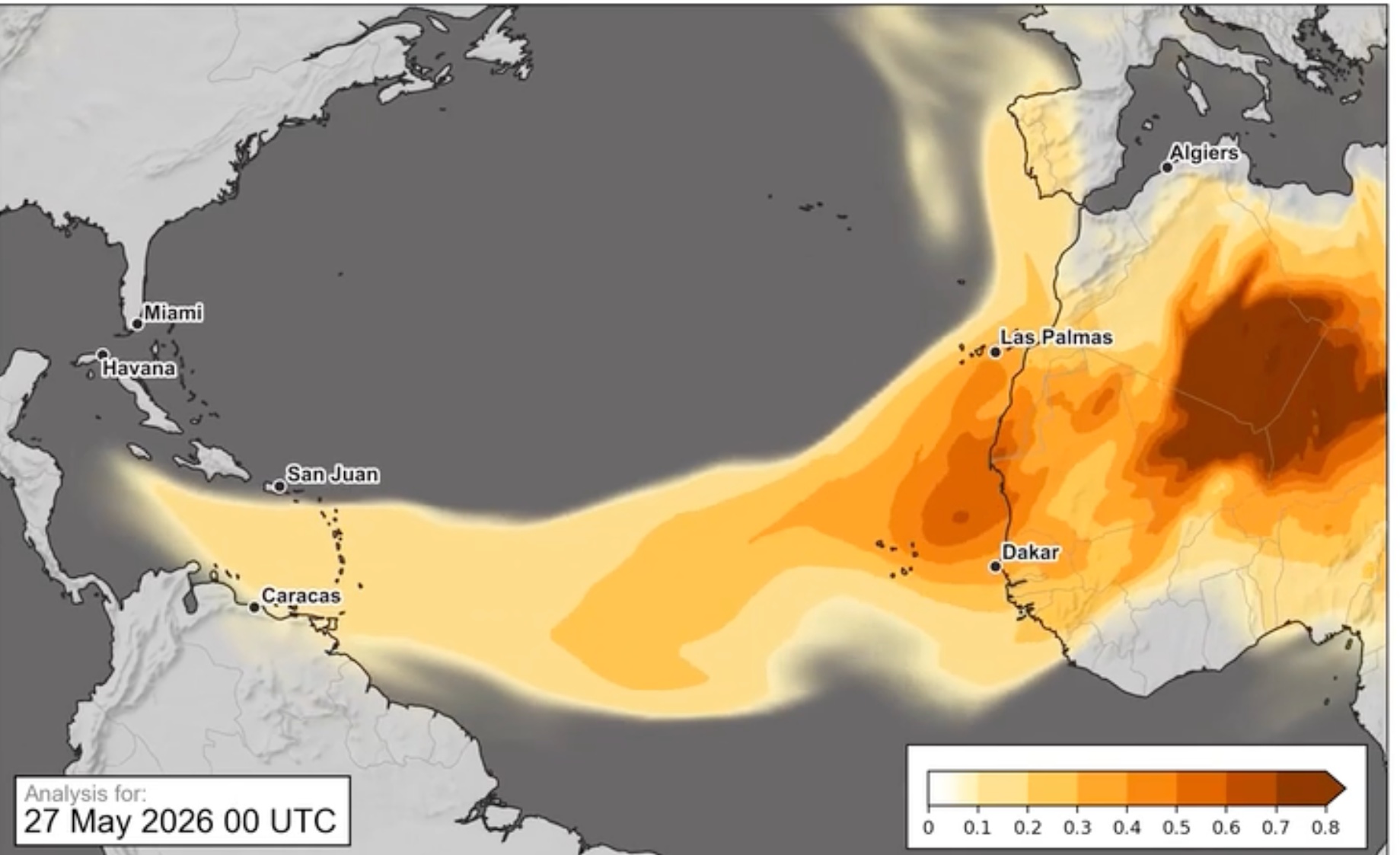
    This latest surge forms part of a much larger Saharan dust plume that has been traversing the entire Atlantic Ocean since early June. Data collected by the European Union’s Copernicus Atmosphere Monitoring Service tracked the massive cloud stretching from the arid west coast of Africa all the way to the Caribbean basin earlier this month. Before reaching Antigua and Barbuda, the plume already degraded air quality across Cabo Verde and other Atlantic island nations along its path, matching longstanding forecasts that predicted the dust would spread across most of the North Atlantic before reaching Caribbean waters.

  • Family returns from airport to find home in flames

    Family returns from airport to find home in flames

    A retired couple from Trinidad and Tobago returned to a devastating scene on Tuesday afternoon, when they found their Tunapuna family home completely overtaken by a sudden blaze, mere 70 minutes after they had left the property to drop their son off for a work trip.

    The property, a two-storey concrete structure located at the intersection of Maingot Road and Monroe Road, belongs to 63-year-old Kungebeharry Samlal, a former checker for the Chaguanas Borough Corporation, and his 62-year-old wife Phulmatee Kadoo Samlal, a retired customer service representative with the Water and Sewerage Authority of Trinidad and Tobago (WASA).

    Local police received the first emergency call about the fire at approximately 2:30 p.m. Responding officers arrived on scene within minutes to find the entire residential building already engulfed in dense, hot flames. A team of fire fighters, led by Sub Fire Officer Cooseelal, was deployed immediately to tackle the blaze, and after an intensive firefighting operation, they successfully brought the fire under control and extinguished it completely.

    A post-fire structural inspection carried out by authorities confirmed that the entire upper floor and roof of the home were completely lost to the fire. The upper level, which held two bedrooms, a private study, and a full bathroom, suffered such severe structural damage that it eventually collapsed onto the ground floor below. The remaining sections of the home also sustained widespread water damage from the thousands of gallons of water used to put out the blaze.

    Investigation into the incident have confirmed that the couple left their home at roughly 1:15 p.m. to drive their 28-year-old son to Piarco International Airport for a work-related international trip. The couple’s adult daughter was also not at the property at the time, as she was away at her workplace. A nearby neighbour spotted the fire breaking out, contacted emergency services, and then alerted the Samlal family, who rushed back to their home from the airport area to find firefighters already working to contain the blaze. Miraculously, neither of the retired couple suffered any injuries during the incident, no other residents or first responders were hurt either.

  • Antigua And Barbuda Participates In Island States Ocean Summit In Tokyo

    Antigua And Barbuda Participates In Island States Ocean Summit In Tokyo

    Against a backdrop of growing climate vulnerability for low-lying coastal nations, the 2026 Island States Ocean Summit kicked off on June 3–4 in Tokyo, Japan, gathering global stakeholders around the central mission of turning ambitious ocean sustainability goals into tangible, resilience-building action for island communities. This year’s gathering, themed “Sustainable Ocean Action for Resilient Islands,” brought together a diverse coalition of island state representatives, global development partners, leading marine scientists and representatives of major international organizations, all united by a shared goal: to advance climate-resilient, data-driven ocean planning that meets the unique needs of small island developing states (SIDS).

    Leading Antigua and Barbuda’s high-level delegation to the summit is Honourable Anthony Shamari Smith Jr., the country’s Minister of Agriculture, Lands, Fisheries and the Blue Economy. He is joined by a cross-sectorial team of experts: Climate Ambassador Her Excellency Ruleta Camacho Thomas, Marver Woodley, Senior Operations and Policy Manager at the national Department of the Blue Economy, Dr. Tricia Lovell, Deputy Chief Fisheries Officer, and Dr. Branson Belle from the Centre of Excellence for Oceanography and the Blue Economy at The University of the West Indies Five Islands Campus. The diverse composition of the delegation reflects Antigua and Barbuda’s holistic approach to blue economy governance, bridging policy, science, and climate action.

    During the summit’s opening High-Level Segment, Minister Smith delivered Antigua and Barbuda’s official national statement, grounding the global conversation in the daily reality of SIDS. He emphasized that for Antigua and Barbuda, the ocean is far more than an environmental resource—it underpins every pillar of the national economy, from food security for local communities to the livelihoods of thousands employed in tourism, fisheries, and maritime sectors. Against this context, he laid out the cascading threats that SIDS like Antigua and Barbuda face daily: accelerating sea-level rise that eats away at coastal land, widespread erosion that threatens tourism infrastructure and residential areas, degradation of critical coral reef habitats that buffer storms and support fisheries, rampant marine pollution from plastic runoff and shipping activity, and mounting pressure on finite marine resources that local communities depend on for survival.

    In his address, Minister Smith also outlined the proactive steps Antigua and Barbuda has already taken at the national level to strengthen ocean governance and build long-term resilience. Key initiatives include the ongoing drafting of a landmark national Blue Economy Bill, designed to create a clear legal framework for sustainable ocean use, and continuous work to implement comprehensive Marine Spatial Planning—an approach that maps out competing ocean uses from conservation to shipping to reduce conflict and protect sensitive ecosystems. Both initiatives are designed to support balanced, sustainable management across all key ocean sectors: commercial and small-scale fisheries, tourism, marine conservation, maritime transport, and coastal development.

    Minister Smith went on to reaffirm Antigua and Barbuda’s full commitment to the global 30×30 biodiversity target, which calls for protecting 30% of the world’s land and oceans by 2030. But he also stressed that SIDS cannot meet these global goals alone. He issued a clear call for expanded global access to critical resources for SIDS: advanced ocean science, targeted research support, standardized marine data collection, innovative climate adaptation technology, and sustained technical assistance to help local governments implement their ocean action plans.

    As a newly admitted member of UNESCO’s Intergovernmental Oceanographic Commission, Antigua and Barbuda also expressed strong support for the Summit’s new Sustainable Ocean Planning and Management Strategy, framing it as a valuable, practical framework to advance integrated ocean governance and deepen regional cooperation between island states facing shared climate challenges.

    Beyond the plenary sessions, Minister Smith took part in a High-Level Special Event focused on “Sea Level Rise and International Law,” a gathering dedicated to advancing legal frameworks that protect the sovereign rights and economic interests of SIDS at risk of displacement and territorial loss from rising seas. A core outcome of this year’s summit is the official launch of the new Sustainable Ocean Planning and Management Support Platform, a global initiative designed to scale up technical assistance, improve cross-stakeholder coordination, and strengthen global partnerships to support ocean action in island states. While in Tokyo, Antigua and Barbuda’s delegation has also held a series of bilateral meetings and technical working sessions covering a range of priority issues, from improved ocean governance frameworks to sustainable fisheries management, climate resilience programming, and innovative climate finance for SIDS.

    In closing, Minister Smith reaffirmed Antigua and Barbuda’s long-standing commitment to working hand-in-hand with regional and international partners to advance science-based sustainable ocean management, and build a resilient, inclusive blue economy that will benefit current and future generations of island residents.

  • Gunmen invade Las Lomas home, rob 68-year-old pensioner

    Gunmen invade Las Lomas home, rob 68-year-old pensioner

    A violent home invasion robbery targeted a 68-year-old local pensioner in Las Lomas on Tuesday morning, leaving the elderly resident shaken after three armed intruders stole thousands of dollars in valuables from her property. The incident unfolded shortly after the victim returned to her private residence on Rodney Road, located in the Las Lomas No. 2 district, at approximately 11:30 a.m., according to local law enforcement.

    When the woman walked through her front door, she was immediately confronted by the three men, who had already gained unauthorized entry to the home and were waiting inside. One of the suspects brandished a handgun, pressing the weapon directly toward the victim’s face before threatening her to stay silent and move to a living room couch to comply with their demands.

    Over the course of the robbery, the three assailants looted the home and stripped the victim of her personal property, including multiple pieces of jewelry: a gold chain, her wedding bands, an additional gold ring, and two silver bracelets. Beyond the jewelry, the intruders took $1,200 in cash from the victim’s purse and also absconded with two of her Samsung mobile phones. Once they had collected all the stolen items, the suspects made their escape by climbing over the home’s front perimeter fence, disappearing before police arrived on scene.

    Following the attack, authorities have released a detailed description of the armed suspect to aid in public tips and the ongoing manhunt. The gunman is described as a person of African descent, standing roughly 5 feet 8 inches tall with a dark brown complexion and short hair. He was wearing a black jersey at the time of the invasion, and used a piece of cloth to cover his nose and mouth to obscure his identifying features. Investigations remain ongoing as police work to identify and apprehend all three involved suspects.

  • Beachgoers welcome Macqueripe Bay reopening

    Beachgoers welcome Macqueripe Bay reopening

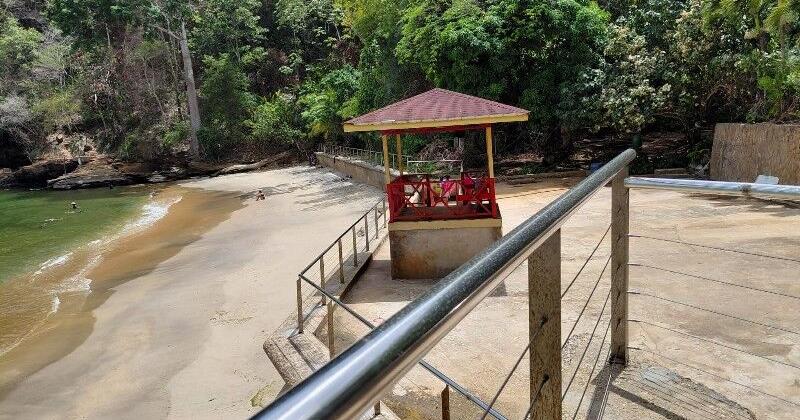
    After weeks of temporary closure for critical infrastructure repairs, Trinidad and Tobago’s Macqueripe Bay in Chaguaramas has officially welcomed back visitors, with local families flocking to the popular coastal spot to enjoy the newly renovated amenities on Tuesday.

    The Chaguaramas Development Authority (CDA) first shuttered the beach facility back on May 11, launching a project to replace the site’s decaying original wooden handrails with a new sturdier metal structure. At the time of the closure announcement, the CDA emphasized that the temporary shutdown was a non-negotiable safety measure to protect all patrons and out-of-town visitors.

    When a local reporter from the Express visited the newly reopened site on Tuesday, many beachgoers expressed clear approval for the completed railing upgrade, noting the tangible improvement to the site’s safety and appearance. Still, many visitors also pointed out that multiple aging and hazardous areas across the facility continue to go unaddressed—most notably a large unmarked, unbarriered hole located directly along the beachfront that poses a major risk to visitors.

    Nasser Khan, an award-winning journalist and frequent Macqueripe Bay visitor who toured the site with his family this week, shared that he was pleased the long-awaited railing repairs were finally complete. For years, Khan has repeatedly submitted formal requests to the CDA calling for facility upgrades, as decaying infrastructure at the beloved coastal spot has been a top complaint among regular visitors for decades. That said, Khan raised pressing questions about whether the new metal railing is built to withstand the harsh tropical marine environment, where constant exposure to salt spray and high humidity causes rapid corrosion of unprotected materials.

    “The upgrade has been a long time coming, but better late than never,” Khan explained. “From a quick look it looks fantastic. My only real hope is that the CDA chose materials that can hold up to these conditions—salt and moisture cause severe rusting here, that’s why the old wooden railing rotted away completely. The new metal option looks good, it works well, and I really hope it lasts and receives regular upkeep moving forward.”

    Khan described Macqueripe Bay as one of Trinidad and Tobago’s most underappreciated natural treasures, adding that chronic under-maintenance has been a persistent problem plaguing the popular recreational site for years. “Macqueripe is genuinely a paradise right here. For years, it got almost no regular maintenance. I’m hoping this railing upgrade is just the first step toward more consistent care for this facility.”

    For some visitors, the timing of the reopening could not have been better. One family from San Juan chose the newly reopened beach as the spot to celebrate a family birthday. “When we found out it was reopening the same week as our celebration, we were thrilled,” said Thomas Sylvester, the group’s organizer. “We love coming down here whenever we can, it’s such a beautiful beach. We just hope they keep up the good work going forward.”

    Another frequent visitor, Clyde Barnes, echoed Khan’s calls for additional upgrades and repairs across the facility. “The CDA should add shaded huts and picnic tables under the existing tree canopy for visitors to use,” Barnes noted. “I understand they may have bigger plans for future upgrades, but that gaping hole on the beachfront needs to be fixed right away—it’s a serious safety hazard.”

    As of Thursday, multiple requests for comment from the CDA regarding visitors’ additional concerns and future plans for the facility have not received a response.

  • COMMENTARY: Cycling for a greener future

    COMMENTARY: Cycling for a greener future

    For centuries, the bicycle has quietly reshaped human society, yet its transformative legacy often flies under the radar of popular history. Dubbed the “people’s nag” — a reference to the expensive, elite horses 19th century working classes could not access — the bicycle democratized personal travel more than 200 years ago, giving ordinary people an affordable, self-reliant way to move freely across their communities. Many observers now draw parallels between the disruptive, world-altering impact of the bicycle’s invention and the rise of artificial intelligence in the 21st century, framing the two as equally revolutionary shifts in how people live and work.

    The modern bicycle as we know it traces its origins to 1885, when 30-year-old English inventor John Kemp Starley began testing new designs in his Coventry workshop. After iterating through multiple prototypes, he unveiled the Rover Safety Bicycle: a 45-pound chain-driven model with two equally sized wheels, a design that remains the baseline for bicycles produced today. From its earliest days, the bicycle rippled through every corner of culture, leaving lasting marks on art, music, literature, and fashion that endure to this day.

    In recognition of the bicycle’s centuries-long contributions to global progress, the United Nations established World Bicycle Day in 2018, observed annually on June 3. The 2026 iteration of the event centers on two interconnected themes: “Cycling for a Greener Future” and “Advancing Sustainable Mobility and Inclusive Transport.” Both campaigns position the simple two-wheeled vehicle as a practical, low-cost solution to two of the world’s most pressing challenges: accelerating climate change and overcrowded, inequitable urban transport systems.

    Beyond its environmental benefits, global health bodies have long emphasized cycling’s far-reaching positive impacts on public health. The United Nations notes that regular moderate physical activity — including cycling — delivers extensive health benefits for people of all age groups, and even small amounts of activity offer greater gains than no activity at all. The World Health Organization (WHO) adds that building safe infrastructure for walking and cycling is also a critical pathway to advancing health equity. For low-income urban communities that cannot afford private motor vehicles, active transport like cycling cuts the risk of heart disease, stroke, several types of cancer, and diabetes, all while providing accessible mobility for work, school, and daily needs. This makes expanded cycling infrastructure both a cost-effective and equitable investment for communities worldwide.

    The bicycle’s history of advancing social progress stretches back to the 19th century, when it became a core tool for women’s liberation, granting women unprecedented mobility and personal autonomy at a time when strict social norms restricted their movement. Today, that legacy of inclusion continues through adaptive bicycle designs that make cycling accessible to people of all physical abilities. The bicycle also helps expand access to critical public services: by offering low-cost transport, it makes education, healthcare, and economic opportunity more reachable for marginalized and vulnerable populations across the globe.

    The shift toward prioritizing cycling in public policy gained new momentum after the COVID-19 pandemic, which reshaped global transport needs and prompted many cities to reimagine their mobility systems as part of “build back better” recovery efforts. In March 2022, the UN General Assembly codified this momentum with a resolution calling for the integration of bicycling into mainstream public transport systems to advance sustainable development. The resolution reaffirms the bicycle’s role as a tool of sustainable transport that encourages sustainable consumption and production, and delivers tangible benefits for climate action. It also commits national governments to promote cycling for all segments of society — across ages, rural and urban communities — and foster a widespread culture of bicycling worldwide.

    As communities around the globe observe World Bicycle Day 2026, organizers call on people everywhere to take actionable steps to support the day’s goals: opt for cycling over motorized transport when possible to cut carbon emissions and boost personal health, and advocate for protected, safe cycling infrastructure in local communities. Far more than just a machine for getting from point A to point B, the bicycle stands as a unifying symbol that connects people, communities, the health of the planet, and shared global progress. In the words of former U.S. President John F. Kennedy, “Nothing compares to the simple pleasure of riding a bicycle.”

    This commentary was written by Wayne Campbell, an educator and social commentator focused on how development policy intersects with culture and gender issues. All views expressed in this piece are the author’s alone and have not been independently verified.

  • Lula hekelt nieuwe Amerikaanse tarieven: ‘Wij accepteren deze behandeling niet’

    Lula hekelt nieuwe Amerikaanse tarieven: ‘Wij accepteren deze behandeling niet’

    In a sharp rebuke that has underscored growing frictions between Brasilia and Washington, Brazilian President Luiz Inacio Lula da Silva has publicly condemned the second Trump administration’s recent proposal to impose 25% tariffs on a range of Brazilian imports entering the United States. Lula has labeled the planned trade measure “unacceptable”, expressing deep surprise that the move would come at a time when ties between the two nations were just beginning to show signs of improvement after years of disagreement. The announcement caught many observers off guard, coming just one month after Lula met with U.S. President Donald Trump at the White House, a meeting that left Lula expressing cautious optimism about a potential thaw in bilateral relations. For years, relations between the two countries have been strained over disputes spanning trade policy, human rights disagreements, and competing priorities in regional politics, but the high-profile Washington meeting had been widely interpreted as the start of a new détente between the two governments. The relationship between Trump and Lula has long been complicated and fraught with ideological divides. Since Trump began his second presidential term in January 2025, he has maintained consistent criticism of Lula’s left-leaning administration. Trump has repeatedly spoken out against what he claims is censorship of right-wing political voices in Brazil, and has kept close personal and political ties to former Brazilian president Jair Bolsonaro and his family, leading figures in Brazil’s conservative right-wing movement. Bolsonaro is currently serving a 27-year prison sentence after being convicted of plotting to undermine Brazil’s democratic system following his narrow loss to Lula in the 2022 presidential election. The new U.S. tariffs were introduced following a U.S. investigation into alleged unfair Brazilian trade practices, including claims of illegal Amazon deforestation, restricted access to Brazil’s domestic ethanol market, and inconsistent enforcement of anti-corruption rules. U.S. Trade Representative Jamieson Greer has argued that current trade practices between the two nations are “unreasonable” and create unfair barriers to American commerce, adding that the U.S. faces a large trade deficit with Brazil. However, publicly available official trade data directly contradicts this claim: in March 2026 alone, the U.S. recorded a $420 million trade surplus with Brazil, rather than a deficit. Independent trade analysts say the proposed tariffs are part of a strategic shift by the Trump administration, which lost its broad legal authority to impose global tariffs under the International Emergency Economic Powers Act following a February 2026 ruling by the U.S. Supreme Court. The new levies are instead being enacted under Section 301 of U.S. trade law, a statute that grants the executive branch wide authority to impose trade sanctions when it claims trade agreement violations have occurred. Key Brazilian export sectors have been granted exemptions from the proposed 25% tariffs, including beef, coffee, rare earth elements, industrial metals, energy products, and aircraft components. The tariffs are still in a public consultation period that will conclude in early July 2026, leaving final implementation uncertain for now. The tariff announcement comes at an extraordinarily sensitive political moment for Lula, who is gearing up for a tightly contested general election in November, where his coalition will face off against a ticket led by Flavio Bolsonaro, former president Jair Bolsonaro’s eldest son. Despite his sharp criticism of the new trade measure, Lula has reaffirmed Brazil’s commitment to building stable, institutional relations with the United States. At the same time, he issued a clear warning that Brazil will actively diversify its trade partnerships and turn to other global markets if the tariffs are ultimately implemented.

  • Vehicle Reported Missing from Cassada Gardens

    Vehicle Reported Missing from Cassada Gardens

    Local law enforcement has issued a public call for information after a privately owned vehicle with registration number A73157 was reported missing from a residential yard in the Cassada Gardens area.

    Details of the incident were first circulated to the public on Thursday, with authorities confirming that the vehicle’s disappearance was discovered earlier that same day. At this stage, investigators have not confirmed the exact circumstances that led to the vehicle going missing, and no suspects have been named or identified in connection with the case.

    Police are urging any member of the public who may have traveled through the Cassada Gardens area recently, noticed the vehicle matching the provided registration number, or has any knowledge of its current location to assist with the ongoing investigation. There are multiple channels available for people to share information: tipsters can either visit their closest local police department in person, or place an anonymous call to one of two dedicated tip lines – 714-5745 or 732-8642.

    Law enforcement emphasized that even small pieces of information could prove critical to recovering the vehicle and resolving the case, and encouraged anyone with relevant details to come forward as soon as possible.

  • ‘I Love Mon Repos’ sign sparks community pride

    ‘I Love Mon Repos’ sign sparks community pride

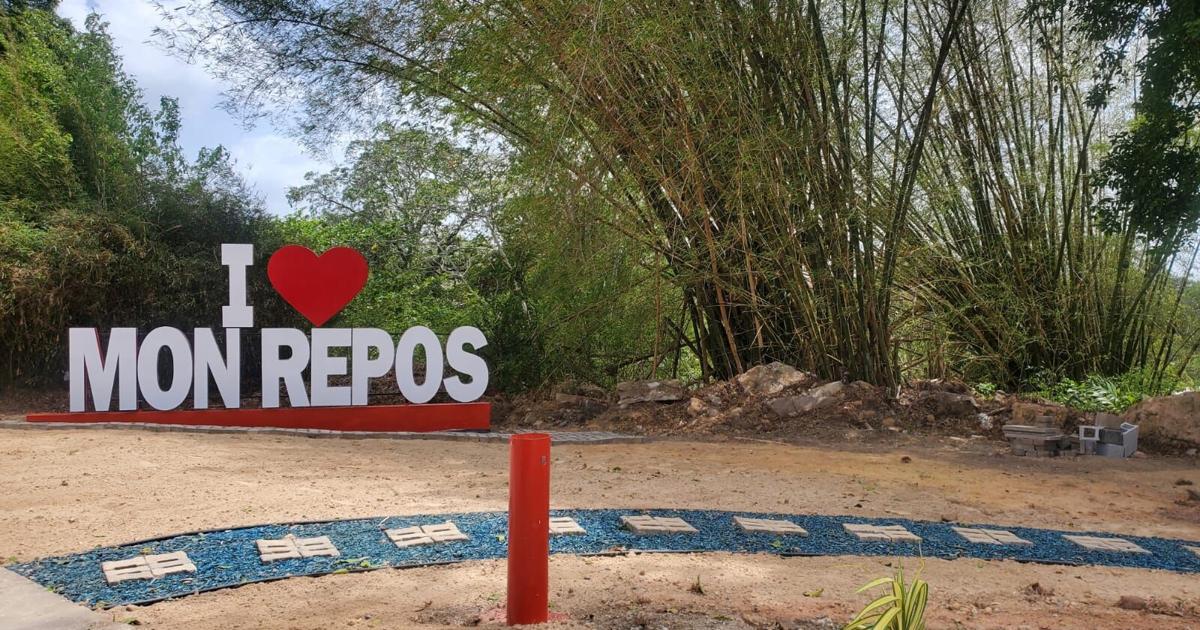
    What began as a simple overgrowth clearing initiative on a quiet Saturday in January has transformed into a beloved new tourist attraction in the coastal community of Mon Repos, Trinidad, drawing hundreds of local and international visitors after the installation of a custom ‘I Love Mon Repos’ landmark sign. Spearheaded by local councillor Nigel Couttier, the project kicked off with a small core team of 10 dedicated volunteers, who gathered every weekend from 5:30 a.m. to 10 a.m. to restore an unmaintained empty plot of land located just steps from the Mon Repos Police Station along the busy Naparima/Mayaro Road. As word of the grassroots initiative spread, more community members stepped up to join the effort: residents living in the apartment buildings directly opposite the site signed on to help, and a professional landscaper from nearby Pleasantville offered his skills entirely for free, drawn by the project’s mission of collective community improvement. After weeks of clearing debris, pulling weeds, and leveling the ground, Couttier felt the newly refreshed space was missing a defining centerpiece. Inspired by his personal affection for the Mon Repos area, he landed on the idea of a signature ‘I Love’ community sign. The custom sign, marked by a unique solid red heart to set it apart from identical signs in other regions of Trinidad and Tobago, was crafted pro bono by a local artisan, costing the project virtually nothing. The outpouring of community support extended far beyond labor: local residents and project supporters donated a wide range of materials, including backfill for landscaping, ornamental plants, paint, and even two decorative water features. Just one month ago, a team of volunteers pulled an all-nighter to lay lush lawn grass across the entire plot, turning the once overgrown lot into a welcoming green public space. Today, the project has already delivered far more than a new public spot — it has restored a shared sense of community pride among Mon Repos residents, Couttier says. For the local councilor, the initiative is also proof of what can be achieved when a group of people comes together with a shared goal to lift up their neighborhood. This sign marks the first ‘I Love’ community landmark in Trinidad’s southern region, a distinction that has helped turn it into an unexpected hit with travelers. Since the project was completed, the site has seen daily visits from sightseers across the country and international tourists. Just last weekend, a full busload of foreign travelers stopped to visit the spot, and visitors regularly flock to the area to snap photos in front of the iconic sign. ‘It’s really amazing,’ Couttier said. ‘That’s exactly what we set out to achieve — to create something that brings people together and makes our community shine.’ While limited funding remains a small hurdle for the next phase of development, the team plans to continue upgrading the space, adding restored public benches and a new concrete gathering area in the coming weeks. When asked about the risk of vandalism to the community space, Couttier said he remains unconcerned. ‘When you do something from the goodness of your heart, you leave everything up to God,’ he explained. Local residents have already embraced the new landmark, with one long-time resident praising the project for encouraging greater social connection among local young people. ‘It is a fresh project… it looking good and feeling good and we enjoying it,’ the resident said. Couttier aims to wrap up all remaining upgrades by the end of the current month, when the community will host an official opening ceremony to celebrate the new public space.

  • Kusal ​Mendis, Chameera power Sri Lankans past Windies

    Kusal ​Mendis, Chameera power Sri Lankans past Windies

    On Wednesday, June 3, Sri Lanka kicked off their three-match men’s One Day International series against the West Indies with a statement 41-run victory at Kingston’s Sabina Park, ending an 11-year dry spell for the side in Caribbean cricket grounds. Even before the first ball was bowled, betting analysts had tipped the South Asian side to claim an opening win, a projection that defied the hosts’ recent strong form — the West Indies had claimed four consecutive ODI series on home soil heading into this clash. That pre-match prediction ultimately held true, delivering Sri Lanka a critical early win in the race for 2027 ICC Men’s Cricket World Cup qualification.

    West Indies captain Shai Hope won the pre-toss coin flip and opted to send Sri Lanka in to bat first, a decision that would come with early misfortune for the hosts. On the very first delivery of the entire series, West Indies batter Keacy Carty dropped Sri Lankan opener Pathum Nissanka off pace bowler Jayden Seales’ bowling. The first wicket of the match fell soon after, when Seales removed opener Kamindu Mendis, Nissanka’s opening partner, for 12 runs. By the end of the mandatory powerplay fielding restrictions, Sri Lanka had posted 32 runs for the loss of just one wicket, a steady start that set the foundation for a big total.

    A century-level third-wicket stand between captain Kusal Mendis and the reprieved Nissanka transformed Sri Lanka’s innings into a dominant position. The pair piled on 136 runs together, with Nissanka capitalizing on his early second chance to notch 79 runs before being dismissed. Kusal Mendis followed close behind with a polished 72-run knock to extend the visitors’ lead. Later in the innings, another quick-fire partnership between Charith Asalanka and Janith Liyanage added 64 runs from just 48 deliveries, pushing Sri Lanka to a commanding final total of 302 runs for seven wickets from their full 50 overs. Asalanka contributed 45 runs in the stand, while Liyanage finished the innings unbeaten on 44.

    Chasing a steep target of 304 runs to open the series with a win, the West Indies got off to a promising start, with Justin Greaves striking 45 runs to give the hosts momentum. Captain Hope kept his side in the hunt for victory with a well-compiled half-century, scoring 56 runs and forging useful middle-order partnerships: 52 runs with Carty, and 33 runs with all-rounder Roston Chase. Chase added 33 runs to the total, left-arm spinner Gudakesa Motie chipped in with 22, and pace bowler Shamar Joseph remained unbeaten on 23 off late overs. Even with these contributions, the hosts could not match Sri Lanka’s earlier run rate, and a brief stoppage of play due to poor early evening light only delayed the final result.

    When the final overs wrapped up, the West Indies had fallen 41 runs short of the required target, handing Sri Lanka their first win in the Caribbean region since 2013. Pace-spin all-rounder Dushmantha Chameera was the standout performer with the ball for the visitors, finishing with four wickets for 67 runs from his 10 overs. With critical World Cup qualification points on the line across the rest of the series, the West Indies now face a rush to regroup ahead of their next fixture, as they fight to secure direct qualification for the 2025 2027 Men’s World Cup.