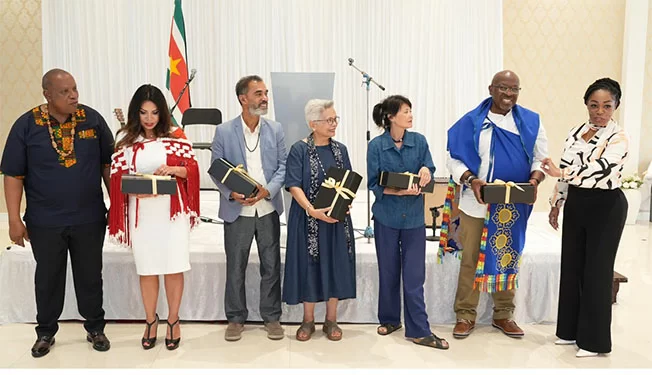
On a recent Saturday, the Consulate General of Suriname in the Netherlands hosted a one-day lecture conference titled “Breaking Borders, United as One”, where senior Surinamese diplomats and community leaders from diverse backgrounds converged to deliver a clear, shared message: greater interconnectedness, mutual respect and cross-group collaboration are non-negotiable prerequisites for Suriname’s long-term sustainable development. The gathering brought together voices representing communities across Suriname and the large Surinamese diaspora in the Netherlands, to address growing social and economic divides that threaten national progress.
Opening the discussions, Surinamese Ambassador Ricardo Panka, who appears at the far left of the event’s group photograph, emphasized that interconnectedness is not an end goal in itself, but the foundational bedrock upon which all productive collaboration and societal advancement is built. For Panka, durable, inclusive growth in Suriname can only be achieved when communities and individuals actively seek out connection, listen to one another, and actively bridge divides that threaten to pull the nation apart. “Connectedness is the foundation on which collaboration is built. And collaboration, in the end, is the engine that drives development,” Panka stated. He issued a call to all Surinamese people, regardless of where they reside, to keep building cross-community bridges, hold one another accountable when needed, and always ground those conversations in mutual respect and a commitment to Suriname’s shared national interest.
Consul General Roseline Daan, featured at the far right of the event’s group photo frame, framed the conference as a direct response to an era of growing social and economic strain that demands more intentional collective action. She noted that public discourse too often centers on highlighting differences between groups, when shared priorities and collective responsibility are the only solid base for long-term, sustainable progress.
Other speakers brought unique perspectives shaped by their distinct community backgrounds, all converging on the urgent need to build a more inclusive Surinamese society. Guest speaker Raj Mohan argued that the Surinamese nation is not confined to its geographic borders; instead, it lives and grows wherever Surinamese people make their homes. Rejecting the idea of a divide between Surinamese residing in the Netherlands and those based in Suriname, Mohan noted, “We form a single story that has stretched across oceans.”
Head Captain Sylvester Aboikoni issued a warning that core values of respect, harmony and mutual understanding are increasingly coming under pressure from rising individualism, persistent economic hardship and growing societal tension. To strengthen overall social cohesion, he argued, these foundational values must be recentered as guiding priorities for the entire community.
Diana Vlet, speaking on behalf of Suriname’s Indigenous community, pointed out that the contributions of Indigenous peoples to Suriname’s national development still do not receive adequate widespread recognition. She called for greater attention to Indigenous history and culture to be integrated into national school curricula and centered in national heritage institutions. True national connectedness, Vlet stressed, can only take root when all population groups are recognized as equal members of the Surinamese community.
Cultural steward Harriëtte Mingoen drew an important distinction between multiculturalism and interculturalism to frame her argument: while multiculturalism simply places different cultures alongside one another without deeper engagement, interculturalism centers intentional encounter, collaborative work, and mutual learning between groups, all without requiring any community to abandon its unique identity.
Carla Tlon, a scholar of Suriname’s Chinese diasporic community, drew attention to the underdocumented history of Surinamese people of Chinese descent. Many family histories of this community have yet to be formally recorded, she noted, even though centering these shared histories builds greater understanding and empathy across all segments of Surinamese society.
Closing the conference, Ambassador Panka reiterated his call to strengthen cross-border ties between Surinamese communities across the globe. For Panka, the ultimate goal of the day’s discussions was clear: to deliver “less distance, more results” for the entire Surinamese community, wherever its members may live.