博客

  • Regering trekt SRD 2,4 miljard uit voor nieuwe elektriciteitssubsidie

    Regering trekt SRD 2,4 miljard uit voor nieuwe elektriciteitssubsidie

    Suriname’s government has unveiled key spending priorities in its 2026 draft budget, allocating SRD 2.4 billion to a revamped electricity subsidy framework as it phases out broad-based general subsidies to the national energy utility Energiebedrijven Suriname (EBS). The policy shift marks a major departure from the country’s long-standing subsidy model, replacing broad institutional support for the utility with direct, targeted support for end-user households, designed to protect household purchasing power during the transition to restructured electricity tariffs.

    Government officials acknowledge that tariff restructuring will likely lead to a noticeable reduction in household disposable income during the transition period. The new targeted subsidy is explicitly intended to mitigate this impact, preventing the costs of tariff adjustments from placing an unsustainable financial burden on low- and middle-income households.

    Alongside the electricity subsidy reform, the administration is establishing a dedicated Special Projects Fund (SPF) with a total endowment of SRD 2.549 billion, managed by the Ministry of Finance and Planning. The fund will serve as the core financing mechanism for a wide-ranging portfolio of national development projects spanning key economic and social sectors. Of the total fund volume, SRD 225 million comes from domestic government resources, while the remaining SRD 2.324 billion is earmarked to come from external financing sources.

    Government digital transformation stands as one of the largest investment priorities under the SPF. Planned investments include expanding the national e-government platform, building infrastructure for secure cross-agency digital data exchange, and developing end-to-end digital public services for citizens. The country’s tax and customs authorities will also receive upgraded digital systems to streamline service delivery and improve operational and revenue management. Additional digitalization projects cover digital verification for social benefits and health services, as well as digital monitoring for public and school transport.

    The agriculture sector, a cornerstone of Suriname’s economy and food security strategy, will also receive significant support. Through the Agro Stimulus Program, the government will fund land preparation, access to production inputs, and agricultural equipment to boost local output and strengthen national food sovereignty. A new food technology laboratory will also be established at the Anton de Kom University of Suriname (NATIN) to support food safety testing, product innovation, and workforce training for the agri-food sector.

    In the health sector, the SPF allocates funding for urgent infrastructure and equipment upgrades, including the purchase of new surgical and diagnostic machinery, improvements to sterilization and safety protocols at public health facilities, and expansion of core medical services. The government also plans to advance the operationalization of community primary care posts, expand specialist care access, and secure a stable supply of affordable essential medications for all citizens.

    Education and youth development represent another key focus area. The government will renovate existing primary school facilities, construct new classroom blocks, and upgrade water and sanitation infrastructure at schools across the country. Funding is also reserved for new school furniture, digital education tools, and the national school feeding program. For out-of-school youth, the government will roll out targeted programs focused on employment placement, skills development, and entrepreneurship support, alongside plans to renovate, expand, and build new youth community centers.

    The fund also supports affordable housing construction and renewable energy expansion. New housing developments will be equipped with core public infrastructure and utility connections, while a dedicated solar energy program will deliver renewable energy systems to public health facilities, schools, and national drinking water distribution networks.

    In a separate notable allocation, the government has set aside SRD 110 million to cover the costs of regular credit rating assessments by leading international rating agencies including Moody’s and Standard & Poor’s. Regular credible ratings are a critical prerequisite for Suriname to maintain access to international capital markets and sustain investor confidence in the country’s economy, as a favorable credit rating lowers borrowing costs for both public and private sector projects.

    The 2026 budget proposals demonstrate the Suriname government’s dual policy focus: protecting household purchasing power during energy sector reform, while investing in long-term inclusive growth across multiple key sectors. However, the successful implementation of the full Special Projects Fund portfolio remains contingent on securing the projected SRD 2.3 billion in external financing, a key dependency that will shape the execution of the national development agenda over the coming year.


  • Contractor-General Amendment Mirrors Proposed Changes to Ombudsman Act

    Contractor-General Amendment Mirrors Proposed Changes to Ombudsman Act

    Two parallel constitutional and legislative shifts are unfolding in Belize, where changes to pay rules for the nation’s top independent oversight offices have sparked debate over institutional independence and government accountability. The developments come as former Ombudsman Major Gilbert Swaso proceeds with a constitutional legal challenge against the Belizean government, centered on disputed compensation claims from his time in office. At the same time, Belize’s National Assembly is advancing paired amendment bills that would rewrite remuneration rules for two constitutionally mandated watchdog agencies: the Office of the Ombudsman and the Office of the Contractor-General.

    The most recently tabled proposal, the 2026 Contractor-General (Amendment) Act, targets Section 10(1) of the original Contractor-General Act. Under current legislation, the head of the office is guaranteed annual emoluments no lower than the salary paid to a sitting judge of Belize’s Supreme Court, a statutory benchmark designed to ensure competitive, politically protected pay for the oversight role. If approved, the amendment would strike this existing guarantee and replace it with a provision that lets the National Assembly set pay and terms of service via legislative act or formal resolution. The draft bill schedules the change to take effect on June 1, 2026.

    A nearly identical amendment was introduced around the same time for the Ombudsman Act, a move that received public coverage upon its introduction. Before this proposal, Section 8(1) of the Ombudsman Act carried the same judicial salary benchmark, guaranteeing the Ombudsman compensation at least equal to that of a Supreme Court justice, matching the structure of the Contractor-General’s pay protections.

    Both watchdog positions are enshrined in Belize’s Constitution under Section 61A, which grants the Senate authority over their appointments and ongoing oversight mandates. As independent bodies, the Ombudsman and Contractor-General are tasked with auditing public spending, investigating official misconduct, and holding government agencies accountable to the public.

    Governance analysts and anti-corruption campaigners have long maintained that genuine institutional independence for oversight bodies relies on three core pillars: guaranteed job security, independent financial resourcing, and unrestricted operational autonomy. Global best practices, codified in frameworks like the United Nations Convention against Corruption, stress that independent oversight bodies must have secure remuneration structures and sufficient resources to carry out their mandates without political interference.

    Debate over the amendments has split along competing lines of constitutional authority and accountability. Proponents of the changes argue that the amendments simply formalize the National Assembly’s inherent authority to set public official compensation, and bring greater clarity to the process for establishing pay for senior oversight roles. Critics, however, warn that removing the statutory tie to Supreme Court judicial salaries eliminates a longstanding safeguard designed to shield these watchdog offices from political pressure. Without fixed pay protections, they argue, the government could potentially use remuneration as a tool to influence the decisions of independent overseers, weakening Belize’s anti-corruption framework.

  • IsraAID expands school disaster preparedness programme to vulnerable primary schools across Dominica

    IsraAID expands school disaster preparedness programme to vulnerable primary schools across Dominica

    In a landmark step toward building long-term climate and disaster resilience across the Eastern Caribbean, humanitarian NGO IsraAID Dominica has officially launched the second level of the Kay & Kelan Early Childhood Disaster Risk Reduction (ECDRR) Toolkit, rolling out the new educational resource to 21 high-vulnerability primary schools across Dominica in partnership with the island nation’s Ministry of Education.

    Designed specifically for early primary learners in Grades 1 through 3, generally aged 6 to 8 years old, this expanded initiative builds on nearly a decade of collaborative work between IsraAID, the Dominican Ministry of Education, and regional stakeholders to embed disaster risk reduction into formal education systems. The original Kay & Kelan programme launched in 2017, starting with preschool and pre-kindergarten students to introduce foundational safety concepts from the earliest stages of learning.

    Unlike traditional textbook-based learning, the Level 2 toolkit uses interactive, play-centered activities tailored to young children’s developmental needs to teach core concepts of disaster preparedness and emergency response. The comprehensive kit includes a wide range of hands-on educational materials: a student activity book titled *Kay & Kelan Can Prepare for Different Hazards*, a detailed teacher’s manual for curriculum integration, a full toolkit implementation guide, 26 educational flashcards, a USB drive loaded with original disaster safety songs, two themed puzzles, two safety-focused board and card games, and a large multi-hazard educational wall poster.

    Synde Moses Joseph, IsraAID’s Director for Dominica and the Eastern Caribbean, noted that the programme has outgrown its original scope and evolved into a self-sustaining regional model, already successfully implemented across neighboring islands including Saint Lucia and Saint Vincent. Joseph emphasized the transformative power of the long-standing partnership with the Ministry of Education, noting that the initiative has become a locally owned, digitally enabled school resilience curriculum that no longer requires external leadership from IsraAID.

    “We are deeply grateful to the Ministry of Education for the collaborative foundation we have built over the years,” Joseph said. “They didn’t just welcome our programme—they helped shape it, opening access to schools, educators, and students across the country. Today, we call on the Ministry to champion this work as a regional model of educational resilience that other island nations can follow.”

    Dominica’s top education officials have expressed enthusiastic support for the programme’s expansion, highlighting its critical role in creating safe, supportive learning environments for young students amid growing climate uncertainty. Chief Education Officer Jeffrey Blaize reaffirmed the Ministry of Education’s unwavering commitment to student safety across all contexts, noting that physical and emotional safety is a prerequisite for effective learning.

    “Safety is at the core of everything we do,” Blaize explained. “We prioritize keeping students safe from all threats, including environmental hazards, and building spaces where children feel comfortable and supported. When children feel safe, they are ready to learn. Beyond that, maintaining continuous education in disaster-impacted communities restores a critical sense of normalcy. In a crisis, education provides psychological and emotional support to children, keeping them protected while helping them process overwhelming challenges.”

    Assistant Chief Education Officer Nadia Ferrol added that the initiative does more than teach individual safety—it cultivates a widespread culture of preparedness that empowers children to protect themselves, their families, and their entire communities. “We thank IsraAID for their investment in building resilience in our schools across Dominica,” Ferrol said.

    The rollout of the Level 2 toolkit marks a new chapter in disaster risk reduction education for small island developing states like Dominica, which face disproportionate risk from climate-fueled natural hazards. By starting safety education in early childhood, the programme aims to embed a lifelong culture of preparedness that will protect generations of learners across the Eastern Caribbean.

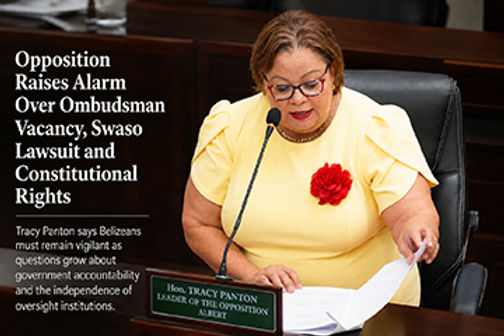
  • Opposition Leader Raises Alarm Over Ombudsman Vacancy, Swaso Lawsuit and Constitutional Rights

    Opposition Leader Raises Alarm Over Ombudsman Vacancy, Swaso Lawsuit and Constitutional Rights

    Belize’s Opposition Leader Tracy Taegar Panton is calling on all Belizean citizens to closely monitor mounting threats to core constitutional rights, government accountability, and the autonomy of national oversight bodies. Her warnings center on two interconnected issues: the months-long persistent vacancy in the Office of the Ombudsman, and a high-profile constitutional legal challenge filed by the office’s former head, Major Gilbert Swaso.

    In multiple recent public addresses, Panton has emphasized that the legal questions raised by Swaso’s claim are far from a personal dispute. Instead, they cut to the heart of a critical national question: can independent constitutional bodies in Belize carry out their mandates without undue political pressure from the ruling government?

    As outlined in this week’s reporting from *The Reporter*, Swaso moved forward with his constitutional challenge against the Government of Belize over his non-renewed appointment. The former ombudsman alleges his term was not extended after he ruled in favor of a Freedom of Information (FOI) request that sought public disclosure of government legal fees tied to a high-profile redistricting court case. He further claims that senior officials repeatedly attempted to interfere in official matters that fell exclusively under the Ombudsman Office’s jurisdiction. At this stage, none of Swaso’s allegations have been adjudicated or proven in court.

    Panton stresses that these claims strike at the core of transparent governance and the protection of constitutional safeguards laid out in Belize’s founding document. She reiterated that the Ombudsman serves as one of the most critical checkpoints on state power, tasked specifically with shielding ordinary citizens from institutional abuse, maladministration, and unfair treatment by government agencies.

    The opposition leader has doubled down on criticism of the ruling administration’s ongoing failure to fill the substantive Ombudsman position, which has been vacant since Swaso’s term expired on December 31, 2025. To date, Belize has operated without a permanent ombudsman for several months, leaving hundreds of citizen complaints against public agencies unaddressed and FOI review requests stalled in limbo.

    Notably, existing Belizean law already creates a framework for temporary oversight during such vacancies. Section 7(1) of the Ombudsman Act explicitly states that when the Ombudsman seat becomes empty, the Governor-General, acting on formal recommendations from the National Assembly, has the authority to appoint an interim officeholder to serve until a permanent appointment can be finalized. Despite this legal provision, no acting appointment has been made.

    Panton frames the Swaso dispute as part of a wider pattern of growing threats to constitutional governance in Belize. She points to two other recent high-profile matters: the case of former United Democratic Party Vice Chairman Alberto August and that of independent journalist Ryan Budna. While Panton acknowledges each case must be evaluated on its own unique set of facts, she argues that the cumulative allegations across these separate incidents raise serious questions about due process, equal treatment under the law, adherence to the rule of law, and the exercise of executive state power.

    For Panton, constitutional rights and fundamental freedoms are not discretionary privileges granted by the sitting government — they are inalienable protections that belong to every Belizean by right. She has issued a sharp warning against the normalization of what she describes as creeping institutional overreach, even the perception of such overreach, noting that a functional democracy relies entirely on robust independent institutions, full government transparency, and meaningful accountability to the public.

    The opposition has formally demanded the government answer three key questions: why no permanent Ombudsman has been appointed since the end of 2025, why no interim Ombudsman has been designated under existing law to keep the office operating, and what options are currently available to Belizean citizens whose rights complaints and FOI matters would normally fall under the Ombudsman’s mandate.

    Panton concluded by urging Belizeans to stay well-informed and remain vigilant on developments that impact constitutional rights and democratic institutions, noting that public trust in national governance is directly tied to the strength and independence of the country’s oversight bodies.

  • Jazz and golf fest ‘boosts tourism appeal’

    Jazz and golf fest ‘boosts tourism appeal’

    Ten years after its humble debut, the Barbados Jazz Excursion and Golf Weekend has emerged as a transformative cultural and economic asset for the Caribbean island, drawing high-value international travelers and cementing Barbados’ reputation as a world-class experiential travel destination, industry officials announced ahead of the 2024 milestone edition.

    This year’s 10th anniversary gathering is scheduled to run from October 8 to 12, building on a decade of growth to showcase Barbados’ unique blend of world-class culture, warm hospitality, and premium leisure offerings that set it apart from traditional holiday destinations. Speaking at the official media launch held at the Wyndham Grand Barbados Sam Lords Castle, Anderson King, Marketing Director of Barbados Tourism Marketing Inc. (BTMI), emphasized that the festival is far more than an annual entertainment event—it is a case study in what collaborative partnership can achieve for a destination’s global brand.

    “We’re celebrating far more than an event,” King noted at the launch. “We are celebrating what is possible when creative vision, strategic partnerships, and a shared belief in Barbados come together to create experiences that resonate on a global stage.”

    King pointed to shifting global travel trends that have shaped Barbados’ modern tourism strategy: today’s travelers no longer settle for generic beach vacations. Instead, they prioritize authentic, immersive experiences that let them connect with local culture, communities, and heritage. The Barbados Jazz Excursion was tailor-made to meet this demand, weaving together live jazz music, recreational golf, award-winning local cuisine, Caribbean heritage, luxury hospitality, wellness programming, and community engagement into one cohesive, memorable experience—aligning perfectly with BTMI’s long-term growth goals.

    The festival also highlights the ripple benefits of cross-sector collaboration across the visitor economy, King explained. Bringing together government tourism agencies, private sector businesses, international airlines, local hotels, cultural attractions, independent restaurants, transportation providers, and world-renowned artists creates shared economic gains that extend far beyond the event weekend. “Tourism succeeds when we work together, and the Barbados Jazz Excursion continues to demonstrate the extraordinary results that collaboration can achieve,” he added.

    Over its first decade, the festival has built steadily growing international appeal, drawing the majority of its attendees from Barbados’ core source markets: the United States, Canada, and neighboring Caribbean nations. King highlighted the outsized importance of the U.S. market, which has become Barbados’ largest source of international visitors, recording a remarkable 60% increase in arrivals over the past three years, with projections set to hit nearly 250,000 U.S. visitors in 2025. The event’s annual scheduling over the U.S. Columbus Day holiday weekend makes it an attractive long getaway option for North American travelers, who can combine world-class jazz and golf with Barbados’ iconic hospitality.

    King also noted that the festival has built exceptional brand loyalty, with a large share of attendees returning year after year. Many of these repeat visitors go on to become informal brand ambassadors for Barbados, encouraging friends, family, and travel groups to book trips to the island.

    Veteran jazz saxophonist Elan Trotman, the founder and creative force behind the festival, reflected on the event’s extraordinary 10-year growth trajectory. What began in 2014 as an intimate gathering of family and friends near the iconic Crane Resort has steadily expanded into one of Barbados’ top annual tourism and entertainment events.

    “Today I proudly celebrate a major upcoming milestone of ten years presenting this event,” Trotman said. “What began in 2014 as a small gathering of family and friends … has grown into one of Barbados’ premier tourism and entertainment events, attracting thousands of visitors in the last decade, while directly supporting our Head Start Music programme.”

    For this year’s milestone 10th anniversary edition, organizers already expect at least 150 in-house guests at the Wyndham Grand, with Grammy Award-winning R&B legend Jeffrey Osborne headlining the festival’s flagship Concorde Experience concert on October 11.

  • National Kriol Council Calls for Recognition of Kriol Indigenous Identity

    National Kriol Council Calls for Recognition of Kriol Indigenous Identity

    Against a backdrop of growing national dialogue around Indigenous rights, territorial ownership and cultural representation in Belize, the National Kriol Council (NKC) has released an official declaration cementing the Kriol people’s status as an Indigenous foundational population of the nation, rooted in centuries of ancestral connection to Belize’s land.

    In the statement, the NKC pushes back against narratives that frame Kriol people as a recent arrival to the territory, emphasizing instead that the community is one of the core founding groups of modern Belize. Over generations, Kriol people have shaped every dimension of national life, the council argues, from economic development and institutional governance to cultural expression and national identity. The group ties its indigeneity to longstanding ancestral bonds with the Mosquitian Nation, a historic regional territory home to multiple Indigenous and Afro-descendant communities whose histories are inextricably linked to the formation of Belize as an independent nation.

    A central grievance outlined in the declaration is the systemic exclusion of Kriol voices from national conversations centered on Indigenous rights, heritage protection, and ancestral land governance. The NKC stresses that Kriol communities, whose centuries-long continuous presence in Belize is well-documented, should not be forced to repeatedly justify their place in national history to gain access to equal rights and recognition. The council specifically names multiple long-standing Kriol communities across the country, arguing these groups cannot be sidelined from discussions or policy decisions related to land rights, territorial stewardship, cultural recognition, or any other issue that impacts their collective future.

    Legally, the NKC asserts that Kriol communities are entitled to full legal protection under both Belize’s national Constitution and binding international human rights frameworks. The declaration cites core principles from the United Nations Declaration on the Rights of Indigenous Peoples (UNDRIP) and other global human rights standards, which enshrine the rights of Indigenous groups to preserve their cultural heritage, maintain their collective community identity, and participate in consultation processes for any decisions impacting their ancestral territories. Going forward, the council maintains that any policy, land use decision, resource allocation plan, or governance change affecting Kriol ancestral communities must include meaningful, representative consultation with the communities themselves, rather than being decided over their heads.

    The declaration closes with a formal call to action, addressed to the Government of Belize, public agencies, non-governmental organizations, and global bodies, urging all stakeholders to formally recognize the Kriol community’s centuries of historical contribution and inalienable ancestral rights. The NKC frames this recognition as a foundational requirement for upholding fairness, equality, and respect for Belize’s rich multicultural national heritage. Beyond institutional advocacy, the council is also urging Kriol people both in Belize and in diaspora communities to actively document and preserve their family histories, cultural traditions, and records of ancestral settlement. This collective documentation, the council argues, is critical for protecting Kriol heritage for future generations and ensuring coming generations understand their community’s enduring role in building Belize.

    For the NKC, recognition of Kriol ancestral communities is far more than a cultural issue: it is a matter of foundational justice, historical accountability, and equal citizenship for all Belizeans. The council emphasizes that the history, contributions, and heritage of the Kriol people are an irreplaceable part of Belize’s national identity, and as such deserve full respect and permanent protection. This declaration comes as Belize navigates broader national conversations about how to reconcile historical narratives, allocate land rights, and honor the contributions of all communities that make up the modern nation, and the NKC has made clear that its advocacy for formal recognition and protection of Kriol ancestral rights will continue in the months and years ahead.

  • Derde helft WK 2026: Mexico wint spannende wedstrijd, drie rode kaarten en vroege goal

    Derde helft WK 2026: Mexico wint spannende wedstrijd, drie rode kaarten en vroege goal

    The 2026 FIFA World Cup officially kicked off on June 11 with a vibrant, culturally rich opening ceremony hosted at Mexico City’s iconic Azteca Stadium, before host nation Mexico claimed a confident 2-0 victory over South Africa in their Group A opening match.

    The opening celebration set a joyful tone for the tournament, showcasing Mexico’s deep cultural heritage and diverse global traditions to a packed stadium of tens of thousands of cheering fans. Global music superstar Shakira, a two-time FIFA World Cup anthem performer with long-standing ties to the tournament, delivered an electrifying headline performance that had the crowd dancing and singing along, building widespread excitement for the upcoming month of elite football competition.

    From the first whistle, the host nation dominated play against South Africa. Mexico earned their first goal just nine minutes into the match, becoming the earliest opening-game goal at a World Cup since Philipp Lahm’s sixth-minute strike for Germany against Costa Rica in 2006. The opening goal came after a sloppy pass from a South African defender put Colombia-born Mexican striker Julian Quinones in a one-on-one breakaway with South African goalkeeper Ronwen Williams. Quinones stayed calm under pressure and slotted the ball between Williams’ legs to find the net, triggering deafening celebrations from the home crowd.

    The first half saw two early yellow cards, issued to South Africa’s Teboho Mokoena and Mexico’s Brian Gutierrez, both for late tackles, before a mandatory hydration break at the 25-minute mark allowed both sides to reset tactically. As the first half wound down, Mexico continued to pile on the pressure: Raúl Jiménez saw a curling shot saved by Williams in the 41st minute, and Quinones hit the post on a follow-up attempt, but South Africa managed to hold the line to go into halftime down just one goal.

    The second half started with no substitutions from either side, but it quickly unraveled for South Africa. In the 52nd minute, South Africa went down to 10 men after Yaya Sithole was issued a straight red card for a reckless tackle from behind on Gutierrez that stopped a clear goalscoring opportunity, handing Mexico a man advantage and a dangerous free kick just outside the 18-yard box.

    Mexico made their numerical advantage count in the 67th minute, when Raúl Jiménez doubled the host’s lead with a powerful headed finish off a pinpoint cross from Roberto Alvarado. The goal marked Jiménez’s first ever World Cup goal, sending the home crowd into a fresh frenzy of celebration.

    Discipline continued to be an issue for South Africa in the closing minutes, when Themba Zwane was sent off for violent conduct, leaving South Africa to play the final stretch with just nine players on the pitch. Mexico’s César Montes also picked up a red card in stoppage time for denying a clear goalscoring opportunity, bringing the total red cards for the match to three. Despite the late reduction to 10 men, Mexico held firm to secure a clean sheet and a full three points to open their tournament.

    Following the opening match, the next Group A fixture is scheduled to kick off at 23:00 the same day, with South Korea set to face the Czech Republic.

  • Fraser blasts govts for ‘total disaster’ in preserving historic buildings

    Fraser blasts govts for ‘total disaster’ in preserving historic buildings

    Barbados’ irreplaceable collection of historic architecture is facing an unprecedented existential threat, driven by decades of inaction from every consecutive national administration, a leading global expert on Barbadian built heritage has warned. Professor Emeritus Sir Henry Fraser, a former president of the Barbados National Trust and one of the nation’s most respected voices on cultural preservation, issued a scathing rebuke of both past and current governments, calling the current state of heritage stewardship an unmitigated disaster.

    In an exclusive interview with Barbados TODAY, Sir Henry said that national efforts to protect the island’s one-of-a-kind architectural landscape have been effectively frozen for generations, stretching back to the administration of Prime Minister Tom Adams. “This government, the last government, the previous government, and the government before that, has made no effort to preserve our built heritage, absolutely none,” he stated. “Not since Prime Minister Tom Adams has there been any serious interest in the magnificent heritage of Barbados.”

    While the expert acknowledged that a small number of isolated preservation wins have been achieved – most notably the phased restoration of Bridgetown’s Parliament Buildings, which he credited entirely to the persistent advocacy of Dame Billie Miller – even these high-profile milestone projects have fallen victim to longstanding bureaucratic neglect. As a key example, he pointed to the Museum of Parliament, which has remained shuttered and inaccessible to the public for years despite the completion of the main building restoration.

    “This is a very poor job of caretaking our heritage. These are our national treasures that carry the story of Barbados’ history that have been allowed almost to rot,” Sir Henry argued. He added a stark warning: the island’s crown jewel of heritage, Historic Bridgetown and its Garrison, a designated UNESCO World Heritage Site, could lose its international protected status if the current trend of neglect continues. “They will sooner or later take it away,” he cautioned.

    Sir Henry’s critique lands amid a period of rapid physical transformation across the Barbadian landscape, as new construction reshapes much of the island’s urban and coastal areas. The professor emphasized that he is not opposed to thoughtful modern architecture, highlighting contemporary projects such as the Sagicor building on Lower Collymore Rock as excellent examples of well-executed contemporary design. The core problem, he argued, lies in a broken regulatory framework that consistently fails to strike a healthy balance between new development and heritage preservation.

    In his view, town planning regulators have repeatedly approved destructive construction projects that should never have been granted permission. Fixing this systemic failure does not require just minor tweaks to existing legislation, Sir Henry explained – it demands a complete shift in institutional priorities and cultural sensitivity towards heritage assets.

    Current planning regulations, overseen by the Planning and Development Department (originally founded in the early 1960s as the Town and Country Planning Department), are constrained by rigid, technocratic rules focused narrowly on site efficiency, property boundaries, building setbacks, and parking requirements. The system has no formal mandate to conduct qualitative, aesthetic assessments of proposed developments that impact historic sites, Sir Henry said.

    Beyond heritage protection, the flawed regulatory framework has created practical public safety risks, he added: “It doesn’t appear to have the power to improve many a blind corner that lead to traffic accidents. And it hasn’t appeared for some time to have town planners who either have the vision, sensitivity, or authority to take decisions that relate to aesthetics. You would have to have a determination on the part of the Minister of Planning, and you would have to have professionals with the appropriate training to have any sort of impact on town planning decisions.”

    The ripple effects of this decades-long neglect extend beyond cultural preservation, directly damaging community heritage and the fast-growing sports tourism sector, a topic Sir Henry explored in depth in a recent Barbados TODAY column. His comments come after the current government announced plans to formally grant heritage status to the childhood homes of two Barbadian cricket legends: Sir Frank Worrell and Sir Garfield Sobers. Reacting to the announcement, Sir Henry offered a measured mix of cautious optimism and deep skepticism, rooted in 35 years of failed efforts to preserve Worrell’s former home.

    He detailed the long and frustrating history of Bostonville, Worrell’s childhood residence in Bank Hall, located just behind the Empire Cricket Club. Sir Henry first discovered the abandoned property 35 years ago, and led a volunteer pro bono restoration effort alongside former West Indies cricketer and builder Richard “Prof” Edwards. The project concluded with a formal ceremony, where then Prime Minister Sir Lloyd Sandiford unveiled a commemorative marble plaque marking the site’s significance.

    Despite that successful community-led restoration, bureaucratic inaction allowed the property to fall back into disrepair and ruin within years. A second effort to redevelop the site into a popular cricket-themed café and museum ahead of the 2007 ICC Cricket World Cup also collapsed when pledged government funding was diverted to other unrelated projects, leaving the historic landmark abandoned once again.

    The property holds unique cultural meaning: its stone veranda was modified by Sir Frank’s father specifically so he could watch his son play cricket from behind the Empire Cricket Club wall. Sir Henry emphasized that the site holds enormous potential to inspire local communities and draw cricket-loving tourists from across the globe. He urged the current government to break the long cycle of official neglect by finalizing a binding formal agreement between the national government, the Worrell family, and the Empire Cricket Club to secure the site’s future.

    As one of the most pivotal figures in West Indian cricket history, Sir Frank Worrell transformed the sport and became a powerful symbol of regional Caribbean pride. Decisive action from national leaders is urgently needed, Sir Henry argued, to ensure that irreplaceable cultural landmarks like this are preserved as living parts of Barbadian history, rather than left to crumble or cleared for short-sighted modern development.

  • Dry spell: El Niño phenom weakens rainfall as drought warnings persist into wet season

    Dry spell: El Niño phenom weakens rainfall as drought warnings persist into wet season

    Even as the Caribbean island nation of Barbados enters its annual wet and hurricane season, a long-running drought is projected to persist for months, with climate forecasters linking sustained dry conditions to El Niño-driven rainfall suppression that could stretch water scarcity into early 2025. In an official advisory released from the capital Bridgetown, the Barbados Meteorological Services (BMS) outlined that while the seasonal shift typically brings more regular showers and active thunderstorm activity, persistent El Niño conditions in the Pacific Ocean are drastically cutting into expected precipitation totals this year.

    El Niño is a recurring climate pattern defined by above-average sea surface warming across the central and eastern Pacific. This oceanic shift reshapes global atmospheric circulation, often weakening the moisture-laden weather systems that ordinarily deliver consistent rainfall to Caribbean island nations.

    For Barbados, which marked the start of its wet season two weeks ago, this translates to far fewer, less sustained rain events, raising the odds of prolonged dry spells and deepening drought even in the wettest part of the year. BMS data shows total rainfall recorded through the end of May hit 278.4 millimeters, near the island’s historical average, but more than 70 percent of that total fell across just a handful of days in January and March, creating extreme uneven distribution of precipitation.

    This patchy rainfall has left vegetation severely stressed, especially in the southern and southwestern regions of the small island. While a handful of tropical waves have passed through the region in recent weeks, they have only delivered minimal, short-term relief from the ongoing dry conditions. Looking ahead to the next three to five months, BMS experts project rainfall will stay at or below historical averages through October, with El Niño forecast to strengthen over that period— a shift that carries a 75 percent probability of occurring, according to current climate models.

    Forecasters caution that while isolated, intense downpours may trigger temporary localized flooding in low-lying parts of the island, these brief bursts of rain do not effectively recharge Barbados’ critical freshwater aquifers. Those underground water reserves require slow, sustained rainfall to replenish, meaning even occasional heavy storms will not resolve the underlying water scarcity.

    Compounding the island’s water challenges, Barbados has also entered its annual heat season. While forecasters do not expect temperatures to surpass the record highs set in 2023 and 2024, with moderate relief from consistent brisk trade winds, above-average air and sea surface temperatures are still locked in for the coming months. This combination of heat and dryness creates elevated heat stress risk for outdoor workers, children, older adults, and vulnerable people living with chronic health conditions, particularly on increasingly humid days and warm nights when overnight cooling is limited.

    Under the current outlook, BMS plans to elevate official drought alert levels through October: formal drought warnings will remain in place for June and July, followed by drought watches from August through the end of October. BMS officials also warn that the convergence of above-average temperatures, below-normal rainfall, and strong winds through this wet season could set the stage for an unusually dry start to 2025, meaning new drought warnings may be issued before the end of 2024.

  • Birth Certificates Can Be Printed on Any Paper, Attorney General Says

    Birth Certificates Can Be Printed on Any Paper, Attorney General Says

    In response to widespread public outcry over changes to the appearance of birth certificates issued by Belize’s Vital Statistics Unit, Attorney General Anthony Sylvestre has publicly clarified the reasoning behind the government’s controversial policy shift, which marks a major overhaul of the country’s civil documentation system.

    Sylvestre explained that the transition away from traditional pre-printed official birth certificates is a intentional policy designed to expand public access to vital record services. Under the new framework, residents can now obtain their birth certificates entirely digitally, eliminating the requirement to visit a government office in person to collect a physical printed document.

    Previously, all official birth certificates were produced on specialized pre-formatted paper that included unique serial numbers and a widely recognized standardized official design that Belizeans had relied on for decades. When the government was developing the new system, officials initially considered keeping both the traditional printed format and the new electronic option available to the public. However, that plan was ultimately scrapped over key concerns from government agencies that regularly verify birth documents.

    Sylvestre noted that maintaining two visually distinct versions of the same legal document would create significant verification challenges for institutions including the Social Security Board and the Immigration Department, which process thousands of document checks annually. To avoid confusion and streamlining verification processes, the government opted to fully transition to the new electronic model.

    “You won’t necessarily have to come into the office or have your birth paper printed on a ‘pretty paper’,” Sylvestre told the public. “Having accessed the service and received your e-copy, you could print it on any paper.”

    The attorney general added that residents who prefer a more polished physical copy still have the option to print their electronic birth certificate on high-quality or specialty paper of their own choosing. The only change is that the government will no longer provide the specialized pre-printed paper that was used under the old system.