分类: world

  • Magnitude 3.8 Earthquake Recorded North of Antigua and Barbuda

    Magnitude 3.8 Earthquake Recorded North of Antigua and Barbuda

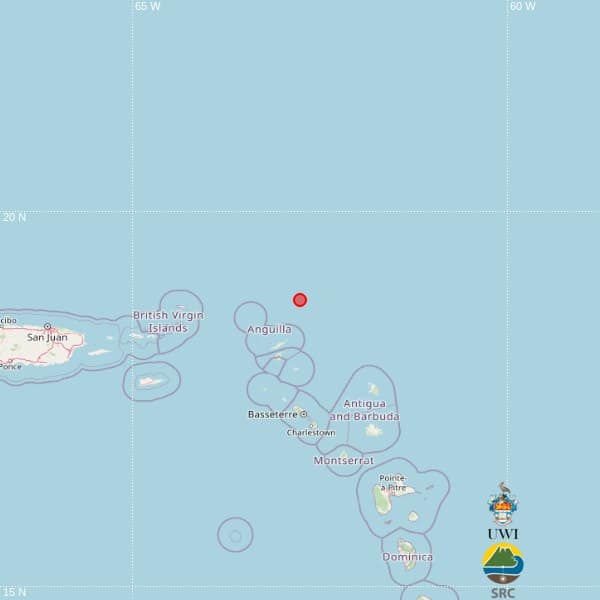
    The Eastern Caribbean region experienced a moderate seismic event in the opening hours of 2026, as confirmed by preliminary data from the University of the West Indies Seismic Research Centre. The tremor, registering magnitude 3.8 on the Richter scale, occurred at 6:24 a.m. local time (10:24 UTC) on January 1, 2026.

    According to automated monitoring systems, the earthquake’s epicenter was precisely located at coordinates 18.82°N latitude and 62.77°W longitude, with the seismic activity originating at a depth of approximately 10 kilometers beneath the Caribbean Sea floor. The event was situated approximately 169 kilometers north of Basseterre, St. Kitts and Nevis; 215 kilometers northwest of St. John’s, Antigua and Barbuda; and 233 kilometers north-northwest of Brades, Montserrat.

    The Seismic Research Centre emphasized that their initial measurements were automatically generated and remain subject to verification and detailed analysis by their team of seismic experts. Standard procedure requires thorough review of all preliminary data to ensure accuracy in location and magnitude assessment. No immediate reports of structural damage, coastal impacts, or injuries have been documented across the potentially affected regions. The earthquake’s moderate strength and offshore positioning significantly reduced any potential impact on populated areas.
  • 2026 : New Year’s Message from the Gang Supression Force

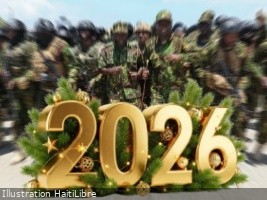
    2026 : New Year’s Message from the Gang Supression Force

    PORT-AU-PRINCE, Haiti – The Gang Suppression Force (GSF) issued a comprehensive New Year’s address on January 1, 2026, outlining significant security achievements and reaffirming its commitment to restoring stability in the crisis-ravaged Caribbean nation.

    The multinational security coalition, operating under UN Security Council Resolution 2793 adopted September 30, 2025, reported substantial progress in combating gang violence that has plagued Haiti for years. The resolution authorized the transformation of previous security missions into the specialized GSF, mandating intelligence-driven operations to neutralize criminal networks, secure critical infrastructure, and isolate gangs from their support systems.

    Throughout the latter half of 2025, GSF personnel working alongside Haitian National Police (HNP) and Forces Armées d’Haïti (FAd’H) achieved measurable security improvements. Joint operations resulted in numerous arrests, recovery of illegal weapons, and the liberation of territories previously under gang control. Enhanced day and night patrols throughout Port-au-Prince and beyond have facilitated the reopening of major transit routes long rendered impassable by violence.

    The mission has prioritized protection of vital national infrastructure including Toussaint Louverture International Airport, seaport facilities, and communication installations to ensure uninterrupted operational continuity. Strategically positioned Forward Operating Bases in gang-affected zones have significantly improved patrol coverage and response times.

    The GSF acknowledged international support mechanisms, including the recent appointment of a Special Representative for the force and successful troop contribution conferences in New York, demonstrating global determination for sustainable Haitian stability.
    In its message, the force specifically recognized the courage of personnel from Bahamas, El Salvador, Guatemala, Jamaica, and Kenya, while applauding Haitian leadership and citizens for their continued faith in the mission. The statement also highlighted the crucial role of local media in providing balanced coverage of security developments.

    As operations continue into 2026, the GSF maintains its focused mandate: dismantling criminal networks, restoring public security, and establishing foundations for lasting peace and democratic governance. The message concluded with optimistic aspirations for a future where Haiti achieves enduring peace, stability, and prosperity.

  • United Nations praises US$2 Billion US pledge to support Global Relief Efforts Human-impact focused

    United Nations praises US$2 Billion US pledge to support Global Relief Efforts Human-impact focused

    In a significant diplomatic development, the United Nations has formally welcomed the United States’ commitment of US$2 billion to bolster worldwide humanitarian operations. The announcement marks a notable shift from the Trump administration’s historically cautious approach to foreign aid under its “America First” policy framework.

    UN Secretary-General Antonio Guterres applauded the substantial financial injection, emphasizing that these resources will dramatically enhance the organization’s capacity to execute critical, life-preserving missions across multiple crisis zones. The funding arrives amid increasingly complex global challenges that have stretched humanitarian resources to their limits.

    UN Emergency Relief Coordinator Tom Fletcher, speaking during a signing ceremony in Geneva, characterized the past operational year as exceptionally demanding for relief workers worldwide. He noted that the memorandum of understanding (MOU) covering 17 specifically identified nations—including Ukraine, Syria, South Sudan, and Mozambique—represents a pragmatic collaboration focused squarely on human welfare outcomes rather than comprehensive political alignment.

    The contribution includes robust accountability mechanisms to ensure transparent utilization of funds, with Fletcher stressing that every dollar will be meticulously tracked to verify life-saving impact. Beyond immediate relief, the agreement acknowledges the intrinsic connection between humanitarian action and diplomatic efforts, with Fletcher advocating for 2026 to emerge as a year dedicated to peacemaking and conflict resolution—the most sustainable method for reducing global humanitarian demands.

  • National Day : 222nd anniversary of Haiti’s independence, first messages

    National Day : 222nd anniversary of Haiti’s independence, first messages

    As Haiti commemorated the 222nd anniversary of its independence on January 1, 2026, diplomatic messages from international partners and diaspora consulates highlighted both the nation’s historic resilience and contemporary struggles. The occasion marked the world’s first independent Black republic, established in 1804 after a successful slave rebellion.

    U.S. Secretary of State Marco Rubio conveyed America’s continued commitment to supporting Haiti’s security and democratic processes. “We stand with the people of Haiti on your Independence Day,” Rubio stated, emphasizing ongoing efforts to establish a Gang Suppression Force to combat violent groups designated as Foreign Terrorist Organizations by the U.S. government. The Secretary also acknowledged progress by Haiti’s transitional government toward conducting the country’s first national elections in a decade.

    Across the Haitian diaspora, consular officials struck a balance between celebration and solemn reflection. The Consulate General in Chicago evoked the legacy of revolutionary leaders Jean-Jacques Dessalines and the Indigenous Army, calling for national unity amid ongoing challenges. “Building a stable and prosperous Haiti is a daily endeavor that demands the patriotism and commitment of each and every one of us,” their message read.

    From Montreal, consular officials emphasized that “peace remains the essential condition for building a prosperous and sustainable future,” while the Santiago Consulate in the Dominican Republic highlighted how Haiti’s national identity was “built on the rejection of injustice and arbitrary rule.”

    The messages collectively acknowledged Haiti’s profound historical significance while addressing current security concerns and governance challenges. Despite political instability and security crises, the international community reaffirmed its support for Haiti’s sovereignty and democratic development as the nation enters its 223rd year of independence.

  • Religion : Pope Leo XIV’s message of peace rekindles hope in Haiti

    Religion : Pope Leo XIV’s message of peace rekindles hope in Haiti

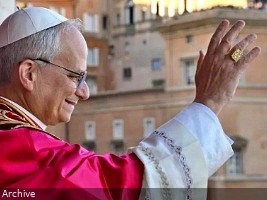
    In a profound address marking World Peace Day, Pope Leo XIV has issued a resonant call for a “disarmed and disarming peace” specifically addressing the protracted crisis in Haiti. This theological framework presents a dual approach to resolving the nation’s violent turmoil, offering a spiritual counterpoint to ongoing security preparations.

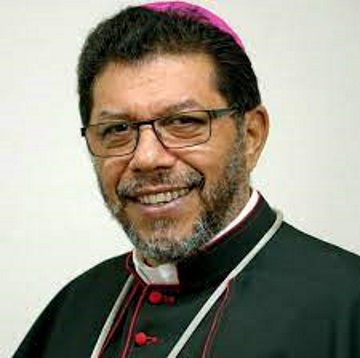
    Bishop Gontrand Décoste of Jérémie provided authoritative interpretation of the papal message, clarifying its practical implications for the Caribbean nation. He explained that “disarmed peace” necessitates the total elimination of firearms and complete cessation of armed hostilities across Haitian territory. Simultaneously, “disarming peace” represents a diplomatic process encouraging armed factions to voluntarily relinquish weapons, thereby facilitating the restoration of state authority and national security infrastructure.

    The pontiff’s intervention arrives amid escalating gang dominance that continues to paralyze Haiti’s economy through systematic road blockades and regional narcotics trafficking. Bishop Décoste condemned how certain entities “profit from insecurity and ammunition sales while the population endures abject poverty,” highlighting the economic dimensions of the security crisis.

    Despite these challenges, the Haitian church demonstrates remarkable resilience. Four decades after Pope John Paul II’s historic visitation, the prophetic declaration that “Haiti will live” continues to inspire spiritual resistance through Marian pilgrimages in Port-au-Prince. These processions have evolved into acts of collective faith against overwhelming darkness, embodying the conviction that “evil will not prevail” as emphasized in Leo XIV’s message.

    For marginalized communities bearing the brunt of violence, this papal communication reaffirms that the current crisis represents a conquerable challenge rather than an inevitable fate, emphasizing unity and faith as foundational to national recovery. The spiritual appeal coincides with practical preparations for the anticipated April 2026 deployment of an international security force aimed at suppressing gang operations.

  • FLASH : Major seizure of weapons and ammunition in Bel-Air

    FLASH : Major seizure of weapons and ammunition in Bel-Air

    In a decisive blow against organized crime, Haitian National Police (PNH) forces conducted a major tactical operation in the Bel-Air neighborhood on December 30, 2025. The targeted raid focused on the stronghold of notorious gang leader Jamesley, resulting in the neutralization of multiple armed combatants and the confiscation of a substantial weapons cache. Despite these successes, authorities confirmed that Jamesley himself evaded capture during the operation.

    The seized contraband included sophisticated military-grade equipment: a Mavic surveillance drone, multiple handguns (9mm and .22mm pistols), high-caliber assault weapons including an M16 rifle, Kalashnikov rifle, and 9mm submachine guns, complemented by three 12-gauge shotguns. Law enforcement also recovered critical logistical support equipment including weapon magazines, communication radios, power batteries, and various bladed weapons such as machetes and axes.

    Most notably, the operation intercepted a massive ammunition stockpile totaling several thousand rounds. The haul included 4,094 rounds of 5.56mm caliber and 867 rounds of 7.62mm caliber ammunition, indicating substantial offensive capabilities. All confiscated materials underwent formal registration and certification by the Weapons Service of the PNH’s Logistics Directorate.

    The operation marks a strategic victory for Haitian authorities, with specialized units successfully degrading the armed group’s logistical infrastructure. While Jamesley remains at large, police officials emphasized that his operational capacity has been severely compromised through the equipment seizure. In a symbolic conclusion, PNH’s heavy equipment unit completely demolished Jamesley’s residential compound.

    PNH leadership reaffirmed their unwavering commitment to pursuing, dismantling, and permanently eradicating criminal enterprises to restore national security, public order, and state authority for the benefit of all Haitian citizens.

  • De wereld neemt afscheid van 2025 met vuurwerk en ijskoude duiken

    De wereld neemt afscheid van 2025 met vuurwerk en ijskoude duiken

    As the world transitioned from Wednesday to Thursday, global citizens bid farewell to the challenging year 2025 and embraced 2026 with renewed optimism through diverse cultural celebrations across continents.

    Sydney inaugurated the new year with its traditional spectacular fireworks display, featuring approximately 40,000 pyrotechnic effects spanning 7 kilometers across harbor buildings and vessels. The celebration occurred under enhanced security measures following recent violence, with organizers holding a minute’s silence at 11 PM local time for victims of the armed attack at a Jewish event. Mayor Clover Moore expressed hope that the occasion would unite the city in looking forward to “a peaceful and happy 2026.”

    Across Asia, distinctive traditions marked the transition. In Singapore, spectators gathered at Marina Bay Sands to witness dazzling fireworks, while Seoul witnessed thousands congregating at the Bosingak Bell Pavilion for the symbolic ringing of a bronze bell 33 times—a Buddhist-rooted tradition believed to ward off misfortune. China’s Juyong Pass at the Great Wall hosted drum performances and festivities featuring horse symbolism, anticipating the upcoming Year of the Horse in February.

    Hong Kong replaced its typical fireworks with a themed light show displaying ‘New Hope, New Beginnings’ following November’s tragic apartment fire. Croatia’s town of Fuzine continued its unique tradition of midday countdowns since 2000, with celebrations featuring champagne toasts and even brave ice-swimmers in Bajer Lake.

    Preparations intensified for Western hemisphere celebrations, with New York organizers setting up barriers and stages for Times Square’s ball drop amid sub-zero temperatures. Rio de Janeiro’s Copacabana beach prepared for its massive “Reveillon” music and fireworks festival, aiming to break its own Guinness World Record for largest New Year’s celebration.

    In snow-covered Kyiv and Moscow, citizens prepared for celebrations while expressing hopes for peace after nearly four years of conflict. While many Ukrainians expressed skepticism about imminent peace, 9-year-old Olesia in Kyiv remained optimistic, stating her belief that peace would come in the new year as she admired the Christmas tree before St. Sophia Cathedral.

  • Saudi Arabia sets executions record in 2025, putting 356 people to death

    Saudi Arabia sets executions record in 2025, putting 356 people to death

    Saudi Arabia recorded its highest number of executions in a single year during 2025, with 356 individuals put to death according to documented figures. This alarming statistic represents the second consecutive year the kingdom has broken its own execution record, surpassing the 338 executions carried out in 2024.

    Analysts identify Riyadh’s intensified ‘war on drugs’ as the primary driver behind this surge, with many cases originating from arrests made several years ago now reaching final verdicts and implementation. Official government data indicates that drug-related cases accounted for 243 of the total executions in 2025 alone.

    In a significant demographic shift, foreign nationals constituted the majority of those executed for the first time in Saudi history, according to the European Saudi Organisation for Human Rights. The Berlin-based monitoring group confirmed the record numbers and noted that migrant workers appear to be disproportionately affected by the anti-drug campaign.

    Duaa Dhainy, a researcher with the organization, characterized the escalating execution rates as evidence that Saudi Arabia’s promises regarding human rights reforms lack substance. She further stated that the executions function as tools of ‘intimidation and fear’ targeting various groups including minors and political dissidents.

    Saudi Arabia resumed capital punishment for drug offenses in late 2022 after approximately three years of suspension. The nation represents one of the largest markets for captagon, an illicit stimulant that previously served as Syria’s primary export during Bashar al-Assad’s regime before his ouster in December 2024.

    The intensified anti-drug campaign has featured increased police checkpoints along highways and border crossings, resulting in millions of confiscated pills and numerous trafficking arrests. Saudi authorities maintain that the death penalty remains essential for preserving public order and is applied only after exhaustive legal appeals processes.

    This persistent use of capital punishment continues to draw international condemnation from human rights organizations, which describe the practice as excessive and contradictory to Saudi Arabia’s simultaneous efforts to project a modernized global image through massive tourism investments and high-profile sporting events like the 2034 World Cup.

  • Roman Catholic bishops call for Caribbean Day of Prayer

    Roman Catholic bishops call for Caribbean Day of Prayer

    PORT OF SPAIN, Trinidad – In a significant regional intervention, the Antilles Episcopal Conference (AEC) has declared Thursday a Caribbean Day of Prayer, urging Roman Catholics across the archipelago to seek divine intervention for peace and stability. The appeal comes amid escalating military activities in Caribbean waters that threaten regional harmony.

    The AEC, representing 19 dioceses across 13 sovereign nations and numerous overseas territories, has positioned itself as a moral voice in growing geopolitical tensions. Archbishop Jason Gordon of Port of Spain, serving as AEC president, issued a comprehensive statement advocating for diplomatic solutions over military confrontation.

    Archbishop Gordon specifically addressed governments with Caribbean interests, including the United States, Venezuela, and CARICOM member states, urging them to prioritize dialogue, diplomacy, and cooperation over force and intimidation. The religious leader expressed particular concern about the fragmentation of regional unity, calling for an urgent CARICOM summit to address divisive geopolitical disputes.

    The archbishop’s statement highlighted the rapid deterioration of regional stability since the AEC’s initial warning about military build-ups in October. What was previously identified as a troubling presence has evolved into active military operations featuring tanker seizures, expanded naval assets, and restrictive airspace measures that directly impact civilian populations.

    Citing the Caribbean’s longstanding designation as a Zone of Peace, the AEC leadership expressed alarm about developments that threaten human dignity and regional stability. The statement referenced recent lethal maritime incidents, blockade operations, and intensified surveillance activities that endanger innocent lives and exacerbate humanitarian suffering, particularly in Venezuela.

    While acknowledging states’ legitimate responsibility to combat transnational crime and uphold international law, the AEC emphatically stated that militarization cannot achieve lasting security. The conference warned that heightened military operations by global powers or regional actors foster mistrust, disrupt economies, and disproportionately endanger vulnerable populations.

    The AEC expressed solidarity with the Venezuelan people, acknowledging their desire for democratic renewal and institutional integrity. Archbishop Gordon emphasized that Venezuela’s quest for justice and peace deserves respectful attention from the Caribbean Community, particularly during this critical juncture in the nation’s history.

  • Panamanians commemorate transfer of canal administration

    Panamanians commemorate transfer of canal administration

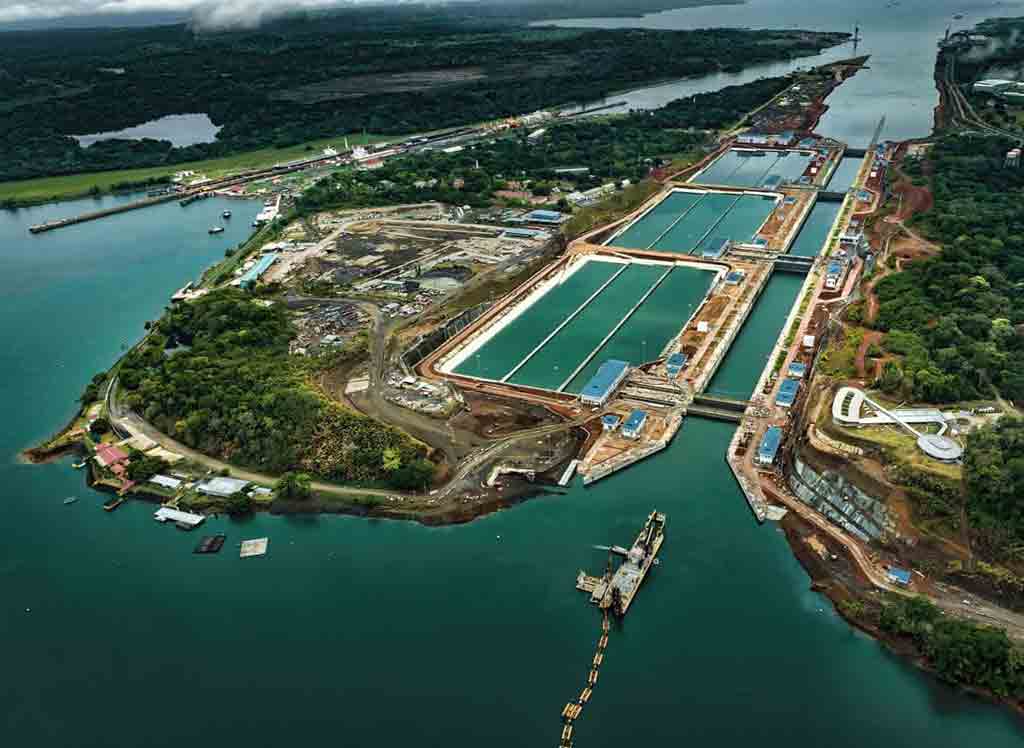
    December 31, 1999, marked a historic transition of power as Panama assumed full sovereignty over one of the world’s most critical maritime infrastructures—the Panama Canal. This transfer ended nearly a century of United States administration that began with the waterway’s 1914 inauguration. During the US operational period, the Canal Zone functioned as a sovereign enclave with separate laws and authorities, creating a physical and jurisdictional division through the heart of the isthmus.

    Over the past 26 years, Panama has not only maintained seamless operations but has significantly advanced the canal’s capabilities and global standing. The establishment of the Panama Canal Authority (PCA) proved instrumental in this success, facilitating comprehensive technical training programs to ensure operational continuity during the sovereignty transition.

    Panama’s stewardship has been characterized by visionary development projects, most notably the 2016 canal expansion that substantially increased transit capacity. The nation has successfully navigated complex water crises while enhancing the waterway’s efficiency. These strategic improvements have solidified the canal’s position in global maritime trade, with the infrastructure now handling approximately 6% of worldwide commercial shipping traffic.