分类: society

  • JCF says ‘restriction’ on firearms at entertainment venues to be introduced soon

    JCF says ‘restriction’ on firearms at entertainment venues to be introduced soon

    KINGSTON, Jamaica — In direct response to a recent violent shooting at a major carnival-linked entertainment event that left three people wounded, the Jamaica Constabulary Force (JCF) has unveiled plans to roll out a strict new restriction banning firearms from all public entertainment spaces across the island.

    The policy shift comes on the heels of a Sunday night altercation that turned deadly in terms of gun violence at the Big Wall Revolution event, hosted at Kingston’s Ranny Williams Entertainment Centre in St Andrew. What began as a minor physical confrontation between two attendees at approximately 9:30 pm escalated rapidly into an exchange of gunfire, leaving three people with gunshot wounds, authorities confirmed.

    Among the injured was Jhaedee Richards, a widely popular Jamaican podcaster who goes by the professional name “Jaii Frais”, alongside a United States citizen and a member of a local entertainer’s personal entourage. When the shooting stopped, it was confirmed that two of the three wounded individuals had been the original parties to the initiating dispute. All three were immediately rushed to nearby medical facilities for urgent care.

    Law enforcement officials confirmed that Richards was treated for his injuries and subsequently taken into police custody following the incident, while the two other victims remain hospitalized in unspecified condition as of the latest updates. Two illegal firearms were recovered by investigators at the scene, and prominent local music producer and manager Jahvel “Jahvy Ambassador” Morrison has also been taken into custody as part of the ongoing probe. As of the latest police briefing, no formal charges have been filed against any individuals in connection with the shooting, and detectives continue to piece together details of the confrontation and attack.

    Moving forward, the JCF announced that it will kick off a series of mandatory consultations with event promoters and party organizers across the country to embed new security and public safety requirements into the event permit approval process. The new firearms restriction, which will be formally implemented in the coming weeks, is framed as a core pillar of the JCF’s long-standing campaign to curb rising gun violence in public gathering spaces and protect attendees at concerts, festivals and other entertainment events.

    Community leaders and public safety advocates have highlighted the shooting as a stark example of the pervasive threat that unregulated gun ownership poses to public life in Jamaica, and have welcomed the new policy as a necessary step to prevent similar violent incidents in the future.

  • UPDATE: Podcaster Jaii Frais among 3 shot at carnival party, producer Jahvy in custody

    UPDATE: Podcaster Jaii Frais among 3 shot at carnival party, producer Jahvy in custody

    A violent shooting incident unfolded in the early hours after carnival celebrations at the Ranny Williams Entertainment Centre in St. Andrew on Sunday night, leaving three people injured and drawing sharp attention to public safety at major Jamaican entertainment events. Among the casualties is Jhaedee “Jaii Frais” Richards, a well-known podcast host, who is currently receiving medical care under constant police guard at a local hospital.

    Authorities have confirmed that the three injured victims have varying backgrounds and conditions. One casualty is an innocent bystander who was caught in the crossfire, while the third victim, a member of a local entertainer’s entourage, remains in critical condition and is currently undergoing emergency surgery to treat gunshot wounds.

    In the wake of the attack, police have taken prominent music producer and talent manager Jahvel “Jahvy Ambassador” Morrison into custody as part of their ongoing investigation. Initial witness accounts and police reports detail the sequence of events: Richards had stepped away from the main carnival crowd to use the venue’s restroom, and was ambushed by a group of men immediately after exiting the facility.

    Two firearms were recovered by law enforcement following the confrontation. The first is a 9mm Glock pistol registered to Morrison, who holds a valid license to carry the weapon. The second gun was seized by Richards himself, who reportedly managed to disarm one of his attackers during the assault before turning the weapon over to responding officers.

    As of the latest update, no formal charges have been filed against any person connected to the incident. Investigators are still reviewing evidence, interviewing witnesses, and working to confirm a motive for the unprovoked attack.

  • Irate residents block Trelawny roadway in protest over lack of piped water

    Irate residents block Trelawny roadway in protest over lack of piped water

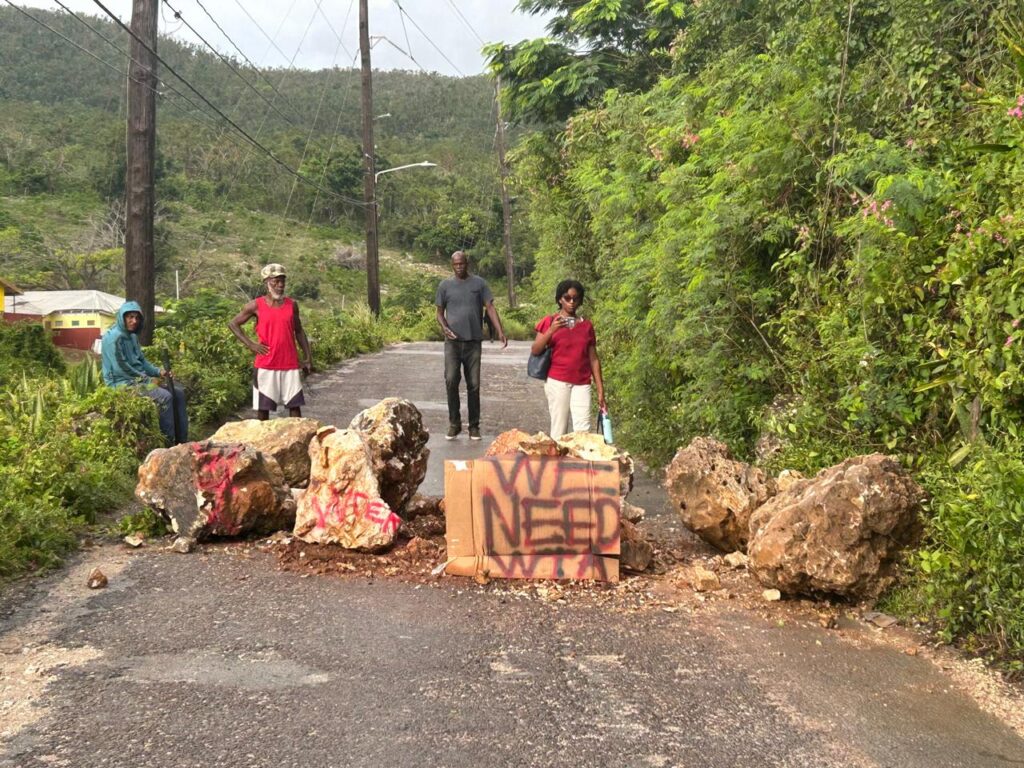
    TRELAWNY, Jamaica — A persistent light rain fell across Trelawny on Monday morning, but it did nothing to dampen the anger of dozens of residents from Salt Marsh, who gathered before dawn to shut down a key regional roadway. Their protest targets a complete outage of piped water from the National Water Commission (NWC) that has persisted since Hurricane Melissa swept through the area.

    Protesters dragged large boulders onto the route and parked an abandoned car across the pavement, completely blocking access for all vehicles. The action has disrupted daily travel for hundreds of commuters, including schoolchildren and daily wage workers, who live in surrounding communities. The blocked road connects several settlements in both Trelawny — including Davis Pen and Johnson Hill — and neighboring St James, where the communities of Goodwill, Chatham, and Adelphi are located. All of these groups depend on the blocked thoroughfare to reach major population and employment centers in Falmouth and Montego Bay.

    According to protesting residents, the water outage extends across a wide swathe of the region, covering households from the vicinity of Salt Marsh Primary School through large portions of the adjacent Davis Pen community. Beyond the inconvenience of having no running water, frustrated community members have added another layer of grievance: even though they have been forced to pay for expensive private water truck deliveries to meet their basic household needs, the NWC continues to send full monthly bills for its unused piped water service.

    Personnel from the Jamaica Constabulary Force have been deployed to the protest site to monitor the situation as of Monday morning, with no immediate reports of a resolution to the dispute between residents and the water utility.

  • Woman bonded for assaulting son’s teacher

    Woman bonded for assaulting son’s teacher

    A 30-year-old self-employed hairdresser from St. Vincent and the Grenadines has been handed a suspended sentence bond for attacking her son’s primary school teacher with a pair of scissors, in a case that highlights the growing tensions between parents and educators over student discipline.

    The sentencing hearing was held Thursday at the Colonarie Magistrate’s Court, which was convened in Georgetown for the session. The defendant, Zonel Joseph, faced two criminal charges: possession of an offensive weapon (a pair of scissors) and assault with intent to wound Alicia Williams, the targeted teacher, during an October 2025 public altercation in the Colonarie community.

    Court documents show that Joseph initially entered a not guilty plea when she first appeared without legal representation. She changed her plea to guilty this week after securing legal counsel from local attorney Nicholas Providence.

    Prosecutor Corlene Samuel, an inspector with the local police service, laid out the background of the conflict to the court: Joseph and Williams were long-time friends who grew up together in the same small Colonarie neighborhood. Their relationship fractured after Williams took on a teaching role that included Joseph’s son in her class.

    The confrontation unfolded around 4 p.m. on the day of the incident, when Williams was visiting a friend’s home and spotted Joseph walking through the area with her son. Samuel told the court that Joseph was openly cursing and shouting about a recent school incident where Williams had disciplined Joseph’s son, calling out “Don’t hit or touch my child again” loud enough for Williams to hear.

    When Williams responded to the comments, the exchange quickly escalated into a heated public argument. As Williams stood against a nearby wall, Joseph approached her, pulled out a small green-handled pair of scissors, and explicitly threatened to stab her before Williams moved away and contacted local law enforcement to file a report.

    In his mitigation argument to the court, Providence explained that Joseph’s initial not guilty plea came only because she lacked access to legal guidance during her first appearance. He acknowledged that the incident had the potential to end in serious harm, but argued the offenses themselves were not premeditated, noting that his client was experiencing significant personal stress at the time of the attack, including a major health crisis just three months prior in July 2025. Providence added that Joseph has expressed genuine remorse for her actions, and asked the magistrate to show “utmost mercy” in sentencing.

    The prosecution did not push for an immediate custodial sentence, but Samuel reminded the court that Joseph had a prior violent conviction: she served a one-year prison sentence in 2020 after being found guilty of stabbing her own children’s uncle in the eye. Samuel recommended that the court impose a bond to keep Joseph accountable, saying “Put her on a bond so she will know that something is hanging over her head.”

    Magistrate Kaywana Jacobs used the hearing to issue a direct warning to Joseph, urging her to address her persistent anger issues. “Don’t act in anger, you have children,” Jacobs told the defendant during sentencing. “Your future can look different if you consider the consequences,” she added, noting Joseph needs clear redirection to avoid future violent outbursts.

    For the assault charge, Jacobs ordered Joseph to enter a 12-month bond set at 1,000 Eastern Caribbean dollars. If Joseph violates the terms of the bond, she will be required to pay the full amount immediately or serve a nine-month prison sentence. On the separate charge of carrying an offensive weapon, Joseph was fined 900 Eastern Caribbean dollars, due to be paid by July 13, 2026, or face three months behind bars.

  • NIA Women’s Self-Empowerment Workshop Promotes Collaboration, Financial Literacy and Community Impact

    NIA Women’s Self-Empowerment Workshop Promotes Collaboration, Financial Literacy and Community Impact

    CHARLESTOWN, Nevis – April 9, 2026 – The Nevis Island Administration (NIA) has advanced its longstanding commitment to uplifting women and girls across the island with the launch of its sixth annual Women’s Self-Empowerment Workshop, an event designed this year to center collective progress, community giving, and tangible professional and financial growth.

    Unlike many empowerment initiatives that focus solely on individual advancement, this year’s workshop framed personal success as a force that grows when shared with others. Through structured interactive sessions, participants were invited to exchange knowledge, offer peer emotional support, and build long-lasting professional networks, all with the dual goal of strengthening local communities and accelerating individual career and personal development.

    Event organizer Hon. Latoya Jones, Special Advisor to the Premier of Nevis, laid out the core mission of the 2026 workshop, emphasizing that the program was built to encourage collaborative leadership, boost participant confidence, and celebrate the often-overlooked contributions of women and girls across every sector of Nevisian society.

    “Our core goals for this sixth annual gathering are simple: to nurture a culture of collaboration and generosity across our local communities, build leadership and team-building skills through hands-on activities, honor the achievements of women and girls in all fields, and help every participant leave with stronger confidence in their own potential,” Jones explained. “We want every woman and girl here to understand that when you lift others up, you elevate yourself along with them. Empowerment isn’t just about individual win – it grows exponentially when we pass it on.”

    Beyond community building, the workshop also prioritized practical economic empowerment, with dedicated sessions covering core financial literacy topics including household budgeting, long-term savings strategies, and foundational investment principles. Organizers also integrated targeted support for emerging and existing women entrepreneurs, creating structured space for cross-business networking and skill sharing.

    Hon. Senator Jahnel Nisbett, Nevis’ Minister of Gender Affairs, opened the event with brief remarks urging attendees to engage fully with both the giving and learning core of the workshop. Echoing the mantra that empowered women lift up entire communities, Nisbett noted that the room was filled with experienced practitioners ready to share expertise across financial literacy, business development, and personal growth.

    “I want every single one of us to take as much as we possibly can from this space,” Nisbett said. “As much as we are here to give our knowledge and support, we are also here to gain new skills and insights that will help us grow. When you leave this workshop, don’t keep what you’ve learned to yourself – multiply your impact by passing it on to someone else, and keep the cycle of empowerment going.”

    The workshop was facilitated by Ramie Wilkinson-Layden, a certified auditor with the NIA, who encouraged attendees to turn the insights they gained into actionable change in their own lives and communities. “Each of us is born with unique talents and skills that we can share with others,” Wilkinson-Layden said. “I urge every participant to give generously of your time, your ideas, your resources, and your support. When you do that, you will see your own gains multiply in ways you can’t yet imagine. My hope is that everyone leaves here with at least one or two concrete steps they can take to improve their financial well-being, strengthen their literacy around money, spend thoughtfully, and build smart, sustainable long-term investments.”

    Since the workshop launched six years ago, it has reached roughly 100 women and girls across Nevis. This year’s iteration drew more than 30 attendees, including 14 young girls, and included formal representation from nine female-owned local businesses spanning a diverse range of sectors: nail care, hospitality, skincare, fitness, gift retail, beauty services, and graphic design, among others.

    Jones highlighted the critical value of having local business owners participate directly in the workshop, noting that their on-the-ground insights gave emerging entrepreneurs and aspiring business owners unfiltered, practical guidance about daily business operations and entrepreneurship that cannot be learned from textbooks.

    Looking ahead, Jones shared her hope that attendees will carry the workshop’s mission forward by paying what they learned forward through mentoring, volunteer work, and mutual encouragement, creating a ripple effect of positive change that lasts long after the event concludes. She also expressed satisfaction with the high level of engagement and active participation across all sessions, and said she is confident that attendees will apply their new skills and knowledge to build lasting personal and financial success for themselves and their communities.

  • Loyalty to a criminal friend versus loyalty to my country’s laws

    Loyalty to a criminal friend versus loyalty to my country’s laws

    Across the small island nation of St. Vincent and the Grenadines (SVG), open talk of violent crime and the people who commit it circulates freely in local communities, shared openly on neighborhood street corners among the right social circles. These offenses are not random acts of impulse; they are carefully planned, coordinated, and even bragged about by perpetrators among their peers. Yet despite this widespread community knowledge, law enforcement agencies continue to face immense barriers to making arrests and reining in the country’s persistent crime problem.

    This gap between public awareness and criminal prosecution has sparked a pressing public debate: Would a greater reliance on undercover policing and structured intelligence gathering finally bring dangerous offenders to justice? Or is this solution far simpler to propose than to implement, given the deep-seated cultural and moral challenges that hold SVG back, chief among them the age-old conflict between personal loyalty to loved ones and civic duty to one’s country?

    For most Vincentians, this dilemma is not an abstract hypothetical—it is a weighty moral question that cuts to the core of personal relationships. Consider the most extreme scenario: a close friend confesses to a murder they committed, and no other authorities know of their guilt. Would you hand them over to law enforcement? If you did, would that make you a disloyal friend? If you stayed silent, would that count as unwavering loyalty worth honoring?

    It is impossible to judge anyone forced into this impossible position, as any choice comes with devastating personal consequences. While on paper, many argue that all murderers must face justice no matter their personal connections, the reality becomes far murkier when the perpetrator is someone you love. What if it was not an acquaintance, but a parent, spouse, sibling, or child who accidentally took a life during a drunken brawl? Could you turn them in, knowing it would end their freedom and destroy your family bond forever?

    For the vast majority of people, the answer to that question is not a simple one. But proponents of civic accountability push back against the framing of silence as loyalty: True friendship demands that you hold the people you care about accountable for their harmful actions. Allowing a friend to walk free after committing murder not only betrays the victim and their family, it also violates the core values that any healthy relationship is built on. A real friend would guide their loved one to do the right thing, not help them hide from the consequences of their actions. Beyond that, staying silent puts the entire community at risk: If a person has killed once, there is no guarantee they will not harm more people in the future. Legally, anyone who chooses to conceal a murderer becomes an accomplice to the original crime and any violence that follows.

    This culture of silence around criminal activity does not only impact murder investigations. Author Troy Prince, a concerned SVG citizen writing in an opinion piece for iWitness News, argues that the same misplaced loyalty is what allows child sexual abuse to remain hidden and persistent across the country. Family members and friends close to abusers often choose to stay silent out of loyalty, allowing abuse to continue for years without intervention.

    Prince argues that this widespread reluctance to report crimes committed by friends and family is a clear sign of deep moral erosion in Vincentian society, and it has severely damaged the country’s justice system. Without community cooperation, even the most well-resourced police forces cannot effectively reduce crime or hold offenders accountable. To rebuild SVG as a nation rooted in moral responsibility, equal justice, and personal accountability, sweeping reform of the country’s justice system is non-negotiable, he says. The key open question remains: Which stakeholders will step up to lead that change?

    In closing, Prince offers advice to every Vincentian grappling with this dilemma: Turning in a loved one who has committed a crime is not “snitching” — it is an act that protects both the broader community and the perpetrator themselves, guiding them to take accountability for their actions rather than carrying the weight of their crime forever. It also shields innocent people from becoming legal accomplices and protects communities from future harm. Fighting the crime that plagues SVG is not solely the responsibility of police or politicians — it is a collective duty that starts with individual self-reflection and a willingness to do the right thing, even when it is hard.

    Disclaimer: The opinions expressed in this piece are solely those of the author, and do not necessarily reflect the official editorial stance of iWitness News.

  • Hospital honours four retiring nurses for decades of service

    Hospital honours four retiring nurses for decades of service

    After dedicating decades of their lives to advancing patient care and strengthening local healthcare services, four long-serving nursing professionals from Sir Lester Bird Medical Centre have closed out their distinguished careers, drawing heartfelt tributes from the institution they served.

    The four retiring team members include two nursing assistants, Loretta Gage and Corrine Scotland, and two experienced registered nurses, Janice Dunbar and Judy St John Edwards. Each brought unique skills, consistent compassion, and unwavering commitment to their roles over their years of service at the facility.

    In an official public statement, hospital leadership extended sincere gratitude to the four retirees, highlighting their far-reaching contributions to the center’s mission of delivering high-quality care to the community. The institution emphasized that the retirees’ consistent dedication to their craft and unwavering adherence to professional standards have shaped the hospital’s culture of care, leaving a profound, lasting impression on both their fellow colleagues and the thousands of patients who relied on their support through vulnerable moments.

    The tribute reflects the wider healthcare sector’s recognition of the critical role that long-serving nursing staff play in building resilient, trusted healthcare systems, and marks the well-deserved transition of four professionals who have given decades of service to public well-being.

  • How New Grant Junction became a rural economic hub

    How New Grant Junction became a rural economic hub

    For any driver traversing the curving stretches of Naparima Mayaro Road, heading east toward Trinidad’s sun-soaked Mayaro beaches or the inactive mud volcano that once engulfed the village of Piparo, the busy New Grant three-way intersection often slips by unnoticed. What many passing commuters fail to recognize, however, is that this quiet crossroads connecting rural communities including Princes Town, Rio Claro and Williamsville has grown over decades into one of the region’s most resilient grassroots economic hubs, home to a thriving cluster of small businesses and the birthplace of a nationally celebrated grocery chain.

    This junction has outlasted seismic shifts in the local economy, including the dissolution of State-owned agricultural conglomerate Caroni 1975 Ltd, which once employed hundreds of multi-generational local workers on its sugar cane, citrus and cocoa estates. It even survived the widespread economic disruption of the COVID-19 pandemic, which forced temporary closures for businesses across the country. Today, nearly 20 businesses remain rooted at the crossroads, with some evolving, some closing, and new ventures launching in just the past five years, continuing to draw loyal customers who have built their lives along this major regional corridor. As one long-time local resident told reporters, “You can get most of the things you need at this junction—not everything, but a lot of things. I think it is worth it to go there; the prices are sometimes better than when you go outside of the area.”

    ### The Historical Roots of a Community Crossroads
    New Grant itself draws its name and origins from the Merikins, liberated African enslaved people who were promised freedom and land grants in exchange for fighting alongside British forces during the American Revolutionary War. What is now known as New Grant Junction was originally called Torrib Trace Junction, and it has hosted small businesses catering to cross-district commuters for as long as locals can recall.

    The earliest permanent commercial operations were run by Chinese traders who set up the area’s first general stores along the main road in the early 1900s. By the 1960s, a public post office and gas station were added to the junction, meeting growing local demand for closer access to essential services. For local residents, the new amenities eliminated the need to travel long distances to the crowded urban centers of Princes Town or Rio Claro, cementing the junction’s role as a convenient community gathering point.

    The turning point for the junction came in 1988, when local entrepreneur Mohan Persad purchased the junction’s original long shop, located on the roadway leading to Rio Claro and Torrib Trace, from previous owner Parsam Nanan. Mohan and his wife Shirley Persad transformed the small store into Persad’s D Food King, the first location of what would grow into a nationwide supermarket chain with a sprawling wholesale and distribution network. Today, that original location still serves hundreds of local customers every week.

    ### A Thriving Cluster of Local Enterprise
    Today, the intersection hosts a diverse mix of businesses that cater to every daily need of local residents and passing commuters. The former Seecharan’s liquor shop has been converted into a hardware store, sitting alongside a gym, poultry outlet, barber shop, cyber cafe, multiple restaurants, and bars. A small religious and variety store has remained a community staple for decades, while street vendors line the roadside, displaying crates of fresh fruit, vegetables, coconuts and other local goods to catch the attention of passing drivers.

    The New Grant post office and long-standing gas station open their doors daily to customers from as far away as Tableland and Reform Village. As locals stop to collect mail or fill their vehicle tanks, they often browse the surrounding shops, picking up fresh produce from street vendors or grabbing a quick meal from one of the junction’s many food vendors. The crossroads has even gained regional fame for its local street food scene, with multiple popular doubles stands drawing customers from across the area.

    “ It is interesting because it is right there; it’s closer than going to Princes Town to San Fernando, and in my opinion, you get more value for some things. In particular, Persad’s grocery always has an offer or a sale, and it is like they consider the people who may not be able to buy in bulk or who need some more economic options, so I like it for that reason,” one resident explained.

    ### Persad’s D Food King: The Heartbeat of the Junction
    No business has shaped New Grant Junction’s growth and identity more than the original Persad’s D Food King location. Local residents say if the junction has a heartbeat, it has been sustained by the supermarket, alongside core community staples like the gas station and hardware store. Today, Persad’s Wholesale operates as an international direct importer, carrying everything from fresh produce, dried fruit, dairy, grains and cooking oils to frozen and processed meats, canned goods, cleaning supplies, personal care products, home goods, electrical fixtures, appliances and seasonal merchandise. Its logistics network reaches more than 30 countries worldwide, but company leaders say the entire business model traces back to this humble New Grant location.

    Ishvani Persad, marketing development executive and granddaughter of founders Mohan and Shirley Persad, explained that the founders started small decades before opening the New Grant location. By the 1970s, Mohan and Shirley were already running a small shop where prices were handwritten on brown paper bags, and sugar and chickpeas were scooped by hand for customers. That community-focused spirit shaped the New Grant location, which quickly grew into more than just a place to shop.

    “Generations have walked those aisles. Stories have been shared at the counters. Trust has been built, day by day, year by year. And that is why New Grant is not just one of our locations. It is the original blueprint of what we know to be Persad’s D Food King,” Ishvani Persad said.

    The founders chose the New Grant location for its strategic position between the east and south of Trinidad, a daily passage point for families commuting to San Fernando for work and school. It was also a deeply personal choice: the Persad family has deep roots in nearby Hindustan, and they understood the needs of the hard-working local community.

    “They knew what it meant to build from nothing, to stretch every dollar, and to rely on trust above all else. At the time, New Grant was a growing community filled with hard-working families who needed access—not just to goods, but to reliability, fairness, and care. There was a gap, and more importantly, there was an opportunity to serve,” she said.

    Built on a foundation of faith and community devotion, the business opened with prayers to Hindu deities Ganesha and Bhandi Mata, and was blessed by the founders’ parents. Today, the company embraces diversity, with a multi-faith staff and ongoing support for cultural and religious events across Trinidad and Tobago.

    As the community continues to grow, Persad’s Group is moving forward with an ambitious new development project called “Legacy Plaza—the Gateway to the south-east,” currently in the planning and permitting phase. Built on the successful model of the company’s Grand Market in Barrackpore, the new development will create a one-stop shopping destination for the entire southeast region. It will combine retail space with an incubation hub for small and medium-sized local entrepreneurs, bringing national brand-name products closer to local residents and eliminating the need for long out-of-region trips for quality goods. The multilevel facility will also address long-standing infrastructure concerns, while honoring the Persad family’s New Grant roots, its founders, employees and generations of loyal customers.

    ### Unresolved Challenges Hold Back Further Growth
    While residents and business owners agree that New Grant Junction’s greatest strength is its convenient, low-key alternative to crowded urban shopping centers, the crossroads still faces significant challenges that limit its growth. The most commonly cited need is a functional on-site ATM: currently, the nearest cash machine is far from the community, and many local businesses only accept cash payments.

    Sharlene, a local resident who requested her last name not be published, said an on-site ATM would cut costs for working people. “There would be no need to spend extra money on taxis/maxis just to access basic banking services. People won’t have to carry large amounts of cash from Princes Town back to New Grant,” she explained.

    Residents have also raised consistent concerns about road safety, traffic congestion and public safety in the area. Many noted that the junction’s pedestrian crosswalk is so faded that drivers no longer notice it, and most pedestrians have stopped using it entirely. Unregulated street vending has created unpleasant odors in the area, and the presence of three nearby bars means there is often no safe pavement for pedestrians to use, due to crowds and unruly behavior from occasionally intoxicated visitors.

    “You have to be constantly on high alert. Where are the traffic wardens and police when you need them?” one local resident lamented.


  • From Sangre Grande to Long Island

    From Sangre Grande to Long Island

    More than three decades after a Trinidadian immigrant was brutally murdered as one of the first victims of Long Island serial killer Rex Heuermann, the long-buried family trauma that shaped her short life has finally come to light, revealing a tragic trajectory of violence, loss and broken dreams.

    Sandra Costilla, born Sandra Rajkumar in the small town of Sangre Grande, Trinidad and Tobago, was one of at least four women confirmed killed by Heuermann, a towering New York architect who targeted vulnerable women working in the sex trade along Long Island’s remote coast. Like many of Heuermann’s other victims, Costilla faced persistent economic instability that pushed her into survival sex work, making her an easy target for the killer who lured women with promises of cash before torturing, strangling and dismembering them, leaving their dismembered remains scattered across Long Island’s marshlands and remote shorelines.

    Costilla immigrated to the United States in 1982 at the age of 17, through a marriage of convenience with a U.S. Army soldier stationed at Schofield Barracks, Hawaii, arranged by her older half-brother Anthony, who had already settled in the U.S. Born to Ramkissoon “Ramki” Rajkumar, a well-known local police officer, and Milly Rattansingh, a skilled seamstress with a reputation for providing underground abortion services in mid-20th century Trinidad, Costilla — called Popo by her family and Sandy by her friends — experienced unthinkable violence from childhood that would shape the rest of her life.

    In June 1975, when Costilla was just 10 years old, her father Ramki arrived at the family’s Foster Road home carrying his service revolver, confronting Milly over allegations of infidelity. What followed that day was witnessed firsthand by Costilla’s 7-year-old younger brother Manny, who still carries vivid, traumatic memories of the massacre that left both his parents dead.

    “The bedroom door opened out into the living room area. I was standing there watching. I pi… myself,” Manny recalled in a 2024 interview, decades after the event. “They had to move me off that spot. I was frozen there. I saw everything. Ramki shot my mother. Sandra ran towards him and grabbed the gun. It went off and a bullet went straight through her right palm. After checking that my mother was dead, he put the gun to the side of his head and pulled the trigger.”

    Left orphaned, Costilla and Manny were bound by shared trauma that would haunt both of their lives for decades. Costilla long grieved the broken family she lost as a child, and after immigrating to the U.S., she struggled to build a stable life of her own, eventually spiraling into economic hardship and addiction that led her to sex work in New York. She was killed by Heuermann in November 1993, her remains dumped on Long Island like discarded meat.

    For Manny, the trauma of losing both parents as a child led to a life of instability, marked by brushes with the law, addiction, and incarceration on three separate occasions in the U.S. After being deported back to Trinidad, he currently awaits trial on a robbery charge in Arima, still consumed by grief and rage over his sister’s murder more than 30 years ago. Though he was never able to protect Costilla from their father’s violence as a child, or from Heuermann’s brutality nearly two decades later, he has never let go of his desire for revenge.

    “Her death destroyed me. It changed everything,” Manny said. “She died from blunt force trauma. I would like to blunt force trauma him! I want to stand over him and…” His words cut off, the pain of his loss still raw after more than 30 years.

  • TTPS targets gang activity

    TTPS targets gang activity

    A recent uptick in violent criminal activity across multiple police jurisdictions in Trinidad and Tobago has pushed the country’s national law enforcement agency to overhaul and reinforce its crime reduction strategies, including ramping up uniformed patrols across high-risk areas, according to senior law enforcement official Suzette Martin. Martin, who serves as Deputy Commissioner of Police for Operations, outlined the updated action plan in an official media statement released Wednesday, noting that the Trinidad and Tobago Police Service (TTPS) has documented a wave of isolated violent incidents across the country over the previous 14 days.

    “In direct response to these developments, we have conducted a full review of our existing crime-fighting frameworks and strengthened our operational protocols, expanding our on-the-ground presence through our ongoing ‘Steady the Guard’ public safety initiative,” Martin stated in the release. “While early operations under this revised plan have delivered measurable progress, we do not underestimate the scale of the challenge ahead – there is still critical work to be done to reverse this recent trend.”

    The TTPS is rolling out a comprehensive, intelligence-led multi-pronged strategy to curb violent crime, with a core focus on addressing the root drivers of illegal activity, most notably organized gang activity. Leveraging targeted anti-gang operations and the expanded legal authority granted under the country’s current state of emergency, law enforcement teams are actively working to disrupt the day-to-day operations of criminal groups and dismantle transnational and local organized crime networks, Martin explained.

    To further improve operational effectiveness, the TTPS has also upgraded the analytical capabilities of its Crime and Problem Analysis Branch. This investment, Martin said, is already enhancing the agency’s ability to map emerging crime patterns, distribute personnel and resources to high-need areas more efficiently, and deploy proactive, preventive interventions that stop violent incidents before they can occur.

    On the ground, operational activities have been ramped up significantly: high-visibility policing has been intensified, with more patrols deployed along major transportation corridors and residential communities, paired with consistent roadblock operations and joint missions that bring together the TTPS’ specialized tactical units. Priority operational targets include intercepting illegal firearms shipments, breaking up gang activities, and disrupting cross-border and local narcotics trafficking operations.

    Martin also emphasized the critical role of inter-agency cooperation in the TTPS’ strategy, highlighting ongoing coordinated work between the police service and other key national security bodies, including the Trinidad and Tobago Defence Force, the national Prison Service, the Immigration Division, and the Customs and Excise Division. “These cross-agency partnerships enable synchronized operations and improved real-time intelligence sharing that makes all of our work more effective,” she noted.

    Beyond collaboration with other government agencies, Martin stressed that ongoing partnership with the general public remains a cornerstone of the TTPS’ long-term crime reduction goals. “We recognize that effective public safety cannot be delivered by law enforcement alone – it requires active buy-in and cooperation from the communities we serve. To that end, we have expanded our community-led intervention programs,” she said. “These initiatives are instrumental in lowering the risk of retaliatory gang violence and building lasting cooperative relationships between police and local residents.”

    The TTPS also places strong emphasis on strategic communication as a tool to shape positive public behavior, build long-term trust between law enforcement and communities, and drive sustainable social change, Martin added. “We are clear that no single strategy on its own can solve this national challenge. Enforcement action without public trust will never deliver meaningful, long-term results, and community engagement without robust enforcement fails to create the deterrence needed to stop criminal activity. This balanced approach is the foundation of our operational philosophy,” she explained.

    Closing out the statement, Martin reaffirmed the TTPS’ unwavering commitment to public safety on behalf of the national community. “As Deputy Commissioner of Police (Operations), I give this assurance to the people of Trinidad and Tobago: the TTPS remains steadfast in our mission to protect and serve our nation with pride,” she said. “We will continue to leverage modern, data-driven policing strategies, strengthened cross-sector partnerships, and community collaboration to drive down violent crime and make every community across our country safer.” She reiterated that the TTPS’ multi-layered, intelligence-centered approach is designed to tackle both the immediate incidence of crime and its deep-rooted underlying causes.