分类: society

  • Hospital Condemns Unauthorised Recording of Patient

    Hospital Condemns Unauthorised Recording of Patient

    Officials from Belize’s largest public healthcare facility, the Karl Heusner Memorial Hospital Authority (KHMHA) based in Belize City, have issued a formal public call for the immediate takedown of an unauthorized patient video circulating widely across social media platforms. The recording, which captures an unidentified patient admitted after a violent assault, has drawn sharp criticism from hospital leadership for flagrant violations of the individual’s fundamental rights to privacy and personal dignity.

    In an official statement released to the public on June 29, 2026, KHMHA leaders outlined deep concern over the unregulated spread of the footage, which was captured without the patient’s consent either by an unauthorized visitor or a member of the public before being shared online. The patient is currently receiving ongoing care at the facility for injuries sustained in the violent attack that led to their hospitalization.

    The KHMHA statement emphasized a core principle of patient-centered care: every individual receiving treatment within the hospital’s wards is more than just a medical case. “Behind every bed in our wards is a person, someone’s mother, father, child, or friend, going through one of the most vulnerable moments of their life,” the statement read. “They deserve compassion, and above all, they deserve privacy.”

    Hospital management is urging all social media platforms users who have shared or reposted the video to remove it immediately, framing the request as a necessary action to uphold the patient’s basic human rights. Officials stressed that the requirement for patient privacy is not merely an internal institutional rule—it is a foundational expectation of basic human decency. “This is not just hospital policy; it is a matter of basic human respect,” the statement concluded.

  • Kiwanis Nature Island Club welcomes 13 new members, installs 2025/2026 executive

    Kiwanis Nature Island Club welcomes 13 new members, installs 2025/2026 executive

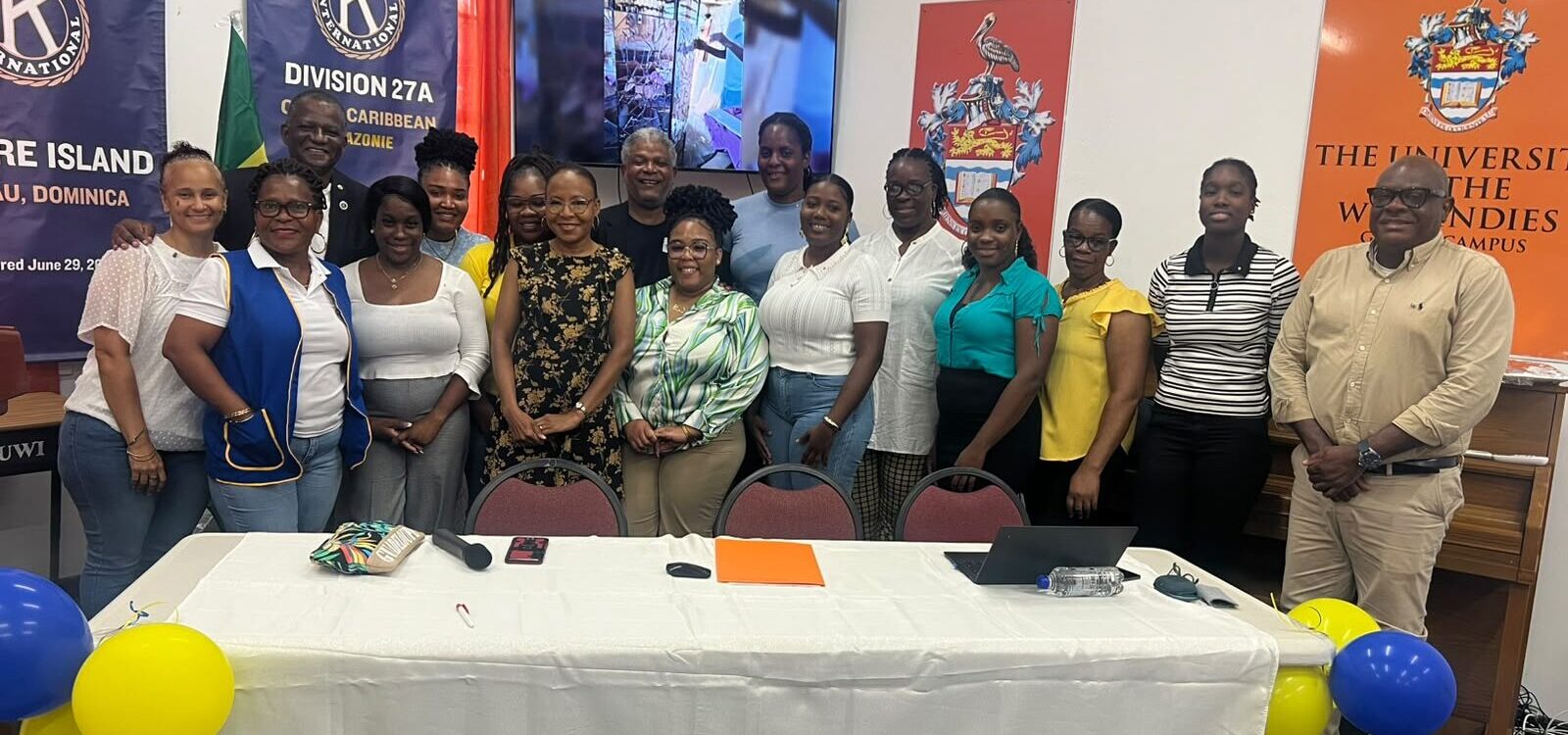
    On Saturday, June 27, 2026, the Kiwanis Nature Island Club of Dominica marked a key milestone in its community service mission, holding an official induction and installation ceremony at the UWI Global Campus Auditorium to welcome 13 new members and swear in its 2025/2026 executive leadership team. The event, which capped a period of steady growth for the local service organization, was officiated by a delegation of senior Kiwanis leaders traveling from neighboring Martinique, including current Lieutenant Governor Jean Michel Pajaniady, 2026-2027 incoming Lieutenant Governor Thierry Jean-Bart, and Distinguished Lieutenant Governor Didier Saint-Louis.

    Mary Winston, who was first elected to the top post of the club on September 30, 2025, was formally installed as president for the 2025/2026 administrative year during the ceremony. In her opening address to gathered members, guests, and organizational partners, Winston opened by expressing sincere gratitude to all stakeholders in attendance, thanking sponsors, affiliated partners, fellow Kiwanians, and community supporters for their ongoing backing, and noting that she deeply valued the confidence the club’s membership had placed in her to lead the organization through the coming year.

    Winston went on to reaffirm the core mission of Kiwanis International, a global volunteer service network bound by the official motto “serving the children of the world.” The organization’s central purpose, she emphasized, is to drive tangible improvements in the lives of children and local communities worldwide, a mission the Dominica chapter has worked tirelessly to advance.

    Looking back on the work of the current tenure to date, Winston highlighted a slate of impactful community projects the club has already delivered. These included a holiday Christmas celebration for students at Goodwill Primary School held in late December 2025, the distribution of essential food hampers to vulnerable individuals and low-income families across the island, a financial contribution to the youth-focused Operation Youth Quake program, targeted support for a household in crisis in the Stock Farm neighborhood, and an in-kind donation of a mirror to contestants in the upcoming 2026 Miss Teen Dominica pageant. Each of these initiatives, Winston noted, reflects the club’s unwavering commitment to centering youth development and responsive community service in all its work.

    “Since assuming this role, I have witnessed firsthand the dedication, generosity, and commitment that defines our Kiwanis family,” Winston told attendees. “These initiatives are only possible because of the generosity and dedication of our members and supporters.” Looking ahead to the remainder of the term, she encouraged all existing members to keep their membership dues current, and challenged the broader club network to continue proactive recruitment of new members to expand the organization’s reach and service capacity across Dominica.

    Beyond the presidential installation, the ceremony formally swore in the full 2025/2026 executive board: Nicole Karama will serve as vice president, newly inducted member Daniah Labadie takes on the role of secretary, and Lisa Francis will act as club treasurer. The full roster of 13 new inductees joining the club this term includes Daniah Labadie, Sherika Winston, Shernel St. Rose, Laila Langford, Mitchel Jean Jacques, Erickson Romain, Kernilia Adams, Nea Liverpool, Lisa Francis, Alicia Griffith, Tamara Etienne, Twanny Govindin and Melisha Blanchard.

    In a closing statement shared via a post-ceremony press release, the Kiwanis Nature Island Club extended its gratitude to all members, community partners, and private supporters who have sustained its work over the past year. The organization reaffirmed its longstanding commitment to strengthening communities across Dominica through the core values of volunteerism, fellowship, and public service, noting that expanded membership will allow the club to take on more impactful projects for island residents in the months ahead.

  • The UWI warns public about fake website using university’s name

    The UWI warns public about fake website using university’s name

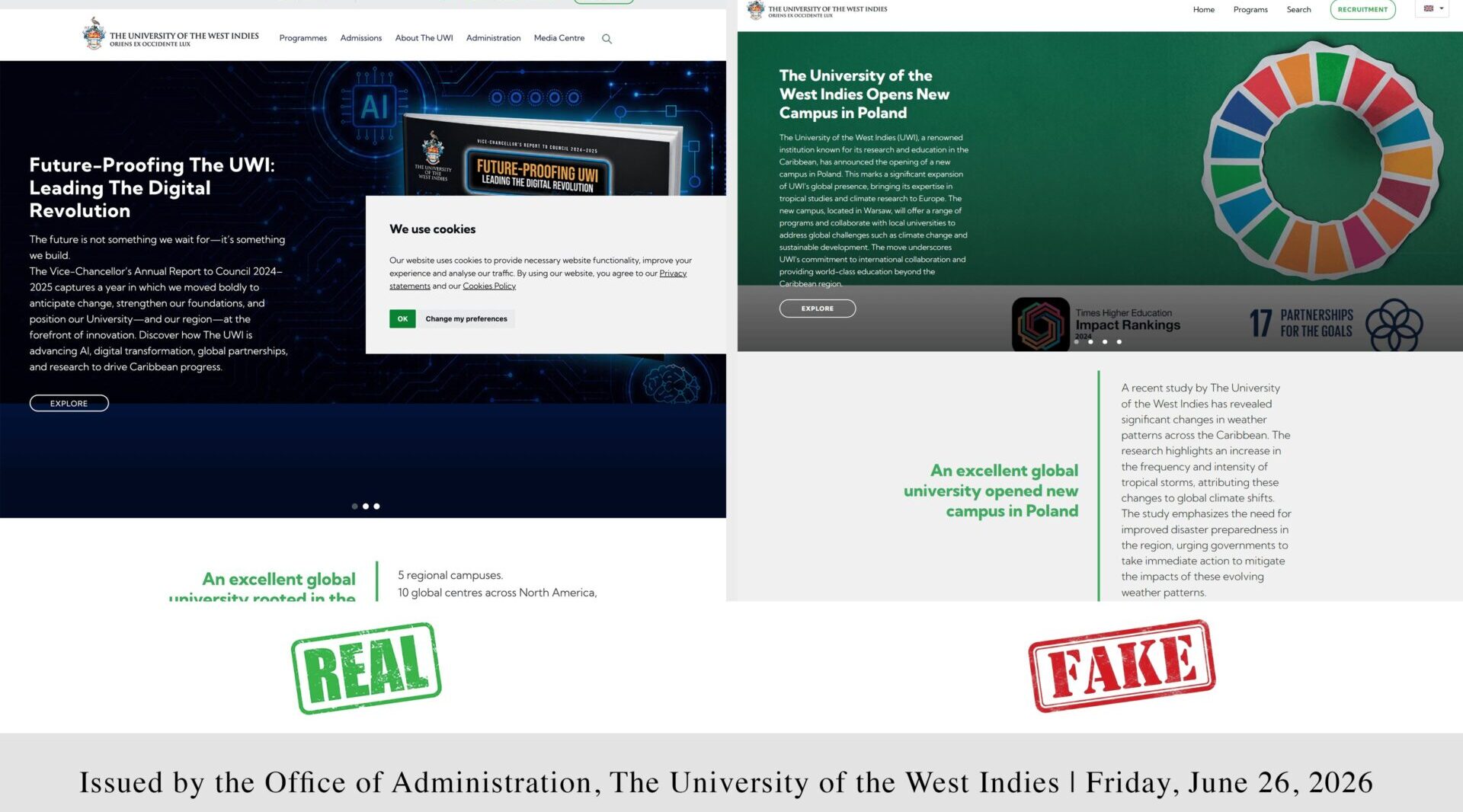
    The University of the West Indies (UWI), a leading regional higher education institution spanning multiple Caribbean nations, has issued an urgent public warning to prospective students, institutional partners and community members after uncovering a sophisticated fraudulent website that impersonates the university.

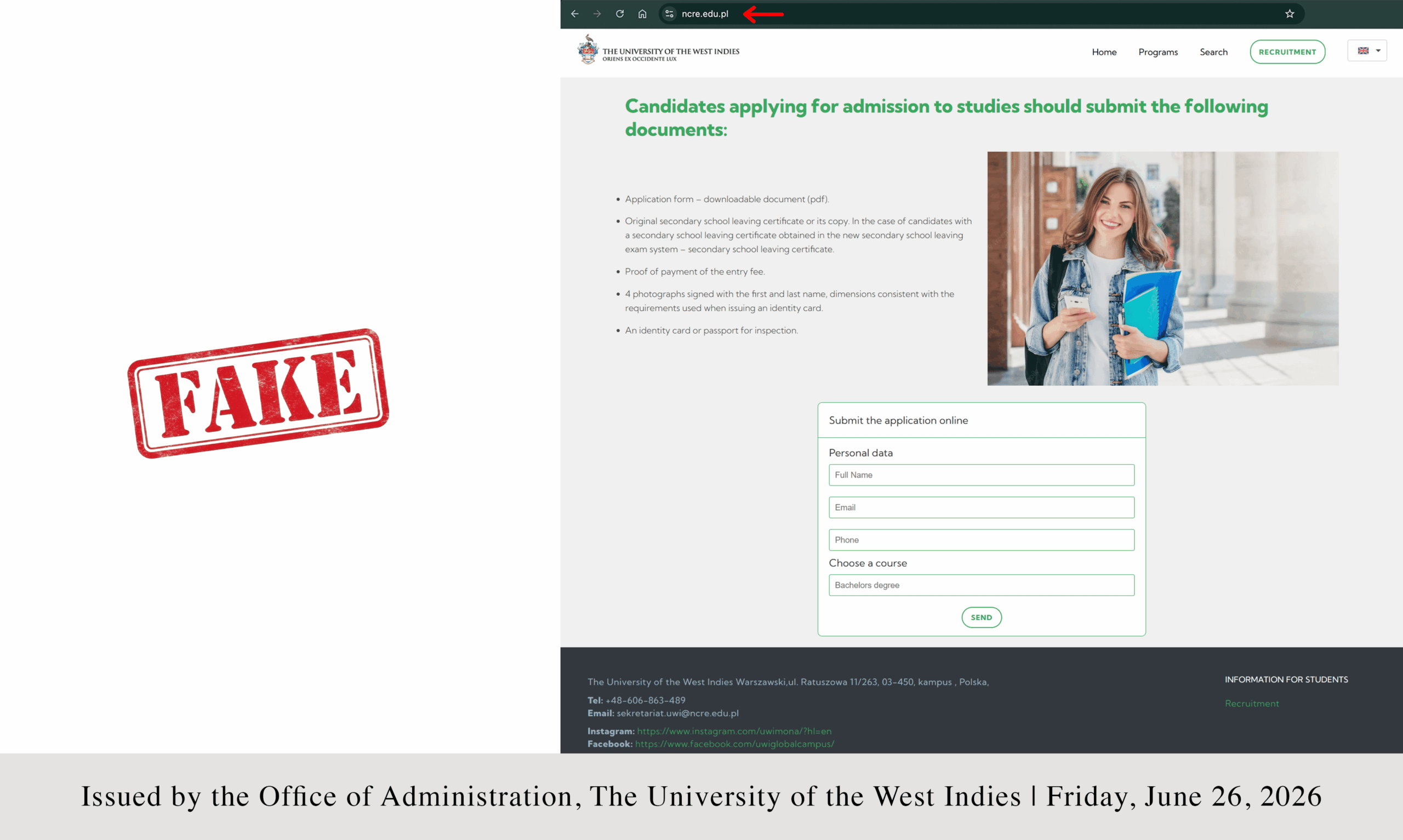
    In an official press release published by the institution, UWI officials confirmed that the unauthorized platform has been misappropriating the university’s official name, branding and visual identity without permission to deceive users into believing it is an official UWI digital resource. The institution emphasized that the fake site holds no endorsement, authorization, or affiliation with the legitimate university in any capacity.

    A key point of concern raised by UWI is the fake website’s inclusion of an interactive form that collects sensitive personal data from unsuspecting visitors. The university clarified that it does not receive any of the information submitted through this fraudulent platform, including full names, email contact details, telephone numbers and other personally identifiable information.

    As a proactive protective measure, UWI is advising any individual who has already interacted with the fake site to exercise extreme vigilance against any unsolicited follow-up communications, including emails, phone calls or messages that falsely claim to originate from the university. The institution has urged the public not to share additional personal or financial information in response to unvetted requests, and to confirm the authenticity of all purported UWI communications through the university’s verified official channels.

    According to the press release, all legitimate information about UWI’s academic programs, admissions processes and institutional partnership opportunities is exclusively hosted on the university’s verified official websites: these include dedicated platforms for the Mona Campus in Jamaica, the St. Augustine Campus in Trinidad and Tobago, the Cave Hill Campus in Barbados, the Five Islands Campus in Antigua and Barbuda, the UWI Global Campus, and the institution’s Regional Headquarters website.

    UWI has already activated a coordinated, multi-pronged response to resolve the incident and mitigate harm. Steps taken so far include reporting the fraudulent activity to international cybercrime watchdogs and relevant law enforcement agencies, pursuing both legal and technical avenues to have the fake website permanently taken offline, and collaborating with digital and industry partners to limit potential damage to users and the institution’s reputation.

    Members of the public who have visited the fraudulent site or hold information that could support the investigation into the scam are invited to contact UWI’s official response team at [email protected]. The institution reaffirmed its ongoing commitment to safeguarding its students, partners and institutional standing, and stated it will continue implementing all necessary measures to fully address this cyber fraud incident.

  • Wijngaarde: Excuses moeten leiden tot kennis en bewustwording

    Wijngaarde: Excuses moeten leiden tot kennis en bewustwording

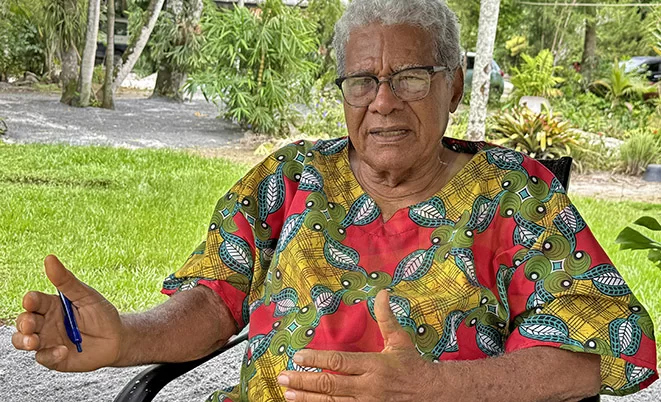
    As the Feydrasi fu Afrikan Srananman (Federation of Afro-Surinamese People) marks its 30th anniversary, its founding president Iwan Wijngaarde reflects on three decades of advocacy for addressing the intergenerational harms of the transatlantic slave trade, arguing that official apologies for historical slavery are a critical starting point — but never an endpoint.

    The federation was founded in 1996, when a coalition of Afro-Surinamese community groups and individual activists came together out of shared deep concern: for generations, the Afro-Surinamese community had faced systemic social, economic, and political marginalization that traced directly back to the legacy of slavery. Organizing a cohesive leadership structure proved challenging in the early days, with no volunteers stepping forward to lead the new coalition before an elder member nominated Wijngaarde to take on the role.

    The early years were defined by grassroots pioneering. To keep the organization financially stable, members ran fundraising events and sold homemade food to cover operating costs. Over time, the federation grew into Suriname’s leading organizer of public commemoration events, educational lectures, and cultural programming centered on Afro-Surinamese identity, historical awareness, and equity, rather than solely focusing on past trauma.

    One of the federation’s earliest milestones was hosting prominent American activist Louis Farrakhan just months after its founding. It also established enduring annual community traditions, most notably Blakaman Dey, later renamed Black Civilization Day, held every first Sunday of January. The holiday is designed to let the community start each new year by centering their own cultural heritage, carrying that identity and traditions forward through the rest of the year.

    Wijngaarde has been clear that apologies from institutions and governments for slavery must be paired with sustained action, not treated as a solution in themselves. He emphasizes that apologies must include clear explanation of why they are necessary, and points to the harmful framing of emancipation in 1863, when formerly enslaved people were pressured to thank their former enslavers and colonial authorities during post-emancipation thanksgiving services. He also notes that abolition was only achieved through widespread resistance by enslaved people, a history that has often been erased from mainstream narratives.

    Wijngaarde argues that religious institutions, particularly the Christian church, have a unique responsibility to participate in the healing process. The church played an active role in erasing Afro-Surinamese cultural identity during the colonial and slavery eras, he says, and now must contribute to the rehumanization of the Afro-Surinamese community by acknowledging this historical role.

    Over 30 years, the federation has expanded its programming to honor the full spectrum of Afro-Surinamese and Black resistance history. It leads annual commemorations of freedom fighters Kodjo, Mentor, and Present; honors 18th-century Maroon warrior Boni on Boni Dey; and holds public remembrances of the 1757 Tempati Uprising, the 1791 Haitian Revolution, and M’ma Seri, an enslaved woman tortured and killed by her enslaver in 1743. Every December, it organizes the national Switiwatra ritual cleansing herbal bath, a traditional practice adapted from small-scale plantation and family ceremonies that has grown into a major public event since the federation took over its organization in 2014. The federation also hosts an annual remembrance for the approximately 700 African people who died in the 1738 sinking of the slave ship Leusden.

    Wijngaarde acknowledges the federation has faced significant challenges across its three decades. It has faced opposition from hostile groups, struggled to retain long-term volunteer engagement, and navigated internal tensions driven by clashing egos, differing strategic visions, and power imbalances. These challenges, he says, are themselves a legacy of the colonial system of division and dehumanization that the federation works against. To counter that, the organization centers a collective “we philosophy” rather than individualism, a core principle that has kept it moving forward.

    This 30th anniversary year marks a new milestone for the federation: for the first time, it will co-host July 1 emancipation commemorations alongside Indigenous Surinamese organizations, following months of collaborative planning. Wijngaarde says the partnership is designed to build collective power, and the next phase of the federation’s work will focus on collaborative development beyond remembrance — leveraging the spiritual and economic strengths of both marginalized communities, and seeking international partnerships when local knowledge and resources are insufficient.

    Wijngaarde welcomes the 2023 formal apology for Dutch slavery issued by King Willem-Alexander, calling it an important foundational step for future work. However, he criticizes the king’s 2025 visit to Suriname for falling short on substantive engagement, arguing that the wreath-laying ceremony at the Mama Sranan national slavery monument remained overly symbolic with little concrete discussion of ongoing harms. He notes that the Kwakoe statue remains the only small-scale public monument to slavery in Suriname, highlighting how much work remains to embed this history in public consciousness.

    Looking back on 30 years of organizing, Wijngaarde identifies three core values that have sustained the federation through challenges including the COVID-19 pandemic, when the organization refused to pause its programming: patience, love, and mutual respect. Healing the intergenerational harm of dehumanization cannot happen overnight, he explains, so sustained patience is essential. The work also requires mutual love within the community, and respect for one’s culture and all community members.

    On July 1, the federation will celebrate its 30th anniversary with a full schedule of public events, including a historical exhibition, cultural performances, the launch of a commemorative book, a public community reception, and the annual wreath-laying at the Kwakoe statue.

  • The UWI Issues Warning Regarding Fraudulent Website

    The UWI Issues Warning Regarding Fraudulent Website

    In a recent official advisory, the University of the West Indies (UWI) has sounded the alarm over a malicious, unauthorised website that impersonates the prestigious regional higher education institution, targeting vulnerable prospective students and members of the public seeking enrollment information.

    University representatives confirmed that the fraudulent platform mimics UWI’s official branding, layout, and program descriptions to trick visitors into sharing sensitive personal data including national identification information, bank details and contact information. In many cases, scammers behind the fake site have demanded non-refundable upfront payments under the false pretense of processing admission applications or reserving spots in popular academic programs. Victims who pay these fees never receive legitimate admission offers, and their personal information is often exploited for further identity theft or financial fraud.

    UWI’s administration has stressed that the university only conducts official enrollment and payment processing through its verified, centralised official website and authorised partner channels. The institution has urged anyone who has interacted with the fake platform to immediately monitor their financial accounts for unauthorised activity, report any suspicious transactions to their local banks, and file a formal complaint with local law enforcement and cybercrime units. UWI also noted that it is working closely with cyberspace regulatory authorities to take down the fraudulent website and track down the individuals responsible for the scam, reminding the public to double-check the URL and authentication of any website claiming to be affiliated with the university before sharing personal or financial information.

  • Joseph ‘Joe Black’ Anatole dies following apparent drowning in Concord on weekend

    Joseph ‘Joe Black’ Anatole dies following apparent drowning in Concord on weekend

    A 61-year-old resident of Concord, Dominica, has passed away following an apparent drowning incident that unfolded over the weekend, local law enforcement has officially confirmed.

    Identified as Joseph Anatole, who was widely known by the nickname “Joe Black” and originally from Castle Bruce, the victim had been living in Concord at the time of the incident.

    In an official statement from the police force, Acting Superintendent Fixton Henderson, the Public Relations Officer for the Commonwealth of Dominica Police Force (CDPF), outlined the timeline of the response. Officers assigned to the Marigot Police Station were dispatched to the scene just after 5:00 PM local time on Saturday, June 27, 2026, after receiving an emergency report that Anatole had been found unresponsive in the river running behind his home.

    First responders immediately transported the unresponsive man to the nearby Marigot Hospital, where a attending physician officially pronounced him dead later the same evening.

    To fully clarify the sequence of events that led to Anatole’s death, the CDPF has opened a formal investigation into the incident.

    Following the incident, Anatole’s remains have been transferred to a local funeral home, where they will be held until a post-mortem autopsy can be conducted to confirm the exact cause of death.

    The CDPF has extended its heartfelt sympathies to Anatole’s family, close friends, and all loved ones as they navigate this devastating loss.

  • Cross-border Inheritance and compliance considerations

    Cross-border Inheritance and compliance considerations

    For centuries, Caribbean migration has reshaped global communities, with millions of Caribbean-born people building new lives across North America, Europe, and beyond while retaining deep cultural and property ties to their home islands. What once operated as an informal, trust-based arrangement for cross-border family assets, however, has grown increasingly complex in the modern era of regulatory compliance, according to Kevon K K Charles, a Grenada-based attorney with dual admission to practice in Grenada and Trinidad and Tobago.

    Charles, who specializes in estate law, notes that many of the most complicated estate cases he handles start with a deceptively simple line: All of the estate’s beneficiaries live outside of the country where the assets are held. This pattern is nothing new: generations of Caribbean families have seen children leave the islands for opportunities abroad, settling in New York, Toronto, London, Trinidad, and other destinations, while family property and assets remain in the home jurisdiction, such as Grenada. But when a family member passes away, what was once uncomplicated shared family property becomes an inheritance matter spanning multiple legal systems, regulatory regimes, and financial institutions.

    “One of the Caribbean’s greatest exports has always been its people,” Charles explains. Today, it is extremely common for an estate to hold property in one Caribbean jurisdiction, have beneficiaries residing in a second country, and manage assets through financial institutions based in a third. Unlike decades past, modern estate administration does not stop at a country’s border; legal teams must navigate conflicting local laws, differing banking requirements, and layered global compliance standards all within a single inheritance case.

    Locating dispersed beneficiaries is rarely the hardest part of the process, Charles stresses. The biggest challenge comes from meeting the strict verification requirements set by financial institutions and legal bodies that control access to the deceased’s assets. Banks routinely demand certified government-issued identification, proof of permanent address, detailed tax information, and additional anti-fraud verification before releasing any funds to foreign-based beneficiaries. Attorneys working on the case often must obtain apostilled authenticated documents or formal grants of representation recognized in multiple countries. Even transferring real estate requires compliance with property laws in all involved jurisdictions, turning what should be a private family matter into a formal international transaction.

    Charles says one of the most frequent questions he receives from families is equally straightforward: If my brother lives in Canada, why can’t we just transfer his share of the inheritance directly to him? Legally, the transfer may be permitted, but practically, large cross-border transfers trigger automatic additional scrutiny from global financial institutions, especially when the recipient has no prior relationship with the sending bank or the purpose of the transfer is not immediately clear. This does not mean the transfer is blocked entirely, Charles clarifies, but it does mean families must follow a lengthy, multi-step process to complete the transaction.

    A major shift from past generations is the new centrality of formal documentation. While mid-20th century Caribbean estate matters relied heavily on interpersonal trust within families, modern inheritance requires extensive paperwork to move forward. Death certificates, formal grants of representation, government-issued identification, proof of address, source of funds verifications, and tax declarations – documents that were once considered secondary are now core to processing an estate efficiently.

    From his daily practice handling multi-jurisdictional estates, Charles has observed that inheritance law still formally defines who is entitled to receive a deceased’s assets. But modern global compliance frameworks ultimately dictate when and how those beneficiaries will actually gain access to their lawful inheritance. As he notes, the pattern of Caribbean migration created this new landscape: the grandparents of current families left the Caribbean seeking opportunity abroad, built wealth in their new host countries, and retained property and roots back in their home islands. Today, the estates they leave behind span oceans, not just islands, with beneficiaries scattered across multiple countries and assets split between jurisdictions to match.

    This analysis forms part of a ongoing series examining the shifting relationship between wealth, property ownership, and regulatory compliance across the Caribbean. NOW Grenada notes it is not responsible for the opinions or content shared by contributing writers, and invites readers to report any abusive content through official platform channels.

  • LETTER: Sick Leave Does Not Mean a Lack of Integrity

    LETTER: Sick Leave Does Not Mean a Lack of Integrity

    In an anonymous letter addressed to the editor, a growing crisis in modern professional environments has been brought to light: the alarming erosion of empathy for employees taking sick leave. Far too often, workers on medical leave face unfair, snap judgments from colleagues and peers who know nothing about the specific realities of their health conditions or recovery journeys.

    One of the most common misconceptions that fuels this unfair judgment is the belief that any employee on sick leave must be confined to bed or trapped within their four walls around the clock. The reality of healing looks vastly different from person to person. While some acute illnesses and invasive medical procedures demand strict, extended bed rest, many other health scenarios allow – and even recommend – light activity as part of the recovery process. This can include gentle short walks to boost circulation, routine trips to pick up essential groceries, scheduled visits to healthcare providers, or simply spending time in fresh air to improve mental and physical wellbeing. Crucially, not all illnesses are visible to the outside eye, and no two recovery timelines or paths follow the same rigid template.

    It is undeniable that a small subset of employees do abuse workplace sick leave policies, claiming illness to take time off while pursuing activities that clearly have nothing to do with healing. But the letter argues that it is a deep injustice to paint every worker on medical leave with the same broad brush because of the poor choices of a few. These widespread, negative assumptions do more than make individual workers feel bad – they erode trust across entire teams and lay the groundwork for a toxic, hostile workplace culture that harms everyone.

    The author also reflects on a shifting norm in workplace relationships: where once colleagues would routinely reach out for a quick check-in, pass along well wishes, or offer support to a teammate on sick leave, those small, meaningful acts of kindness have become increasingly rare. Today, empathy in many workplaces has become a selective commodity, often extended only to popular, well-connected workers, while others are left without support or open to harsh judgment. All too often, a worker’s treatment during sick leave comes down to personal popularity rather than shared human respect: if a colleague is not personally liked, their health struggles are dismissed or ignored entirely.

    The letter makes a clear, pressing argument: respect and empathy should be extended equally to every employee, no matter the nature of personal relationships or the tangled dynamics of workplace politics. No outsider can ever fully understand what another person is navigating physically, mentally, or emotionally, even when they work side by side. As a community, the author argues we must work collectively to rebuild workplaces where people feel supported rather than scrutinized during their most vulnerable moments. A workplace rooted in a culture of genuine empathy does not only improve individual employee wellbeing – it also makes entire organizations stronger, by building a foundation of mutual respect that binds teams and businesses together for long-term success.

  • This Day in History: 29 June 1830

    This Day in History: 29 June 1830

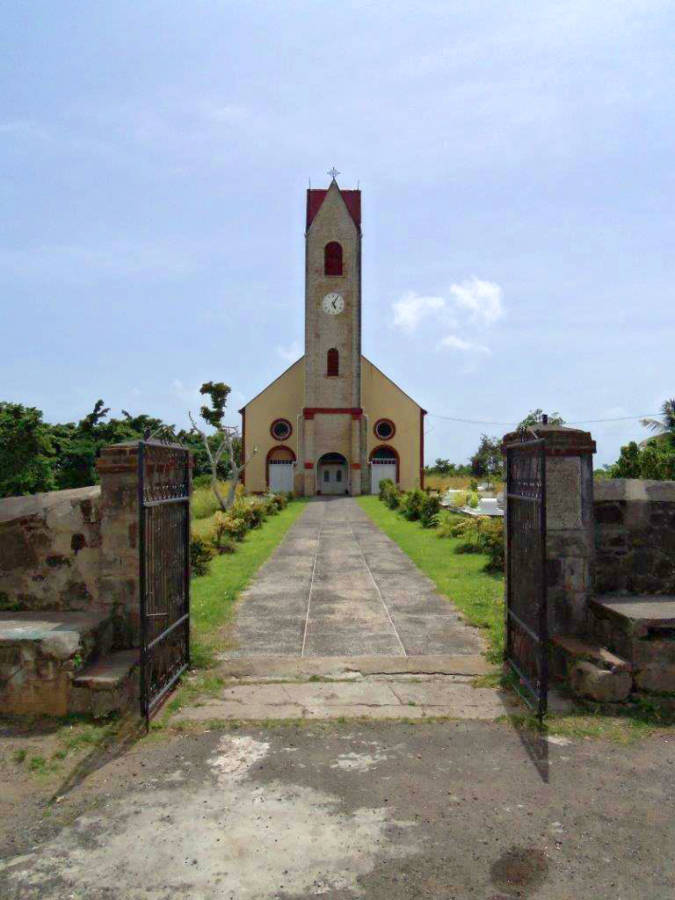
    On June 29, 1830, a landmark moment in Grenada’s religious and architectural history unfolded when the foundation stone of St. Patrick’s Anglican Church was laid. This structure was one of four major religious buildings initiated that same year across the island, joining Anglican churches in the parishes of St. Andrew and St. David, plus the Presbyterian Kirk in the capital of St. George’s. The British Crown covered construction costs for all three Anglican churches through a dedicated grant, provided to support the expansion of established Protestant churches across its Caribbean colonial holdings.

    Long before the current church’s construction, this stretch of coastal land on Grenada’s northern coast held layers of layered human history. In 1650, following a violent French military campaign against the Indigenous Kalinago people at Leapers’ Hill, French colonists built Fort d’Esnambuc, a coastal battery and palisade fortification, on this very hilltop. Around 1718, French settlers built the Notre Dame du Bon Secours Catholic Church in the same general area, where the ruins of a later police station now stand. When British forces took control of Grenada, Protestant officials appropriated the Catholic house of worship to repurpose it for Anglican services. However, this early structure was completely destroyed during the widespread Fedon’s Rebellion that raged across the island between 1795 and 1796.

    Historical analysis of 1763 cartographic records from Pinel’s map of Grenada has led local heritage researchers to a striking conclusion: this hilltop is far more likely the actual historical site of Leapers’ Hill than the more widely celebrated site marked behind the modern Catholic church located on the opposite adjacent hill. The 1763 map confirms the location of the original coastal battery overlooking the St. Patrick’s River, matching the geographical footprint of the church’s current site.

    Construction of the current chapel moved forward from its 1830 founding, and just over 12 months later, on July 21, 1831, Bishop Coleridge of Barbados and the Windward Islands formally consecrated the new building. As the first and oldest Anglican church ever built in St. Patrick Parish, it stands as a striking example of Caribbean Georgian architecture, tucked into the slopes of a scenic hill that offers sweeping panoramic views of the Caribbean Sea. Its signature design features include a tall central tower capped with pointed quadripartite vaults, reinforced by stacked superimposed buttresses. The main facade hosts three entry doors, with semi-oval fanlight windows positioned above the two smaller side doors. A sprawling historic cemetery surrounds the main sanctuary, where weathered headstones date back more than 150 years, chronicling generations of local residents.

    Parish record-keeping for the church stretches back to 1807, decades before the current building was completed. Early records were grouped under combined parish administrations: first with St. Andrew, St. Patrick and St. David from 1807 to 1825, then with just St. Patrick and St. David after 1825, before the parish gained its own independent administrative record-keeping. In the wake of catastrophic Hurricane Ivan that struck Grenada in 2004, the church underwent a careful, historically faithful restoration that preserved its original architectural character. Today, a dozen commemorative memorial plaques line the church’s interior walls, honoring prominent local figures including John Anthony McSween, George Augustus Gentle and George Paterson.

    Historical archive photos from around 1992 show the church’s cemetery overgrown with Antigonon leptopus, the invasive climbing vine commonly known as bee vine or Mexican creeper, a common sight across Grenada’s uncultivated green spaces.

  • Woman Pleads Not Guilty in Fatal Crash That Killed Keane Gregoire

    Woman Pleads Not Guilty in Fatal Crash That Killed Keane Gregoire

    Nearly two and a half years after a devastating car collision claimed the life of an 18-year-old local teen, the case is moving toward a public trial after the accused driver entered a formal plea of not guilty to a dangerous driving causing death charge.

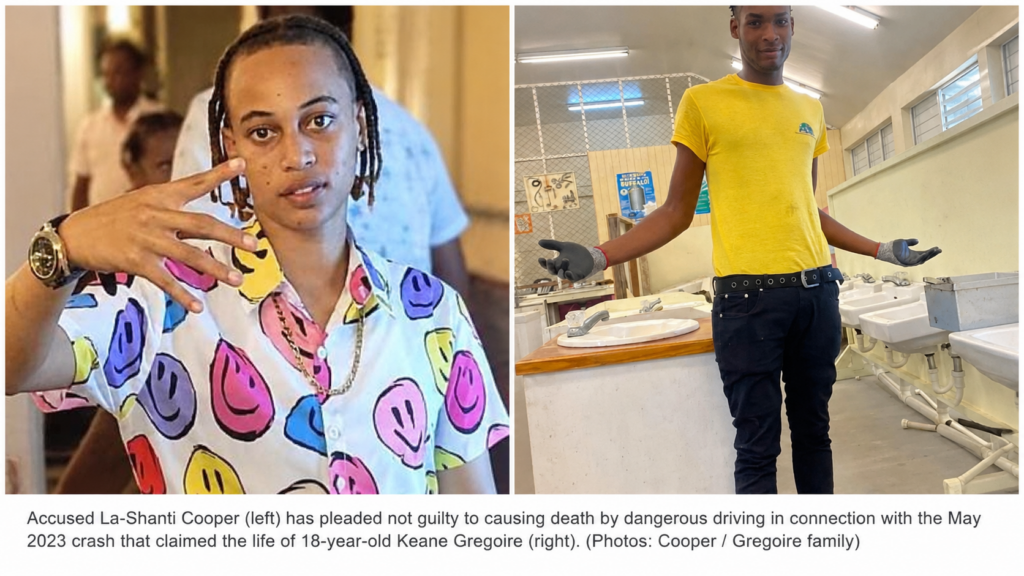
    La-Shanti Cooper, who was 19 years old at the time of the 2023 crash, appeared in court recently to formally respond to the charge against her, entering a not guilty plea that paves the way for a full judicial examination of the incident. Court officials have scheduled a case management hearing for September 25, where legal representatives from both sides will address procedural matters and a final trial date is projected to be officially confirmed.

    The fatal collision unfolded on All Saints Road, close to the John I. Martin Race Track, on May 18, 2023. Keane Gregoire, the 18-year-old victim, was riding as a passenger in the vehicle driven by Cooper when the crash occurred. Gregoire was rushed to a local hospital with severe, life-threatening trauma after the incident, and he succumbed to his multiple injuries on May 19, 2023, just one day after the wreck.

    Law enforcement’s official account of the collision alleges that Cooper was operating a Toyota BB at excessive speed when she lost control of the vehicle. Per investigative reports, the car veered off the paved roadway, collided with a structural column, and eventually crossed over into the lanes of oncoming traffic on the opposite side of the road.

    Investigators have also noted that in the immediate aftermath of the crash, Cooper reportedly mislead responding officers, claiming she was not the driver of the vehicle and that the person operating the car had fled the scene shortly after the collision. After completing a full, systematic investigation into the crash details and evidence, law enforcement officials moved forward with formal charges of dangerous driving resulting in death against Cooper.

    Now, with Cooper maintaining her outright innocence in the case, the judicial process will proceed to a full trial once all pre-trial procedural steps are completed and a hearing date is finalized.