
分类: society

  • Advocate slams Govt’s delay explanation

    Advocate slams Govt’s delay explanation

    Migration and human rights activists in Trinidad and Tobago are pushing back against the government’s official justification for widespread delays in processing migration and residency applications, arguing that the policy punishes law-abiding migrants who have followed all regulatory requirements to gain legal status. The criticism comes in direct response to recent remarks from Minister of Homeland Security Roger Alexander, who blamed the backlog on undocumented migrants crossing the country’s porous borders to sneak into the ongoing registration exercise, falsely claiming long-term residency in the nation.

    Speaking via telephone with the Express on Thursday, leading migrant rights advocate Sofia Figueroa-Leon rejected Alexander’s explanation as logically inconsistent and fundamentally unfair. She emphasized that there is no connection between the alleged illegal entry of new arrivals and the thousands of migrants who already completed all pre-requisite steps for registration, including submitting online applications and attending mandatory in-person appointments.

    Figueroa-Leon argued that if the government is facing operational challenges in securing its borders or managing the registration process, those issues should be addressed directly rather than shifting the burden onto compliant applicants. “If they lack sufficient staffing or the capacity to manage the process, that is an administrative failure on the government’s part, not a problem that migrants should have to bear,” she noted. “Migrants came forward voluntarily to complete the registration process because they want to live legally in this country. They fulfilled their end of the agreement, so it is the government’s responsibility to hold up its end. Putting all applications on hold because of border control failures is unprofessional and not a serious policy response. The ball is now firmly in the government’s court to move forward with processing.”

    Her criticism was echoed by other migrant support leaders and registered applicants, who echoed the call for the government to separate border enforcement from the processing of lawfully completed applications. Angie Ramnarine, coordinator of the Romaine Migrant Support Group, noted that it was predictable that registered migrants would encourage family members to join them after the government launched the regularization exercise, adding that securing national borders has always been the government’s core responsibility. “Rather than punishing people who already followed all the rules, the government should focus on doing its job to stop unauthorized new arrivals,” Ramnarine said.

    Gabriela Alvarado, a 40-year-old migrant who completed her registration years ago and has lived in the country with her family for more than a decade, also called Alexander’s comments unfair. “I stood in long lines, filled out all the required paperwork, paid my $700 fee, and did everything by the book, and we are still waiting for approval,” Alvarado said. “It’s unjust that we have to pay for the government’s failures.”

    The controversy comes as the country’s first-ever Migrant Registration Framework wraps its initial phase, which has already drawn nearly 30,000 applications from people representing more than 60 nationalities. Venezuelan nationals make up the overwhelming majority of applicants, with children accounting for more than half of the total registered population. The regularization program grants approved applicants temporary legal status to live and work in Trinidad and Tobago through September 2026.

    Even before the latest delay controversy, the program has faced widespread criticism from civil society groups. After the initial online registration portal closed earlier this year, hundreds of undocumented migrants who missed the deadline due to system glitches or a lack of clear public outreach pleaded with authorities for a final extension to sign up. Civil society organizations have also raised ongoing concerns about a lack of transparency from national security officials, documenting multiple cases where migrants who visited immigration offices to ask for application updates were instead served deportation orders.

  • TOTING FOR TOILETS

    TOTING FOR TOILETS

    Decades of unaddressed infrastructure failures have left both correctional officers and incarcerated people at Trinidad and Tobago’s Port of Spain Prison trapped in unacceptable living and working conditions, leading the national Prison Officers’ Association (POA) to publicly pressure the Ministry of Homeland Security to approve the purchase of critical replacement water pumps.

    POA Public Secretary Lester Logie outlined the gravity of the crisis during an address to union members on Wednesday, urging the ministry’s permanent secretary to issue immediate authorization to acquire the three pumps the facility has lacked for an extended period. Without functioning pumping equipment, every section of the prison – from senior leadership offices to correctional officer dormitories and the facility’s Emergency Response Unit quarters – has been cut off from reliable running water.

    Logie detailed the grim daily reality for people at the prison: correctional staff are forced to manually carry water to flush toilets and bathe, a burden that even extends to the superintendent’s own office. Incarcerated people face the same dehumanizing conditions, hauling water to their cells for hygiene and toilet use.

    What makes the situation even more unacceptable, Logie argued, is that funding for the low-cost pumps already exists through revenue generated by the prison’s on-site commissary. The commissary, where family members purchase personal items for incarcerated people, generates consistent profits that Logie says should be allocated to improving core prison operations. He questioned where these accumulated profits have been diverted, noting that the small cost of three 3-horsepower pumps should not be an insurmountable barrier.

    “We cannot have officers continuing to work in these conditions, making requests to the association for these types of basic items when there is an available source of funds that are clearly being used for other things that are not critical for the running of the prison,” Logie said. The union leader is now calling for a full public accounting of all commissary revenue, to ensure funds are directed toward the improvement of the Prison Service as they were intended.

    The water crisis is not the only unaddressed hazard at the facility, Logie added. He revealed the prison recently faced a severe rat infestation in its ration storage room, but management took no action until the POA escalated the issue directly to the Minister of Homeland Security. Rather than prioritizing pest control to protect food supplies, Logie said prison leadership focused instead on disciplining officers who reported the problem, launching an investigation to identify which staff member shared information with the union.

    Logie urged correctional officers to continue reporting unsafe working conditions to the union regardless of potential pushback from management, emphasizing that exposing these failures is the only path to reform. He has now called for direct intervention from Homeland Security Minister Roger Alexander and Prime Minister Kamla Persad-Bissessar to resolve the crisis.

    As of Wednesday, repeated attempts by journalists to reach Minister Alexander and acting Commissioner of Prisons Carlos Corraspe for comment on the allegations went unanswered.

  • Moonilal: Act of sabotage

    Moonilal: Act of sabotage

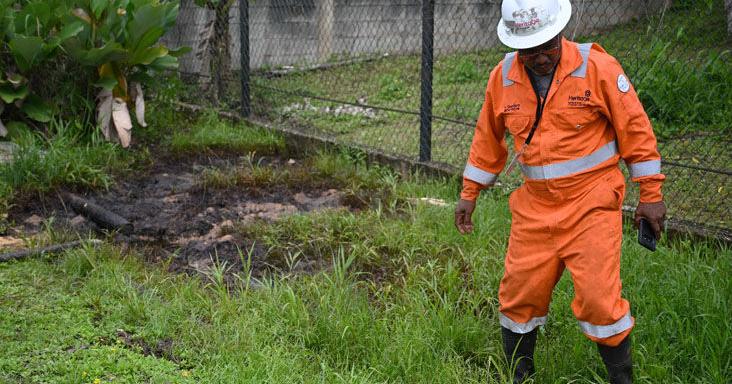
    A deliberate act of vandalism targeting an energy infrastructure pipeline in Barrackpore has caused an oil leak, prompting a large-scale emergency response and clean-up operation led by national energy authorities and private industry partners. Trinidad and Tobago’s Minister of Energy Dr. Roodal Moonilal confirmed the incident occurred along GP Road, where thieves deliberately damaged a joint pipeline operated by a private firm in partnership with state-owned Heritage Petroleum Ltd. The attackers removed a 6-foot section of the pipeline to steal the metal, leaving the line compromised and spilling crude hydrocarbon into the surrounding area.

    Minister Moonilal shared details of the incident with reporters on the sidelines of a graduation ceremony for Grant Memorial Presbyterian School, held at Susamachar Presbyterian Church in San Fernando. The case has been formally registered with local law enforcement as an act of sabotage, marking a troubling escalation of criminal targeting of critical national energy assets.

    “Individuals unlawfully entered the facility, destroyed the pipeline, and their clear intention was to steal large lengths of this critical infrastructure,” Moonilal explained to the press. “This is an act of vandalism and theft that we unreservedly condemn, and it has reached a point where criminals are directly targeting operational pipeline networks.”

    In the immediate aftermath of the incident being reported, Heritage Petroleum and multiple state agencies mobilized rapidly to contain the spill and mitigate environmental harm. Clean-up crews have already deployed specialized resources to protect nearby residential communities, active agricultural lands, and local livestock populations, while formal criminal investigations are underway.

    “We have mobilized all necessary resources for clean-up and have implemented scientific environmental monitoring protocols to protect the environment, private property, crops, livestock and all other at-risk assets,” Moonilal added. The national government is collaborating closely with law enforcement to advance the investigation and identify the perpetrators responsible for the attack.

    Looking ahead to prevent future incidents, Moonilal confirmed the government will partner with Heritage Petroleum to boost security protocols across all national oilfield operations, hardening critical infrastructure against criminal tampering and theft.

    In an official public statement released yesterday, Heritage Petroleum also joined in condemning the sabotage, echoing the minister’s concerns over public safety and environmental risk. The company confirmed that a preliminary on-site assessment verified the removal of approximately six feet of pipeline by the attackers. Immediately after receiving reports of the leak, Heritage activated its formal Incident Command System, rolling out pre-planned emergency response protocols to manage the incident.

    The company has deployed vacuum trucks and heavy industrial equipment to recover spilled oil, and has placed containment booms in nearby waterways to stop the spread of hydrocarbon contamination. Company representatives have been in direct communication with local residents and other stakeholders to provide real-time updates and any necessary support. As a precautionary public health measure, ongoing air quality testing and monitoring is being conducted to confirm that pollutant levels in the surrounding area remain within safe limits.

    “Heritage Petroleum unequivocally condemns all acts of sabotage against our infrastructure,” the company’s statement read. “These incidents not only cause loss of containment but also create unacceptable risks to public safety, the natural environment, and the critical national energy infrastructure that supports our country’s economy. In response, we have already expanded proactive precautionary measures to increase monitoring and security across all of our hydrocarbon assets.”

    The matter has been formally referred to local law enforcement for full criminal investigation, and all relevant national regulatory bodies including the Ministry of Energy and Energy Industries and the Environmental Management Authority have been notified of the incident, with investigations continuing as clean-up operations progress.

  • Prime Minister Drew pleased with strong progress and job creation at Basseterre High School Construction Site

    Prime Minister Drew pleased with strong progress and job creation at Basseterre High School Construction Site

    BASSETERRE, Saint Kitts – July 1, 2026 – On Wednesday afternoon, Saint Kitts and Nevis Prime Minister Dr. Terrance Drew led an on-site inspection of the long-awaited new Basseterre High School construction project, pushing back against public rumors of stalled work and showcasing the tangible, rapid progress that has transformed the site over the government’s term in office.

    Accompanied by the project’s lead manager Vivake Khan, Drew walked the entire active construction zone, where dozens of local construction workers and specialized technical teams are currently advancing work on what stands as one of the federation’s largest and most consequential public education infrastructure investments in recent decades.

    The prime minister’s visit was explicitly scheduled to address growing speculation among members of the public that little to no work had been carried out on the site. In remarks to reporters and stakeholders during the tour, Drew emphasized that he wanted citizens to see the scale of progress firsthand, rather than relying on secondhand claims.

    “We have heard repeated claims that nothing is happening at the Basseterre High School site,” Drew noted during the tour. “That is why I came here today: I want every person in our country to see just how much work is actually underway. I believe most people will be genuinely surprised by how far we have come in such a short period.”

    Drew drew particular attention to the large local workforce currently employed at the site, framing the project as a win for both education and national employment. “We have dozens of local workers here on site, working alongside international technical experts, and we are incredibly proud that this major public investment is putting paychecks in the pockets of our own citizens,” he said.

    For the current Labour Government, the new Basseterre High School is the fulfillment of a decades-old unmet national promise. Drew highlighted that prior administrations allocated $21 million to the project without laying a single foundation block, but in just three and a half years, his government has moved the project to active, large-scale construction. “Walk this site with me, and you will not just see laid blocks – you will see poured concrete, erected structural steel, and locally sourced quarry materials. This is tangible, real progress that cannot be denied,” Drew said.

    The prime minister confirmed that his administration will maintain close, regular oversight of the project to ensure it stays on its scheduled completion timeline. Once finished, the new facility will be a fully turnkey, climate-resilient campus designed to withstand the growing threats of extreme weather in the Caribbean. It will come fully equipped with modern learning spaces, state-of-the-art science laboratories, updated digital education technology, and new furniture and equipment, giving students and teaching staff a unified, safe, and innovative environment for learning.

    Beyond its core educational benefits, the multi-million-dollar project is delivering sustained economic benefits across Saint Kitts and Nevis. It has created ongoing full-time and part-time employment for local construction workers, and spurred new opportunities for local suppliers and related service sectors, boosting near-term economic activity while building a stronger foundation for the country’s long-term human development.

  • Sir Lester Bird Medical Centre Launches First Leadership Development Programme

    Sir Lester Bird Medical Centre Launches First Leadership Development Programme

    In a landmark move aimed at strengthening healthcare governance and nurturing the next generation of medical leaders, the Sir Lester Bird Medical Centre has launched its first-ever comprehensive leadership development programme. Designed to address growing gaps in managerial and strategic expertise across Antigua and Barbuda’s public healthcare system, the initiative marks a significant turning point for the island nation’s flagship medical facility.

    The programme, which was developed in consultation with regional healthcare management experts, targets mid-level and senior clinical and administrative staff at the centre. Over the course of six months, participants will engage in a structured curriculum that combines hands-on practical training, mentorship from veteran healthcare leaders, and interactive workshops focused on key competencies. Key modules include crisis resource management, patient-centered care strategy, cross-departmental team collaboration, financial stewardship for medical facilities, and adaptive leadership in evolving public health landscapes.

    Hospital administrators note that the launch comes amid a broader push to upgrade the country’s healthcare infrastructure and improve service delivery outcomes. For years, the Sir Lester Bird Medical Centre, which serves as the primary referral hospital for Antigua and Barbuda, has faced challenges related to transitioning leadership as long-tenured senior staff prepare for retirement. This new programme is intended to create a structured pipeline of trained leaders who can step into critical roles seamlessly, avoiding disruptions to patient care.

    “This is more than just a training course – it’s an investment in the future of healthcare for all Antiguans and Barbudans,” said the hospital’s Chief Executive Officer in a press briefing ahead of the programme’s launch. “We’ve seen firsthand how strong, empathetic leadership directly impacts patient satisfaction and clinical outcomes. By equipping our talented staff with the strategic skills they need to lead, we’re building a stronger, more resilient healthcare system for generations to come.”

    Initial feedback from the first cohort of 25 participants has been overwhelmingly positive, with many noting that the programme fills a long-unmet need for professional development focused specifically on healthcare leadership in the region. Organizers plan to expand the initiative to include junior staff in future iterations, with the goal of fostering a culture of continuous leadership growth across the entire facility. The programme’s progress and outcomes will be evaluated at the conclusion of the six-month curriculum, with findings shared with other regional healthcare facilities looking to implement similar development schemes.

  • Sen. Chester Hughes Graduates with Law Degree from Arden University

    Sen. Chester Hughes Graduates with Law Degree from Arden University

    A senior leader of Antigua and Barbuda’s largest trade union has marked a major career and academic milestone, graduating with honors from a prominent British higher education institution to better defend workers’ rights in an increasingly complex labor landscape.

    Chester Hughes, who serves as Deputy General Secretary of the Antigua and Barbuda Workers’ Union (ABWU) and holds a Senate seat in the country’s legislature, completed his Bachelor of Laws with Honors (LLB Hons) at Arden University in the United Kingdom, earning the distinguished classification of Upper Second-Class Honours. The ABWU made the formal announcement of Hughes’ achievement earlier this week, framing the graduation as a key step forward in his ongoing development as both a scholar and a labor leader.

    Hughes pursued the degree while balancing a demanding full-time role at the union, a feat that required rigorous time management and personal sacrifice. To accommodate his professional duties, he rearranged his schedule to fit early-morning classes and dedicated late-night hours to coursework and exam preparation. Because the program centered on the United Kingdom’s legal framework, he invested extra hours in independent research and targeted study to fully master the specialized curriculum.

    In comments shared ahead of the announcement, Hughes explained that his decision to pursue legal training was rooted in shifting dynamics in industrial relations across the region. As more companies retain legal representation to advocate for their interests in labor disputes, trade unions must evolve their own capabilities to avoid being at a disadvantage when fighting for their members’ rights, he argued.

    “This degree is intended to elevate my capacity as a trade unionist in Antigua and Barbuda, particularly as the landscape of industrial relations evolves,” Hughes explained. “With an increasing number of lawyers representing companies in labor matters, unions must adapt to these changing times to effectively advocate for their members.”

    Looking ahead, Hughes has laid out clear next steps to translate his academic achievement into practical advocacy for working people. He plans to travel to the United Kingdom next to complete required bar training, before returning to the Caribbean to finish the conversion process that will allow him to be admitted to the bar in Antigua and Barbuda, as well as across member states of the Organization of Eastern Caribbean States (OECS).

    Beyond his own career, Hughes also hopes his achievement will inspire fellow labor organizers across the region to prioritize ongoing professional development through education. He emphasized that his ultimate goal is to use his new legal expertise to deliver stronger representation and more effective support for working people across Antigua and Barbuda.

  • ABWU Deputy General Secretary Chester Hughes Graduates with Law Degree in the United Kingdom

    ABWU Deputy General Secretary Chester Hughes Graduates with Law Degree in the United Kingdom

    A senior labor leader from Antigua and Barbuda has marked a major career and academic milestone, wrapping up years of rigorous combined work and study to graduate with top honors from a leading UK higher education institution. Chester Hughes, Deputy General Secretary of the Antigua and Barbuda Workers’ Union (ABWU), crossed the graduation stage on Tuesday to collect his Bachelor of Laws with Upper Second-Class Honours from Arden University, based in the United Kingdom.

    Following the official ceremony, Hughes gathered with close family and friends to celebrate the achievement, which caps off years of intentional late nights, early mornings, and careful prioritization that let him complete his degree while continuing to hold one of the union’s most senior executive leadership roles. Unlike traditional full-time students, Hughes balanced the heavy workload of labor advocacy, union leadership, and personal responsibilities alongside his academic requirements, a challenge that he says shaped his entire learning journey.

    In reflecting on the years he spent working toward the degree, Hughes emphasized that the experience was as demanding as it was transformative. He described the program as both “challenging and rewarding,” noting that successfully juggling competing demands from his career, coursework, and personal life relied on consistent discipline, unwavering resilience, and relentless determination. Many modules introduced him to entirely new legal frameworks and concepts that felt overwhelming at the start, but he worked steadily through each subject, gradually expanding his legal knowledge, deepening his nuanced understanding of the field, and building confidence in his new skills. For Hughes, this entire academic journey has equipped him with irreplaceable expertise and perspective that he plans to bring back to his work advocating for workers, leaving him eager to step into the next phase of his career with clear purpose and renewed enthusiasm.

    The ABWU has formally extended its warmest congratulations to Hughes on the groundbreaking achievement. Union leadership emphasized that Hughes’ successful completion of the degree while continuing to serve working people is a powerful testament to his core commitment to both personal growth and the advancement of the global labor movement, which he advances through intentional education and values-based leadership. The organization’s entire Executive Council, administrative staff, and rank-and-file membership share the collective belief that this new academic credential will amplify Hughes’ ability to serve workers across Antigua and Barbuda with exceptional distinction, especially in core priority areas including labor legislation, industrial relationship management, collective bargaining negotiation, and advancing systemic social justice for working communities.

    Looking ahead, Hughes will continue his legal training later this year: he plans to depart Antigua and Barbuda over the coming summer to enroll in the required Bar Training Course, a critical prerequisite for practicing law that marks the next key phase of his combined legal and labor career. The ABWU has expressed full confidence in Hughes and extended well wishes for his upcoming training, noting that all his academic and professional work is rooted in a commitment to advancing justice for the working class. Beyond celebrating one leader’s achievement, the union highlighted that Hughes’ accomplishment is a source of tremendous organizational pride, and serves as a motivating example for working people across Antigua and Barbuda to prioritize lifelong learning and pursue ongoing professional excellence regardless of existing career and personal responsibilities.

  • Antigua Grammar School Alumni Donate Toward Steelpan Program

    Antigua Grammar School Alumni Donate Toward Steelpan Program

    A quarter-century after graduating from Antigua Grammar School, the 1999 Form 5 cohort has made a meaningful contribution to lifting up current students, stepping forward to donate funds to grow the institution’s beloved music program.

    Organized collectively by members of the school’s Form 5A and Form 5 Alpha groups, the contribution is earmarked specifically for acquiring new steelpans, a key instrument that is central to Caribbean musical culture and the school’s existing music education work, the school confirmed in an official statement.

    Dr. Jonah Greene, principal of Antigua Grammar School, extended sincere gratitude to the returning alumni on behalf of the entire school community, framing the gift as far more than a simple financial contribution. Instead, he emphasized that it is a targeted investment in the raw talent and long-term futures of the young people currently learning and growing at the school.

    “Their contribution, which will go towards the purchase of steelpans, is more than a gift of instruments. It is an investment in the talents, creativity, and future of our students,” Greene shared in his remarks.

    Greene went on to note that the alumni’s gesture speaks volumes about the lifelong, enduring bonds that graduates maintain with their alma mater. It also highlights the longstanding culture of “Old Boys” — former male students of the institution — stepping up to lift up the next generation of learners that walk the school’s halls.

    This ethos of community support and ongoing growth aligns perfectly with Antigua Grammar School’s official motto, Semper Virens, which translates to “ever flourishing” in Latin, the principal added.

    Closing his message, Greene once again expressed appreciation for the cohort’s generosity, and issued a gentle call to action for other alumni across all graduating classes to carry forward the powerful tradition of giving back to the institution that shaped them. For current students, the donation will not only expand access to music education but also serve as a lasting reminder of the support network that stands behind them as they develop their skills.

  • Rotaract Club of Antigua Thanks Supporters as 2025-26 Rotary Year Ends

    Rotaract Club of Antigua Thanks Supporters as 2025-26 Rotary Year Ends

    As the 2025-26 Rotary international service year draws to a close, the Rotaract Club of Antigua is publicly acknowledging the critical role that its wide network of sponsors, partners, presenters, individual supporters and friends have played in advancing its work across the island. In an official end-of-year statement, the youth-led service organization emphasized that every form of support it received over the past 12 months — from financial sponsorships and in-kind donations to collaborative partnerships, venue access, shared professional expertise, active participation and simple words of encouragement — laid the groundwork for a full slate of successful initiatives.

    Operating under the 2025-26 Rotary theme “Service Beyond Borders: Unite. Inspire. Lead.”, the Antigua club structured its programming around eight core priority areas: expanding grassroots community service, creating professional development pathways for young people, fostering member fellowship, growing its membership base, raising public awareness around critical health topics, increasing youth engagement in civic action, and running strategic fundraising campaigns to sustain future projects. The collective backing from external stakeholders allowed the organization to scale these efforts far beyond what it could have achieved independently, turning planned small-scale projects into impactful programs that reached more community members.

    Club President Martina Lewis delivered the formal message of gratitude on behalf of the 2025-26 Board of Directors and the club’s entire membership, noting that external partnerships were not just helpful but foundational to advancing the organization’s core mission of service and youth empowerment. Looking ahead to the upcoming Rotary year, the Rotaract Club of Antigua says it is eager to deepen its connections with existing supporters, build new collaborative relationships with cross-sector stakeholders, and continue delivering work that creates long-lasting positive change for communities across Antigua.

  • Russian-made handgun seized, two arrested

    Russian-made handgun seized, two arrested

    In a targeted operational sweep conducted on Tuesday, Guyana’s Customs Anti-Narcotics Unit (CANU) made a significant illicit weapons seizure that led to the arrest of two men, the agency confirmed in an official public statement released earlier this week. The operation, executed at the Castello Housing Scheme location, uncovered two unregistered handguns hidden on the suspects’ property during a court-authorized search. One of the recovered weapons is a Russian-manufactured 9mm Baikal Makarov pistol, while the second is a Smith and Wesson .38 special revolver. Along with the two firearms, agents also found one live bullet matching the caliber of the revolver. Following the completion of the CANU operation, both detained suspects, all seized firearms, and the recovered ammunition have been transferred to the Guyana Police Force for further processing and ongoing investigation. Law enforcement sources note that illegal unregistered firearms remain a persistent public safety challenge in Guyana, and interagency cooperation between CANU and local police is designed to disrupt illegal weapons trafficking and prevent potential violent crime linked to unlicensed firearms. As of the latest update, investigators have not yet released additional details on whether the weapons are linked to other open criminal cases, or what bail status the two suspects hold following their transfer to police custody.