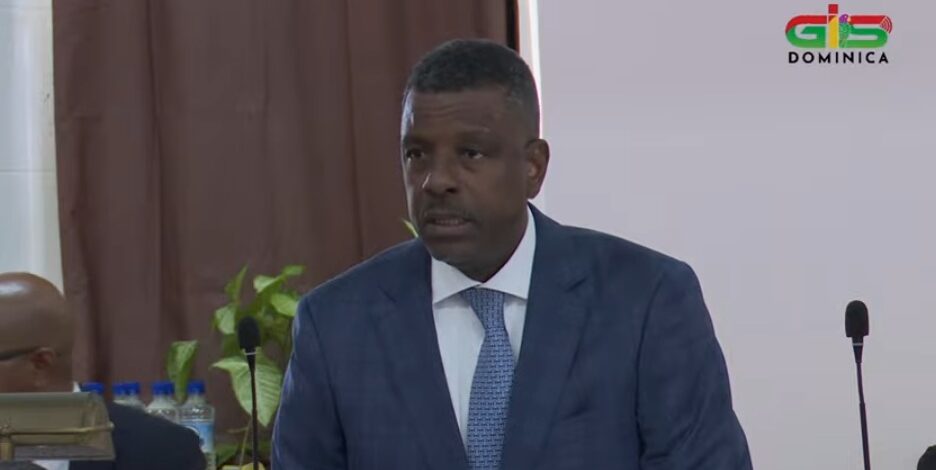
Prime Minister Gaston Browne has robustly defended the Peace Beach development at Barnacle Point, asserting that the reclaimed land is unequivocally public property. During a parliamentary session on Thursday, Browne addressed concerns raised by the Opposition, emphasizing that while the foreshore in front of the reclaimed area is privately owned, the newly created land belongs to the state. ‘All reclaimed land is public land,’ Browne stated. ‘The threshold in front of that beach is owned privately.’ The Prime Minister also dismissed allegations that the project infringes on marine rights previously granted to the Yida Group, labeling such claims as ‘mischievous’ and clarifying that Yida holds no such rights. Browne highlighted that the coastline already includes several reclaimed properties, such as a six-acre parcel owned by the Hadeed family and an adjacent marina, both created through dredging. ‘Practically all of the land on that coast was dredged,’ he noted. ‘It’s not a pristine area as suggested by some.’ The Prime Minister further assured that all necessary environmental and statutory approvals were secured before the project commenced, underscoring the government’s commitment to regulatory compliance. The development, named Peace Beach, was inspired by Browne’s daughter and symbolizes the island’s aspiration for unity and harmony. ‘Peace Beach is about promoting peace,’ Browne said. ‘I happen to have a daughter whose name is Peace, and as you know, I’m a peace practitioner.’
分类: politics
-

Gajadien: VHP heeft geen nieuwe naam nodig, maar echte hervorming
The proposed name change of the Progressive Reform Party (VHP) has not been widely discussed within the party, according to Deputy Chairman Asis Gajadien. He emphasized that, as far as known, the idea stems from party leader Chan Santokhi and does not represent an official stance or decision by the party’s governing bodies. Santokhi mentioned the proposal during a radio interview on ABC. Gajadien stated that the VHP does not need a new name but rather genuine reform. ‘If the party wants to maintain its role as a broad people’s movement, it must stop focusing on symbolic changes and instead prioritize structural reforms: more internal democracy, honest leadership, and credible renewal,’ he told Starnieuws. The deputy chairman warned that without a course correction, any name change would remain an empty gesture—a façade that fails to address underlying challenges. ‘The VHP has a rich history, but its future depends on its willingness to regain the people’s trust. Not by changing names, but through actions and leadership that serve the people,’ Gajadien stressed.
-

President benadrukt klimaatrechtvaardigheid en solidariteit tijdens Caricom-top
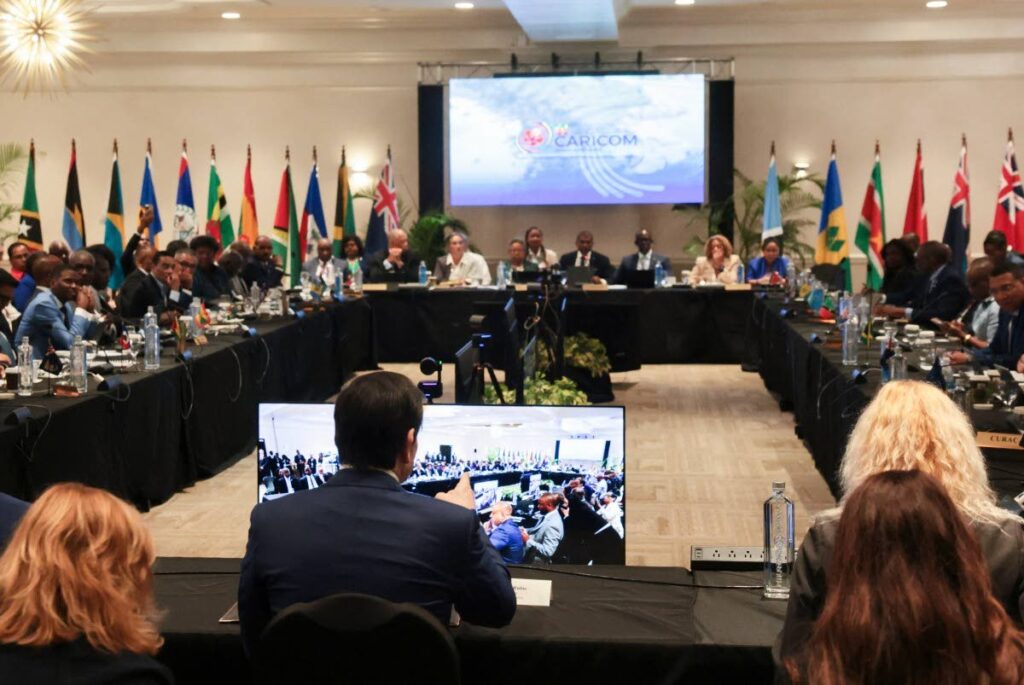
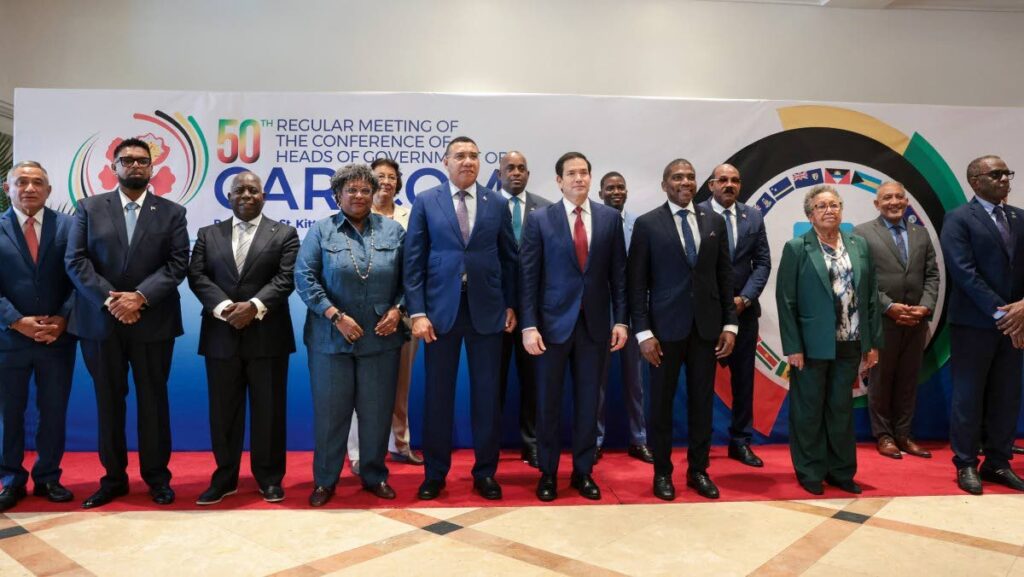
During the Caricom Inter-Sessional Meeting held on Thursday, President Jennifer Simons of Suriname emphasized the urgent need for regional unity in addressing climate change and restoring stability in Haiti. Accompanied by Foreign Minister Melvin Bouva, President Simons represented Suriname at the virtual summit, where Caribbean leaders discussed pressing regional and global issues. The meeting, attended virtually from the Presidential Cabinet, served as a crucial platform for dialogue on climate change, security, the Haitian crisis, and Caribbean solidarity. Suriname highlighted its unique role as a carbon-negative nation, with vast forest areas contributing significantly to global climate health. Minister Bouva stressed that countries actively preserving the environment deserve fair compensation and sustainable climate financing. The leaders also addressed the ongoing crisis in Haiti, with Suriname expressing solidarity and support for international efforts to restore democracy, human rights, and security. Bouva affirmed Suriname’s commitment to contributing to stabilizing measures in alignment with UN resolutions. Additionally, the summit focused on regional security challenges, including maritime incidents and drug trafficking. President Simons underscored the importance of peace through dialogue and cooperation. Suriname is set to assume the chairmanship of the Council for Foreign and Community Relations (COFCOR), positioning the country to play a pivotal role in shaping the regional foreign policy agenda. Bouva reiterated Suriname’s belief in collaboration, dialogue, and solidarity as essential for building a future of peace, sustainability, and mutual benefit.
-

Column: Ondoordacht gratieverzoek ontsteekt kruitvat in NDP-barak en bedreigt politieke stabiliteit
The recent call by Ramon Abrahams, Deputy Chairman of the National Democratic Party (NDP), for pardons for four individuals convicted in the December Murders has reignited old wounds and risks triggering an internal crisis within the party. Initially perceived as an act of loyalty to former leader Desi Bouterse, the move now threatens to weaken President Jennifer Simons politically and destabilize the fragile equilibrium of Suriname. During a commemoration event for Bouterse’s 80th birthday on October 13, Abrahams urged clemency for three imprisoned convicts and one fugitive, Iwan Dijksteel, who remains at large. Bouterse’s lawyer, Irvin Kanhai, added weight to the appeal by announcing he had submitted a pardon request to the President’s Cabinet on behalf of the convicts. President Simons, present at the event, appeared visibly surprised and stated she had not seen the request, leaving her unable to take a stance. The speech drew immediate backlash, both from society and within the NDP, as it reopened the unhealed trauma of the December Murders, a national tragedy. Critics labeled Abrahams’ remarks as ill-timed and politically tone-deaf, with some suggesting the move was poorly coordinated with Simons. The incident has exposed a growing rift within the NDP between a hardline faction loyal to Bouterse and a moderate group aligned with Simons, who seeks to restore the party’s image and maintain the ruling coalition. Simons now faces a delicate balancing act: as party leader, she cannot ignore the wishes of her colleagues, but as president, she must consider the sentiments of her coalition partners and the public. Coalition members like the NPS and A-20 are unlikely to support pardons for the December Murders convicts, given the symbolic weight of such a decision. While humanitarian arguments for clemency exist—three of the convicts are elderly and in poor health—the broader societal context, including the unresolved grief of victims’ families, complicates the matter. The situation is further muddied by conflicting reports about the legitimacy of the pardon request, with the convicts denying they authorized Kanhai to act on their behalf. This raises questions about internal power dynamics and whether the pardon issue is being weaponized in a factional struggle. Simons’ leadership is being openly tested, and some party members appear willing to undermine her if she does not align with their agenda. The irony is that Bouterse once warned that the NDP’s greatest threat would come from within—a statement that now rings prophetic. As Suriname grapples with significant economic challenges, including mounting debt and hopes for future oil revenues, the country’s political stability is once again jeopardized by internal strife and unresolved historical grievances. What Suriname needs is calm, clarity, and leaders who use the past as a lesson for the future, not as a weapon. Abrahams’ call, however, serves as a stark reminder of how thin the veneer of reconciliation remains.
-

US Revokes Visas Over Comments on Charlie Kirk’s Death
In a decisive move, the Trump administration has revoked the visas of at least six foreign nationals following their controversial social media posts celebrating the murder of conservative influencer Charlie Kirk. The U.S. State Department announced the decision on X, stating, ‘The United States has no obligation to host foreigners who wish death on Americans.’ The department also shared screenshots of the offending posts. The individuals affected hail from Argentina, South Africa, Mexico, Brazil, Germany, and Paraguay. Charlie Kirk, 31, co-founder of Turning Point USA and a close ally of Donald Trump, was tragically shot dead while speaking at Utah Valley University on September 10. Trump has since honored Kirk as a ‘martyr’ and posthumously awarded him the Presidential Medal of Freedom. Among those impacted by the visa revocations are South African businessman Nhlamulo Baloyi and Brazilian comedian Tiago Santineli, both of whom confirmed their visas had been canceled after mocking Kirk online.
-

Security : Donation of 90 Kawasaki motorcycles and logistical equipment to the PNH
In a significant move to enhance Haiti’s law enforcement capabilities, the Organization of American States (OAS), in collaboration with the Canadian government, has donated 90 Kawasaki motorcycles and essential logistical equipment to the Haitian National Police (PNH). The donation, comprising Kawasaki KLX 300 and KLR 650 models, aims to bolster police deployment in operations against armed gangs, which have been a persistent threat to the nation’s security. The handover ceremony also served as a platform for discussions between Cristobal Dupouy, the OAS Secretary General’s Representative in Haiti, and Vladimir Paraison, the Acting Director General of the PNH. Key topics included structural reforms, modernization of police operations, and improvements in officers’ social benefits. This initiative is part of a broader international effort to support Haiti’s fight against violence, with contributions from the United Nations, Canada, the United States, France, and Taiwan. Earlier this year, the PNH also received armored vehicles and personal protective equipment, further strengthening their operational capacity.
-

“We must give our all for Venezuela”
In a powerful display of unity, Cuba has reaffirmed its unwavering support for Venezuela, a nation currently facing significant military pressure from the United States. Miguel Díaz-Canel Bermúdez, First Secretary of the Central Committee of the Communist Party of Cuba and President of the Republic, expressed solidarity with Venezuela and its President, Nicolás Maduro, during a public statement on X. He emphasized that Venezuela, the homeland of Simón Bolívar and Hugo Chávez, will not stand alone amidst the escalating tensions. Díaz-Canel condemned the US military deployment, which includes approximately 1,200 missiles, as well as covert CIA operations targeting Venezuela. He invoked the words of Cuban national hero José Martí, who famously declared, ‘Give me Venezuela to serve, she has a son in me,’ and echoed Fidel Castro’s sentiment that ‘For Venezuela, we must give our all.’ The Cuban people have also demonstrated their solidarity, gathering at the equestrian statue of Simón Bolívar to express their support. Díaz-Canel further quoted Bolívar, who once warned that the United States ‘seems destined by Providence to plague America with misery in the name of freedom.’ This statement underscores Cuba’s commitment to defending Venezuela against external aggression and its broader critique of US interventionism in Latin America.
-

“We are defending the great homeland that is humanity”
On Thursday, October 17, 2025, a pivotal meeting took place at Casa de las Américas in Havana, marking the launch of a new phase for the Network of Artists and Intellectuals in Defense of Humanity. Established in 2003 by Commanders Fidel Castro Ruz and Hugo Chávez Frías, the Network aims to unite left-wing thinkers globally to counter neo-fascism and imperialist threats. Cuban President Miguel Díaz-Canel Bermúdez, alongside prominent intellectuals and activists, emphasized the urgency of defending humanist values and fostering solidarity in the face of global challenges. The meeting, held in the Che Guevara Room, lasted nearly four hours and focused on revitalizing the Network’s mission. Díaz-Canel highlighted the need for unity among leftist movements, particularly in Latin America, to resist military and ideological aggression. He also condemned the ongoing crisis in Gaza and the media attacks against Venezuelan President Nicolás Maduro. The newly elected general coordinator of the Network, Miguel Pérez Pirela, echoed these sentiments, stressing the importance of ideas, beauty, and solidarity in combating barbarism. The event also featured contributions from Cuban and international intellectuals, who discussed the role of culture, science, and ethics in shaping a progressive future. The gathering underscored the Network’s commitment to fostering critical thinking, digital literacy, and revolutionary praxis as tools for social transformation.