In a significant campaign pledge, Democratic Labour Party (DLP) contender Ryan Walters has committed to a comprehensive transformation of educational infrastructure and youth development initiatives in St Michael North West should he secure victory. Addressing constituents at a political gathering, Walters highlighted the critical state of disrepair plaguing multiple educational institutions, including Deacon’s Primary, Eagle Hall Primary, St Stephen’s Primary, St Stephen’s Nursery, and Ellerslie Secondary School. He asserted that years of neglect have severely compromised the learning environment, directly impacting student welfare and academic performance. Walters specifically criticized incumbent representative Neil Rowe for ineffective leadership, alleging that his efforts were limited to writing letters that were subsequently ignored by colleagues. The cornerstone of Walters’ educational agenda involves either a complete reconstruction or extensive refurbishment of Deacon’s Primary, which he described as an ‘ageing plant’ creating unacceptable conditions for students. Furthermore, he vowed to address surrounding environmental hazards, such as overgrown vegetation attracting rodents, which pose health and safety risks. Beyond physical infrastructure, Walters announced plans to launch an after-school literacy program and reinstate academic scholarship schemes to reward student excellence, initiatives he noted were successfully implemented during previous DLP administrations. In a bold move to tackle community divisions, Walters proposed establishing a St Michael North West Youth and Culture Club. This initiative aims to unite young people from various communities including Deacon’s Farm, Free Hill, Pile Bay, Cave Hill, and Black Rock through cultural activities like steel pan and stilt walking, alongside skill development workshops. Walters emphasized that fostering early friendships and cultural appreciation is essential to breaking cycles of violence and creating a safer, more cohesive constituency where youth can interact freely without fear.
分类: politics
-

Panton Says ‘No Prime Minister Should Have to Instruct the P.U.C.’
Opposition Leader Tracy Panton of the United Democratic Party (UDP) has declared her party’s intention to directly engage regulatory bodies regarding Belize Telemedia Limited’s proposed acquisition of Speednet (Smart). Panton emphasized that the UDP parliamentary caucus and leadership team will seek formal meetings with both the Public Utilities Commission (PUC) and Social Security Board to formally record their position on the telecommunications merger.
Panton delivered sharp criticism against the PUC, accusing the regulatory body of awaiting political directives rather than exercising its independent authority. She asserted that the commission possesses established legal frameworks that should guide its actions without requiring instructions from government officials. The opposition leader further questioned the impartiality of the PUC’s composition, noting that all members were appointed by the current Briceño administration, which she described as a matter of serious concern.
These developments follow last Friday’s announcement that merger discussions have been temporarily suspended following Prime Minister John Briceño’s intervention. Michel Chebat, Minister of Public Utilities, informed the House of Representatives that the pause was implemented to facilitate public consultation and ensure proper legal procedures are followed. Chebat clarified that acquisitions of this magnitude necessitate preliminary review by the PUC, with formal submissions to be made pending approval from both the Social Security Board and BTL.
The UDP maintains its commitment to demanding rigorous oversight throughout the process, highlighting the transaction’s substantial financial implications and advocating for complete transparency in all proceedings. Panton concluded by reinforcing that existing laws clearly define the PUC’s responsibilities, making ministerial or prime ministerial instruction unnecessary for the commission to act in the public interest.
-

UDP Questions ‘Yellowman’ Detention as Politically Motivated
BELIZE CITY – Political tensions escalated in Belize as the United Democratic Party (UDP) launched sharp criticisms against the national police force following the brief detention of party affiliate Brian “Yellowman” Audinett last Wednesday. The incident has sparked allegations of political motivation and triggered street demonstrations that disrupted major infrastructure.
During a press conference, UDP leadership challenged the official justification for Audinett’s apprehension after law enforcement provided contradictory explanations. Initial reports suggested detention either for alleged gang affiliation or for suspected plans to incite public violence—both claims vigorously disputed by opposition figures.
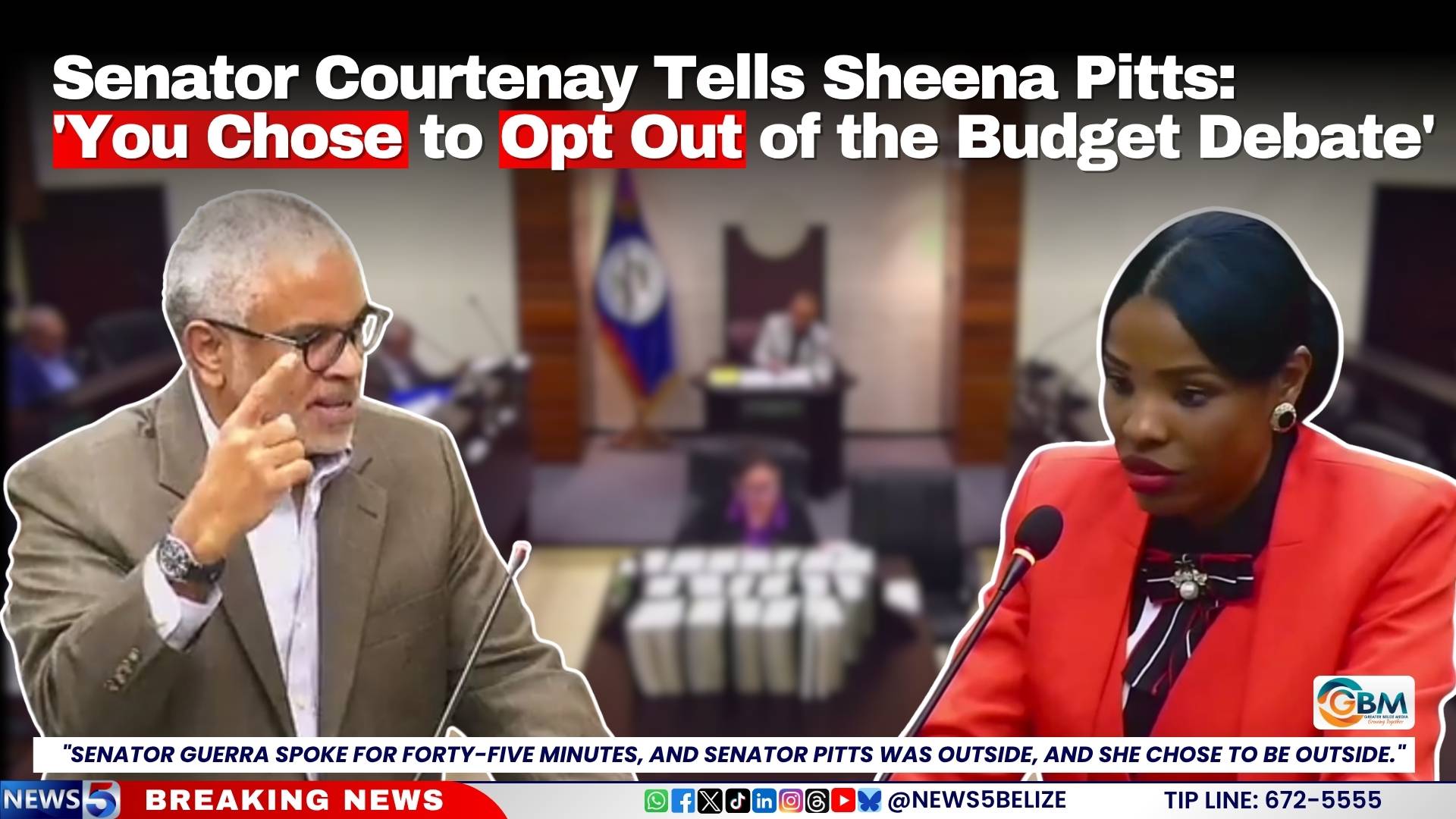
UDP Senator Sheena Pitts denounced the arrest as politically targeted, stating: “Yellowman is a recognized political affiliate of our party. This action by the police department raises serious questions about their motives and impartiality.”
The detention prompted immediate mobilization of UDP supporters, who blockaded the strategic Belcan Bridge in a show of protest. Demonstrators marched from the Social Security Board building to the bridge, intensifying demands for Audinett’s release.
Police Commissioner Dr. Richard Rosado condemned the bridge blockade as a violation of agreed protest conditions, warning that “legal consequences for the organizers” may follow. Audinett was released by midday Wednesday and has since threatened legal action against the police department, potentially setting the stage for protracted legal and political battles.
-

Grenada’s 52nd Independence Address
In a profound address marking Grenada’s 52nd Independence Anniversary, Prime Minister Dickon Mitchell delivered a transformative vision of national sovereignty that transcends ceremonial observance. Speaking under the theme “Anchored in Faith, Guided by Purpose,” the Prime Minister challenged conventional understandings of independence as mere historical commemoration, reframing it instead as an active, daily practice requiring collective discipline and productivity.
Mitchell articulated a crucial distinction between freedom ‘from’ colonial domination and freedom ‘for’ constructive nation-building. He emphasized that true independence represents not a completed achievement but an ongoing assignment demanding practical contribution from every citizen. “Independence did not hand us a finished house,” Mitchell stated. “It handed us tools and said: ‘Go forth and Build.’”
The address outlined specific responsibilities across societal sectors: farmers must prioritize agricultural productivity, teachers must shape minds with excellence, public officers must serve with integrity, entrepreneurs must embrace innovation and risk, while young people must choose discipline over entitlement. Mitchell warned that “freedom without productivity is temporary” and that nations consuming more than they produce become like “fruitless trees” incapable of sustaining their people.
Significantly, the Prime Minister rejected the notion of independence as isolationism, advocating instead for “interdependence with dignity” across personal, community, national, regional, and international levels. He positioned Grenada as a small state navigating a rapidly transforming global landscape where strategic thinking outweighs physical size. Key priorities include human capital investment, economic resilience, food and energy security, technological adoption, and climate adaptation.
The government’s Vision 75 and National Sustainable Development Plan 2020-2035 provide measurable frameworks for progress assessment, focusing on tangible outcomes rather than political rhetoric. Mitchell concluded with a powerful metaphor: “Faith is our anchor. Purpose is our sail. Work is our wind,” urging citizens to embrace nation-building as their generational responsibility rather than resting on historical achievements.
-

UDP Defends House Meeting Boycott
The United Democratic Party (UDP) has publicly justified its strategic boycott of a recent House of Representatives session, framing the move as a principled stand against governmental corruption. During a press conference held on February 10, 2026, Opposition Leader Tracy Panton characterized the decision as an essential ‘act of conscience’.
The boycott was directly triggered by mounting concerns surrounding Belize Telemedia Limited’s (BTL) proposed $80 million acquisition of Speednet/SMART. Panton’s caucus expressed firm resolve, declaring that UDP parliamentarians would not permit the national Assembly to serve as a ‘rubber stamp for corruption.’
Panton launched a pointed critique against Prime Minister John Briceño, highlighting a perceived contradiction in his actions. She questioned how the Prime Minister, who initially claimed unawareness of BTL’s negotiations with his own family company, could now assert authority to direct a pause in the acquisition process. ‘The prime minister of this country has inserted himself to direct a pause on a deal he knew nothing about,’ Panton stated, emphasizing the apparent inconsistency.
The opposition leader’s rhetoric intensified as she asserted that UDP parliamentarians ‘will not be treated like kunumunu’—a Belizean Creole term implying foolishness or being misled.
In the absence of opposition lawmakers, the political atmosphere outside the newly renovated National Assembly took on a celebratory tone. A significant gathering of supporters from the ruling People’s United Party (PUP) assembled, described by Secretary General Collet Montejo as showing general support for party leaders and celebrating the parliamentary building’s reopening. Party Chairman Henry Charles Usher added that supporters were present to endorse the passage of the Occupational Safety and Health Bill. However, attendees including Pickstock Street captain Shaheed Hauze confirmed their presence was specifically to support the controversial BTL acquisition currently under scrutiny.
-

OP-ED: A primer into 21 st Century Caribbean geopolitics – The importance of Guyana
The Caribbean Community (CARICOM), comprising 15 member states across insular Caribbean territories and mainland regions of Central and South America, faces complex geopolitical challenges stemming from its numerous territorial boundaries. The region contends with 10 land borders and 37 maritime boundaries, many of which remain disputed—including tensions between Guyana and Venezuela, Belize and Guatemala, and Trinidad and Tobago and Barbados.
Geopolitically, CARICOM exists in the shadow of global powers, positioned proximate to the United States to the north, Brazil to the south, and Cuba in the central Caribbean. Member states grapple with post-colonial legacies, environmental vulnerabilities, resource distribution inequalities, and persistent border complications that challenge regional cohesion.
Guyana emerges as a critical actor in this landscape, serving as the only English-speaking nation in South America and functioning as a strategic bridge between Caribbean and South American integration initiatives. Since Exxon Mobil’s landmark oil discovery in 2015, Guyana has experienced transformative economic growth, positioning itself as a potential future BRICS member candidate due to its growing regional influence and commitment to multilateralism.
The nation’s agricultural capacity—producing staples of the West Indian diet including rice, sweet potatoes, and various fruits and vegetables—offers significant opportunities for enhancing regional food security. Additionally, its cross-border connectivity with Brazil through the Lethem-Bon Fim corridor provides CARICOM members access to broader South American markets.
Despite operating in an increasingly volatile global environment where power dynamics often override multilateral cooperation, Guyana represents Caribbean resilience and potential. As noted by Dr. Kai-Ann Skeete, Trade Policy Research Fellow at the Shridath Ramphal Centre, the country exemplifies how Caribbean nations can maintain cultural identity while pursuing deeper regional integration and economic transformation, even amid the uncertainties inherent in geopolitical change.
-

Democratic lawmakers accuse US attorney general of Epstein file ‘cover-up’
WASHINGTON, United States – Congressional Democrats launched scathing accusations against Attorney General Pam Bondi during a heated House Judiciary Committee hearing on Wednesday, alleging a systematic cover-up of Jeffrey Epstein-related documents and the transformation of the Justice Department into President Donald Trump’s personal instrument of retaliation.
The hearing, attended by several of Epstein’s victims, witnessed intense exchanges as Democratic representatives condemned the handling of evidence related to the convicted sex offender. Representative Jamie Raskin, the committee’s ranking Democrat, spearheaded the criticism, asserting that the Justice Department had deliberately suppressed millions of documents despite congressional mandates.
“You’re orchestrating a massive Epstein cover-up directly from the Department of Justice,” Raskin declared. “Despite subpoenas and congressional orders demanding six million documents, photographs, and videos, you’ve produced merely half that amount.”
The Epstein Files Transparency Act (EFTA), passed with overwhelming congressional support in November, legally compelled the Justice Department to release all Epstein-related documents within 30 days. The legislation specifically required redaction only for victims’ identities—numbering over 1,000 according to FBI estimates—while explicitly prohibiting the shielding of powerful associates, including politicians and business magnates, based on embarrassment or political sensitivity.
Raskin countered Bondi’s claims of compliance, stating that numerous names of “abusers, enablers, accomplices and co-conspirators” had been improperly redacted, apparently to protect them from public scrutiny. He further alleged that the department had simultaneously failed to adequately protect victims’ identities.
Attorney General Bondi, a staunch Trump ally, defended the department’s efforts, noting that hundreds of attorneys and reviewers had dedicated thousands of hours to document examination. “We’ve released over three million pages, including 180,000 images, to the public while striving to protect victims within the legislative timeframe,” she testified.
Beyond the Epstein controversy, Democrats condemned what they characterized as politically motivated prosecutions against Trump’s opponents, including former FBI Director James Comey and New York Attorney General Letitia James. Raskin accused Bondi of transforming “the people’s Department of Justice into Trump’s instrument of revenge,” suggesting the department responded to presidential directives like “ordering pizza.”
The context of these allegations traces back to Epstein’s death in his New York jail cell in 2019 while awaiting trial for sex trafficking minors—a death ruled suicide. His associate, Ghislaine Maxwell, remains the only individual imprisoned in connection with Epstein’s crimes, serving a 20-year sentence for sex trafficking underage girls.
Trump’s prolonged resistance to document release regarding Epstein—a former longtime friend—ultimately succumbed to Republican pressure, leading to his endorsement of the transparency law. This legislative move reflected growing public demand for accountability regarding suspected protections for powerful figures within Epstein’s network.
-

US top official in Venezuela for oil talks after leader’s ouster
CARACAS, Venezuela — In a significant diplomatic overture, United States Energy Secretary Chris Wright conducted high-level discussions in Caracas on Wednesday with Venezuela’s acting president Delcy Rodríguez and key oil industry executives. The landmark meeting focused on strategies to revitalize Venezuela’s enormous crude oil reserves, which rank as the world’s largest.
This visit represents the most senior Trump administration official to enter Venezuela since US special forces orchestrated the overthrow of socialist leader Nicolás Maduro on January 3. President Trump has conditionally endorsed Rodríguez as interim leader, contingent upon her administration complying with Washington’s requirements including granting US access to Venezuelan petroleum resources and reducing state-sponsored repression.
The US Embassy publicly welcomed Wright’s arrival via social media, stating: “Your visit is key to advancing @POTUS’s vision of a prosperous Venezuela.” The embassy further emphasized that American private sector involvement would be “essential to boost the oil sector, modernize the electric grid, and unlock Venezuela’s enormous potential.” Official photographs captured Wright’s arrival at Maiquetía International Airport alongside Laura Dogu, the newly appointed US chargé d’affaires in Venezuela.
According to the US Department of Energy, Wright’s itinerary included inspections of Venezuelan oil fields as part of efforts to “advance President Trump’s mission to restore prosperity, safety, and security for Venezuela, the United States, and the entire Western Hemisphere.”
Venezuela’s oil industry presents both extraordinary potential and formidable challenges. The nation possesses proven reserves exceeding 303 billion barrels—approximately one-fifth of global oil reserves—according to OPEC data. However, years of chronic underinvestment, economic mismanagement, and international sanctions have crippled production capabilities. By 2024, Venezuela’s output had dwindled to merely one percent of worldwide crude production.
Recent developments have created new opportunities for cooperation. The Trump administration relaxed sanctions on Venezuelan oil last month following Rodríguez’s implementation of legislation opening the state-controlled energy sector to private investment. President Trump has articulated ambitions for US oil corporations to rapidly reconstruct Venezuela’s energy infrastructure and increase production by millions of barrels daily.
Trump has proposed a profit-sharing arrangement, stating: “We’re going to be selling a lot of oil, and we’ll take some, and they’ll take a lot. They’re going to make more money than they’ve ever made, and it’s going to be beneficial to us.”
Energy Secretary Wright praised Venezuela’s newly enacted hydrocarbons law in recent comments to Politico, describing the legislation as “a gesture of improvement already very early on in this new relationship between the US and Venezuela.” He added that both governments “want to see investment coming into Venezuela.”
The US Treasury Department reinforced this diplomatic shift on Tuesday by issuing licenses permitting certain transactions involving Venezuela’s government and state oil company PDVSA. These authorizations specifically enable provisions of goods, technology, and software essential for oil and gas exploration, development, and production.
Despite these developments, significant obstacles remain. Potential investors face persistent political instability, security concerns, and the substantial capital requirements needed to restore production capacity in a deteriorated energy sector.
-

Barbadians voting for new government
BRIDGETOWN, Barbados — Barbados commenced a pivotal snap general election on Wednesday, with an electorate of 271,205 citizens heading to the polls. Prime Minister Mia Mottley called the vote a full year ahead of schedule, seeking to secure an unprecedented third consecutive term for her Barbados Labour Party (BLP).
The political landscape features 96 candidates representing six political parties and independent contenders, all vying for control of the 30-seat Parliament. However, political analysts characterize the contest as primarily a bilateral struggle between the long-established BLP and the principal opposition Democratic Labour Party (DLP).
Election authorities, under the direction of Supervisor of Elections Sherland Turton, have implemented stringent measures to safeguard electoral integrity. In an official statement titled ‘Prohibited Devices,’ Turton assured voters of complete privacy, noting that polling booths would be strategically arranged to ensure each voter enters with their back to the presiding officer.
Polling stations opened at 6:00 AM local time, remaining operational for a 12-hour period. For the first time in the nation’s political history, the electoral process is being monitored by international observer missions from both the Caribbean Community (CARICOM) and the Commonwealth Secretariat. Prime Minister Mottley extended these invitations to preserve Barbados’ democratic reputation, simultaneously dismissing opposition requests for a postponement.
New regulations explicitly prohibit all communication devices within polling stations, including smartphones, smartwatches, and smart pens. The Electoral and Boundaries Commission has reiterated that voters must present their national identification cards, though valid passports or driver’s licenses will also be accepted as official identification.
Employers across the island have been formally instructed to permit workers ‘a reasonable period of not less than one hour’ for voting, with explicit prohibitions against wage deductions or any form of penalty for this absence.
In final pre-election appeals, Prime Minister Mottley pledged to BLP supporters that ‘there will not be arrogance’ in her party, which achieved a historic clean sweep of all parliamentary seats in the previous two elections. Opposition DLP leaders countered with calls to ‘restore the balance’ in the country, urging voters to ‘take back our country.’
-

Senior FNMs to Minnis ‘your time has passed’
The Bahamian political landscape was thrown into turmoil following former Prime Minister Dr. Hubert Minnis’s declaration to contest the Killarney constituency as an independent candidate, effectively severing his longstanding affiliation with the Free National Movement (FNM). This unexpected move has triggered strong reactions from former cabinet members of the Minnis administration, who expressed both disappointment and criticism regarding the decision.
Senior FNM figures characterized the move as politically damaging and historically unpromising. Former Deputy Prime Minister and Finance Minister Peter Turnquest described the development as ‘disappointing,’ framing it as symptomatic of a broader failure within Bahamian politics where veteran leaders struggle to recognize their appropriate time to exit the stage. He emphasized that independent candidates have historically faced near-insurmountable challenges in achieving electoral success within the country’s two-party dominated system.
Former Tourism Minister Dionisio D’Aguilar offered more pointed criticism, questioning the rationale behind ending a political career through open conflict with one’s own party. He suggested Dr. Minnis would face expulsion from the FNM for challenging the party’s ratified candidate in Killarney, Senator Michaela Barnett-Ellis. D’Aguilar further noted that Dr. Minnis had already reached the apex of political office and questioned the value of returning to parliament as a backbencher.
Adding to the chorus of concern, former Immigration Minister Brent Symonette suggested Dr. Minnis could have maintained relevance without severing party ties, arguing that meaningful contributions remained possible even after electoral and leadership defeats. He implied that an earlier, more graceful exit would have demonstrated stronger character.
The FNM organization, through its chairman and former health minister Duane Sands, indicated it would not be distracted by Dr. Minnis’s ambitions, instead focusing support on its official candidates. Meanwhile, Senator Barnett-Ellis reported that her campaign continues unchanged, centered on addressing constituent concerns including infrastructure issues, flooding, and economic development opportunities.