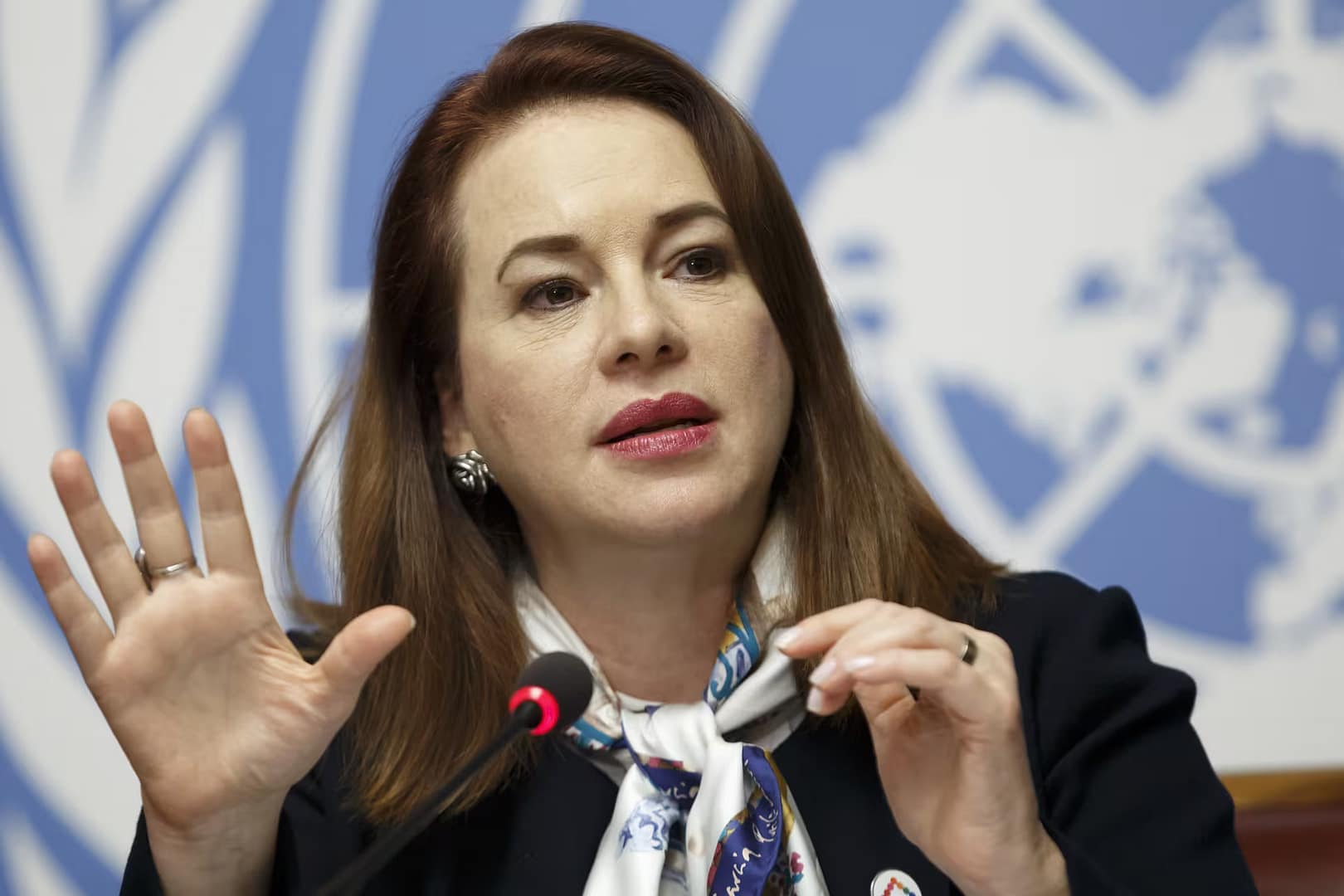
Antigua and Barbuda has officially put forward Her Excellency María Fernanda Espinosa Garcés, a veteran Ecuadorian diplomat and former United Nations General Assembly President, as its candidate for the next United Nations Secretary-General. The nomination was formally submitted to the heads of both the UN General Assembly and Security Council, aligned with the established selection process outlined in a joint November 25, 2025 document.
分类: politics
-
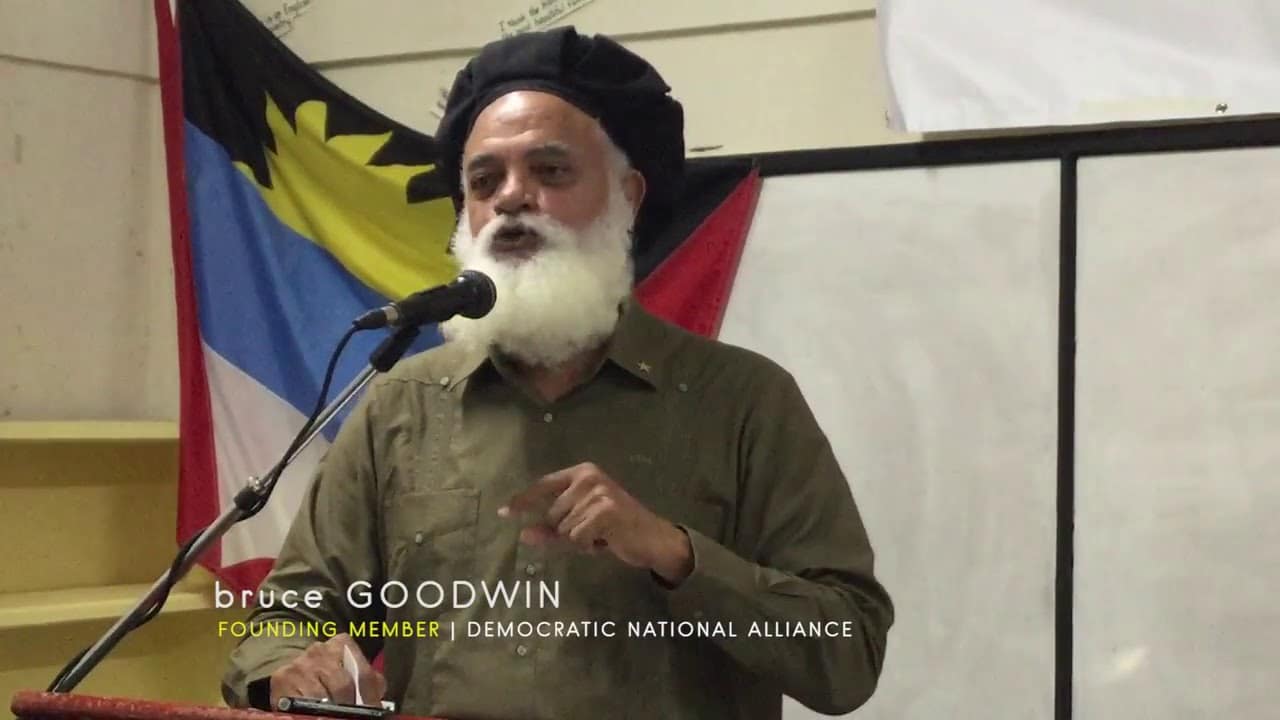
ABEC Demands Retraction, Threatens Legal Action Over Bruce Goodwin Allegations
The Antigua and Barbuda Electoral Commission (ABEC) has issued a firm public rebuke of its former chair Bruce Goodwin, demanding he immediately withdraw a series of incendiary unproven claims that the commission has compromised its institutional independence and cast doubt over the legitimacy of the 2026 April 30 general election. Goodwin made the allegations during a recent appearance on *Eye on the Issues*, a local current affairs program hosted by Louisa Tully, prompting the unusually strongly worded official statement released by ABEC on Tuesday.
In the statement, ABEC categorically rejected every claim Goodwin put forward, describing his comments as false, reckless, malicious, and completely unsupported by any credible evidence. The commission emphasized that all of its internal policies, operational frameworks, and procedural rules remain fully compliant with national law, and that it has operated with unwavering transparency and institutional independence since its establishment. ABEC flatly denied widespread claims in Goodwin’s remarks that the body has been “captured by the State,” controlled by partisan political interests, or maintains inappropriate improper ties to any government apparatus, calling any assertion to the contrary a scandalous and deeply irresponsible distortion of fact.
ABEC expressed particular disappointment that these damaging allegations came from a former leader of the organization, noting that Goodwin should be uniquely aware of the critical constitutional role the commission’s independence plays in upholding Antigua and Barbuda’s democratic system. The body warned that unsubstantiated public misinformation of this kind does lasting damage to public trust in core democratic institutions, framing Goodwin’s comments as not just an attack on individual commissioners and staff, but on the integrity of the entire electoral process itself.
The commission also came out in full defense of all its personnel, including the Supervisor of Elections, appointed commissioners, administrative staff, and election scrutineers, affirming that every team member has consistently carried out their statutory duties with professionalism, integrity, and relentless commitment to fair process. ABEC further clarified that any individual holding credible evidence of actual electoral misconduct should submit that evidence to the appropriate statutory authorities through established channels, rather than airing unproven accusations in public to sow public distrust.
“The dissemination of serious accusations in the public domain, without proof and in a manner calculated to inflame suspicion and disrepute, is a reckless abuse of public commentary and an affront to responsible democratic engagement,” the commission’s statement read.
ABEC also highlighted the long-standing practice of inviting local, regional, and international independent observer groups to monitor all stages of its electoral processes, noting that the full transparency of the commission’s operations would be clearly evident to any independent monitoring mission. The body closed by urging the general public to disregard Goodwin’s unsubstantiated claims, and reaffirmed its unwavering commitment to upholding impartiality, full compliance with the law, and radical transparency in all aspects of electoral administration moving forward. It also warned that it is fully prepared to pursue all available legal avenues to defend its reputation, institutional independence, and the integrity of the national electoral process.
-
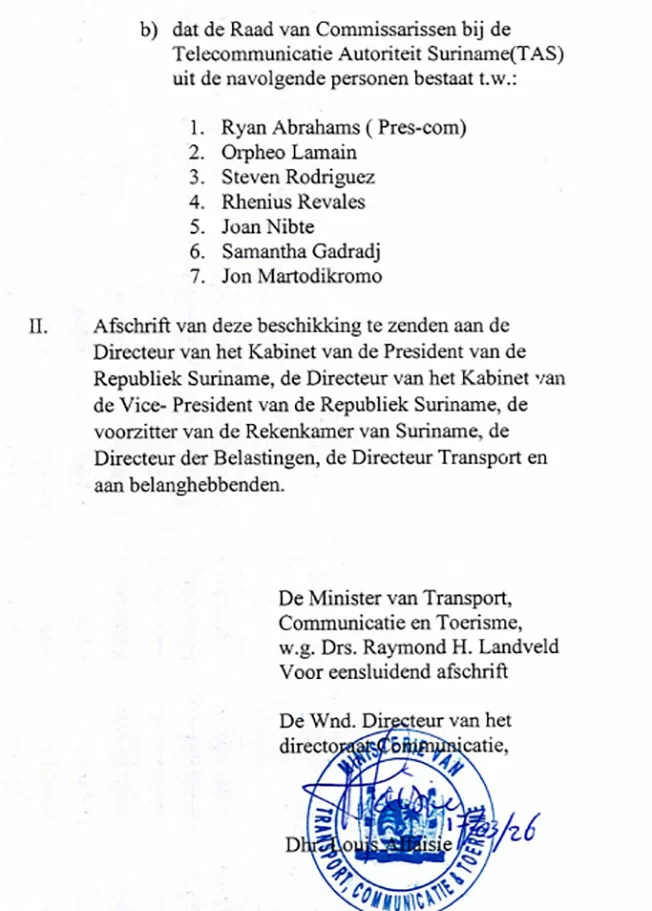
Ryan Abrahams officieel benoemd bij TAS, maar functie gaat naar Scheek
Political circles in Suriname are abuzz with speculation after conflicting appointments to the key leadership post of the Telecommunicatie Autoriteit Suriname (TAS) created an unprecedented administrative and political controversy.
In February 2026, an official ministerial decree from Suriname’s Ministry of Transport, Communication and Tourism formally named Ryan Abrahams as the new president-commissioner of the TAS Board of Commissioners, effective February 5. That same order also granted an honorable discharge to the outgoing officeholder, Donaghy Malone, with official gratitude extended for his past service to the regulator. The decree explicitly outlined the full composition of the new board, confirming Abrahams in the top leadership role.
However, in a sudden and unpublicized shift, Emanuel Scheek has now been installed in the same president-commissioner position. Crucially, no public announcement has been made confirming that the original 2026 ministerial decree appointing Abrahams has been formally revoked, leaving the legal status of both appointments and the TAS board’s leadership in uncertainty.
The confusion has been amplified by the recent political appointment of Ryan Abrahams’ father, Ramon Abrahams — who also serves as vice-chair of the National Democratic Party (NDP) — as a state advisor just two weeks prior. The elder Abrahams has publicly denied any involvement in building the current ruling coalition, only re-emerging in public political life over the past fortnight after an extended period out of the spotlight.
Local media outlet Starnieuws has confirmed that Suriname President Jennifer Simons is scheduled to hold a closed-door meeting with Ryan Abrahams on the day of the report. As of press time, no details have been released about what topics will be on the agenda for the discussion. To date, no government official or TAS representative has issued an official statement explaining the sudden leadership change or clarifying the conflicting appointments, intensifying ongoing political speculation across the country.
-
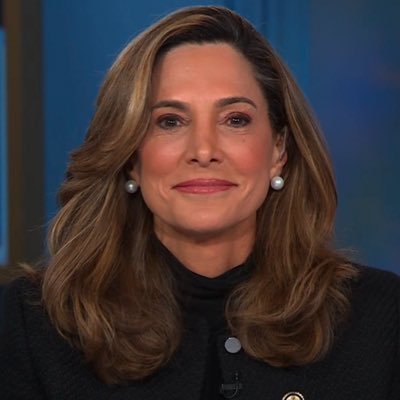
PPP calls US congresswoman’s rebuke of Venezuela’s interim President “forceful”
On Tuesday, May 12, 2026, Guyana’s governing People’s Progressive Party Civic (PPPC) publicly praised a forceful statement from U.S. Republican Congresswoman María Elvira Salazar backing Guyana’s territorial sovereignty amid escalating tensions with Venezuela over a long-running border dispute. Salazar, who chairs the House Foreign Affairs Subcommittee on Western Hemisphere Affairs, made her remarks on the social platform X one day after Venezuelan interim president Delcy Rodriguez delivered a provocative address to the International Court of Justice (ICJ) during oral hearings on the merits of the border case.
During her Monday appearance before the United Nations’ highest judicial body, Rodriguez doubled down on Venezuela’s rejection of any ICJ ruling on the validity of the 1899 Arbitral Tribunal Award that established the current land boundary between the two South American nations. She insisted that the 1966 Geneva Agreement—signed by Venezuela and the United Kingdom shortly before Guyana gained independence—remains the only legally valid framework for resolving the dispute through bilateral negotiations. Rodriguez warned that any ICJ judgment on the 1899 award would not resolve tensions, stating, “No judgment by this court on the territorial controversy will provide a definitive solution acceptable to both parties. On the contrary, it will exacerbate the differences between the parties, and will lead the parties to entrench themselves in their respective positions, distancing them from the practical, satisfactory and mutually acceptable settlement to which they committed in 1966 by signing the Geneva agreement.”
Salazar pushed back sharply against Rodriguez’s comments and her repeated threats to Guyana’s territorial integrity in her X post. She argued that Rodriguez mistakenly believes she can manipulate U.S. President Donald Trump the same way she and former ousted Venezuelan president Nicolás Maduro “tricked and destroyed” Venezuela. “Delcy should stop threatening Guyana and start learning from it,” Salazar wrote. She also warned Rodriguez against sending confidential correspondence to President Trump, emphasizing, “You don’t deal with him through secret letters while trying to steal territory from a free and sovereign nation like Guyana.”
Beyond addressing the border dispute, Salazar commended Guyana’s prudent management of its new oil wealth, noting that in less than a decade, the South American nation has set a stark contrast with Maduro’s regime in Venezuela. “Unlike the Maduro regime, Guyana didn’t rob its people. They managed their oil wealth responsibly, created a sovereign wealth fund, and saw GDP per capita quadruple in just five years,” she added.
As of Tuesday, Guyana’s national government had not issued an official public response to Salazar’s social media statement. The ICJ is on track to issue its binding ruling on the border dispute by the end of 2026 or in the first quarter of 2027, a decision that will shape the future of regional security and territorial claims in northeastern South America.
-
PNCR/APNU leader shrugs off more defections to PPP
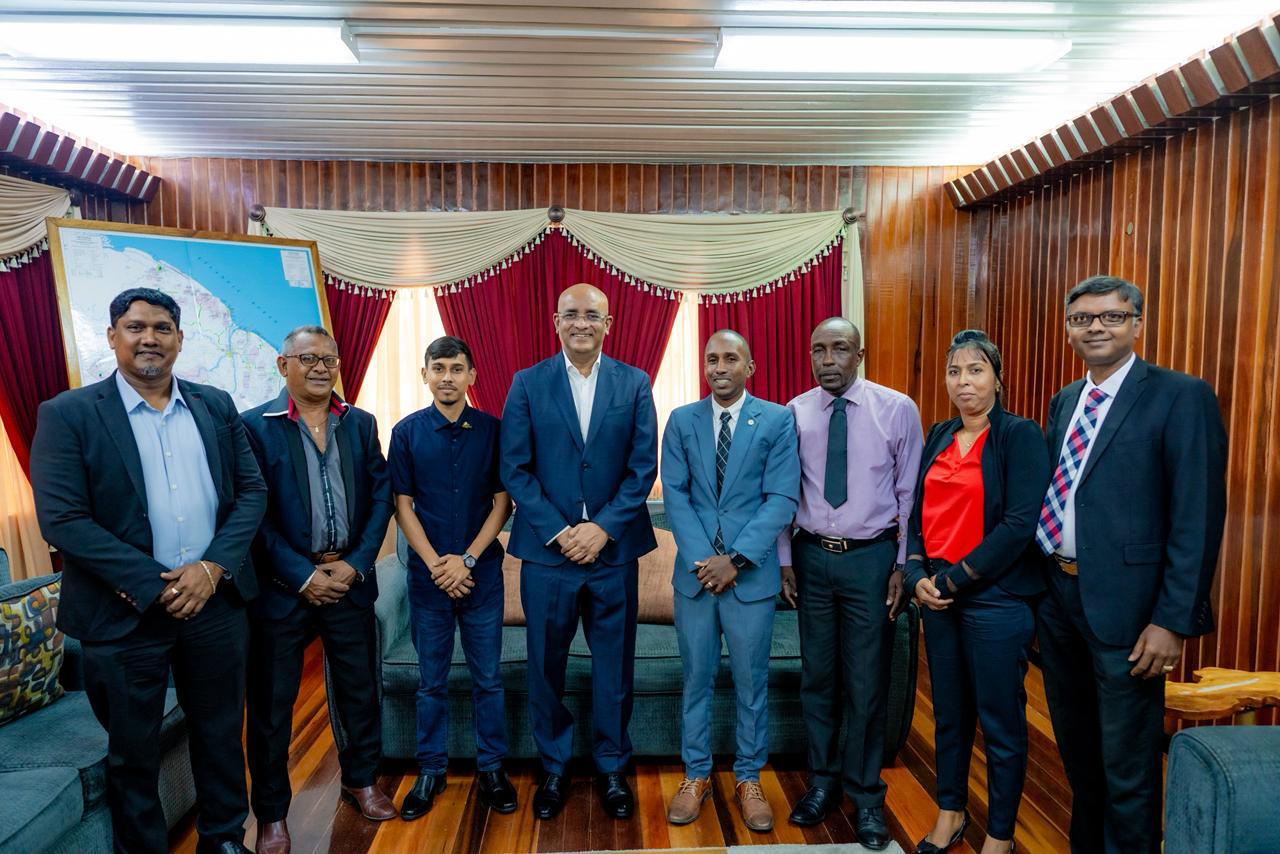
On Tuesday, 12 May 2026, People’s National Congress Reform (PNCR) and opposition bloc A Partnership for National Unity (APNU) leader Aubrey Norton pushed back against growing concerns over the party’s ongoing exodus of members, after the ruling People’s Progressive Party Civic (PPPC) announced the defection of seven current and former opposition-aligned politicians.
The seven new PPPC recruits include three former APNU+AFC Members of Parliament: Rickly Ramsaroop, Shurwayne Holder, and Dinesh Jaiprashad, plus four sitting regional councillors: Ravoldo Birbal, Sheik Yaseen, Prince Holder, and Gangadai Lloyd. Shurwayne Holder, a former PNCR Chairman, had openly signaled his dissatisfaction with the party after being excluded from APNU’s 2025 parliamentary slate following September’s general and regional elections, while Ramsaroop had already split from coalition partner Alliance For Change (AFC) in mid-2025 before briefly aligning with PNCR-led APNU.
In comments to Demerara Waves Online News, Norton framed the latest departures as an expected outcome that did not catch him off guard. “Everybody is free to go to whichever political party they want to go but even Stevie Wonder would have seen that that group was preparing to go to the PPP from the time most of them weren’t seeming to become members of parliament,” he noted. When pressed on whether he had detected disloyalty ahead of candidate nominations, he declined to speculate, saying that leaders can never fully predict the decisions of their members.
This latest wave of defections is part of a years-long trend that has seen more than a dozen opposition politicians leave PNCR and APNU for either the ruling PPPC or the new opposition bloc We Invest in Nationhood. Over less than five years, high-profile departures to the PPPC include James Bond, Jermaine Figueira, Geeta Chandan-Edmond, Richard Van West Charles, Daniel Seeram, and Samuel Sandy, while three other former members have taken executive roles with the new opposition grouping.
Addressing questions about how he will stem further departures, Norton acknowledged that sustained opposition status naturally creates this type of challenge for political parties. “When you’re in opposition for a while that happens. Don’t forget when we were in government- the PNC- many PPP people came and, of course, there are two different things. There is a difference between going to a political party based on principle and ideology and going for whatever personal reasons. You can’t stop people from going for their personal reasons,” he explained.
Norton rejected criticism that the steady “bleeding” of the party is a failure of his leadership, noting that all leadership tenures face challenges. He pushed back against claims he should be held responsible for the defection of figures like former Region Four Chairman Daniel Seeram, saying many of the departing politicians were not selected by him for their current roles. “There are many people I didn’t choose that went so it’s a reality you have to face. We will just continue to organise ourselves and move forward,” he said.
When asked if he was disappointed by the defection of young, rising politician Ravoldo Birbal, in whom he had previously expressed confidence, Norton described Birbal as young and inexperienced, framing his departure as a predictable outcome for less seasoned political actors.
The PPPC’s announcement of the new defections came just one day after former PNCR central executive member Dr. Aubrey Armstrong warned the opposition that it risked losing more supporters if it failed to address the needs of its base. During a commemorative lecture for former PNCR Leader and President Desmond Hoyte, Armstrong urged the party: “You have to take care of your people. You have to find ways of feeding them and so on. If not, you open the door for somebody else to poach them.”
In its official statement announcing the new recruits, the PPPC said the seven politicians requested a meeting with the party’s General Secretary to formalize their shift in affiliation. The group told PPPC leadership they wanted to contribute to Guyana’s ongoing period of unprecedented economic growth and modernization, while advancing the public interest. They praised the ruling party’s open, inclusive governance style, its successful implementation of its policy manifesto, and the tangible improvements it has delivered to communities across the country. The defectors also highlighted the PPPC’s effective economic stewardship, its commitment to inclusive governance that serves all Guyanese regardless of identity, and its proven capacity to sustain national growth.
Notably, the four sitting regional councillors who have switched affiliation cannot be recalled from their posts under current Guyanese electoral law, as no existing statute allows list representatives to remove sitting elected regional councillors after they have taken office.
-
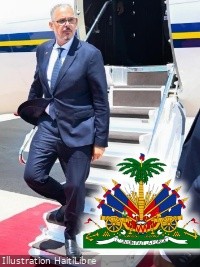
Extraordinary Council of Ministers meeting on the security situation in Haiti
Fresh off an official working tour of European nations including Italy’s capital Rome, Haitian Prime Minister Alix Didier Fils-Aimé did not delay before prioritizing the country’s escalating security crisis. On Tuesday, May 12, 2026, within hours of his return to Haitian soil, Fils-Aimé called together and led an Extraordinary Council of Ministers at the diplomatic lounge of Port-au-Prince’s Toussaint Louverture International Airport, with the deteriorating national security environment as the sole top agenda item.
Against a backdrop of renewed criminal activity that has stoked widespread, well-founded unease across Haitian communities, the Prime Minister issued a firm, clear reaffirmation of the executive branch’s unshakable dedication to reestablishing the rule of law across every region of the country. Participants in the working session conducted a granular, rigorous review of on-the-ground security conditions, ultimately approving a series of explicit directives and actionable policy measures designed to immediately boost the operational capacity of Haiti’s law enforcement bodies. The approved framework establishes a structure for a coordinated, forceful, and long-term response to all categories of criminal activity plaguing the nation.
During the meeting, Fils-Aimé stressed that the Haitian state will not surrender to fear or pressure from violent actors. He confirmed that all required resources are being mobilized to target criminal groups, dismantle transnational and local gang networks, and rebuild durable public safety across the country. The Prime Minister also restated his personal commitment to leading this fight for collective security without relent, urging the Haitian public to remain calm, alert, and united in national solidarity. He emphasized that the state is fully accepting its responsibility to guide the nation out of the ongoing security crisis.
Immediately after adjourning the extraordinary council meeting, Fils-Aimé traveled to the General Directorate of the Haitian National Police (PNH) to extend his direct support to Acting Director General Vladimir Paraison. He publicly commended the work of the PNH High Command and every frontline police officer deployed across the country to counter rising insecurity. The trip served as a tangible reaffirmation of the government’s backing for law enforcement personnel who work daily to restore national stability, and it aligns with the Prime Minister’s previously issued instructions to all state institutions to ramp up offensive operations against the gangs that have terrorized civilian populations in recent months.
-
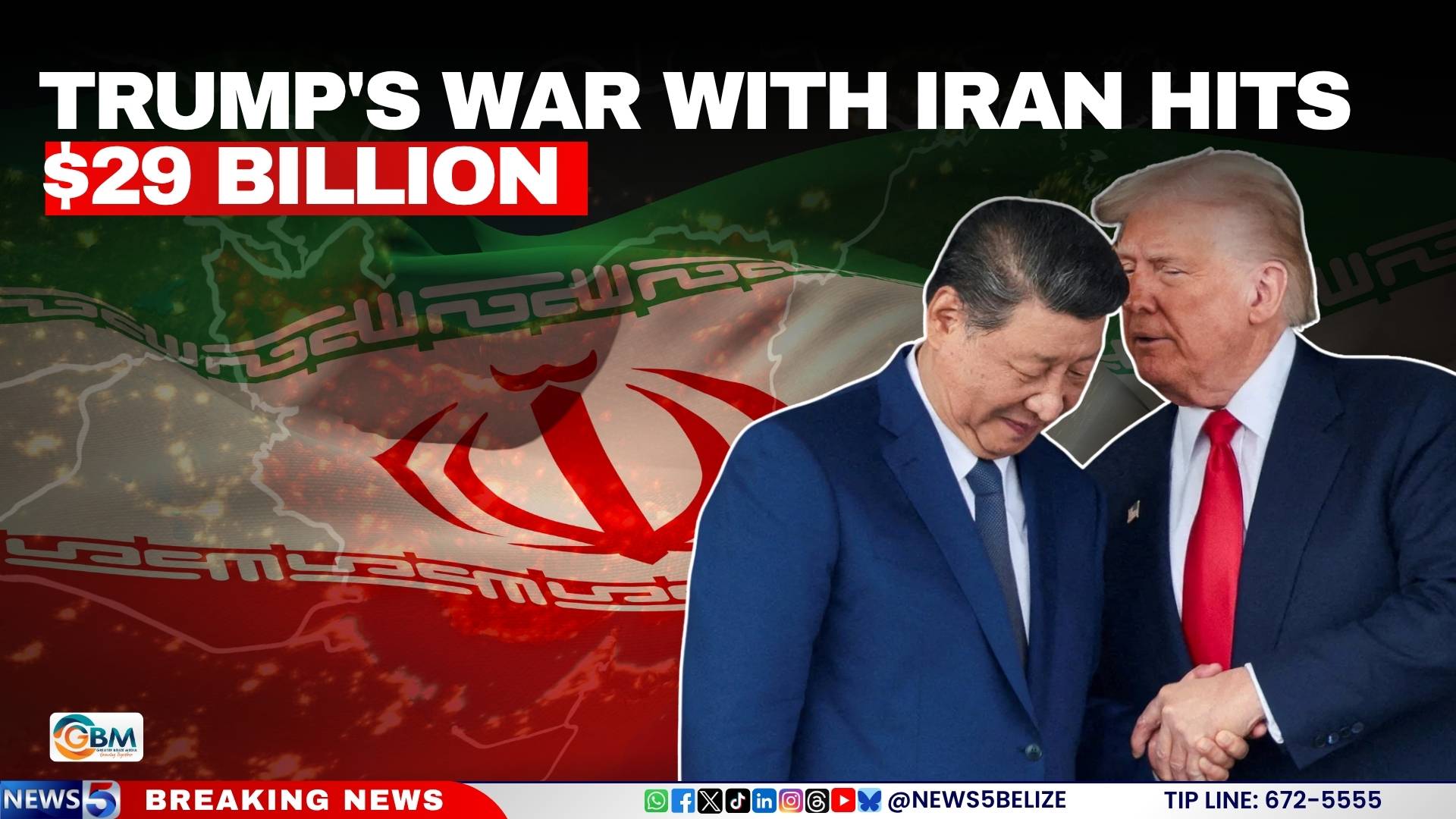
Trump’s War with Iran Hits $29 Billion
As of May 12, 2026, the cumulative financial cost of the ongoing military conflict between the United States and Iran has surged to an estimated $29 billion, marking a $4 billion increase from the official congressional estimate released just two weeks prior, according to a senior Pentagon official Jay Hurst. This rising price tag has amplified already widespread economic anxiety across the United States, as policymakers and households brace for cascading impacts on daily living expenses.
Parallel to the mounting costs, the U.S. Department of Energy has issued a formal warning that global crude oil prices are projected to stay above the $100 per barrel threshold in the coming weeks. The energy price surge stems from escalating regional instability: Iranian military operations have damaged critical energy infrastructure across the Middle East, disrupting global oil production and shipping lanes. Compounding the crisis, a large uncontrolled oil spill off Iran’s major Kharg Island export terminal continues to spread, threatening further disruptions to global energy supplies and worsening ecological damage in the Persian Gulf.
Despite these mounting pressures, diplomatic efforts to de-escalate the conflict remain stuck in a deadlock. Negotiations between the Trump administration and Iranian leadership have failed to produce any breakthroughs to date. Amid the stalemate, international attention has turned to China as a potential third-party mediator to facilitate dialogue between Washington and Tehran. U.S. President Donald Trump is scheduled to travel to China on the same day the new cost estimate was released, where he confirmed he will hold a “long talk” with Chinese President Xi Jinping, CNN reported.
However, Trump has downplayed the need for Chinese mediation, striking a confident tone in comments to CNN. “We’ll win it one way or another,” he said. “We’ll win it peacefully or otherwise.” Observers note that China’s close economic and diplomatic ties with Iran position it uniquely to broker a negotiated solution, but the Trump administration’s reluctance to explicitly request assistance could complicate any potential de-escalation efforts. With the financial and human costs of the conflict continuing to climb and energy markets already strained, policymakers and global markets are closely watching the upcoming U.S.-China talks for any signs of progress toward ending the standoff.
-
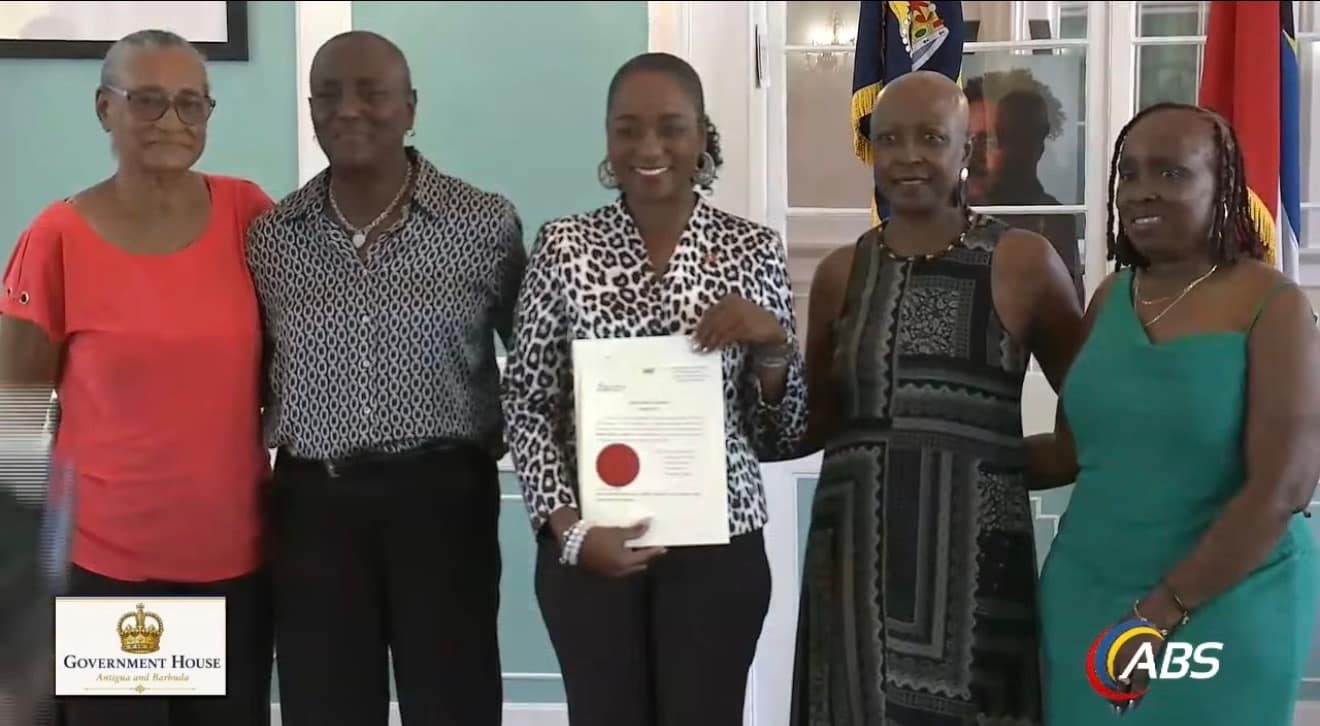
WATCH: Senator Jamilla Kirwan Says Public Service Must Be About “Doing” Not “Shouting”
As independent Senator Jamilla Kirwan prepares to rejoin the Australian Senate for a new parliamentary term, she is charting a deliberate departure from the acrimony that defines much of modern politics, saying public office should center on tangible service rather than performative confrontation.
In a post-swearing-in interview, the first-term senator opened up about the personal and political trials she navigated in the months leading up to her return to parliament, noting these challenges tested her perseverance and deepened her dedication to serving the national public. “Beyond feeling overwhelmed, I am deeply humbled and incredibly honored to carry this responsibility,” Kirwan shared. “Strength only reveals itself when it is put to the test, and this role is that test for me.”
Her short initial tenure in the upper house only reinforced her drive to contribute to public life and national progress, she said. Frameed by the principle that great responsibility comes with great privilege, Kirwan said she planned to approach her work with full energy and focus.
Kirwan also turned her attention to the systemic barriers that keep women and young people from engaging in political life, pointing to the increasingly bitter tone of modern public discourse as a major deterrent for emerging leaders. “I have not been comfortable with the current political landscape,” she explained. “It has grown so caustic, so divisive, that it’s a traumatic experience for anyone entering politics — regardless of gender — and it pushes young people away before they even get started.”
For Kirwan, effective politics should be rooted in community service, not ego-driven posturing, public shouting matches or performative arguments. “Voters don’t want representatives who care more about their own profile than getting things done,” she said. “They want leaders who show up for people, full stop.”
She pointed to her six years leading the Calvin Air Foundation as proof of her commitment to empowering marginalized communities and advocating for groups that are often shut out of political conversations. “That work has always been about one thing: service,” she noted. “Standing with people who can’t advocate for themselves, and giving a voice to those who have been silenced.”
The senator said she hopes her career path will encourage more young women to pursue political leadership, even amid the often harsh pressures of public life. Echoing her commitment to action over words, she said: “I don’t just plan to talk about change. I plan to deliver it. It’s not about preaching, it’s not about empty rhetoric — it’s about doing.”
The swearing-in proceedings also carried deep personal meaning for Kirwan, who became emotional reflecting on the legacy of her late mother “Momi” Lucy, who passed away recently. Kirwan described her mother as a quiet, unassuming woman with unshakable resilience who always encouraged her to pursue any goal she set her mind to. “I will carry her legacy forward for myself and for my children,” she said.
Looking ahead to the opening of the new parliamentary term, Kirwan said her first priority after formal swearing-in is to begin what she calls “the people’s work.” “No matter what comes across the agenda, I’m ready,” she said. “I’m prepared to do my part for the Australian public.”
-
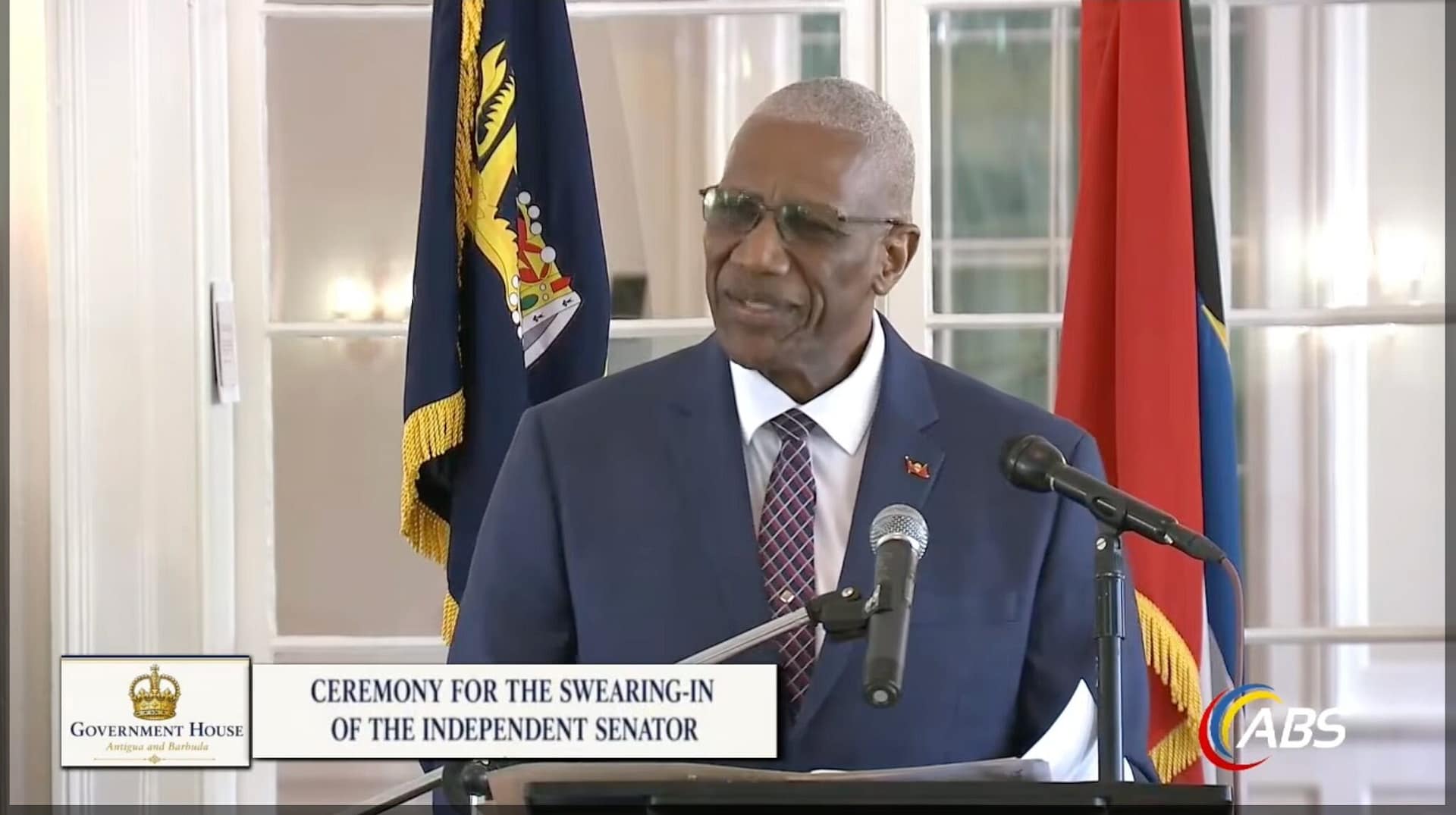
Governor General Praises Jamilla Kirwan’s Strength as She Returns to Senate While Mourning Mother
In a moving swearing-in ceremony held at Government House on Monday, Governor General Sir Rodney Williams publicly honored the extraordinary resilience of independent Senator-designate Jamilla Kirwan, who stepped back into her Senate role just days after losing her mother, with her family’s funeral arrangements for the late matriarch still underway.
Addressing attendees gathered for the formal occasion, Sir Rodney opened his remarks by acknowledging the heavy weight of personal sorrow that framed the day. He noted that while Kirwan was there to take the oath of office and resume her legislative duties, she remained in the depths of bereavement following the passing of her beloved parent.
Sir Rodney described Kirwan’s late mother as the senator’s most steadfast cheerleader and a foundational source of strength throughout her life and public career. Extending sincere condolences to Kirwan and her entire family on their loss, the Governor General emphasized that Kirwan’s choice to continue her commitment to public service even in the midst of profound grief embodied the kind of courage that lifts up entire communities.
“Even in grief, there are examples of strength that inspire us,” he told the assembled guests.
Sir Rodney went on to reflect that the resilience people display is rarely born from circumstance alone. Instead, he argued, it is rooted in the values, work ethic, and determination passed between generations through family upbringing and shared experience. “There’s courage that comes not only from experience, but from upbringing — not only from circumstance, but from the values, resilience and determination passed on from one generation to the other,” he explained.
As Kirwan prepares to take up her seat in the Upper House of Parliament, Sir Rodney noted that she carries far more than her own policy ambitions and public service goals. She also carries the lasting influence and unwavering spirit of the mother who helped shape her into the leader she is today.
This swearing-in marks Kirwan’s return to the Senate, following her first initial appointment as an independent senator on November 27, 2025. Though her first term was short, Sir Rodney highlighted that even that brief period of service made clear Kirwan’s ability to contribute thoughtful, meaningful insight to national policy debates and legislative review processes.
The Governor General also took a moment to thank Kirwan’s family and friends for their ongoing support, noting that public service is uniquely demanding, both professionally and emotionally, and that the backing of loved ones is critical to allowing elected and appointed officials to carry out their work.
Speaking after the formal ceremony, an emotional Kirwan reflected on her mother’s lasting impact on her life and career. She shared her commitment to honoring her mother’s legacy by upholding the values her mother instilled in her and her children, as she carries forward her work in the Senate.
-
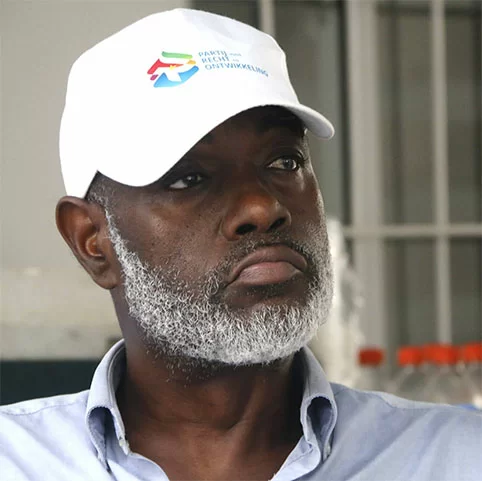
PRO rouwt om overlijden van hoofdbestuurslid Marlon Hoogdorp
Suriname’s Party for Law and Development (PRO) has confirmed the passing of its prominent senior executive board member Marlon Hoogdorp, who died Monday evening at the age of 59. Hoogdorp had been hospitalized for two weeks prior to his death.
A long-time supporter of PRO’s core mission, Hoogdorp officially joined the party in late 2024, drawn to its founding ideals of “law and development” — a framework that aligned closely with his own vision for equitable progress across Suriname. He quickly rose to a seat on the party’s top executive board, where he played an influential role in the lead-up to the 2025 Surinamese general elections. He was also named a candidate on the joint electoral list of the A20/DOE/PRO opposition coalition.
Within PRO, Hoogdorp earned widespread respect for his deep expertise in communications and media strategy, as well as his naturally collaborative, community-focused demeanor. Party officials described him as a warm, committed, and driven public servant who remained dedicated to long-term, positive change for Suriname. Prior to his passing, Hoogdorp had been nominated to a senior post at the Surinamese embassy in Paris, and had already completed multiple specialized training programs to prepare for the role.
In an official statement released this week, PRO expressed profound sadness over the loss of Hoogdorp, extended sincere gratitude for his years of contribution to both the party and Surinamese civil society, and offered condolences to his family, friends, and loved ones, wishing them strength in this difficult period of grief.