分类: politics

  • Senior FNMs to Minnis ‘your time has passed’

    Senior FNMs to Minnis ‘your time has passed’

    The Bahamian political landscape was thrown into turmoil following former Prime Minister Dr. Hubert Minnis’s declaration to contest the Killarney constituency as an independent candidate, effectively severing his longstanding affiliation with the Free National Movement (FNM). This unexpected move has triggered strong reactions from former cabinet members of the Minnis administration, who expressed both disappointment and criticism regarding the decision.

    Senior FNM figures characterized the move as politically damaging and historically unpromising. Former Deputy Prime Minister and Finance Minister Peter Turnquest described the development as ‘disappointing,’ framing it as symptomatic of a broader failure within Bahamian politics where veteran leaders struggle to recognize their appropriate time to exit the stage. He emphasized that independent candidates have historically faced near-insurmountable challenges in achieving electoral success within the country’s two-party dominated system.

    Former Tourism Minister Dionisio D’Aguilar offered more pointed criticism, questioning the rationale behind ending a political career through open conflict with one’s own party. He suggested Dr. Minnis would face expulsion from the FNM for challenging the party’s ratified candidate in Killarney, Senator Michaela Barnett-Ellis. D’Aguilar further noted that Dr. Minnis had already reached the apex of political office and questioned the value of returning to parliament as a backbencher.

    Adding to the chorus of concern, former Immigration Minister Brent Symonette suggested Dr. Minnis could have maintained relevance without severing party ties, arguing that meaningful contributions remained possible even after electoral and leadership defeats. He implied that an earlier, more graceful exit would have demonstrated stronger character.

    The FNM organization, through its chairman and former health minister Duane Sands, indicated it would not be distracted by Dr. Minnis’s ambitions, instead focusing support on its official candidates. Meanwhile, Senator Barnett-Ellis reported that her campaign continues unchanged, centered on addressing constituent concerns including infrastructure issues, flooding, and economic development opportunities.

  • Former FNM women’s president defects to PLP after 33 years

    Former FNM women’s president defects to PLP after 33 years

    In a significant political realignment, Karen Shepherd, a longstanding Free National Movement (FNM) figure, has publicly severed ties with her party of 33 years to pledge allegiance to Prime Minister Philip Davis and the Progressive Liberal Party (PLP). The formal induction ceremony occurred at PLP headquarters on Farrington Road, where she received her membership credentials alongside senior officials including party chairman Fred Mitchell.

    Shepherd, who previously held multiple leadership roles including three terms as president of the FNM’s Women’s Association and party trustee, attributed her defection to fundamental philosophical disagreements. She asserted the FNM has deviated from its foundational principles, noting a disconnect between the party’s rhetoric and its operational conduct. “Their words are saying one thing, yet their actions show another,” she observed, referencing the erosion of the FNM’s traditional ‘all together’ motto.

    The former Englerston candidate revealed that FNM leader Michael Pintard failed to initiate contact following her resignation announcement. She described a party experiencing substantial grassroots erosion while focusing disproportionately on visible leadership positions, metaphorically noting that while “the party was filling their spaces from the front, the back is hemorrhaging.”

    Shepherd detailed how her decision crystallized during constituency canvassing, where she repeatedly encountered dissatisfied supporters whose concerns were systematically ignored by party leadership. She framed her move as ethically motivated rather than opportunistic, emphasizing her commitment to national interest through “holy courage” and clear conscience.

    Citing her political heritage as the daughter of late PLP MP James Shepherd, she invoked historical continuity by referencing her father’s advocacy for price controls, housing initiatives, urban renewal, and labor reforms during the transformative 1967 general election. She specifically highlighted his role as the first House of Assembly Whip and his association with former Prime Minister Sir Lynden Pindling.

    Shepherd concluded with an explicit endorsement of Prime Minister Davis’s reelection bid, urging undecided voters to “join me on the winning team” committed to Bahamian service. PLP leadership welcomed her as a valuable organizational asset, with Women’s Branch chairwoman Calverna Small recognizing her as a formidable campaign operative.

  • ‘They ain’t coming in my yard’: FNM veteran slams Rick Fox pick

    ‘They ain’t coming in my yard’: FNM veteran slams Rick Fox pick

    The Free National Movement’s ratification of former NBA star Rick Fox as its Garden Hills candidate has ignited significant internal dissent within the party ranks, exposing deep divisions regarding leadership decisions and candidate selection processes. Prominent party figures have publicly condemned the move, characterizing it as symptomatic of the organization’s broader decline under current leadership.

    Ricardo Rolle, a former constituency chairman and nine-year president of the Garden Hills association during the Ingraham administration, delivered scathing criticism of both the party hierarchy and Fox’s nomination. The veteran FNM supporter, who has maintained party allegiance since 1985, asserted that the decision to bypass established political figures like former MPs Dr. Hubert Minnis and Renward Wells in favor of a political newcomer represents a fundamental misjudgment that has disillusioned long-standing members.

    ‘This constitutes the most poorly managed period in FNM’s history,’ Rolle declared to The Tribune, emphasizing Fox’s lack of local political knowledge. ‘He cannot even delineate Garden Hills’ boundaries despite seeking to represent the constituency.’

    The controversy emerges amid revelations that this year’s general election will mark Fox’s first-ever electoral participation in The Bahamas, a fact that has raised eyebrows among party traditionalists who expected longtime aspirant D’Angelo Ferguson to secure the nomination after extensive campaigning.

    Kendal Culmer, an FNM meritorious council member, echoed these concerns, noting the absence of proper consultation regarding Fox’s selection. Culmer questioned whether Fox’s celebrity status and financial success qualified him for political office, criticizing party leader Michael Pintard’s communication on the matter.

    Despite the substantial opposition, some party voices have expressed support for Fox’s candidacy. Former area MP Brensil Rolle endorsed the decision, describing Fox as a qualified Bahamian who merits opportunity and predicting that Garden Hills voters would prioritize performance over political rhetoric in their electoral decisions.

  • Van der San: Synchronisatie leidt tot forse inkomensstijging rechterlijke macht

    Van der San: Synchronisatie leidt tot forse inkomensstijging rechterlijke macht

    A controversial judicial compensation law in Suriname has triggered alarm over its substantial fiscal implications, according to administrative expert Eugène van der San. The Judicial Position Act, intended to regulate the financial status of the judiciary as mandated by the Constitution since 1975, has instead created unprecedented salary structures that threaten state finances.

    Van der San’s detailed analysis reveals that the legislation has effectively merged both sitting magistrates (judges) and standing magistrates (prosecutors) under a single compensation regime with exceptionally high income percentages. Most notably, the Prosecutor General now receives approximately SRD 1 million net monthly income – a figure that far exceeds previous compensation norms.

    The critical shift occurred when the new law abandoned the traditional practice of linking judicial salaries to percentages of presidential compensation (typically 70-80%) and implemented a system allowing incomes to reach 95% of presidential salary, excluding allowances. The most concerning aspect, according to Van der San, is the allowance regime that permits supplementary payments reaching 150-170% of base salary, all tax-free.

    This creates an anomalous situation where tax-free allowances exceed taxable base salaries, violating fundamental principles of sound governance. The arrangement establishes long-term budgetary obligations without consideration for the country’s economic capacity, as the law automatically applies to both judicial branches including prosecutors and the Prosecutor General.

    Van der San emphasizes that the timing of implementation – after elections – obscured the financial impact during legislative consideration. He characterizes the situation as a ‘financial time bomb’ beneath the national budget and calls for immediate correction by President Jennifer Simons. His proposed solution involves repealing the current law and creating separate regulatory frameworks: one constitutional arrangement for sitting magistrates and a more modest, separate system for standing magistrates.

  • Commonwealth law ministers meeting launches with appeals for equal application to global rule of law in changing times

    Commonwealth law ministers meeting launches with appeals for equal application to global rule of law in changing times

    Nadi, Fiji – Against a backdrop of global uncertainty, the Commonwealth Law Ministers Conference opened today with a powerful call to reinforce legal systems worldwide. Hosted in Fiji, the gathering brings together justice ministers and attorneys general from all 56 Commonwealth nations to address pressing legal challenges affecting citizens’ daily lives and economic stability.

    The conference commenced with a traditional Fijian welcoming ceremony for dignitaries including Fijian Prime Minister Sitiveni Rabuka, Tuvalu’s Prime Minister Feleti Penitala Teo, and Tonga’s Deputy Prime Minister Viliami Latu. Over 250 delegates are participating in the three-day summit focused on practical solutions for strengthening judicial integrity.

    In his opening address, Prime Minister Rabuka issued a stark warning about the global deterioration of legal frameworks. “When the rule of law is weakened, inconsistently applied, or loses public confidence,” he stated, “the most vulnerable members of our societies bear the ultimate cost.” Rabuka emphasized that the conference must transcend theoretical discussions to deliver actionable strategies that ensure justice systems remain reliable and accessible.

    The Prime Minister particularly highlighted the critical intersection of climate change and legal protection, urging ministers to develop legal mechanisms that safeguard both communities and environments from ecological threats.

    Commonwealth Secretary-General Shirley Botchwey addressed the assembly amid concerns about growing political instability and economic volatility. “When the rule of force begins to overshadow the rule of law,” Botchwey cautioned, “the very foundations of our societies become compromised.” She characterized the ministers’ work as essential to rebuilding institutional trust and strengthening democratic resilience.

    The conference agenda focuses on three primary areas: legal frameworks for democratic preservation, economic development through judicial reliability, and environmental sustainability legislation. Specific discussions will address maritime rights protection in the face of rising sea levels and technological applications for improving access to justice.

    Under the theme “Anchoring Justice in a Changing Tide: Strengthening the Rule of Law for a Resilient Future,” the conference is chaired by Fiji’s Minister for Justice and Acting Attorney-General Siromi Turaga. The proceedings will conclude on February 11th with the adoption of a comprehensive outcome statement detailing concrete commitments Commonwealth nations will implement to reinforce legal protections for their citizens.

  • Attorney General of Grenada attends Commonwealth law ministers meeting in Fiji

    Attorney General of Grenada attends Commonwealth law ministers meeting in Fiji

    Against a backdrop of mounting global challenges, justice ministers and attorneys general from the 56 Commonwealth nations gathered in Nadi, Fiji, on February 9, 2026, for a pivotal three-day conference addressing the erosion of legal protections worldwide. The assembly, marked by a traditional Fijian welcoming ceremony for over 250 delegates including Grenada’s Attorney General Claudette Joseph, commenced with urgent calls to reinforce judicial systems as pillars of societal stability.

    Fijian Prime Minister Sitiveni Rabuka set a sober tone in his opening address, cautioning that weakening legal frameworks disproportionately harm vulnerable populations. ‘When the law is undermined, inconsistently enforced, or fails to earn public trust, it is ordinary citizens who bear the real consequences—not abstract systems,’ Rabuka emphasized. He framed the gathering as a working session demanding actionable outcomes rather than mere theoretical discussions.

    Commonwealth Secretary-General Shirley Botchwey identified political instability, economic fluctuations, and environmental crises as factors diminishing public confidence in governance institutions. ‘This is the inevitable result when the rule of force supersedes the rule of law,’ she stated, underscoring the ministers’ critical role in rebuilding institutional trust. Botchwey highlighted the organization’s new strategic plan focusing on making legal protections tangible in daily life beyond courtroom settings.

    The ministerial agenda encompasses pressing contemporary issues including climate justice, maritime rights amid rising sea levels, and technological applications for improving legal accessibility. Deliberations will culminate on February 11 with the adoption of a concrete action plan outlining specific measures Commonwealth countries will implement to strengthen legal resilience. Chaired by Fijian Justice Minister Siromi Turaga under the theme ‘Anchoring Justice in a Changing Tide,’ the conference represents a coordinated effort to ensure laws serve those most dependent on protection rather than those best positioned to exploit them.

  • CHOGM training steps up as Antigua and Barbuda prepares for 2026 summit

    CHOGM training steps up as Antigua and Barbuda prepares for 2026 summit

    The Government of Antigua and Barbuda has launched an intensive training program for public officials to enhance operational readiness for the upcoming 2026 Commonwealth Heads of Government Meeting (CHOGM). Conducted at the Antigua and Barbuda Defence Force Training Centre, the sessions bring together personnel from multiple ministries and agencies to strengthen interdepartmental coordination capabilities.

    Foreign Affairs Minister E. P. Chet Greene emphasized the national significance of CHOGM 2026, characterizing it as a substantial governmental undertaking that demands seamless collaboration across all sectors. “This summit requires unprecedented coordination to guarantee security, operational efficiency, and an exceptional experience for all visiting delegations,” Minister Greene stated during the training inauguration.

    The comprehensive preparation program forms part of a broader initiative to build public service capacity and establish Antigua and Barbuda’s reputation as a competent host for major international gatherings. Ambassador Dr. Clarence Pilgrim highlighted the crucial role of the newly established National CHOGM Secretariat, which provides a centralized framework for strategic planning and interagency alignment while addressing emerging logistical challenges.

    Brigadier Telbert Benjamin, Chief of Staff of the Defence Force, indicated that preparatory efforts are transitioning from strategic planning to practical execution phases. “We are entering the most critical implementation stage where discipline, coordinated response mechanisms, and timely decision-making will determine our success,” Benjamin noted during tactical exercises.

    The 2026 gathering will convene leaders from across the Commonwealth nations, positioning Antigua and Barbuda at the forefront of global diplomatic engagement and potentially elevating its international profile as a capable host state for significant multilateral events.

  • One Bill to receive first reading in the National Assembly on Thursday, February 12, 2026

    One Bill to receive first reading in the National Assembly on Thursday, February 12, 2026

    The National Assembly of Saint Kitts and Nevis is scheduled to convene on Thursday, February 12, 2026, at 10:00 a.m. in the National Assembly Chambers at Government Headquarters, Basseterre. The parliamentary session will feature the inaugural reading of significant financial legislation proposed by the government.

    Prime Minister Hon. Dr. Terrance Drew, who holds multiple portfolios including Finance, National Security, Citizenship and Immigration, Health and Social Security, will formally introduce the Saint Kitts and Nevis Sovereign Wealth and Resilience Fund Bill (2026). This legislative initiative represents a continuation of the administration’s commitment to principles of good governance, transparency, accountability, and the Rule of Law.

    The parliamentary proceedings will receive comprehensive media coverage, being broadcast live on ZIZ Radio (96 FM) and several partner radio stations. Television audiences can watch the session on Channel 5 in St. Kitts and Channel 98 in Nevis, while digital access will be available through live streaming at www.zizonline.com.

    Official copies of the proposed legislation will be made accessible to the public through multiple channels once available. These include the official website of the St. Kitts and Nevis Information Service (www.sknis.gov.kn) under the ‘Bills’ section, as well as through their Facebook platform, ensuring widespread public access to the document.

  • Column: Samen voelen? Dan eerst samen inleveren

    Column: Samen voelen? Dan eerst samen inleveren

    A profound disparity in compensation between Suriname’s political elite and its public sector workers has ignited widespread social discontent. While teachers with 35 years of experience barely net SRD 13,000 monthly, nurses remain systematically underpaid, and civil servants survive on minimal allowances, members of De Nationale Assemblee enjoy compensation packages increasingly indefensible to the populace they represent.

    The controversial legislation enabling these benefits was passed in the previous parliament shortly before May 2025 elections. The National Democratic Party (NDP), then in opposition, stood alone in principled opposition, condemning the increases as unjust, antisocial, and irreconcilable with the nation’s economic reality. Today, that same party sits in the coalition government, not only accepting but defending the very law they once rejected.

    Financial disclosures reveal staggering figures: The President receives SRD 130,364 monthly, while the Assembly Chairperson gets 85% of that amount (approximately SRD 110,000). Regular assembly members earn 60% of the presidential salary (roughly SRD 66,485 gross), but with additional allowances and provisions, their net monthly income approaches SRD 95,000—totaling approximately SRD 132,000 gross.

    Beyond base compensation, parliamentarians receive comprehensive medical coverage for themselves and their families—including dental, vision care, and overseas treatment when necessary. Additional benefits include vehicle, housing, communication, and representation allowances; travel and accommodation expenses; domestic travel reimbursements including vehicle rentals; VIP airport facilities; diplomatic passports; and potentially a forthcoming 20% management allowance.

    This privileged existence contrasts sharply with a nation where parents struggle to afford public transportation for their children, where healthcare and education sectors must repeatedly strike to be heard, where many work two or three jobs to stay afloat, and where consecutive economic reforms have decimated the middle class.

    Proponents argue that assembly members must maintain full-time availability—a reasonable requirement in principle. While formally barred from holding additional government positions, they face virtually no restrictions on private sector activities. Many serve as entrepreneurs, exporters, or consultants, while others enjoy continuous income from previous ministerial, advisory, or civil service roles. The emerging portrait reveals a political class securing itself while demanding sacrifices from the rest of society.

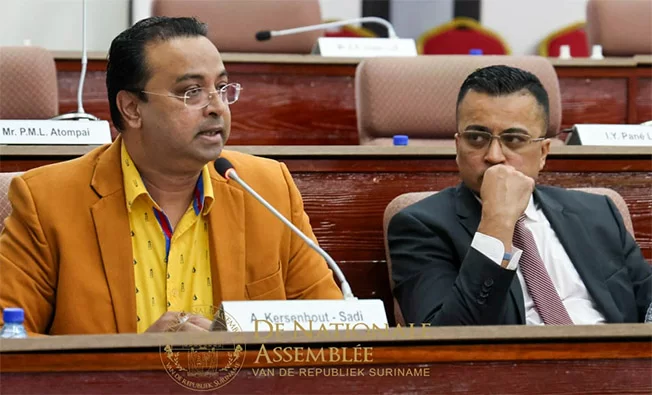
    Poetini Atompai (NPS) during the election campaign pledged to amend this law—a promise he now renews with commitment to legislative initiative. While positive, words alone no longer suffice. Society has moved beyond trusting intentions to demanding action: submit the proposal, gather co-sponsors, place it on the agenda, force a vote, and show the nation who supports correction versus who clings to privileges at the treasury’s expense.

    Labor unions observe closely while negotiating, recognizing that calls for wage restraint ring hollow while leadership makes no concessions. Negotiations concern not merely percentages but exemplary conduct. Officials frequently claim “no space” exists for increasing civil servant salaries, yet apparent abundance remains for luxury, official travel, and expanding benefits for those in power—a contradiction the public both sees and remembers.

    Social media anger appears raw and sometimes unrefined but not unfounded. Terms like “puppet show,” “theater,” and “self-enrichment” emerge from years of disappointment. Cynicism isn’t innate but learned through repeated behavioral patterns.

    Nobody claims assembly members should serve without compensation, but remuneration must correspond to level, responsibility, performance, and social context. Those receiving top compensation must deliver excellence: substantive work, attendance, legislation, oversight, and integrity.

    “Feeling together,” asserts Atompai—a powerful phrase. But feeling together without sacrificing together constitutes rhetoric, not solidarity. If seriousness exists, it must begin where power resides, not with the populace. Submit the amendment law. Place it on the agenda. Demonstrate who truly wishes to feel together—and who merely wishes to enjoy together.

  • PM Friday presents tax-free $1.9b budget

    PM Friday presents tax-free $1.9b budget

    The Parliament of St. Vincent and the Grenadines commenced deliberations on Tuesday regarding a substantial EC$1.9 billion fiscal package, presented by Prime Minister and Finance Minister Godwin Friday. This budget marks the inaugural financial blueprint from the New Democratic Party administration since assuming power on November 27.

    In a significant departure from traditional budget approaches, the government explicitly ruled out implementing new taxes. Instead, the administration unveiled a comprehensive strategy centered on enhancing revenue collection through systemic reforms rather than increasing tax rates. The cornerstone of this approach involves addressing substantial revenue leakage from import concessions and property tax inefficiencies.

    Prime Minister Friday revealed startling figures regarding import concessions, disclosing that EC$624.1 million in potential revenue was forgone between 2022 and 2025—equivalent to 30% of the total value of concessional imports. The situation reached critical levels in 2025 alone, with EC$152.3 million in uncollected revenue representing 64% of all revenue collected from import taxes and charges.

    The government proposed a 20% reduction in total import concessions applied uniformly across categories, which would generate an estimated EC$30.4 million in additional annual revenue. This approach emphasizes targeted priority sectors, tighter eligibility criteria, and stronger oversight rather than outright abolition of concessions.

    Simultaneously, the administration identified property tax reform as another critical pillar of revenue enhancement. The current valuation system, based on a 2013 property assessment despite significant market changes, has resulted in systematic undervaluation, erosion of the tax base, and persistent revenue leakage. The government announced plans for a nationwide property registration program and comprehensive national property revaluation exercise.

    Additional modernization efforts include full digitization of tax administration through the Tax Information Management System (TIMS) and development of the Vincy Single Window for Trade Facilitation (VSWiFT), which will integrate 16 trade-related government agencies into a single digital interface. These administrative reforms aim to enhance revenue collection through improved governance rather than higher tax rates.

    Opposition Leader Ralph Gonsalves is scheduled to lead the Budget Debate response, setting the stage for parliamentary discussions on this comprehensive fiscal strategy.