分类: politics

  • Asabina: Slavernij verleden roept nog altijd emoties op

    Asabina: Slavernij verleden roept nog altijd emoties op

    In a landmark address during the extraordinary public assembly attended by Dutch King Willem-Alexander and Queen Máxima, BEP faction leader Ronny Asabina emphasized the profound emotional resonance of colonial history in contemporary Surinamese-Dutch relations. The high-profile meeting, marking the first visit by a Dutch head of state in 47 years, served as a pivotal platform for addressing historical grievances and forging new bilateral frameworks.

    Asabina characterized the royal visit as an unprecedented opportunity to deepen Netherlands-Suriname relations through mutual respect, awareness building, and sustainable cooperation. He advocated for mature and prominent treatment of colonial history within educational systems, asserting that comprehensive historical knowledge contributes significantly to identity formation, citizenship development, and national integration.

    A central concern raised by the parliamentarian involves access to historical archives. “We seek to understand and learn about historical connections and their contemporary manifestations,” Asabina stated, invoking the liberating power of historical truth. The BEP faction perceives the state visit as a catalyst for embracing new relational dynamics and developing future-oriented visions that prioritize human dignity and sustainable development.

    The political leader framed this diplomatic engagement as transcending mere intellectual understanding, encouraging bilateral relations to be experienced with emotional authenticity and heartfelt connection. This approach, he suggested, would transform historical baggage into constructive pathways for mutual understanding and progressive collaboration between the former colonizer and formerly colonized nation.

  • Antigua Hosts Fourth US–Caribbean Talks on Citizenship by Investment Oversight

    Antigua Hosts Fourth US–Caribbean Talks on Citizenship by Investment Oversight

    In a significant diplomatic development, officials from five Eastern Caribbean nations operating Citizenship by Investment (CBI) programs convened with United States representatives to review substantial governance enhancements within the region’s economic citizenship framework. The high-level roundtable, hosted in Antigua and Barbuda, marked the fourth such collaborative meeting in approximately thirty months.

    Co-chaired by Eastern Caribbean Central Bank Governor Timothy NJ Antoine and US Treasury Acting Deputy Assistant Secretary Warren Ryan, the discussions included participation from international partners including the United Kingdom, European Commission, Organisation of Eastern Caribbean States Commission, and CARICOM IMPACS/Joint Regional Communications Centre. US Departments of State and Homeland Security also contributed to the multilateral dialogue.

    Participants acknowledged the region’s considerable advancements in implementing the comprehensive risk mitigation framework known as the ‘Six Principles,’ initially established during the inaugural US-Caribbean Roundtable in February 2023. These principles encompass collective agreements on application denials, mandatory interviews, enhanced background checks, systematic audits, retrieval mechanisms for revoked passports, and standardized protocols regarding applicants from Russia and Belarus.

    The timing of this meeting follows the landmark September 2025 signing of the agreement establishing the Eastern Caribbean Citizenship by Investment Regulatory Authority (ECCIRA), which all five participating nations have subsequently enacted into domestic legislation. This independent regional regulatory body is poised to commence operations in 2026, tasked with establishing uniform industry standards, enforcing compliance, and publishing annual transparency reports.

    The reform initiative has been characterized by extensive stakeholder consultations and robust political support, reflecting the critical importance of CBI programs to the economic resilience and socio-development objectives of Eastern Caribbean nations. The participating countries reaffirmed their commitment to ECCIRA’s successful implementation while welcoming continued international partnership in strengthening program integrity and sustainability.

  • NIA, Federal Government Reach Agreement on Nevis’ ‘Fair Share’ of CBI Receipts

    NIA, Federal Government Reach Agreement on Nevis’ ‘Fair Share’ of CBI Receipts

    In a historic breakthrough for intergovernmental relations, the Nevis Island Administration (NIA) and the Federal Government of St. Kitts and Nevis have finalized a comprehensive agreement regarding revenue distribution from the Citizenship By Investment (CBI) Programme. The landmark arrangement was formally announced by Premier Honourable Mark Brantley during his 2025 Budget Address delivered before the Nevis Island Assembly on December 2, 2025.

    The negotiated settlement establishes that Nevis will receive 25% of all CBI-generated revenue, effectively implementing the long-advocated population-based proportional sharing model that the Nevisian government has consistently pursued. This resolution addresses what had been a persistent and contentious fiscal dispute between the two administrations.

    Supplementing this percentage allocation, the Federal Government has committed to providing $4.8 million in grant funding to further bolster the NIA’s financial resources. Premier Brantley, who concurrently serves as Minister of Finance, emphasized that these developments represent a significant milestone in fiscal cooperation between Nevis and the federal authority.

    Despite this achievement, the Premier adopted a cautiously conservative approach in his revenue projections for the upcoming fiscal year. He noted the substantial regional slowdown affecting CBI programs industry-wide, with projected revenues falling considerably below previous years’ performances. Accordingly, the NIA has budgeted approximately $35 million from its CBI share—a substantial reduction from the $66 million previously received—while anticipating a combined total of roughly $39.8 million when incorporating grant remittances.

    Premier Brantley confirmed that Nevis has already begun receiving its designated 25% allotment, while expressing measured optimism that actual revenues might exceed current projections, potentially providing additional resources for government operational expenditures.

  • Hoge Raad ook ‘sceptisch’ over Constitutioneel Hof

    Hoge Raad ook ‘sceptisch’ over Constitutioneel Hof

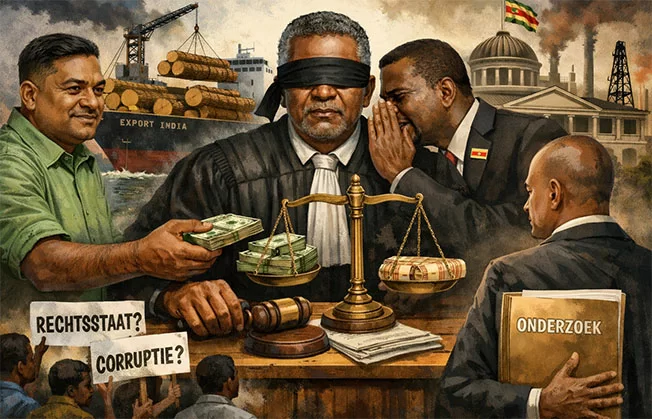
    A significant judicial debate has emerged regarding the establishment of constitutional courts in both Suriname and the Netherlands, revealing critical concerns about political interference in judicial systems. Legal expert Gerold Sewcharan, attorney and chairman of the Foundation for the Legal Order in Suriname (SRiS), has highlighted striking parallels between both nations’ constitutional court discussions.

    In a May 2024 article titled “No Constitutional Court for Suriname,” Sewcharan concluded that such an institution offered no substantive added value to Suriname’s legal framework, noting that existing systems already adequately addressed all relevant judicial needs. His analysis suggested that a constitutional court would contribute neither to legal development, political stability, nor legislative enhancement.

    The debate gained renewed relevance when a September 2025 publication in the Dutch Jurists Journal (NJB) revealed that the Netherlands’ highest judicial authorities—including the Supreme Court, the Administrative Jurisdiction Division of the Council of State, and the Trade and Industry Appeals Tribunal—expressed significant skepticism about establishing a constitutional court. The NJB article characterized such an institution as “an alien element in the Dutch legal system” that carried substantial risks of political influence in both judicial appointments and verdicts.

    Sewcharan notes that Suriname’s legal system derives directly from the Dutch model, making the Dutch judicial authorities’ reservations particularly relevant. Despite this shared heritage, Suriname incorporated constitutional court provisions into its 1975 and 1987 constitutions without thorough public discourse or justification regarding its necessity.

    The expert now calls for Surinamese legal professionals to urgently re-examine this constitutional question. Sewcharan has previously proposed establishing a third judicial instance for Suriname that would safeguard legal uniformity within the nation’s jurisdiction—a suggestion that gains renewed importance in light of the ongoing regional debate about judicial independence and constitutional review mechanisms.

  • Pierre and SLP Retain Government in St. Lucia

    Pierre and SLP Retain Government in St. Lucia

    In a landmark electoral outcome, the St. Lucia Labour Party (SLP) under Prime Minister Phillip J. Pierre has achieved a resounding victory in the nation’s general elections held on December 1, 2025. The ruling party secured an overwhelming mandate by capturing 14 out of the 17 parliamentary seats, solidifying their governance for another term.

    The electoral results revealed a significant setback for the primary opposition party, the United Workers Party (UWP) led by Allan Chastanet, which managed to secure only one seat. Adding to the SLP’s dominance, two independent candidates aligned with the ruling party claimed the remaining two constituencies.

    This triumph represents a historic breakthrough in St. Lucian politics, marking the first instance in ten years that an incumbent administration has successfully secured consecutive terms. The victory stands in contrast to recent regional political trends, particularly referencing the unexpected defeat of Prime Minister Dr. Ralph Gonsalves in neighboring St. Vincent and the Grenadines.

    Addressing media representatives during his post-victory appearance, Prime Minister Pierre expressed profound relief and gratitude. “I humbly accept this renewed mandate from the people of St. Lucia,” stated the Prime Minister, acknowledging that his party had not only retained power but expanded its parliamentary representation by one additional seat compared to previous elections.

    Pierre further reflected on the significance of his political standing: “I am fortunate to have the confidence of the people of St. Lucia—not only as a Parliamentary Representative, but also first as a minister and now as Prime Minister.” This electoral outcome reinforces the current administration’s policies and development agenda while potentially reshaping the Caribbean political landscape.

  • NPS-fractieleider Pawiroredjo: Gelijkwaardigheid begint bij menswaardige visumbehandeling

    NPS-fractieleider Pawiroredjo: Gelijkwaardigheid begint bij menswaardige visumbehandeling

    Suriname’s National Party of Suriname (NPS) faction leader Jerrel Pawiroredjo has issued a forceful critique of the Netherlands’ visa policies toward Surinamese citizens, characterizing the current treatment as a persistent diplomatic concern that strains bilateral relations. The remarks were delivered Monday during an extraordinary public assembly attended by the Dutch royal couple.

    Pawiroredjo commenced his address by warmly welcoming King Willem-Alexander and Queen Máxima, acknowledging the profound linguistic and historical ties binding the two nations through a colonial history spanning over three centuries. While recognizing this shared past contains dark chapters, the parliamentarian noted it had ‘unintentionally laid the foundation for Suriname’s beautiful, diverse contemporary society.’

    The statesman then pivoted to what he described as matters requiring concrete action rather than rhetorical diplomacy: mutual respect and equality. ‘The treatment of our citizens during visa application procedures remains an enduring concern,’ Pawiroredjo asserted. He detailed how Surinamese applicants face exhaustive questioning while Dutch financial guarantors must disclose comprehensive personal financial information—a contrast he found particularly striking compared to larger South American nations whose citizens enjoy visa-free travel despite lacking historical ties with the Netherlands.

    The NPS leader simultaneously acknowledged decades of Dutch support across multiple sectors, specifically highlighting collaborative efforts in education, healthcare innovation, climate change mitigation, water management systems, and agricultural technology as areas ripe for continued partnership development. Pawiroredjo also expressed appreciation for the Netherlands’ formal apologies for historical slavery, suggesting the relationship should now progress forward-looking. ‘Let a positive vision for the future become our shared compass,’ he concluded, expressing hope that bilateral relations would deepen further for ‘the glory of both living communities.’

  • Prime Minister Pierre relieved at general election victory

    Prime Minister Pierre relieved at general election victory

    CASTRIES, St. Lucia – In a decisive electoral outcome that defied regional political trends, the St. Lucia Labour Party (SLP) has secured a second consecutive five-year term in office. Prime Minister Phillip J. Pierre’s administration achieved a resounding victory in Monday’s general elections, which international observers characterized as peaceful and well-administered.

    The preliminary results indicate the SLP is positioned to surpass its previous 13-2 parliamentary majority from the 2021 elections. A visibly relieved Prime Minister Pierre, 71, addressed jubilant supporters, praising the maturity of St. Lucian democracy. “I would like to thank the people of St. Lucia for conducting what was a very decent election, an election free from violence,” Pierre stated, acknowledging the efforts of party members and constituency workers.

    The Prime Minister extended congratulations to United Workers Party (UWP) leader Allen Chastanet, who appears to be his party’s sole successful candidate. Pierre emphasized the importance of opposition in maintaining democratic traditions, despite the lopsided results.

    The election campaign was notably contentious, with the UWP focusing allegations of corruption and mismanagement against the government, particularly targeting the Citizenship by Investment program and Deputy Prime Minister Dr. Ernest Hilaire. These allegations were previously dismissed by the Caribbean Court of Justice earlier this year.

    Pierre criticized what he termed “misinformation and propaganda” that characterized opposition politics over the past four and a half years, expressing hope that such tactics would not return to St. Lucian politics. The Prime Minister indicated he would be sworn in later this week, with cabinet announcements expected next week.

    International observer missions from the Organization of American States and CARICOM monitored the polling process, which proceeded without significant incident.

  • Koning vraagt vergiffenis en spreekt met open hart over geschiedenis, heling en toekomst

    Koning vraagt vergiffenis en spreekt met open hart over geschiedenis, heling en toekomst

    In a remarkably personal address during Monday evening’s state banquet at Ballroom Prince, King Willem-Alexander of the Netherlands delivered an emotionally charged speech that transcended diplomatic formalities. The monarch’s visit to Suriname during its 50th anniversary of independence (Srefidensi) became a profound historical moment as he directly addressed the painful legacy of Dutch colonialism.

    The King, visibly moved, reflected on his family’s multi-generational connection to Suriname, noting how his grandparents had made the first state visit to the young republic. “Since then,” he observed, “much water has flowed through the Suriname River”—a poignant acknowledgment of turbulent political decades and enduring connections.

    Most significantly, Willem-Alexander built upon the Dutch government’s 2023 slavery apologies by personally requesting forgiveness for the historical failures of Dutch monarchs. “Your history bears the brand of slavery in the name of the Dutch state,” he stated. “The Dutch government has apologized for this, and personally I have added the request for forgiveness for the failure to act against this crime against humanity by stadholders and kings of the House of Orange-Nassau.”

    The King had previously repeated these apologies and personal requests for forgiveness during meetings with descendants of enslaved people and Indigenous communities, emphasizing that healing requires continuous generational truth recognition.

    Beyond historical reconciliation, Willem-Alexander praised Suriname’s resilience, describing the nation as a “beacon of humanity” in an increasingly polarized world. He specifically honored resistance heroes including the maroons who fiercely defended their hard-won freedom and legendary figures like Boni, whose moral authority inspired fights for dignified existence.

    The banquet also focused on future cooperation, with the King highlighting Suriname’s youth potential, rainforest conservation (noting the country absorbs more CO₂ than it emits), and responsible mineral resource management. He emphasized Dutch support would be offered “with due humility.”

    In a notable diplomatic gesture, the King announced the Dutch ambassador would lay a wreath at the December Murders monument during December 8th commemorations, acknowledging Suriname’s developing rule of law.

    The evening concluded with lighthearted moments as the King anticipated potential World Cup football rivalry between the nations in 2026, and a recitation of Dobru’s famous multicultural unity poem: “Wan Sranan, Someni wiwiri, Someni skin, Someni tongo, Wan pipel” (One Suriname, Many leaves, Many skins, Many tongues, One people).

  • ‘Humbled’ Pierre thanks supporters after seventh straight win in Castries East

    ‘Humbled’ Pierre thanks supporters after seventh straight win in Castries East

    In a resounding electoral triumph, Prime Minister Philip J. Pierre’s Saint Lucia Labour Party (SLP) has secured a commanding parliamentary majority, winning 14 of 15 seats in Monday’s general elections. The victory marks Pierre’s unprecedented seventh consecutive term representing Castries East, solidifying his political legacy.\n\nAddressing supporters from his constituency office in Marchand, the Prime Minister expressed profound humility regarding the public’s renewed confidence in his leadership. \”I remain humbled by the trust placed in me,\” Pierre stated, emphasizing his commitment to collaborative governance. \”We will move forward together as the country enters its new term.\”\n\nThe electoral outcome delivered a decisive rebuke to the United Workers Party (UWP), which secured only a single seat. Independent parliamentarians Richard Frederick (Castries Central) and Stephenson King (Castries North) both retained their positions, adding complexity to the parliamentary landscape.\n\nPierre specifically acknowledged the enduring support from constituents who have stood with him since his initial 1997 campaign, noting these long-term relationships reflect a deep bond between representative and community. He extended gratitude to family members, party workers, and public servants—including medical staff, law enforcement, and correctional facility employees—for their national service.\n\nThe Prime Minister condemned the deterioration of political discourse during the campaign, particularly referencing personal attacks against his daughter. \”I feel very sad that Saint Lucian politics reached the depth it reached,\” he remarked, expressing hope that future opposition parties would maintain higher ethical standards.\n\nIn a gesture of political reconciliation, Pierre congratulated Allen Chastanet, the sole successful UWP candidate, affirming that \”there is a place in Parliament for the opposition.\\” The Prime Minister credited former PM Dr. Kenny Anthony for initially bringing him into cabinet leadership.\n\nLooking forward, Pierre announced imminent policy implementations including VAT-free days and promised back pay for public servants. He expects to be sworn in by week’s end with cabinet appointments following next week, declaring \”this country is on the right trajectory\” toward continued progress.

  • Column: Koning, nooit meer oranje boven

    Column: Koning, nooit meer oranje boven

    In a strikingly candid address to visiting Dutch King Willem-Alexander, Surinamese commentator Nita Ramcharan delivered a powerful critique of contemporary Netherlands-Suriname relations during the monarch’s recent state visit. The article captures Suriname’s assertive national awakening fifty years after independence, challenging historical power dynamics and demanding equal partnership.

    The piece begins by acknowledging Suriname’s traditional hospitality while immediately establishing that formal politeness no longer masks unresolved tensions. Ramcharan references outdated colonial-era imagery of schoolchildren singing ‘orange above, long live the royal couple’ to highlight how far the nation has evolved into a digitally-connected modern society.

    King Willem-Alexander witnessed Suriname’s transformation firsthand—encountering tech-savvy youth who fact-check in real-time, engaging with traditional leaders, and receiving direct political messaging that ‘We walk beside you, not behind you’ in the National Assembly. This sets the stage for the central issue: visa policies that Surinamese citizens find deeply discriminatory.

    The author contrasts the seamless entry process for Dutch travelers to Suriname with the ‘theatrical tragedy’ Surinamese face when applying for Netherlands visas—requiring extensive documentation ‘as if leaking state secrets’ while subject to consular officials’ arbitrary decisions. Ramcharan dismisses potential Schengen Zone excuses, insisting the king possesses both platform and moral authority to address what she characterizes as institutional humiliation.

    Beyond visa grievances, the article outlines Suriname’s vision for truly balanced relations: trade without dependency, cooperation without paternalism, and ensuring future oil revenues benefit local generations. While acknowledging domestic challenges, Ramcharan emphasizes national resilience and self-determination.

    The powerful conclusion rejects orange symbolism entirely: ‘The shadow of orange lies behind us. The sun of Suriname lies before us.’ This encapsulates the piece’s core message—Suriname now stands beside its golden star symbol, on its own soil, as an equal partner rather than former colony.