分类: politics

  • Former Police Commissioner Questions DPP’s Decision to Drop Major Cannabis Case

    Former Police Commissioner Questions DPP’s Decision to Drop Major Cannabis Case

    A former police commissioner-turned-attorney is putting pressure on Antigua and Barbuda’s top prosecutor to open up about why authorities dismissed a high-profile cannabis importation case against a Canadian defendant, shining a new spotlight on accountability within the country’s criminal justice system. Attorney-at-law Wendell Alexander, who is representing the family of a teen killed in a recent police-involved shooting, argues that the Office of the Director of Public Prosecutions (DPP), as a publicly funded constitutional body, owes the public a fulsome explanation for its decision to discontinue the high-stakes drug case, rather than the brief one-sentence reference to medical reasons the office has already released.

    Speaking during an interview on Observer Radio’s *Voice of the People* current affairs programme, Alexander framed transparency as a core requirement for maintaining public trust in justice institutions. “In the interest of transparency, I would say that the public has a right to know because the office of the Director of Public Prosecutions is a public office,” Alexander said. “When certain major decisions are taken, especially if the matter has become a cause célèbre, to give a proper explanation before the general public is good for the justice system.”

    DPP Clement Joseph has defended his decision, noting that the accused Canadian woman is living with late-stage cancer, and that local correctional and health facilities lack the capacity to meet her complex medical needs if she is held in custody ahead of trial. Joseph also emphasized that the choice to discontinue the case was not a rushed one: it has been under active review by his office since March. He added that the case is not permanently closed, and could be reopened at a future date if the defendant’s medical situation changes.

    Still, Alexander has raised questions about whether proper legal protocols were followed in the decision-making process. Though he acknowledges he does not have access to the full case file, he pointed to prior legal precedents where defendants initially ruled medically unfit to stand trial ultimately returned to court after being cleared by medical experts. He also pushed back against the common misconception that DPP decisions are immune from legal challenge, noting that even with the broad discretionary powers granted to the role under Antigua and Barbuda’s Constitution, decisions can be overturned via judicial review in the High Court if they are found to be unreasonable or an abuse of authority.

    Joseph also addressed separate recent public criticism he faced over another drug case involving a Jamaican national, noting that online accusations of improper influence to drop charges were unfounded, as he had not even received the full case file when the allegations began circulating online. He reiterated that the Constitution grants the DPP wide discretionary authority over case prosecution, and that it is not standard practice for Caribbean prosecutors to hold public press briefings to justify rulings on individual cases.

    Beyond the cannabis importation dispute, Alexander is also challenging official handling of the fatal police shooting of 18-year-old Khaleel Simon, a case he has been retained to handle for Simon’s family. Alexander has made a series of serious allegations about procedural misconduct during the incident: he claims a Criminal Investigations Department detective used his personal unmarked vehicle to pursue Simon after receiving tip-off messages via WhatsApp from a female associate of the teen, and that a uniformed officer who rode along in the private vehicle opened fire on Simon without first identifying himself as law enforcement or ordering Simon to exit his vehicle.

    “There is absolutely no right for a police officer in his private vehicle, bring another officer in uniform at the scene and accost Khaleel Simon,” Alexander said. “That’s not the way in which this process and this operation ought to be done.” He also added that no weapon was found in Simon’s vehicle following the shooting, contradicting unconfirmed claims that the teen was armed.

    In response to the shooting allegations, DPP Joseph confirmed that the incident remains an active police investigation, and his office has not yet received the case to review for potential prosecution. Alexander confirmed that Simon’s family is moving forward with plans to file a wrongful death lawsuit against the involved officers and relevant authorities. The attorney is also using both high-profile cases to push for broader criminal justice reforms in Antigua and Barbuda, including the creation of an independent oversight body to investigate all police-involved shootings, mandatory timely public updates on cases of major national interest, and the consolidation of scattered criminal legislation into a single unified penal code.

  • LETTER: One Deportee Is One Too Many

    LETTER: One Deportee Is One Too Many

    In an open letter addressed to the editor of an Antiguan publication, a concerned mother based in St. John’s has added her voice to the growing opposition to the United States’ plan to deport non-citizens to Caribbean nations including Antigua and Barbuda, arguing that even a single deportee would place an unacceptable burden on her already vulnerable country.

    As a parent raising children in Antigua and Barbuda, the writer says she has watched negotiations over the deportation plan with increasing unease. The twin-island nation is one of the smallest sovereign states in the Western Hemisphere, and its domestic institutions already face steep strain from persistent challenges: elevated crime rates, chronically stretched law enforcement budgets, and widespread social instability that touches working families across every community. For parents across the country, daily life already comes with unrelenting worry: children’s safety is uncertain when they travel to school, wait for public transit, or gather with friends outside the home. The writer argues that Antigua and Barbuda should never be forced to absorb additional public safety risks that stem directly from the immigration policy choices of a global superpower.

    The letter voices approval for Prime Minister Gaston Browne’s current stance, which has pushed back against U.S. pressure and demanded formal safety safeguards for any deportation transfers. But the writer goes further, calling on Browne to adopt a total ban on accepting any deportees from the U.S. She emphasizes that no financial compensation can offset the harm that would come if even one high-risk person enters the country through gaps in screening.

    A core contradiction in U.S. assertions about the deportation program underscores the danger, the writer argues: U.S. officials claim that deportees sent to Caribbean nations are not convicted criminals, but at the same time, negotiations over mandatory background checks are still ongoing. This uncertainty over the identities, origins, and criminal histories of potential deportees is enough to justify rejecting the entire plan, she says. If there is any doubt about who is being sent to Antigua and Barbuda, the government has no business agreeing to participate.

    The writer acknowledges that the United States holds full authority to enforce its own sovereign immigration laws. What it is not entitled to, she insists, is shifting the logistical and public safety burden of its deportation program onto small, developing Caribbean nations that lack the resources to manage the risk. The Antiguan government’s first and most important duty is to its own citizens: to the children, aging populations, local communities, and future generations that call the islands home. The writer argues that no amount of external pressure from a larger, more powerful nation justifies making concessions that could erode public safety for Antiguans and Barbudans.

    Closing with a personal appeal rooted in her experience as a mother, the writer urges Browne to hold firm to his opposition and reject all transfers, not just limit the number. The risks of accepting any deportees, she argues, far outstrip any potential economic or diplomatic benefits that might be offered. For her and for countless other parents across the country, the top non-negotiable priority is protecting the safety and security of the next generation as they grow up on the islands.

  • Former Saint Lucia Governor General Sir Neville Cenac dies at 86

    Former Saint Lucia Governor General Sir Neville Cenac dies at 86

    One of Saint Lucia’s most consequential and controversial political figures, Sir Neville Cenac, who held the nation’s top ceremonial office as Governor General and previously served as Foreign Minister, has passed away at the age of 86. His death was confirmed on Tuesday, closing a decades-long chapter in the island country’s political development.

    Cenac’s tenure as Governor General, the representative of the British monarch in the independent Caribbean nation, spanned from January 12, 2018, through October 31, 2021. He took on the ceremonial role during the administration of the United Workers Party (UWP), the party he would align with in the latter half of his political career.

    The late politician’s journey in public service began long before his appointment as Governor General, with early roots in the Saint Lucia Labour Party (SLP). In 1982, he served as leader of the parliamentary opposition while a member of the SLP, and in the 1987 general elections, he secured victory for two separate seats representing the constituency of Laborie on the Labour Party ticket. During his early years with the SLP, Cenac emerged as a vocal critic of the UWP leadership, condemning what he framed as an authoritarian governing style from the party’s head.

    A pivotal and still-debated turning point in Cenac’s political career came when he made the decision to cross the floor and join the UWP. His party switch reshaped the island’s parliamentary landscape: the defection helped the UWP claim a slim one-seat majority in the legislature, holding 9 seats to the SLP’s 8. Following the shift, UWP founder Sir John Compton appointed Cenac to the cabinet as Minister of Foreign Affairs, a portfolio he held from the party switch through 1992.

    The high-profile party change sparked intense public debate across the island, even inspiring a collection of popular calypso songs that reflected the public’s divided reaction to the move. It still stands as one of the most controversial episodes in modern Saint Lucian political history.

    Late in his life, in 2024, Cenac moved to set the record straight on his decades-long political career with the release of his autobiography, titled *C’est L’huere – Crossing the Divide*. In the memoir, he offered his personal account of major political events unfolding from his entry into politics with the SLP in 1961 through the end of his cabinet tenure in 1992, aiming to address longstanding misconceptions about his decisions and career.

  • COMMENTARY: If Loving Antigua And Barbuda Is Xenophobic – So Be It!

    COMMENTARY: If Loving Antigua And Barbuda Is Xenophobic – So Be It!

    Across the small island developing states of the Caribbean, conversations about national identity, resource allocation and foreign influence have grown increasingly heated in recent years. No where is this tension more visible than in Antigua and Barbuda, where a provocative new commentary has thrown long-simmering debates about national interest into the global spotlight. The piece, titled “If Loving Antigua And Barbuda Is Xenophobic – So Be It!”, makes an unapologetic case for prioritizing the economic, social and political needs of native-born and long-standing citizens over the interests of foreign investors, transient residents and outside interests that have gained increasing footholds in the country’s economy in recent decades.

    For decades, small Caribbean nations like Antigua and Barbuda have leaned heavily on foreign direct investment, particularly through citizenship-by-investment programs that grant legal status to wealthy outsiders in exchange for major capital infusions into local real estate and infrastructure. These programs have lifted government revenues and spurred job growth in the critical tourism sector, but they have also sparked growing grassroots discontent. Local residents increasingly complain that skyrocketing housing prices have pushed native citizens out of property markets, that foreign-owned businesses reserve the highest-paying positions for overseas staff, and that the political influence of wealthy non-nationals has skewed policy away from addressing widespread poverty and underdevelopment in local communities.

    The commentary’s provocative framing is not an endorsement of blanket hatred or exclusion of outsiders, its author argues. Instead, it is a deliberate rejection of the common tactic used by pro-foreign investment interests to label any call for stricter regulation or prioritization of local citizens as bigotry. By reclaiming the label of “xenophobic” as a badge of honor for those who put Antigua and Barbuda first, the commentary forces a public reckoning with the trade-offs that have come with decades of open-door investment policies. In a region where small island nations are often pressured by global economic powers and international institutions to prioritize foreign business interests over domestic well-being, the piece strikes a chord with a growing nationalist movement that demands greater sovereignty and economic equity for local populations.

    This debate does not exist in a vacuum. Across the globe, small states are grappling with the same balance between opening their borders to global capital and protecting the rights and opportunities of their own people. For Antigua and Barbuda, a nation of fewer than 100,000 people that relies heavily on tourism and offshore finance, the question of who gets to benefit from national development will continue to shape the country’s political and economic trajectory for generations to come. The commentary’s unflinching stance has already sparked fierce pushback from business groups who warn that such rhetoric will deter investment, but it has also galvanized local activists who argue that the current system has left too many citizens behind. What is clear is that this conversation will not be silenced by accusations of bigotry: the fight to define national priority in Antigua and Barbuda is only just beginning.

  • Antigua and Barbuda Continues Discussions with the United States over deportees

    Antigua and Barbuda Continues Discussions with the United States over deportees

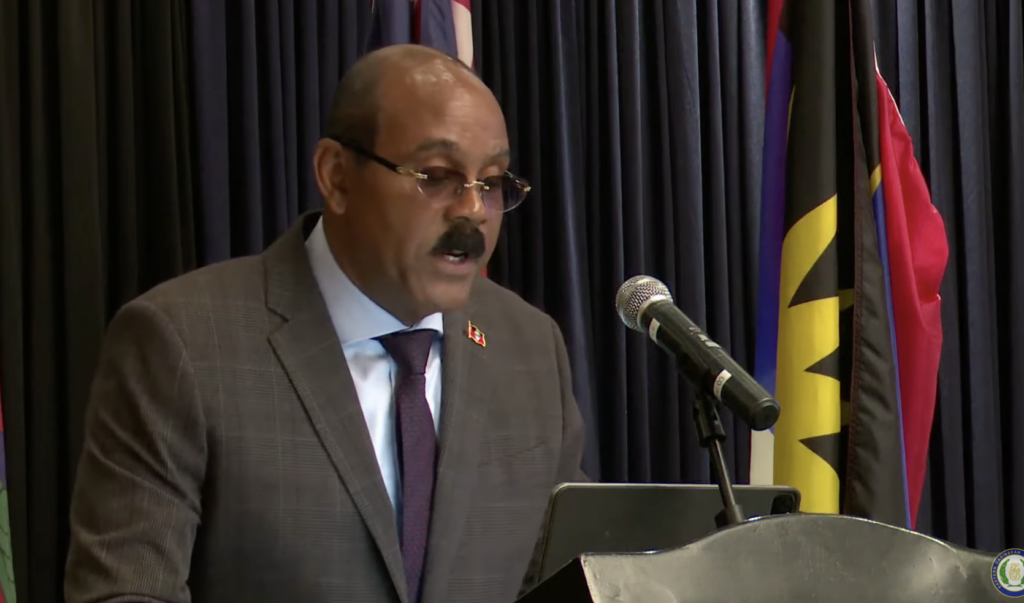
    Negotiations between the small Caribbean twin-island nation of Antigua and Barbuda and the United States over a planned deportee resettlement agreement have hit an impasse, driven by a sharp divide over how many deportees the Caribbean country would be required to take in, according to Prime Minister Gaston Browne.

    During his regular weekend radio broadcast, Browne explained that talks have ground to a halt because the volume of deportees Washington has proposed far outstrips the maximum capacity his administration has deemed sustainable for the small nation. Antigua and Barbuda has only offered to accept around 10 deportees per year, yet U.S. negotiators have pushed for a monthly quota of roughly 10 people, a 12-fold increase over the Caribbean country’s proposal.

    Browne emphasized that taking in a far larger cohort of deportees than Antigua and Barbuda can handle would place an unjustifiable strain on the nation’s limited resources and raise tangible risks to public safety. He revealed that at an earlier stage of negotiations, U.S. officials requested the country accept up to 120 deportees, with no promises of financial support or pre-transfer background vetting, a proposal he immediately rejected as completely unacceptable. The prime minister challenged whether any accountable national government could back an agreement that fails to properly defend its core national interests.

    Browne’s public remarks come on the heels of an announcement from neighboring St. Kitts and Nevis, which confirmed the arrival of its first group of Caribbean-born deportees as part of a U.S.-led third-country deportation program. The initiative has been circulated for discussion among multiple member states of the Caribbean Community (CARICOM), with Dominica, Grenada and Guyana also named as potential destination countries for transfers.

    U.S. officials have publicly claimed that the individuals eligible for transfer do not include people convicted of serious crimes, instead limited to those facing removal for immigration violations and other non-felony offenses. Still, Browne has remained firm that Antigua and Barbuda will not agree to accept any deportees under the program without full, comprehensive background checks for every individual.

    As a small, low-population nation with limited law enforcement and social infrastructure, Antigua and Barbuda is uniquely vulnerable to security risks, Browne argued. “We’re small, powerless and very vulnerable,” he said, noting that even one individual with a hidden violent criminal history could cause disproportionate harm to a country of the nation’s size.

    Beyond strict vetting requirements, the Antigua and Barbuda government is also pushing for guarantees that all deportees will arrive with valid, official travel documentation. Browne pointed out that a number of migrants destroy their identity papers after entering the United States, which creates major administrative hurdles to confirming an individual’s nationality and verifying their legal status.

    The government has additionally requested dedicated financial assistance from the United States to cover the costs of supporting, housing and integrating any deportees Antigua and Barbuda agrees to accept. As negotiations between the two sides continue, Browne reaffirmed that protecting the country’s domestic security remains the administration’s top non-negotiable priority.

  • EULOGY: Mary-Clare Hurst ‘Multiplied Herself in Others,’ Oswald Thomas Tells Mourners

    EULOGY: Mary-Clare Hurst ‘Multiplied Herself in Others,’ Oswald Thomas Tells Mourners

    On Tuesday, at the official funeral service for former Antiguan and Barbudan senator Mary-Clare Hurst, longtime colleague and friend Dr. Oswald Thomas delivered a moving, deeply personal eulogy that redefined Hurst’s legacy beyond the political titles and institutional achievements that defined her public career. To hundreds of gathered mourners spanning family, political peers, and community members, Thomas painted a nuanced portrait of a leader whose greatest impact grew not from the power of her office, but from the intentional, life-changing connections she built with everyone around her.

    Thomas centered his tribute on Hurst’s uncommon approach to leadership, a philosophy that prioritized connection over command. “Leadership is not merely about speaking; it’s about listening,” Thomas told the crowd. “It is not about authority. It is about influence, and the influence begins with understanding people.” While Hurst built an impressive public resume — including tenures as Leader of Government Business in the Senate and general secretary of the Antigua and Barbuda Labour Party — Thomas emphasized that these roles only scratch the surface of who she was.

    Much of the eulogy turned to the intimate personal bonds that shaped Hurst’s life, starting with her decades-long, unbreakable relationship with her sister, known affectionately to loved ones as “Jelly Bean.” The two were polar opposites in temperament: Hurst grew up bold, adventurous, and unapologetically rebellious, while Jelly Bean carried a quiet, reserved demeanor. Yet those differences never drove a wedge between them. “As children they shared dreams, as adults they shared burdens, and as sisters they shared a love that never wavered until the very end,” Thomas said. When Hurst’s health began to decline in her final years, Jelly Bean stepped forward as her constant companion, joining her on international medical trips, accompanying her to every doctor’s appointment, and staying by her side through every hard moment.

    Thomas also highlighted the critical role Hurst’s niece Layla played in her final years, stepping in as a dedicated caregiver, advocate, and unwavering source of strength. Even amid the stress of ongoing medical care, Thomas recalled, Hurst never lost the sharp, warm sense of humor that endeared her to so many. Whenever medical teams would ask Hurst questions about her treatment plan, she would simply gesture to Layla and joke that her niece knew every detail of her care. Those exchanges, Thomas said, almost always ended in laughter — with Hurst laughing the loudest of all. Even as her illness progressed, Hurst refused to slow down, remaining determined to live life fully and make clear she would fight until her final breath.

    Thomas also shared a charming anecdote of Hurst’s playful bond with her young nephew Takari, whom she nicknamed her “landlord.” The young boy proudly told all guests to their shared home that the property belonged to him, and Hurst played along faithfully, paying her monthly “rent” in the form of candy, home-cooked meals, and small thoughtful gifts.

    The eulogy reached its most emotional point when Thomas turned to his own experience of grief, recalling the death of his son eight years prior. In one of the darkest periods of his life, Thomas said, Hurst showed up for him without hesitation. When his son died, Hurst immediately left an in-progress sitting of the Senate — where she was serving as Leader of Government Business at the time — and traveled to New York to attend the funeral. “She came not because protocol required it, but because love compelled it,” Thomas remembered.

    As he closed out his tribute, Thomas reflected on the full weight of Hurst’s legacy, arguing that her greatest contributions will never be found in official government records or party history books. “As I reflect on all that Mary-Clare accomplished, I realize that her greatest contribution was not a title she held, an election she influenced, or an institution she served,” he said. “Her greatest contribution was people.” Thomas recalled that Hurst spent much of her later career mentoring emerging leaders, expressing confidence in the next generation to carry on her work and making clear she would always be available to guide them as they stepped into leadership roles.

    Thomas closed with a reflection on what makes a life well-lived, tying the idea directly to Hurst’s legacy. “The true measure of a life is not how many doors open for us,” he said. “The true measure of a life is how many doors remain open because we passed through them.” He urged every mourner in attendance to honor Hurst’s memory by carrying forward her example: continuing to serve communities, lift up peers, and uplift those around them, just as she did. “You did not simply live, you multiplied yourself in others,” he said. “As long as we continue to serve, to build, to encourage and to love as you did, your influence will continue to shape lives long after this day has passed.”

    When Thomas finished his remarks, the room erupted into sustained applause, as family, colleagues, and friends joined together to remember a leader who proved, as Thomas put it, that the most powerful people in the world are not those who chase the spotlight — they are the ones who work to help others shine.

  • DNA stemt unaniem in met wijziging Begrafeniswet

    DNA stemt unaniem in met wijziging Begrafeniswet

    On Tuesday, Suriname’s legislative body, the Nationale Assemblée (DNA), passed an amendment to the country’s 1959 Burial Act with 33 votes in favor, marking a key interim step toward broader modernization of the nation’s funeral and cemetery regulations. This incremental change is designed to introduce clearer, more up-to-date rules for the handling of deceased persons and the management of burial grounds, while government stakeholders work to complete a full, comprehensive revision of the entire piece of legislation.

    Government officials frame the newly adopted amendment as a critical milestone in bringing Suriname’s funeral sector into line with 21st century needs. By formalizing updated procedures and official guidelines, the reform aims to strengthen guarantees for respectful, orderly, and hygienic management of remains and public cemeteries. The amendment bill was originally tabled before parliament on January 27, 2025.

    During parliamentary debate on the proposal, Minister of Justice and Police Harish Monorath emphasized that the upcoming full review of the Burial Act will align the entire regulatory framework with current social, administrative, and environmental developments. Key areas up for reconsideration during the comprehensive overhaul include regulations for grave reuse, availability of land for new burial grounds, cremation protocols, and standards for alternative end-of-life body disposal methods. Monorath also confirmed that religious groups, cultural organizations, and civil society stakeholders will be actively consulted throughout the full revision process.

    Pre-parliamentary review of the amendment was handled by a special Committee of Rapporteurs led by chair Iona Edwards, with additional members Harriët Ramdien, Ingrid Bouterse-Waldring, Le-Roy Doorson, Marciano Dasai, Dorothy Hoever, and Dinotha Vorswijk.

    Debate revealed widespread cross-party support for the interim amendment. Rabin Parmessar, parliamentary leader of the NDP faction, noted that the changes earned broad backing within the DNA after a period of constructive cross-faction negotiations. He also reiterated the widespread expectation that the government will follow through on its commitment to deliver the promised full overhaul of the act.

    Government coordinator Marinus Bee, speaking on behalf of the administration, confirmed that the comprehensive revised Burial Act will be submitted to the Nationale Assemblée within four months, fulfilling the government’s earlier pledge.

    Asiskumar Gajadien, leader of the VHP faction, noted that parliamentary discussions made clear that a full update of the outdated 1959 legislation is an urgent necessity. Following Bee’s formal commitment to the four-month timeline for full reform, the VHP faction agreed to support the interim amendment.

    With the adoption of this targeted change, Suriname now has an updated temporary legal framework for its funeral industry, as stakeholders prepare for the more extensive legislative reform that will address all unmet needs in the sector.

  • Harris praises contributions of Guyanese Community to St. Kitts and Nevis

    Harris praises contributions of Guyanese Community to St. Kitts and Nevis

    On the occasion of Guyana’s 60th Diamond Jubilee of Independence, commemorative events held across St. Kitts and Nevis brought a clear message from one of the federation’s most senior political figures: the Guyanese diaspora is an irreplaceable driver of national progress, and the bilateral bond between the two Caribbean Community (CARICOM) nations remains a model of mutually beneficial regional partnership.

    In an exclusive interview with local media outlet SKNVibes.com, former St. Kitts and Nevis Prime Minister and current People’s Labour Party leader Dr. Timothy Harris shared his reflections on the decades-long ties between the two nations, highlighting the outsized impact of one of the federation’s largest expatriate communities. For generations, Guyanese migrants have embedded themselves across every critical sector of St. Kitts and Nevis’ economy, from agriculture and education to small business, hospitality, sports, and media, building a legacy of contribution that extends far beyond labor support.

    Harris traced the deep roots of this relationship back to the early 2000s, when St. Kitts and Nevis’ vital sugar industry faced a critical labor shortage. At that time, Guyana was one of the primary countries that stepped in to supply the workforce the federation needed to keep its core industry operational. In the decades since, that initial wave of migration has evolved into full integration: Guyanese nationals have become core contributors to the federation’s productive output, while their cultural traditions around food, music, and art have enriched the social fabric of St. Kitts and Nevis, strengthening people-to-people ties across the region.

    Looking across Guyana’s 60-year journey as an independent nation, Harris praised the South American CARICOM member for its remarkable resilience and unwavering commitment to regional integration. While he acknowledged that the original vision of deeper regional integration has yet to be fully realized, he noted that the bloc remains on a steady progressive path, with Guyana at the forefront of modern regional growth.

    In recent years, Guyana has undergone a dramatic economic transformation, sparked by major offshore oil discoveries that have pushed it to become one of the fastest-growing economies in the world, and the fastest-growing within CARICOM. Harris emphasized that this new era of prosperity for Guyana creates unprecedented opportunities for shared growth across the region, including for St. Kitts and Nevis. For decades, Guyanese educational institutions have provided critical agricultural training and expertise to St. Kitts and Nevis citizens, laying the groundwork for future collaboration in food security, energy development, and industrial expansion. Harris added that Guyana’s growing economy could also help address persistent labor shortages across smaller Caribbean island nations, turning its progress into collective regional benefit.

    Beyond economic cooperation, Harris highlighted Guyana’s longstanding reputation for excellence in education and human capital development, noting that hundreds of St. Kitts and Nevis citizens have advanced their skills, particularly in agricultural fields, at institutions like the University of Guyana and Guyanese technical colleges. He called for continued expansion of these institutions’ regional impact to empower more Caribbean people.

    When asked what lessons St. Kitts and Nevis and other small Caribbean nations can draw from Guyana’s 60 years of independence, Harris pointed first to the enduring resilience of the Guyanese people through decades of economic and social ups and downs. He also stressed the importance of responsible natural resource stewardship, noting that Guyana has long leveraged its abundant agricultural potential to drive growth, a lesson he explored during his time in office when his administration studied opportunities to add value to St. Kitts and Nevis’ own sugar industry, including the use of sugarcane byproducts for energy generation. He acknowledged that the federation’s small size creates inherent structural constraints to development, making it all the more important to identify targeted opportunities for growth.

    Ultimately, Harris summarized the core lesson from Guyana’s six decades of independence as the value of disciplined, inclusive development, noting that this principle holds true for nations of all sizes, from the largest regional economies to the smallest Caribbean island states.

    The 60th Independence Diamond Jubilee, celebrated officially on May 26, was marked by events across Guyana and across the global Guyanese diaspora, including the community in St. Kitts and Nevis, who gathered to mark the historic milestone.

  • T&T-born woman nominated as US envoy

    T&T-born woman nominated as US envoy

    Nearly 17 months after the departure of the last U.S. ambassador to Trinidad and Tobago, President Donald Trump has put forward a historic nomination to fill the long-vacant diplomatic post: Jennifer Johnson-Carroll, a Trinidad-born former Florida lieutenant governor with a decades-long record of U.S. public service.

    The post has remained empty since former ambassador Candace Bond concluded her tenure on January 20, 2025, shortly before the new Trump administration took office. On June 1, 2026, the White House released an official statement listing Johnson-Carroll, a Florida resident, among a slate of new diplomatic nominees, tapping her to serve as Ambassador Extraordinary and Plenipotentiary of the United States to the Republic of Trinidad and Tobago. The nomination was formally submitted to the U.S. Senate for confirmation the day after the White House announcement.

    Born in Port of Spain, Trinidad and Tobago in 1959, Johnson-Carroll moved to the United States with her family at age 8, building a diverse career that spans military service, public office, and private sector leadership. She enlisted in the U.S. Navy in 1979 as a jet mechanic, retiring 20 years later as a lieutenant commander aviation maintenance officer. She went on to earn multiple degrees in political science and business administration, and entered electoral politics in 2003, when she made history as the first Black female Republican elected to the Florida House of Representatives. In 2010, she was selected as running mate by Republican gubernatorial candidate Rick Scott, taking office as Florida’s 18th lieutenant governor in 2011—again breaking barriers as the first woman and first Caribbean-born person to hold the statewide post. She resigned in 2013 amid questioning connected to a federal investigation into an illegal gambling and money laundering scandal at a charity organization, though she was never criminally charged.

    The American Chamber of Commerce of Trinidad and Tobago (AMCHAM T&T) has publicly welcomed the nomination, emphasizing its significance for bilateral relations between the two nations. In an official statement released shortly after the nomination announcement, the chamber noted that Johnson-Carroll’s roots in Arouca, Trinidad and Tobago make the appointment particularly meaningful. If confirmed by the U.S. Senate, she will become the first Trinidad and Tobago-born woman to serve as U.S. ambassador to her country of origin, a milestone that AMCHAM T&T says underscores the far-reaching global contributions of the Trinidadian and Tobagonian diaspora.

    AMCHAM T&T also highlighted Johnson-Carroll’s long record of demonstrated leadership and commitment to public service across government, policy, and community advocacy, noting her repeated history of breaking barriers for underrepresented groups in U.S. politics. The organization acknowledged that the nomination must now advance through the formal Senate confirmation process: first a review by the Senate Foreign Relations Committee, followed by a full vote by the entire Senate. AMCHAM T&T said it expects the process to conclude successfully and looks forward to welcoming the new ambassador in the near term.

    Beyond welcoming the nominee, the chamber reaffirmed the deep strategic ties between the United States and Trinidad and Tobago, which span trade, investment, energy, security, education, technology, and cultural and community connections. The bilateral relationship, the organization noted, remains a core driver of economic growth, democratic governance, and regional cooperation across the Caribbean. AMCHAM T&T said it remains committed to advancing the strong commercial and diplomatic partnership between the two nations, and looks forward to working with Johnson-Carroll, if confirmed, to expand opportunities for collaboration, innovation, increased investment, and shared prosperity for both countries.

  • ‘NO GHOST GANGS IN NPUPS’

    ‘NO GHOST GANGS IN NPUPS’

    A public employment and community maintenance initiative in Trinidad and Tobago has found itself at the center of heated political debate, with the cabinet minister in charge pushing back hard against longstanding accusations of so-called “ghost work” — a practice of paying unemployed workers for no completed labor that plagued two now-discontinued national programs.

    Rural Development and Local Government Minister Khadijah Ameen, who also serves as the Member of Parliament for the St Augustine constituency, made her remarks during a community plant distribution event held at her constituency office on Pasea Main Road, St Augustine on the day before the Corpus Christi public holiday.

    Addressing public and political scrutiny of the National Programme for the Upkeep of Public Spaces (NPUPS), Ameen refuted claims that the initiative’s roughly 1,600 deployed workers across 14 local corporations are non-existent “ghost gangs”. She emphasized that program staff are active in every region and electoral district across the country, turning out consistent, verifiable work. “We have been reviewing daily work logs and conducting on-site observations of teams in the field,” she stated. “I do not run ghost gangs. The number of workers may be smaller than previous programs, but every person on the payroll is showing up to work. Taxpayer money no longer goes to workers who do not perform any duties.” Ameen added that the central government is also conducting a full performance review of all local corporations to bring greater accountability and structure to local governance.

    The NPUPS was launched as a replacement for two decades-old public employment programs, the Community-Based Environmental Protection and Enhancement Programme (CEPEP) and the Unemployment Relief Programme (URP), both of which were permanently shelved by the Trinidad national government in 2023 after repeated accusations of widespread corruption and ghost worker schemes. Thousands of workers lost their positions when the programs ended, though both continue to operate in Tobago.

    Ameen told attendees at the community event that her ministry is currently exploring expansion of the NPUPS to under-served rural communities including Blanchisseuse, Paramin, Lopinot, Maracas and Matelot. Any scaling of the program will depend on approval of the new national budget, expected to be delivered in October, she noted. The initiative’s core mandate, she explained, is to address urgent public maintenance needs while the government develops long-term solutions for persistent unemployment and community underdevelopment. It also pairs ongoing productivity assessments of workers with support for local municipal governance and the creation of short-term income opportunities for out-of-work citizens.

    When the NPUPS launched nationwide on April 27, a ministry statement outlined that the 1,600 hired workers would be responsible for regular maintenance of public recreational grounds, parks, and other community open spaces. “This program strengthens proactive, consistent maintenance across all communities, as our ministry remains fully committed to advancing local development and raising quality of life for all citizens,” Ameen said in the post-launch statement. The program currently offers three-month fixed-term employment contracts to all participants, and was first rolled out on a smaller scale in February to support post-Carnival cleanup operations, where NPUPS teams handled public space cleaning outside official Carnival venues, complementing cleanup teams operated by the National Carnival Commission.

    Despite the minister’s defense, reactions from local government leaders across the country have been deeply divided, with some praising the program’s accountability and others criticizing its limited scope, short contract lengths, and alleged political bias.

    In a phone interview conducted the week after the launch, Kwesi Antoine, deputy chairman of the San Juan/Laventille Regional Corporation, argued that the small size of NPUPS work teams is woefully inadequate to meet widespread need in the wake of the CEPEP and URP closures. “We are being told to send just one name for an opening, when thousands of people in this region are out of work and struggling to put food on the table,” Antoine said. The program currently assigns small teams of roughly 12 people per area, including one laborer, one checker, and one foreman. “Thousands of people lost their jobs from CEPEP, URP, the Forestry Division, even other government ministries, and we only get a handful of openings. It is impossible to choose just one person when so many are in need.” Antoine added that three-month fixed contracts do not offer the stable, long-term employment that workers need to plan for the future, pay into national insurance, and qualify for pensions. “The government could allocate the same budget to create stable permanent positions instead of these short-term stints,” he said. He also alleged that the program shows a clear allocation bias against areas controlled by the opposition People’s National Movement (PNM).

    Not all local leaders have criticized the initiative, however. Siparia Mayor Doodnath Mayrhoo called the NPUPS a positive improvement over the previous programs, noting that rampant corruption in CEPEP and URP required urgent government action. He added that NPUPS workers earn just over $200 per day, compared to the $79 per day workers received under the old CEPEP system. “The program has rolled out across all 14 corporations nationwide, and it is already delivering results in our area,” Mayrhoo said. “Schools and recreational grounds are now in excellent condition, and communities are cleaner than they have been in years. Local corporations just need to ensure the program is managed efficiently to keep that progress going. If the national economy were stronger, we would be able to do even more for residents.”

    Other municipal leaders have echoed Antoine’s concerns about insufficient staffing. Point Fortin Mayor Clyde James said the 36 workers assigned to his municipality could not replace the much larger CEPEP workforce that previously operated in the area. Josiah Austin, chairman of the Tunapuna/Piarco Regional Corporation, reported that his corporation received 218 NPUPS workers, far fewer than the CEPEP contingent it previously had. To cover the corporation’s nine electoral districts adequately, Austin estimated the region needs roughly 2,500 workers to maintain public spaces effectively.

    Opposition leaders have also raised broader criticisms of the initiative. Opposition Senator Faris Al-Rawi argued shortly after the launch that the NPUPS fails to deliver sustainable employment for former CEPEP and URP workers, and has left communities under-maintained ahead of the annual rainy season. Al-Rawi noted that CEPEP employed roughly 11,000 workers nationwide, compared to the NPUPS’s 1,600, and the reduced workforce has already led to unkempt communities and delayed critical maintenance at a time when upkeep is most needed.

    Some other local leaders have backed the program’s structure. Ryan Rampersad, chairman of the Couva/Tabaquite/Talparo Regional Corporation, said the 204 workers assigned to his region were sufficient to meet current needs. Chaguanas Mayor Faaiq Mohammed also praised the initiative, noting that under the previous CEPEP system, coverage was inconsistent across the borough, with only one team serving Chaguanas West and unreliable support for Chaguanas East. “NPUPS brings a far more equitable, structured approach to public space maintenance across the entire Borough of Chaguanas,” Mohammed said.