分类: politics

  • PM Explains Police Involvement in Budna Investigation

    PM Explains Police Involvement in Budna Investigation

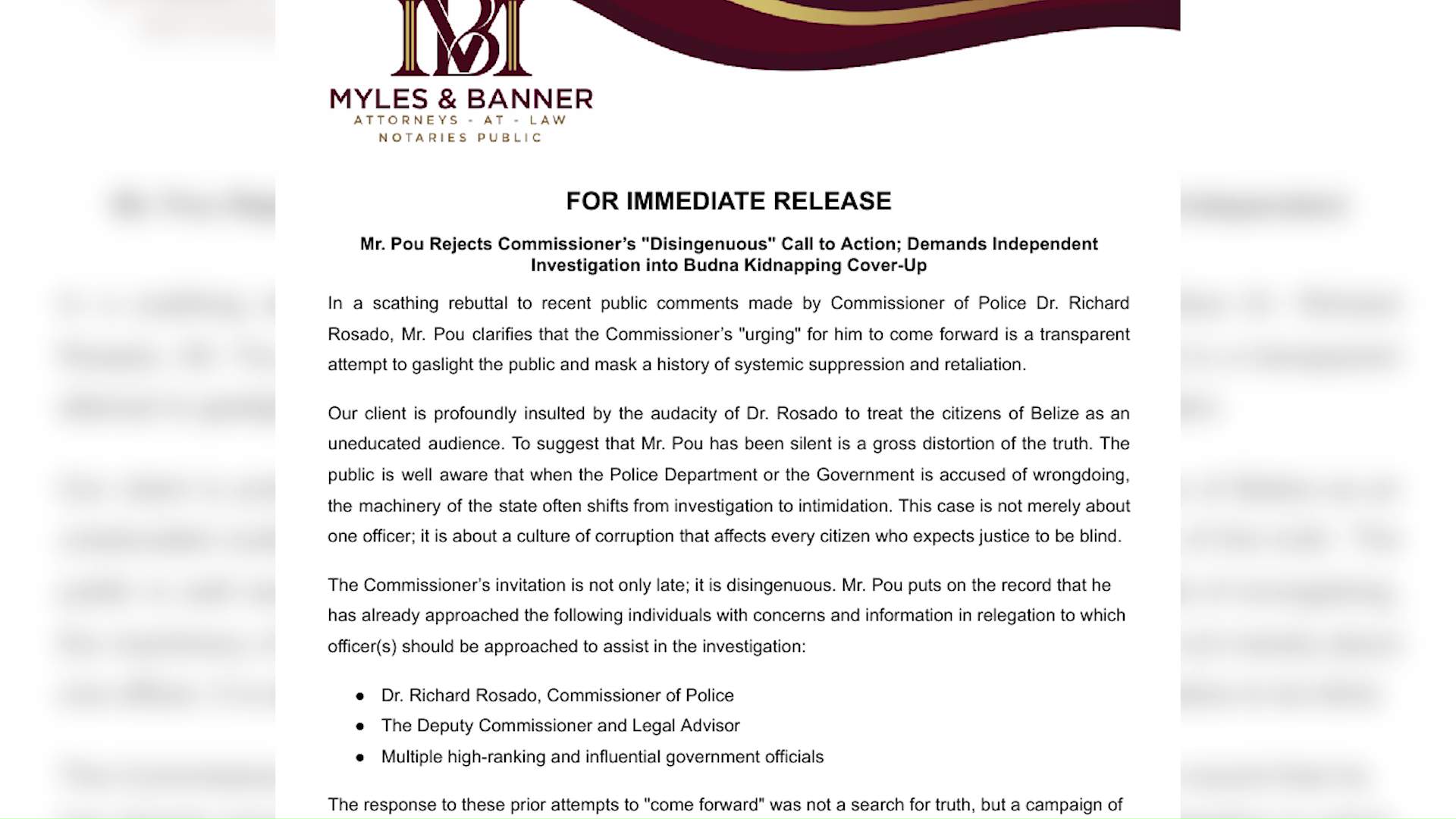
    Prime Minister John Briceño has reaffirmed his administration’s position regarding the ongoing investigation into the Joseph Budna kidnapping case, maintaining that the Belize Police Department retains sole jurisdiction over the matter. During a recent press engagement, Briceño emphasized that Belizean legislation currently lacks provisions for independent investigative bodies to assume control of such cases.

    The Prime Minister’s statements come amid growing public scrutiny surrounding allegations of procedural misconduct within the police force. Online speculation has suggested that officers involved in the investigation may have provided falsified statements during questioning, raising concerns about the integrity of the investigative process.

    When pressed about potential conspiracy theories regarding a cover-up in the kidnapping case, Broneño adopted a measured stance. “I don’t know if police officers—if it was just police officers,” he stated, suggesting that public service personnel sometimes resist administrative transfers and might make unfounded claims accordingly. The Prime Minister deferred specific operational questions to Police Commissioner Chester Williams, acknowledging that the commissioner would be better positioned to address detailed inquiries about the investigation’s conduct.

    Briceño expressed particular disappointment with the Director of Public Prosecutions’ (DPP) public criticism of the investigation, while simultaneously affirming Belize’s democratic principles that allow for such expressions of dissent. He emphasized that the current priority remains ensuring police conduct a thorough and proper investigation into the Budna case.

  • Justice : Unwarranted search of the residence of Port-au-Prince Mayor Ralph Youri Chevry

    Justice : Unwarranted search of the residence of Port-au-Prince Mayor Ralph Youri Chevry

    Port-au-Prince Mayor Ralph Youri Chevry has publicly condemned an early morning police raid on his private residence that he claims violated constitutional protections and standard legal procedures. The incident occurred between 6:00 and 7:00 a.m. in the Juvenat neighborhood, involving multiple armed police units under the direction of Government Commissioner Fritz Patterson Dorval.

    According to Mayor Chevry, the operation began with gunshots that awakened him and resulted in the unjustified killing of his dog. He emphasized that no search warrant was presented despite his repeated requests, and no formal charges were brought against him during the nearly three-hour operation. One of his security agents was temporarily arrested but later released in the Delmas area.

    The police confiscated several weapons assigned to the mayor’s security detail, including a Galil AC 22 (Taurus), a T4, an AR-15 rifle, along with ammunition, a communication radio, and a surveillance drone.

    In his official statement, Mayor Chevry cited Article 24.1 of Haiti’s 1987 Constitution, which establishes the inviolability of homes and requires that any search be conducted according to legally prescribed procedures. He further referenced the Code of Criminal Procedure, which mandates that searches must be authorized by a competent judge, accompanied by a reasoned warrant, and executed in the presence of witnesses.

    Despite what he characterized as procedural violations, Chevry stated that he cooperated ‘calmly and responsibly’ during the operation, acknowledging the ‘specific circumstances’ while reaffirming his commitment to the rule of law, legal procedures, and transparency. The mayor emphasized his continued devotion to Port-au-Prince and Haiti, promising to provide further clarification through appropriate legal channels with his counsel.

    He concluded by urging respect for established facts to prevent ‘confusion or manipulation’ of the incident, which raises significant questions about police procedures and constitutional protections in Haiti’s ongoing governance challenges.

  • Nieuwe wet in de maak om crimineel vermogen af te pakken

    Nieuwe wet in de maak om crimineel vermogen af te pakken

    Suriname’s governing coalition has presented a transformative legislative proposal to the National Assembly designed to significantly strengthen the country’s anti-corruption framework. The Illegally Obtained Advantage Deprivation Act (Wet Ontneming Wederrechtelijk Verkregen Voordeel) represents a comprehensive legal overhaul enabling prosecutors to confiscate criminal proceeds even when concealed through sophisticated financial schemes or complex ownership structures.

    This landmark legislation supplements the existing Penal Code and Code of Criminal Procedure, addressing critical deficiencies in Surinamese law enforcement identified by international monitoring bodies. The explanatory memorandum accompanying the bill characterizes organized crime—including systemic corruption, narcotics trafficking, money laundering, and human trafficking—as an existential threat to national stability and institutional integrity.

    Prosecutors will operate under judicial supervision within an expanded investigative framework permitting exhaustive financial examinations. The scope encompasses bank accounts, cryptocurrency wallets, real estate holdings, vehicles, securities, and any assets where suspects maintain de facto control regardless of nominal ownership.

    A pivotal innovation introduces the principle of wealth discrepancy: when investigations reveal assets substantially exceeding legitimate income sources, courts may compel suspects to provide convincing explanations for these disparities. Failure to satisfactorily account for unexplained wealth creates legal presumption of criminal origins.

    The legislation also establishes value substitution seizure mechanisms, allowing authorities to confiscate equivalent-value assets when original criminal proceeds have been transferred abroad, laundered through third parties, or already expended.

    Notably, the law breaches banking confidentiality under strict judicial authorization requirements, extending disclosure obligations to accountants, insurers, and notaries public. Proponents emphasize these provisions include robust safeguards against abuse while remaining essential for investigating contemporary money laundering techniques.

    The legal framework aligns Suriname with international conventions including the UN Convention Against Corruption (UNCAC) and UN Convention Against Transnational Organized Crime (UNTOC), while implementing recommendations from the Financial Action Task Force (FATF) regarding confiscation procedures and financial investigations.

    According to official documentation, the act specifically addresses deficiencies highlighted by the Caribbean FATF, including inadequate cryptocurrency regulations, insufficient information sharing protocols, and limited capabilities for tracing and freezing illicit assets.

    Government officials position this legislation as signaling Suriname’s determination to eliminate its reputation as a safe haven for criminal proceeds, simultaneously enhancing law enforcement capabilities and restoring public confidence in judicial institutions.

  • FLASH : DHS terminates Humanitarian Parole and Family Reunification programs for Haiti

    FLASH : DHS terminates Humanitarian Parole and Family Reunification programs for Haiti

    In a significant immigration policy shift, the Department of Homeland Security has announced the termination of all categorical Family Reunification Parole (FRP) programs for nationals from seven countries, including Haiti, Colombia, Cuba, Ecuador, El Salvador, Guatemala, and Honduras. The decision, effective immediately, marks a dramatic reversal from previous administration policies.

    The DHS justification centers on addressing what it characterizes as systemic vulnerabilities in the humanitarian parole system. Administration officials contend that the FRP programs enabled insufficiently vetted individuals to bypass established immigration protocols, creating potential national security risks. The department emphasized that parole authority was never intended for broad categorical use but rather for individualized case assessments as originally mandated by Congress.

    According to the federal notice published in the Federal Register, current FRP beneficiaries will see their parole status terminate on January 14, 2026, unless they have pending Form I-485 applications postmarked by December 15, 2025. Those with pending applications may maintain parole status until either their parole period expires or USCIS renders a final decision on their adjustment of status application.

    The policy change carries substantial implications for employment authorization, as termination of parole status will automatically revoke work permits derived from that parole. DHS has committed to providing individual notifications to affected persons regarding both parole termination and employment authorization revocation.

    The department is implementing a structured departure process, encouraging individuals without lawful status after program termination to utilize the CBP Home application to coordinate their departure. Financial incentives including exit bonuses, travel document assistance, and civil fine forgiveness are being offered to qualifying individuals who voluntarily depart by the established deadline.

  • Blue Economy Minister Andre Perez Hits Back: ‘No Mismanagement at Hol Chan’

    Blue Economy Minister Andre Perez Hits Back: ‘No Mismanagement at Hol Chan’

    Belize’s Minister of Blue Economy and Marine Conservation, Andre Perez, has issued a forceful rebuttal against allegations of financial misconduct at the Hol Chan Marine Reserve. The minister characterized recent claims of fund mismanagement as “false, unfounded, and irresponsible” while defending his administration’s record.

    In an official statement released Friday, Minister Perez asserted that since his ministry assumed oversight in November 2020, no evidence of embezzlement, misappropriation, or misuse of funds has been discovered. He emphasized that all financial operations at the marine reserve strictly adhere to established governance protocols and audit procedures.

    The controversy emerged after the Association of Conservation and Community Development (ACCSD) expressed concerns regarding the abrupt removal of the Board of Trustees Chair and her subsequent replacement by the current Lions Club Chair. The conservation watchdog organization has called for a comprehensive six-year independent financial audit to ensure transparency.

    ACCSD further questioned whether the statutory instrument governing Hol Chan is being properly implemented, particularly regarding maintaining genuine community representation. The organization highlighted that the reserve was founded on principles of “openness, accountability, and authentic community involvement.”

    Minister Perez dismissed the allegations as politically motivated, challenging critics to present verifiable evidence rather than engaging in speculation. He revealed that when his leadership assumed control of Hol Chan in November 2020, the reserve was nearly bankrupt and burdened by significant debt. After five years of management, Perez maintains the marine reserve has been transformed into a “stronger, solvent, and thriving” institution.

    The escalating dispute highlights ongoing tensions between government management of natural resources and conservation groups’ calls for increased transparency in Belize’s protected areas.

  • OM  niet gekend bij initiatiefwetten: ‘Ongehoorde gang van zaken’

    OM niet gekend bij initiatiefwetten: ‘Ongehoorde gang van zaken’

    Suriname’s judicial system faces mounting tension as Prosecutor General Garcia Paragsingh has publicly denounced the government’s exclusion of the Public Prosecution Service from legislative processes directly affecting its operations. The controversy stems from two recently proposed laws that would fundamentally reshape the nation’s prosecution apparatus, including the establishment of a College of Prosecutors General.

    In an unprecedented rebuke, Paragsingh revealed that the Public Prosecution Service learned about these significant judicial reforms through media reports rather than official channels. She characterized this exclusion as “unheard of and incompatible with democratic constitutional principles,” describing the government’s approach as imposing and even dictatorial in nature.

    The proposed College of Prosecutors General has drawn particular criticism. Paragsingh questioned whether proper preliminary research was conducted regarding the prolonged duration of court cases, emphasizing that her office bears no responsibility for delays once cases reach trial proceedings. “The role of the Public Prosecution Service as dominus litis ends when the case is called to session by the bailiff,” she stated, noting that prosecutors lose all control over case duration once proceedings begin.

    Additional concerns were raised regarding plans to lower the retirement age for prosecutors to 65 while maintaining a 70-year retirement threshold for the President and members of the Court of Justice. Paragsingh challenged this discrepancy, questioning why the Prosecutor General—who is similarly affiliated with the Court of Justice—should not receive equal treatment.

    The Public Prosecution Service emphasized that careful governance requires consulting relevant institutions and stakeholders before implementing legislation that directly affects them. The organization expressed profound dismay at learning about these consequential reforms through a press conference, with Paragsingh asserting that such procedures violate fundamental democratic principles.

  • MP Says Government Seeking EC$1.6B in Borrowing Despite ‘Surplus’ Claims

    MP Says Government Seeking EC$1.6B in Borrowing Despite ‘Surplus’ Claims

    In a striking parliamentary confrontation, Opposition Member of Parliament Sherfield Bowen has leveled serious allegations against the Gaston Browne administration regarding its fiscal management practices. During Friday’s Budget Debate, Bowen presented a detailed critique asserting that the government’s proclaimed fiscal surplus constitutes an accounting illusion that collapses under rigorous examination.

    Bowen’s central argument focused on the administration’s controversial methodology of excluding debt amortization from expenditure calculations—a technical maneuver that creates an appearance of financial health while substantial obligations remain outstanding. The parliamentarian maintained that applying standard accounting principles reveals the government is actually operating at a deficit rather than the proclaimed EC$200 million surplus.

    The opposition figure raised compelling questions about the administration’s simultaneous declaration of surplus while seeking parliamentary approval for substantial new borrowing authority. Bowen highlighted the apparent contradiction in requesting approximately US$600 million (equivalent to EC$1.6 billion) in new borrowing capacity immediately after announcing a budget surplus, suggesting this discrepancy indicates deeper fiscal challenges.

    Bowen connected these fiscal concerns to broader transparency issues, revealing that his attempts to obtain financial documentation from state entities have been systematically obstructed. This lack of access to public records, he argued, prevents proper parliamentary oversight and verification of whether government expenditures have received appropriate authorization.

    The parliamentarian concluded with a sobering assessment that the pattern of deficit spending and accumulating debt has persisted despite repeated governmental assurances of improving public finances. As of this reporting, the Gaston Browne administration has not issued a direct response to these allegations.

  • Bowen Threatens Legal Action After Transport Board Withholds Vehicle Records

    Bowen Threatens Legal Action After Transport Board Withholds Vehicle Records

    In a dramatic escalation of his ongoing transparency campaign, opposition parliamentarian Sherfield Bowen issued a stark ultimatum during Friday’s 2026 Budget Debate: release crucial government records or face legal proceedings. The legislator revealed he would seek writs of mandamus – judicial orders compelling public officials to execute their statutory duties – against multiple government agencies.

    The confrontation originated from what Bowen termed a ‘vehicle-registration controversy’ when he sought basic information from the Transport Board regarding government-owned vehicles. Despite what he characterized as a straightforward inquiry about the number of officially registered state vehicles, Bowen received a blunt refusal: ‘I don’t think we can give you that information.’

    This obstruction, according to Bowen, transcends mere bureaucratic resistance. He framed it as a fundamental breach of democratic principles, emphasizing that elected representatives must have unfettered access to information concerning public assets and expenditures. The Transport Board case proved merely symptomatic of a broader pattern, with Bowen detailing similar stonewalling from multiple record-holding entities.

    He provided a particularly telling example involving the Social Security institution. Whereas several years prior he successfully obtained and utilized their data for governmental financial analysis, his subsequent requests for updated information have met with complete silence. ‘Ever since I did that, no matter how many times I request the data, not even an answer,’ Bowen told Parliament.

    Bowen’s threatened legal action specifically targets the Transport Board and the designated ‘keeper and custodian of government records.’ He maintains that this struggle transcends partisan politics, touching upon the core democratic obligation of transparency in governance. Public institutions, he argued, bear a non-negotiable duty to disclose information pertaining to state assets, public spending, and national financial management.

  • Bowen Says National Debt Rose from $2.6B in 2014 to $4B Today

    Bowen Says National Debt Rose from $2.6B in 2014 to $4B Today

    In a striking parliamentary confrontation during the 2026 Budget Debate, Opposition Member of Parliament Sherfield Bowen delivered a scathing critique of the government’s fiscal narrative, presenting evidence that Antigua and Barbuda’s national debt has dramatically increased rather than decreased under current administration.

    Bowen challenged the administration’s frequent claims of successful debt management, revealing that while the government emphasizes debt-to-GDP ratios showing improvement from over 100% to approximately 61%, the actual dollar value of national liabilities tells a different story. According to the MP’s analysis, the national debt has ballooned from EC$2.6 billion in 2014 to approximately EC$4 billion in the current budget—representing a substantial increase in real terms.

    The parliamentarian referenced the 2014 Director of Audit’s Report as his baseline, highlighting that when the Antigua and Barbuda Labour Party assumed office, the debt stood at EC$2.6 billion. He systematically deconstructed the government’s percentage-based presentations, arguing that focusing solely on GDP ratios creates a misleading perception that obscures the true scale of borrowing.

    Bowen enhanced his argument with per-capita calculations, demonstrating that each citizen’s share of the national debt has effectively doubled from approximately EC$24,000 in 2014 to about EC$50,000 currently. This tangible metric, he contended, more accurately reflects the actual burden on the population than abstract percentage comparisons.

    The opposition MP attributed this debt accumulation to years of sustained budgetary deficits and continued borrowing, directly contradicting government assertions of improved public finances. His critique formed part of a broader examination of the budget’s presentation methods, which he accused of masking structural economic weaknesses behind favorably framed headline figures.

  • Government Appoints Dr. Dave Ray Diaspora Officer, Plans 2026 Diaspora Forum

    Government Appoints Dr. Dave Ray Diaspora Officer, Plans 2026 Diaspora Forum

    In a strategic move to deepen ties with its overseas citizens, the government of Antigua and Barbuda has established a specialized diplomatic position dedicated to diaspora relations. Foreign Affairs Minister EP Chet Greene formally announced the appointment of Dr. Davery as the nation’s first Diaspora Officer during his parliamentary address on the 2026 Budget.

    The creation of this role signifies a substantial policy shift from conventional consular assistance toward building a more structured and impactful partnership with Antiguans and Barbudans residing abroad. Minister Greene emphasized that this initiative reflects a renewed commitment to engaging diaspora communities, particularly those in major hubs like New York.

    Complementing this appointment, Minister Greene unveiled plans for a landmark Diaspora Business Forum, scheduled to take place in St. John’s in 2026. The government has strategically planned the event to coincide with the vibrant Carnival season, facilitating greater participation by enabling overseas nationals to combine cultural celebration with economic engagement without the need for multiple transcontinental trips.

    The forum’s primary objective will be to catalyze investment and foster the transfer of knowledge and skills from the diaspora to the domestic economy. Minister Greene explicitly stated that while financial remittances are valued, the administration seeks a more profound level of economic involvement. “We can’t just be talking about remittances,” Greene told Parliament, outlining a vision for the forum to serve as a platform for serious business dialogue that directly contributes to national development.

    This dual-pronged strategy—a dedicated officer and a major investment forum—forms part of a broader governmental effort to transform global overseas connections into sustainable, long-term economic partnerships for Antigua and Barbuda.