分类: politics

  • Jamaicans cannot eat fiscal credibility, says Hylton

    Jamaicans cannot eat fiscal credibility, says Hylton

    KINGSTON, Jamaica — In a pointed address to Jamaica’s House of Representatives during Tuesday’s annual Sectoral Debate, opposition trade spokesperson Anthony Hylton launched a sharp critique of the ruling Jamaica Labour Party (JLP) administration’s economic approach, accusing the government of fixating on headline fiscal indicators while ignoring the growing financial strain facing ordinary Jamaican households.

    Hylton, who serves as the Opposition Spokesman on Trade, Industry and Global Logistics, argued that the JLP administration has grown complacent in celebrating macroeconomic wins that do little to improve daily life for most citizens. The government has repeatedly highlighted its achievements in fiscal discipline, macroeconomic stability, and growth in the country’s Net International Reserves — benchmarks that Hylton acknowledges hold genuine importance as foundational pillars for national economic health.

    But these abstract numbers do not tell the full story of Jamaica’s economic reality, Hylton emphasized. “The Jamaican people are not living inside spreadsheets,” he said, outlining the gap between government reporting and on-the-ground experience: working families across the country are navigating persistent spikes in food and energy costs, stagnant wages that fail to keep up with the rising cost of living, and shrinking pathways to upward economic mobility.

    The opposition spokesperson added that even young professional Jamaicans, a core demographic for long-term national growth, are increasingly questioning whether the country can offer them a stable, rewarding future. Too many households, he noted, are barely clinging to financial stability from one month to the next, rather than building long-term prosperity.

    For Hylton, the central question facing Jamaica’s legislative body is not whether the government can balance its books — it is whether the country’s economic strategy is delivering tangible, felt prosperity to everyday people. In one of the most memorable lines of his address, he argued: “Jamaicans cannot eat fiscal credibility. They cannot pay mortgages with macroeconomic statistics. And they cannot build businesses from press releases.”

    Beyond criticizing the current administration’s approach, Hylton pushed for a transformative shift in economic policy, arguing that Jamaicans deserve far more than just basic stability management. What the country needs, he insisted, is a bold, comprehensive national growth strategy designed to build long-term economic resilience, expand access to opportunity, boost domestic productivity, and deliver shared, sustainable prosperity for all segments of society.

    Hylton pointed to a host of inherent advantages Jamaica already holds to support strong growth: a strategic geographic position along the world’s busiest shipping corridors, a skilled English-speaking workforce positioned for global trade and investment, close proximity to some of the world’s largest consumer markets, globally influential cultural brands, a population of driven entrepreneurs, and vast untapped economic potential across multiple sectors. Yet he stressed that inherent advantages are useless without intentional, targeted planning. “Potential without strategy is merely an unrealized opportunity,” he said.

    Hylton framed this gap as the core failure of the national budget the government introduced in March, and positioned the push for a actionable growth strategy as the defining challenge facing the sitting administration and the entire House of Representatives in the coming term.

  • Man for the mission

    Man for the mission

    As he nears his 80th birthday, one of the Caribbean’s most long-serving and influential political figures has announced he will step away from front-line electoral politics, but has no plans to exit public life. Instead, former St Vincent and the Grenadines Prime Minister Dr. Ralph Gonsalves is preparing to step into a new, high-profile role advancing the regional movement for reparatory justice for the harms of chattel slavery, indigenous genocide, and centuries of colonial exploitation.

    Gonsalves, who led his country for more than 22 years before his Unity Labour Party (ULP) suffered a lopsided electoral defeat in November 2023 that left him as the sole opposition lawmaker in parliament, made the remarks during an address to the Jamaica Observer Press Club last Wednesday. While confirming he will not encourage his party to select him as its lead candidate in the next general election, he stressed that the final decision on his electoral future rests with ULP membership.

    “I’m a party man, but I would not encourage the party to do that,” Gonsalves told attendees, pushing back on speculation he could reverse course if party leaders would beg him to stand again. “The ruling New Democratic Party has publicly hoped he would fade quietly from public life after the election result, but Gonsalves made clear that stepping back from electoral leadership is not equivalent to full retirement.

    “Fate, history, and circumstance have accorded me this current role in the legislature. The Government would have liked it if I would just fade away but the good Lord doesn’t intend for me to do that,” he declared.

    In recent weeks, Gonsalves was appointed senior advisor to the Repair Campaign, a regional advocacy initiative launched in 2022 by Irish businessman Denis O’Brien that supports the work of the Caribbean Community (Caricom) Reparations Commission (CRC). The campaign focuses on public education, academic research, and global diplomatic engagement to push for formal reparations from former colonial powers for harms inflicted on Caribbean peoples. Drawing on his decades of experience in regional politics and his background as a trained lawyer and social scientist, Gonsalves plans to leverage existing professional and personal connections to strengthen coordination between governments, civil society groups, academic institutions, and international stakeholders working on the reparations cause.

    Gonsalves argues that reparations is far more than a government-led initiative, saying the movement requires coordinated action from across regional and global groups. “We do not make history in circumstances chosen by ourselves but by conditions which are inherited from the past and those which have arisen from the extant circumstances,” he noted in his address, framing the reparations fight as a defining historical project for the Caribbean region.

    His new role is not the only activity keeping him engaged post-election. Gonsalves shared that he is putting the final touches on a 480-page manuscript examining Caribbean political leadership, hosts a three-hour weekly radio show on his party’s radio station twice a week, and prioritizes time with his 15-month-old granddaughter, whom he called “a beautiful young lady in my life” that he often brings with him on regional travel.

    “ I take her walking in the morning, walking in the evening. She loves to be with her papa. If I come to Jamaica, I have to bring her with me because she wouldn’t want me to leave her home,” he said warmly.

    Even as he spoke of personal life and political transition, Gonsalves repeatedly circled back to the reparations movement, framing it as an unfinished great cause that demands unwavering commitment from regional leaders. Invoking a quote from Jamaican National Hero Norman Manley, he argued that transformative progress cannot be achieved by leaders who are uncertain of the cause.

    “In August I am going to be 80 years old. As you notice, I have all my marbles, the brain is ticking over well,” he joked. “West Indian integration, regional integration, is a great cause, and great causes have never been won by doubtful men and women. The same thing with reparations; it is a great cause, and this cannot be won by doubtful men and women.”

  • Government to present territorial planning plan for Verón-Punta Cana

    Government to present territorial planning plan for Verón-Punta Cana

    Verón-Punta Cana, the Dominican Republic’s crown jewel of international tourism, is set to enter a new era of organized, sustainable growth following a joint announcement from the Dominican Ministry of the Presidency and the Verón-Punta Cana Tourist Municipal District. The two governing bodies have confirmed that the district’s long-awaited Territorial Planning Plan will be officially presented to key stakeholders on May 11, 2026, at the iconic Hard Rock Hotel & Casino Punta Cana.

    This strategic policy initiative is crafted to address a pressing challenge that has emerged alongside Verón-Punta Cana’s explosive expansion: unregulated growth that has strained local territorial organization and urban development frameworks. Over recent decades, the region has seen unprecedented surges in both population growth and tourist arrivals, outpacing existing urban planning structures and creating uncoordinated development patterns that threaten the area’s long-term competitiveness as a tourism destination.

    At the official launch event, regional and national authorities will publicly release the full technical document that lays out clear, actionable guidelines for four core pillars of development: responsible land use, managed urban expansion, modern infrastructure upgrades, and cross-cutting sustainability standards. To ensure broad alignment and transparency, organizers have extended invitations to a wide range of participants, including senior national and local government officials, tourism industry business leaders, and community stakeholders invested in the district’s long-term growth.

    Local authorities frame the official presentation of the plan not as an endpoint, but as the foundational starting point for a transformative new phase in Verón-Punta Cana’s development trajectory. By establishing clear, forward-looking planning rules, the initiative aims to balance continued economic growth in the tourism sector with the preservation of local resources and improved quality of life for permanent residents, setting a benchmark for sustainable tourism development across the Caribbean region.

  • Audit raises questions about ODPEM’s management of disaster relief

    Audit raises questions about ODPEM’s management of disaster relief

    KINGSTON, Jamaica — Jamaica’s national audit watchdog has raised serious red flags over how the country’s top emergency management agency handles public and donated disaster relief funding, including a major post-hurricane recovery program.

    The Auditor General’s Department (AGD) released a damning audit report Tuesday, which was formally presented to Jamaica’s parliament, calling out widespread systemic failures at the Office of Disaster Preparedness and Emergency Management (ODPEM), the government body tasked with leading national emergency response and recovery operations. The probe centered specifically on ODPEM’s stewardship of resources allocated to the Hurricane Melissa Relief Initiative, alongside broader oversight of the National Disaster Fund and the government’s Restoration of Owner or Occupant Family Shelters (ROOFS) shelter recovery program.

    According to the report, ODPEM has demonstrated significant shortcomings across three core operational areas: financial management, institutional governance, and program accountability. One of the most notable gaps uncovered is the extreme lack of transparency around how Hurricane Melissa relief resources have been deployed. As of the audit cutoff date of February 23, 2026, just 1.8 percent of total cash donations earmarked for relief efforts had been spent — a mere $26.2 million out of the $1.44 billion received.

    Auditors also found insufficient regulatory controls for donations processed through a partnering financial services institution. Key documentation gaps include the absence of a formal written agreement outlining terms for retained funds, and incomplete financial reconciliation records that make it impossible to fully track how all donations have been managed.

    For the ROOFS Program, which relied on emergency procurement rules to speed up delivery of shelter materials, the audit identified multiple critical gaps in operational oversight. ODPEM failed to carry out required due diligence on participating suppliers, did not complete formal verification that ordered materials were delivered, lacked proper supporting documentation for payments, and failed to maintain complete records of project completion. These failures mean regulators have no guarantee that $167.3 million worth of program materials were used fully and for their intended purpose, the report concluded.

    Beyond the specific program findings, the audit also assessed whether ODPEM’s internal control systems are robust enough to prevent, identify, and address fraud, waste, and misuse of public and donated disaster resources. The report confirmed that significant unaddressed gaps also remain in the ongoing oversight of the broader National Disaster Fund, raising questions about the agency’s ability to responsibly manage disaster resources at a systemic level.

  • SPARK programme falling short in St Ann South East, says Opposition MP

    SPARK programme falling short in St Ann South East, says Opposition MP

    KINGSTON, Jamaica — A sitting Jamaican member of parliament has launched a scathing rebuke of the national government’s flagship road improvement initiative, accusing the administration of failing to deliver critical infrastructure upgrades to his coastal constituency, leaving thousands of residents trapped in a cycle of unsafe and impassable road conditions.

    Kenneth Russell, who represents St Ann South East, laid out his damning indictment of the Shared Prosperity Through Accelerated Improvement to Our Road Network (SPARK) Programme during a dedicated press briefing Tuesday, branded “Uncovering the Facts on the SPARK Road Programme”. The event was organized to draw public and government attention to what Russell calls systemic failure and disrespect for local communities.

    First launched to align with the Jamaican government’s broader economic growth and inclusive social development targets, SPARK organizes national infrastructure upgrades into four large-scale construction packages designed to overhaul the island’s aging road network. For St Ann South East, nine roads were formally added to the SPARK project roster with a total projected investment of $2.3 billion. But according to Russell, only $315 million – less than 15% of the required funding – has been allocated to date, with just three of the nine roads marked for any work. Shockingly, only one of those three projects has broken ground, while the remaining two have been given at least six separate announced start dates that have all come and gone with no construction activity whatsoever.

    The constituency faces uniquely pressing infrastructure needs: Russell reports St Ann South East has roughly 225 kilometers of roads managed by Jamaica’s National Works Agency, more than any other parliamentary constituency in the country, with 80% of that network assessed as needing full rehabilitation. Decades of underinvestment have left almost no stretch of road in the area free of damaging potholes, according to the MP, and many communities face daily life-threatening hazards that disrupt access to work, school, and emergency services.

    Russell pointed to Johnny Spring Road in Higgin Town as a prime example of the government’s broken promises. “There was a promise sold to the country that under SPARK, this road would be rehabilitated. They were given dates before the hurricane and since the hurricane, we have had not just one or two, not three…[but] at least six start dates,” he said, noting that every deadline has passed without any official explanation for the delays to local residents.

    This pattern of unmet commitments has left local communities increasingly frustrated, a sentiment Russell says amounts to “the height of disrespect” for constituents who rely on functional roads for their daily livelihoods. Poor conditions affect communities across the constituency, including Dunnsville, White Hall, and Nine Mile, where residents report major difficulties entering and exiting their neighborhoods. Russell also highlighted the road adjacent to Golden Grove Primary School, calling it one of the most dangerous stretches in the area: “When it rains, it’s treacherous,” he said.

    Beyond potholes and surface damage, Russell warned that several sections of road in White Hall and Nine Mile are at risk of complete breakaway, and that urgent intervention is required to prevent fatal accidents. “I would hate if it would have to come to someone losing their lives for action to be taken,” he emphasized.

    Even if the government completes all nine SPARK projects currently allocated for St Ann South East, Russell added, the upgrades would only address less than 40% of the constituency’s NWA-managed road network, leaving the majority of the area’s infrastructure still in dire need of repair. The criticism puts renewed pressure on the Jamaican government to address funding gaps and delivery delays in its signature infrastructure programme, as opposition from local representatives grows over unfulfilled campaign and policy commitments.

  • Jamaican attorney Tamar Hamilton announces bid for Florida judge post

    Jamaican attorney Tamar Hamilton announces bid for Florida judge post

    A long-time South Florida resident with Jamaican roots, attorney Tamar N Hamilton has officially thrown her hat in the ring for the Broward County Circuit Court Judge seat in Group 52. Her announcement comes on the heels of the recent retirement of Michael G. Kaplan, who held the position for 24 years, leaving the vacancy that three candidates now seek to fill.

    The upcoming election, scheduled for August 18, is a statewide judicial contest in Florida that will see voters select 20 new Circuit Court judges across the state. Originally hailing from Kingston, Jamaica, Hamilton has built her life and career in Florida over the past 25 years, establishing deep roots in the local legal and community landscape. Currently serving as a special magistrate, she maintains dual office locations in Cutler Ridge and Lauderhill, and previously held the role of president of the Jamaican American Bar Association. Interestingly, a run for the judicial seat was already on her agenda six years ago, when she first considered challenging the incumbent Kaplan.

    Hamilton shared her motivations for entering the race in an interview with Observer Online, noting that her first serious consideration of a judicial run came in 2020, when she observed a growing gap in community engagement and public understanding of the U.S. legal system. “Through my work educating and supporting residents across Broward County, I developed a deep passion for serving from the bench, where I can ensure that every person who enters the courtroom is heard, respected and treated fairly,” she explained. Hamilton pointed to her multi-faceted professional background — spanning work as a special magistrate, adjunct law professor, practicing attorney, and community advocate — as comprehensive preparation for the demands of the judgeship.

    Her academic journey began at Jamaica’s St. Andrew Technical High School, before she pursued higher education in Florida. She earned a Bachelor of Arts degree in interdisciplinary arts and humanities from Florida Atlantic University in Boca Raton, followed by a Juris Doctorate degree with honors from St. Thomas University School of Law in Miami Gardens, where she still teaches as an adjunct professor today.

    In Florida, Circuit Court judges are elected to six-year terms, with no term limits imposed on this non-partisan public office. These judicial positions carry broad responsibility, as judges preside over a wide range of legal matters including criminal proceedings, civil disputes, and family law cases. Hamilton emphasized that her decades of legal work have given her direct experience across all these core practice areas.

    Outlining what she believes makes an effective judicial leader, Hamilton noted: “An effective Circuit Court judge is experienced, fair and committed to listening. It requires a strong understanding of the law, sound judgment, patience, and the ability to remain impartial in every case. Equally important is the ability to ensure that all parties feel heard and that decisions are made thoughtfully and respectfully, in accordance with the law.” As election day approaches, Hamilton will join the two other candidates in vying for voter support to claim the open Group 52 seat.

  • Dominican Republic renews U.S. access to Las Américas Airport and San Isidro Air Base

    Dominican Republic renews U.S. access to Las Américas Airport and San Isidro Air Base

    Santo Domingo, Dominican Republic – The Caribbean nation has reauthorized temporary access for United States aircraft and military personnel to two key air facilities, Las Américas International Airport and San Isidro Air Base, as a core component of bilateral security cooperation under the multilateral Shield of the Americas initiative.

    Under the terms of the renewed authorization, U.S. aircraft are permitted to conduct overflights, land, and park at the two sites, with all activity operating under the direct supervision of Dominican national authorities. Local security officials have emphasized that the agreement is designed to bolster cross-border and regional security capacity, boosting joint efforts including aerial surveillance operations, real-time intelligence sharing, specialized training programs for Dominican personnel, and targeted technical assistance.

    These collaborative measures are focused on addressing persistent threats to the Dominican Republic and the broader Caribbean region, including illicit drug trafficking, transnational organized criminal networks, and other evolving cross-border security risks.

    As an addendum to the broader bilateral security framework, the Dominican government also signed a non-binding memorandum of understanding that creates a pathway for the temporary, exceptional entry of a small group of third-country nationals. The provision only applies to transiting travelers with no prior criminal records, and places strict limits on the number of individuals eligible for this arrangement.

    In a parallel move to strengthen national security infrastructure, the Dominican government is currently rolling out modernization upgrades to airport and border security systems. The upgrades integrate cutting-edge biometric identification technologies and new digital verification tools, which officials say will not only enhance domestic and regional security but also lay the groundwork for improved air connectivity and growth in the country’s critical tourism sector in the long term.

  • Abinader named keynote speaker at World Free Zones Congress in Panama

    Abinader named keynote speaker at World Free Zones Congress in Panama

    On Tuesday, Dominican Republic President Luis Abinader will embark on an official trip to Panama, where he is set to take center stage at the 2024 World Free Zones Congress. Scheduled to run across May 12 and 13, the global gathering will feature Abinader as the event’s keynote speaker, with a core mission to position the Caribbean nation as a premier investment hub for global companies eyeing expansion in free zone operations, advanced logistics, and high-value manufacturing.

    Beyond his keynote address, Abinader has planned a full schedule of targeted engagements with top international corporate executives and leading figures from Panama’s local business community. These one-on-one and group meetings are designed to highlight the Dominican Republic’s competitive advantages in specialized free trade zone sectors, from favorable regulatory frameworks to strategic geographic positioning, and drum up new foreign capital commitments for the country.

    This investment outreach forms a central plank of the Abinader administration’s broader economic strategy, which aims to steadily boost foreign direct investment inflows and cement the Dominican Republic’s standing as one of the most dynamic and fast-growing economies in Latin America.

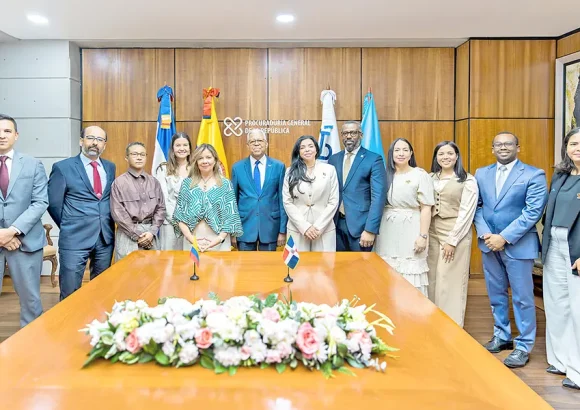
    Abinader will also hold a formal bilateral meeting with his Panamanian counterpart, President José Raúl Mulino, to discuss bilateral relations and potential cross-border economic cooperation between the two nations. He will be joined on the trip by a high-level official delegation including Eduardo Sanz Lovatón, Dominican Minister of Industry, Commerce and MSMEs, Biviana Riveiro, and Dominican Ambassador to Panama Roberto Salcedo.

  • DCP Quashie Attends ACCP 40th Annual General Meeting & Conference In Suriname

    DCP Quashie Attends ACCP 40th Annual General Meeting & Conference In Suriname

    Paramaribo, Suriname – Top law enforcement leaders from across the Caribbean have gathered in the Suriname capital this week for the 40th Annual General Meeting and Conference of the Association of Caribbean Commissioners of Police (ACCP), an event focused on tackling growing cross-border security challenges that threaten regional progress.

    Deputy Commissioner of Police Louisa Benjamin-Quashie is representing the Royal Police Force of Antigua and Barbuda at the five-day event, which runs from May 11 to 15, 2026. This gathering marks Quashie’s first attendance at the high-profile regional conference since assuming the role of Deputy Commissioner, bringing Antigua and Barbuda’s perspective to collective security conversations.

    The official opening ceremony kicked off on May 11 at Paramaribo’s Royal Torarica Resort, drawing commissioners of police, senior law enforcement command staff, national government representatives, and heads of local security agencies from across the Caribbean and Suriname. Attendees are convening to address a wide range of pressing security threats under this year’s central theme: “Organized Crime: Implications for Regional Development”.

    Over the course of the conference, participants will take part in a full schedule of plenary addresses, interactive panel discussions, and closed-door strategic working sessions. Key topics on the agenda include countering transnational organized criminal networks, curbing the illicit flow of firearms across regional borders, addressing the evolving threat of cybercrime, expanding the use of intelligence-led policing frameworks, deepening cross-border security cooperation, and exploring the responsible integration of artificial intelligence into modern law enforcement operations.

    For decades, the annual ACCP conference has functioned as a critical regional platform for forging stronger ties between Caribbean law enforcement bodies, aligning collaborative practices, and developing coordinated, collective strategies to counter emerging security risks that no single nation can address alone.

    In line with this shared mission, the Royal Police Force of Antigua and Barbuda reaffirmed its longstanding commitment to building robust regional and international law enforcement partnerships. These partnerships, the force noted, are core to advancing public safety outcomes, boosting operational effectiveness across agencies, and upholding high professional policing standards across the entire Caribbean region.

  • Trump en Xi Jinping bereiden gesprekken voor over Iran, nucleaire wapens, handel en AI

    Trump en Xi Jinping bereiden gesprekken voor over Iran, nucleaire wapens, handel en AI

    On the eve of a landmark bilateral meeting that could reshape the trajectory of U.S.-China relations, U.S. President Donald Trump and Chinese President Xi Jinping are preparing to sit down for their first in-person talks in more than half a year. The two-day summit, scheduled to kick off Thursday in Beijing, will tackle a sprawling agenda spanning everything from geopolitical hotspots like Iran and Taiwan to emerging global competition in artificial intelligence and global nuclear non-proliferation, according to senior U.S. officials. A top item on the agenda includes a potential extension of a critical trade agreement governing rare earth mineral exports that has kept bilateral trade tensions in check for months.

    Trump is set to arrive in the Chinese capital Wednesday, marking his first visit to the country as U.S. president since 2017. The overarching goal of the summit is to stabilize bilateral relations, which have been pushed to their breaking point in recent months by escalating trade disputes, growing friction over the U.S.-Israel conflict with Iran, and a wide range of other lingering policy disagreements.

    Diplomatic observers widely expect the two world powers to reach agreement on establishing new bilateral forums designed to boost cross-border trade and direct investment. Chinese officials are also preparing to announce new purchases of U.S. Boeing aircraft, American agricultural goods, and U.S. energy exports, according to sources familiar with the meeting’s planning. Formal unveiling of plans for a dedicated Trade Council and Investment Council is on the table, though the finer details of the new bodies will still require further negotiation after the summit concludes.

    One of the most consequential pending issues is the potential extension of the existing rare earth export truce between Beijing and Washington. While a final deal may not be locked in during this week’s talks, U.S. officials have expressed cautious confidence that the current agreement, reached last fall, will be extended to avoid new disruptions to global supply chains that rely on Chinese rare earth exports, a critical input for everything from electric vehicle batteries to defense technology.

    Beyond trade and economic cooperation, the summit will dive deep into a series of long-simmering sensitive geopolitical issues that have fueled decades of tension between the two global powers. Iran remains a core point of disagreement: China maintains deep economic and diplomatic ties to Tehran, and is one of the largest importers of Iranian crude oil. The U.S. is pushing China to use its considerable influence to pressure Iran into entering a peace agreement with Washington to end the ongoing conflict that reignited in February following U.S. and Israeli military strikes on Iranian targets.

    U.S. concerns over China’s deepening strategic partnership with Russia will also be raised during the talks. U.S. officials have repeatedly raised alarms over reported Chinese shipments to Russia, including dual-use goods that can be repurposed for military applications, and have suggested the possibility of lethal weapons transfers as well.

    Taiwan remains one of the most intractable sticking points in the bilateral relationship. Beijing claims the self-governing, democratically ruled island as an inalienable part of its sovereign territory, and has significantly expanded military patrols and exercises in the Taiwan Strait in recent years. The U.S., meanwhile, remains Taiwan’s primary security partner and arms supplier, and U.S. officials confirm that longstanding U.S. policy toward the island will not change during the summit.

    Trump’s national security advisors have also raised growing alarms over the rapid development of cutting-edge artificial intelligence systems in China, and are pushing to open a formal bilateral dialogue on AI governance during the summit. The goal of these talks would be to establish clear communication channels to prevent misunderstandings or unintended conflicts stemming from the unregulated development and deployment of advanced AI.

    On the issue of nuclear arms control, Beijing has maintained a notably cautious stance. According to a senior U.S. official, the Chinese government has made clear it has no current interest in opening formal nuclear disarmament negotiations with the U.S.

    The last in-person meeting between Trump and Xi took place last October on the sidelines of the APEC (Asia-Pacific Economic Cooperation) summit in Busan, South Korea. At that meeting, the two leaders agreed to a temporary pause in the escalating bilateral trade conflict that had roiled global markets. That conflict had seen the U.S. impose sweeping new tariffs on Chinese imports, and sparked Chinese threats to restrict global exports of rare earth minerals, a move that would have caused massive disruption to manufacturing and tech sectors worldwide.

    In a separate development earlier this year, the U.S. Supreme Court ruled in February that Trump exceeded his legal authority when imposing many of his global import tariffs. Despite that ruling, Trump has pledged to reimpose many of the tariffs through alternative legal pathways in the coming months.