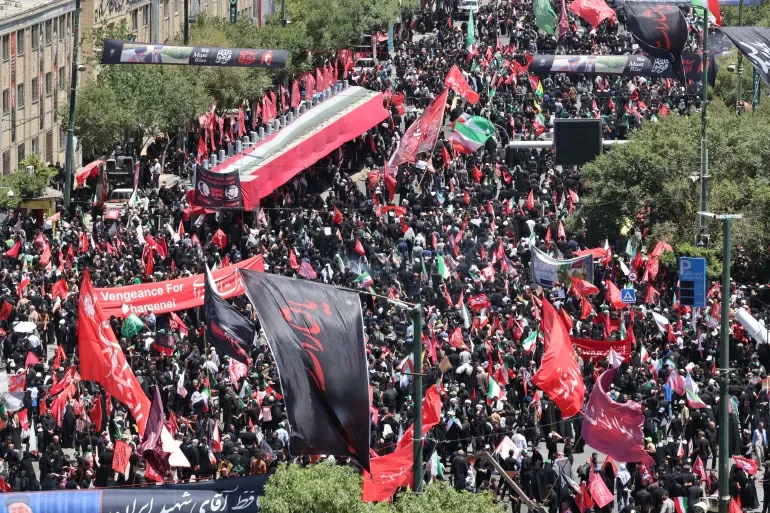
On July 9, 2026, one week after his assassination, Ayatollah Ali Khamenei, the long-serving Supreme Leader of Iran, was laid to rest in his hometown of Mashhad, near the Imam Reza shrine — the resting place he personally requested ahead of his death. The ceremony capped seven days of large-scale mourning processions held across Iran and neighboring Iraq, drawing what Iranian state media describes as the largest public gathering in the modern history of the nation.
Millions of mourners, dressed all in black and carrying Iranian flags and framed portraits of the deceased leader, marched through Mashhad’s streets to pay their final respects. Parallel mass processions unfolded across the border in Iraq’s holiest Shia cities, with more than 2.3 million people joining the gathering in Najaf alone, demonstrating the broad regional reverence for Khamenei among Shia communities.
Despite a previously announced temporary pause in United States military operations in the region, air strikes continued in the lead-up to the funeral, including targeted attacks on the critical railway line connecting Iran’s capital Tehran to Mashhad. Even with this ongoing violence, the burial ceremony proceeded according to the original schedule, with Khamenei’s casket processed slowly through crowded city streets, flanked by senior Iranian clerics and thousands of solemn mourners.
One of the most widely noted absences from the ceremony was Mojtaba Khamenei, Ali Khamenei’s son and newly appointed Supreme Leader who assumed office shortly after the assassination. He has not appeared in any public setting since taking power, with widespread speculation attributing his seclusion to injuries sustained during the same air strike that killed his father. While other members of the Khamenei family were present at the burial, the new leader’s absence has sparked growing speculation about internal power dynamics within Iran’s top leadership circles.
International delegations from more than 100 countries traveled to Iran to attend the funeral and offer condolences, a turnout that Iranian officials framed as a powerful show of global recognition of the country’s standing, intended to project a unified national front amid escalating regional geopolitical tensions.
Despite the united public display of mourning, Iran remains deeply divided over Khamenei’s 30-year legacy. His decades-long rule was defined by authoritarian governance, the systematic suppression of reformist political movements, and persistent nationwide economic crises that have left much of the population struggling. His assassination has thrown Iran’s future into deep uncertainty, with observers and Iranian citizens alike questioning what policy and ideological direction Mojtaba Khamenei and the new ruling establishment will take.
For Iran and the broader Middle East, Khamenei’s funeral marks a defining turning point: the close of a decades-long era of leadership under a figure who shaped both Iran’s domestic trajectory and its role on the global stage, and the opening of a period of profound uncertainty for the nation as it grieves the loss of one of its most influential and polarizing leaders.