The submitted news material only contains social media sharing buttons (share, tweet, share, pin) and a link to an image file hosted at https://news-minio.triplec.cc/news/2026/08/12/bb7ec5e78c593e6b82b469c2eb147a6a.jpg. No substantive text content of the news report is included with the submission. Without the core narrative, key details, source information, and contextual text of the original news, it is impossible to complete a comprehensive analysis, structured rewriting, or detailed assessment of the story. The image link cannot be accessed and parsed for text content in this processing context, leaving no usable news content to work with.
分类: other
-

LIVE: Disaster and You with the Office of Disaster Management 11th Aug 2026
When a news item is submitted for professional analysis and rewriting, it is expected to include full, actionable text content that outlines the event, context, and key details being reported. In this particular submission, the only content provided is social media sharing prompts (including options to share, tweet, and pin the content) and a link to an external image. No core news text, event description, or factual details about the story in question are included in the submission.
Without access to the full text of the original news report or clear information about the event being covered, it is impossible to conduct a comprehensive, accurate rewrite, analysis, or classification of the material. External image links may also be unstable, restricted, or unresponsive, meaning they cannot be relied upon to retrieve the missing news content. For any future news processing requests, submitters are required to include the complete full text of the original news story to ensure proper analysis can be completed.
-
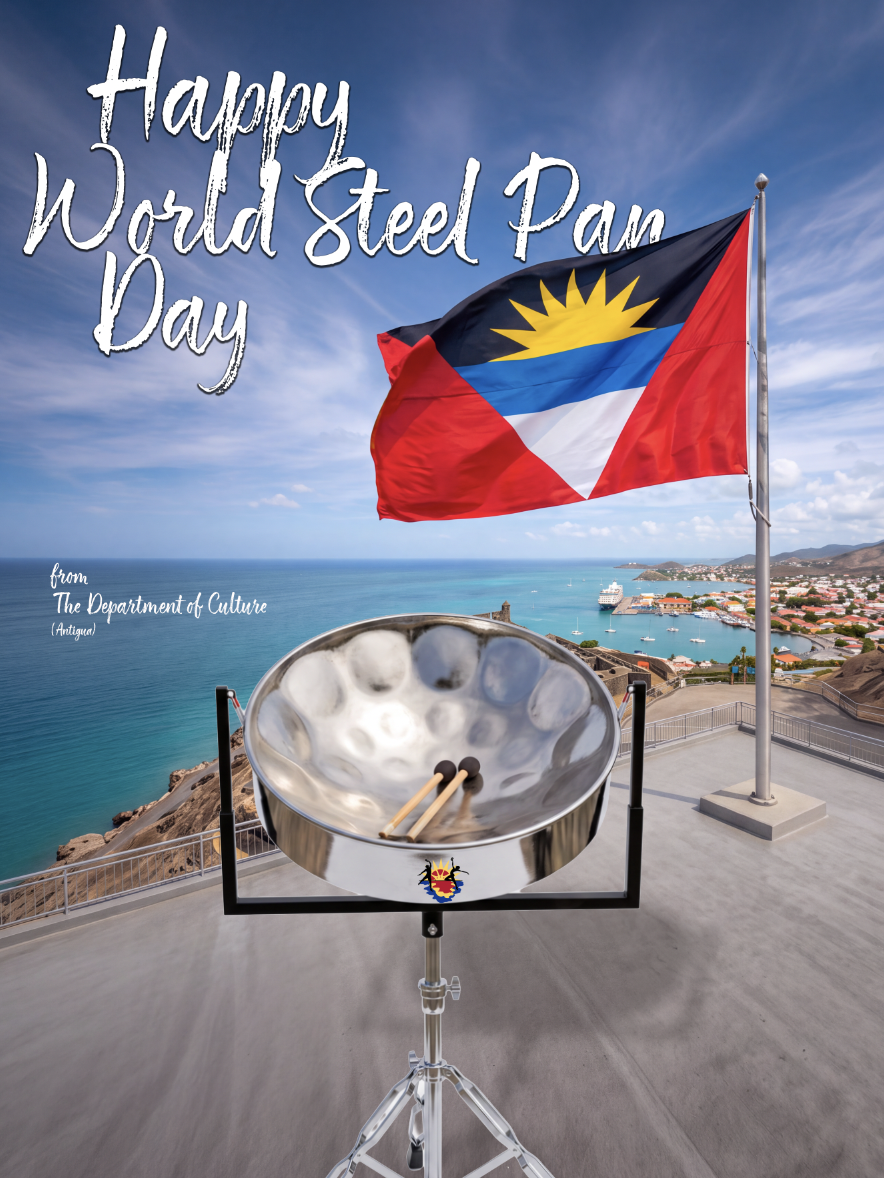
Department Of Culture Launches “Antigua And Barbuda Steelpan Icons” Campaign
On the cusp of 2026 World Steelpan Day, Antigua and Barbuda’s Department of Culture has launched a landmark three-week honor initiative to celebrate the generations of creators that built the nation’s beloved steelpan tradition, extending warm greetings to the Caribbean nation’s residents and steelpan communities across the globe. Running from August 11 to August 31, 2026, the campaign will shine a spotlight on the most influential figures in local steelpan history – from master players and creative arrangers to skilled tuners, instrument builders, dedicated tutors, visionary bandleaders, and pioneering steelbands – whose collective talent, innovation, leadership, and decades of service have forged Antigua and Barbuda’s enduring steelpan legacy.
To ensure that unsung community heroes get their long-overdue recognition, the Department of Culture has issued a public call for recommendations. Local residents are invited to submit profiles of deserving steelpan icons or groups from their communities, including basic information such as the nominee’s name, affiliated community, and area of contribution, along with a short description of their work and any available historical materials or photographs that document their impact.
At its core, the campaign pursues three key goals: celebrate excellence in steelpan craft, preserve at-risk cultural histories that might otherwise be lost, and foster deeper national pride for the instrument that has become a defining symbol of Antigua and Barbuda’s identity. For the pioneers of the mid-20th century, the road to respect was long and fraught with prejudice. Born as a working-class cultural invention in Trinidad and Tobago, the steelpan arrived in Antigua and Barbuda in the mid-1940s, with 1945 widely marked as the official start of the local movement. In working-class communities across the nation – including Point, Grays Farm, Ottos, Pigotts, Barnes Hill, and New Winthorpes – ordinary laborers turned discarded scrap metal into a groundbreaking new instrument and a unique form of cultural expression.
In those early days, steelpan players faced rampant discrimination: they were publicly ridiculed, legally punished, physically assaulted, and labeled troublemakers solely for their association with the instrument. Large segments of society dismissed steelpan music as a “hellish cacophony”, rejecting it as an unworthy art form. Yet despite systemic prejudice and widespread resistance, these early pioneers persisted, building instruments by hand, organizing community bands, rehearsing tirelessly, performing across the region, and refining their craft against all odds. Through unwavering determination, the sound once dismissed as mere noise evolved into one of Antigua and Barbuda’s most cherished national musical traditions.
It did not take long for Antigua and Barbuda’s steelpan movement to earn international acclaim. The nation hosted its first official steelpan competition in 1949, and early local bands began touring across the Caribbean to share their sound with new audiences. By 1952, studio recordings featuring iconic early groups Brute Force, Hells Gate, and North Stars entered the official recorded history of Caribbean steelpan music, cementing the nation’s reputation as a hub of steelpan excellence. Early trailblazing bands including Hells Gate, Brute Force, Red Army, North Stars, and Rising Sun laid the organizational and creative foundation that allowed future generations of steelpan artists to thrive. As the 2026 World Steelpan Day honor campaign gets underway, the Department of Culture reaffirms its gratitude to these pioneers and extends happy World Steelpan Day wishes to the nation and the global steelpan fraternity.
-
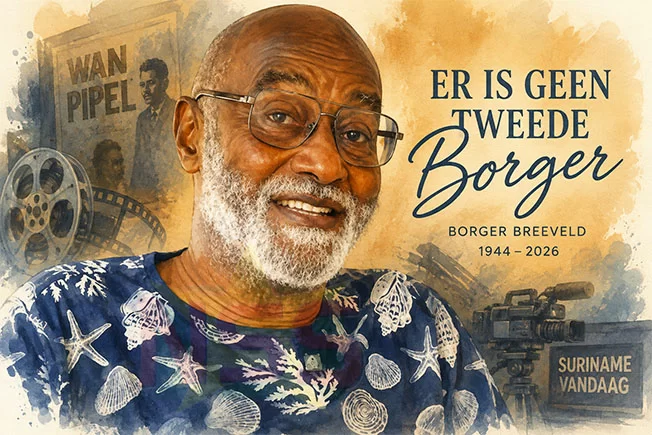
Column: Er is geen tweede Borger
It was a shock that rippled through Suriname’s media and cultural communities when news broke of Borger Breeveld’s passing on Monday morning. While we all know that life is finite, there are some people who feel as though they should always be with us — and Borger was one of those people for me. A distinct, unforgettable personality, a trailblazer of Suriname’s media sector, and a gifted actor who carved out a unique, permanent place in the nation’s history.
For most people, mentioning Borger Breeveld immediately brings *Wan Pipel* to mind. His portrayal of Roy in Pim de la Parra’s iconic classic remains etched deep into Suriname’s collective cultural memory, nearly 50 years after the film first premiered, conversations about his performance still continue. Countless Surinamese film and television productions have launched in the decades since, introducing a new wave of local acting talent, but for me, the unmatched impact of *Wan Pipel* has never been equaled — and Borger’s extraordinary acting skill was undeniably a core reason for that lasting legacy.
My personal memories of Borger extend far beyond his famous role in that film. I first got to know him during a very different chapter of Suriname’s history, when he served as a spokesperson during the country’s military rule. That was no easy era for journalists working in the nation. Power dynamics were fraught, the space for independent journalistic work was tightly constrained, and access to reliable public information was never a given.
Even in that tense context, Borger remained approachable to reporters. He had empathy for the work journalists needed to do, while also understanding the complexities of the system he operated within. This allowed him to serve as a critical bridge between the press and military leadership. This did not mean all barriers suddenly fell, or every question received an answer — but it meant there was always someone willing to talk, someone who acknowledged that journalists had a job to do. That mattered a great deal in that difficult time.
Later in his career, I got to see a whole other side of Borger up close: Borger the television producer. When the current affairs program *Suriname Vandaag* launched, he agreed to take on the role of director. I co-led the program and served as one of its co-presenters, so I got to witness his behind-the-scenes talent firsthand.
*Suriname Vandaag* was broadcast live, a format that anyone working in television knows carries unique pressure. There are no second takes. What happens on air stays on air: a presenter might fumble their lines, a satellite connection could cut out, a segment runs longer than planned, or breaking news can throw the entire run of show completely off schedule. In those moments, you need someone behind the scenes who understands the medium, can make quick, calm decisions, and keep the entire team grounded. That was Borger.
No one understood the craft of television production better than he did. It was not just knowing where to place a camera or when to cut between angles — he had an intuitive grasp of rhythm, visual storytelling, timing, and on-screen presence. He knew what would resonate with audiences and what would fall flat, and he had a masterful ability to communicate that insight to his team. That last skill is one that should not be underestimated.
Borger taught the craft to generations of media professionals. An entire cohort of Suriname’s media workers has benefited directly or indirectly from his knowledge and decades of experience. Unlike many people who guard their professional expertise closely, Borger never fit that mold. He was eager to pull others into the field, to help them grow and become better at their work. That is why reducing his legacy to just his role as Roy in *Wan Pipel* does him a deep disservice. He was an actor, yes, but also a director, a producer, a communications strategist, and a teacher. He was part of the pioneering generation that built Suriname’s modern television industry from the ground up, working in an era with far fewer technical resources than we have today.
Now, almost anyone can shoot footage and stream it live to an audience from a smartphone. But technology alone does not make someone a television professional. Television is a learned craft, and Borger knew that craft inside and out. That is what sticks with me today, alongside the grief of his passing: how much irreplaceable institutional and craft knowledge is lost when a pioneer like Borger leaves us.
As a country, Suriname has not always done a good job of documenting and passing down the knowledge of the people who built our core industries and cultural sectors. Only when these icons are gone do we realize how much they knew, how many untold stories they carried, how much of our national history is tied to their lives and work. Borger Breeveld was exactly that: a walking, living archive of Suriname’s media and film history.
For me, I will remember him as I knew him: approachable, deeply knowledgeable, completely at home in every corner of the television industry. He was a man who knew his craft, and dedicated himself to lifting others up along with him.
*Wan Pipel* will remain, the footage will remain, the memories will remain. And for the many people who learned the craft from him, a part of Borger will live on through their work. But Borger himself is gone. There will never be another like him.
I send my deepest strength to Borger’s family and all his loved ones as they navigate this enormous loss. Thank you for everything you left to us, and to all of Suriname’s media community. Rest easy, Borger.
-
LIVE: UWP Discussion on National Budget 2026/2027
The material submitted for news rewriting and analysis only contains social media sharing buttons, an image link, and no complete textual news content. Without the full core narrative, key facts, background details and event descriptions of the original news report, it is impossible to carry out the required in-depth analysis, framework reconstruction and content rewriting work. Receivers of this incomplete submission are unable to complete the requested news processing task as the necessary information to accurately deliver the original news story is missing.
-

LIVE: Budget Debate 2026/2027 continues
The content submitted for processing only includes social media sharing prompts: “Share, Tweet, Share, Pin”. No complete body of a news article, core event information, or relevant contextual details were included alongside these sharing labels. Without the full text of the original news report, it is not possible to conduct a comprehensive analysis, fact-checking, or structured rewriting of the content. This incomplete submission prevents any further processing of the requested news-related tasks.
-

LIVE : Prime Minister Roosevelt Skerrit to address the nation
This submission contains only sharing tools, a reference to an external image hosted at a public URL, and a note indicating that a live link will be provided at a later time. No core journalistic content, event details, or newsworthy information is included in the original material provided for processing. Without the full text of the original news story, it is not possible to expand on specific events, key actors, background context, or potential impacts of any reported development. This incomplete entry lacks all of the fundamental components required for a full news analysis and rewrite.
-
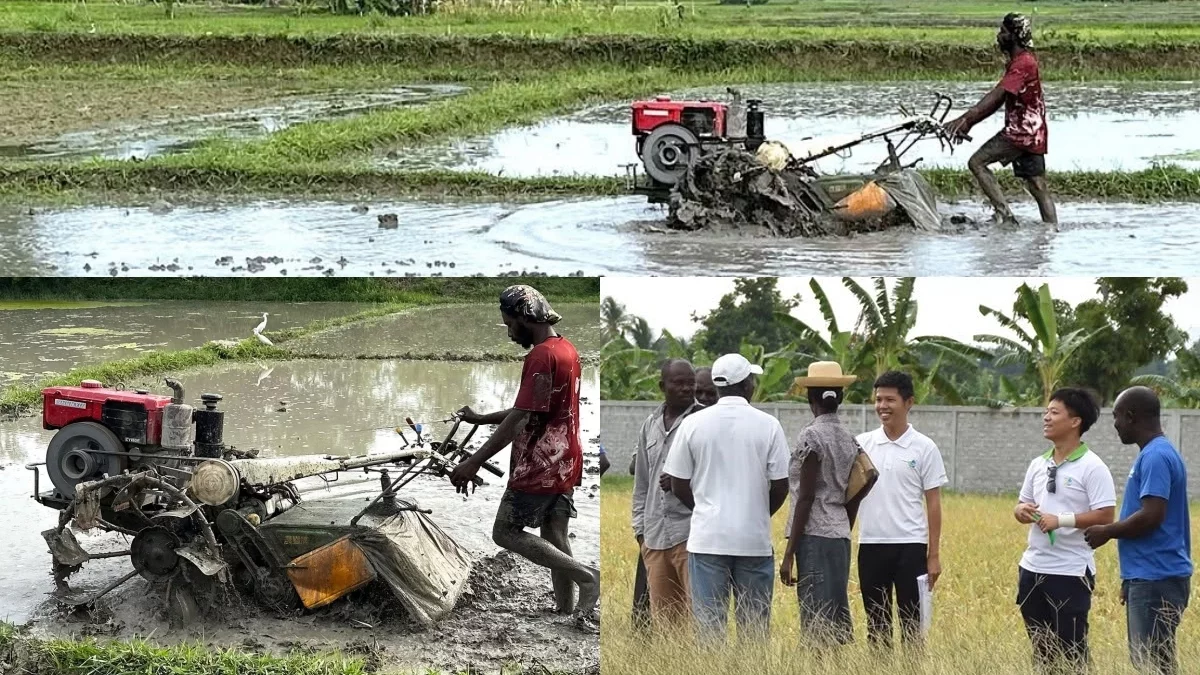
Taiwan : Official start of the 2nd rice-growing season in Artibonite
On September 8, 2026, the official launch of the year’s second rice-growing season marked a key milestone for agricultural development in Haiti’s Artibonite Department, backed by the Taiwan International Cooperation and Development Fund (ICDF) through its ongoing Rice Production Improvement Project.
As the initiative gets underway, joint teams from the ICDF and local partner farmers have already moved into the critical pre-planting preparation phase across target plots. Workers are deploying mechanized tillers to break up compacted soil, a step that improves root penetration and water retention, before carefully leveling each paddy to create the uniform growing environment critical for strong rice yields. Parallel to land preparation, nursery operations are already underway, utilizing high-quality seeds harvested from the previous growing season to cultivate robust, disease-resistant seedlings that will underpin the new season’s output.
Project organizers have emphasized that proper paddy leveling is not just a routine task, but a foundational practice that drives long-term productivity. A perfectly leveled field ensures even growth after seedlings are transplanted, eliminating common stressors that cut into harvests: low-lying spots no longer face the risk of root rot from standing water accumulation, while higher, naturally drier areas avoid the unchecked weed growth that outcompetes young rice plants for nutrients and moisture.
For fields with large natural variations in elevation, the project is advising farmers to segment plots into separate growing zones aligned with the natural topography. This targeted adjustment simplifies irrigation management, ensures every section of the field receives the right amount of water, and makes routine crop health monitoring far more efficient for local producers.
Going into the 2026 second season, both the Taiwan-based project technical team and Artibonite’s local farming community have highlighted their commitment to context-appropriate sustainable agricultural practices. Through coordinated preparation and shared expertise, stakeholders are working to transform carefully tended paddies into productive landscapes that will support healthy, high-yield rice crops for Haiti’s domestic food supply.
-

LIVE (from 7:30 p.m.): DBF discussion on 2026-2027 National Budget
When a request to process and rewrite a piece of news is submitted, only a set of social media sharing labels and an image link are provided, with no actual core news text included. Without the full, substantive content of the original news report, it is impossible to conduct in-depth analysis of the event it covers, extract core information, reconstruct a narrative framework, or complete any of the required processing steps. To receive a full, compliant rewrite and analysis, submitters are required to provide the complete original text of the news alongside any supporting links or metadata.
-
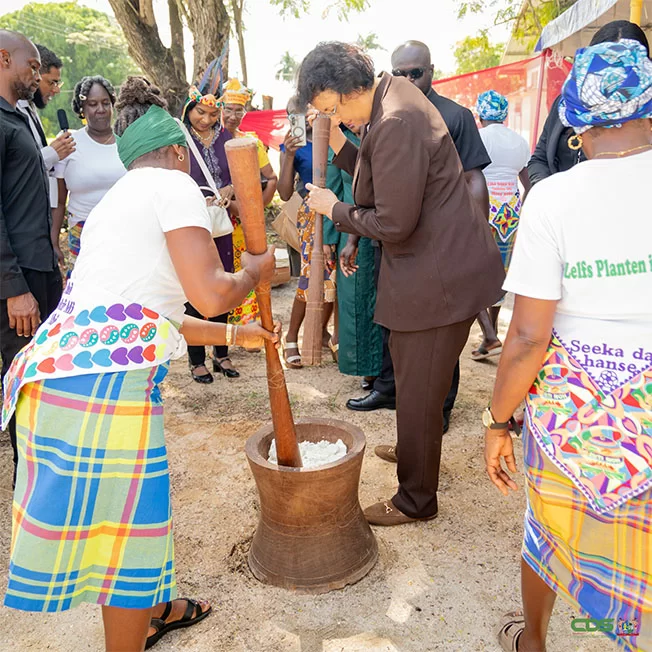
President Simons kondigt steun aan voor onderzoek naar cultureel erfgoed
As Suriname wraps up its 2026 Heritage Month, national leaders have announced a lasting commitment to preserving and celebrating the country’s diverse cultural roots, promising government funding for targeted academic research and cultural projects focused on Surinamese heritage after the month-long celebration concludes.
The announcement was made by President Jennifer Simons this past Friday during a student-organized mini-congress held at the Anton de Kom University of Suriname (AdeKUS), an event designed to center conversations around heritage, scientific inquiry, cultural identity, and heritage’s evolving role in modern Surinamese society. The congress, held as a core part of 2026 Heritage Month programming, was paired with a public Heritage Fest that gave attendees the chance to engage with traditional food and drink from Suriname’s many distinct cultural communities. According to the Communication Service of Suriname, the festival also featured dedicated exhibit spaces showcasing cultural artifacts and educational materials highlighting the unique heritage of each of the country’s population groups. Event photos even captured President Simons participating in traditional cassave pounding, demonstrating her hands-on engagement with local cultural practices.
In her keynote address to attendees, President Simons emphasized that Heritage Month extends far beyond a simple annual cultural celebration. For the country, the initiative serves a critical purpose: helping Surinamese people deepen their sense of shared responsibility for the nation’s future. Greater public awareness of personal history, ancestral origins, and collective national identity, she argued, is a foundational building block for mutual understanding and cross-cultural respect across communities.
“Heritage Month aims to help every person better understand themselves, and learn to respect themselves — because if you respect yourself, you can extend that same respect to others,” Simons told the audience. The president stressed that Suriname draws its core national strength from its longstanding cultural diversity, and that cross-generational collaboration is essential to building a society that actively values and protects differences between communities.
Looking beyond the 2026 celebration, Simons outlined next steps for the initiative: following the conclusion of this year’s Heritage Month, an official post-event report will be compiled to guide preparations for the 2027 iteration. Crucially, the national government will allocate dedicated funding to support academic research, artistic expression, and community-led heritage projects in the months between annual celebrations.
“After this year’s event, the government will make funding available for scientific research, artistic projects, and a wide range of initiatives centered on themes put forward by Surinamese civil society,” Simons said. She explained that the long-term goal is to keep young people, researchers, and cultural organizations actively engaged in heritage-focused projects throughout the year, so that their work can contribute to more robust and inclusive future Heritage Month programming. The president issued a special call to university students, urging them to deepen their exploration of both Suriname’s rich history and its dynamic contemporary society, noting that this knowledge will foster a stronger, more cohesive national community.
Education, Science and Culture Minister Dirk Currie echoed the president’s remarks, focusing his address on the critical role that academic institutions like AdeKUS play in advancing heritage preservation. Currie argued that the university’s mission goes far beyond simply transmitting existing knowledge to students; it also has a responsibility to generate new, evidence-based insights to solve pressing social challenges.
“A university does not only have the job of passing on existing knowledge. It also has a responsibility to create new knowledge,” Currie stated. The minister noted that durable, effective public policy can only be developed when it is rooted in rigorous research, community-derived data, and on-the-ground insights from across Suriname. He encouraged all Surinamese people to take ownership of the country’s national unity, framing cultural diversity not as a source of division, but as one of the nation’s greatest assets. Currie concluded by emphasizing that the country’s history, collective identity, and shared heritage must be protected through scientific inquiry and documented by the Surinamese people themselves.