分类: business

  • Centrale Bank haalt SRD 400 miljoen uit de economie via nieuwe spaarcertificaten

    Centrale Bank haalt SRD 400 miljoen uit de economie via nieuwe spaarcertificaten

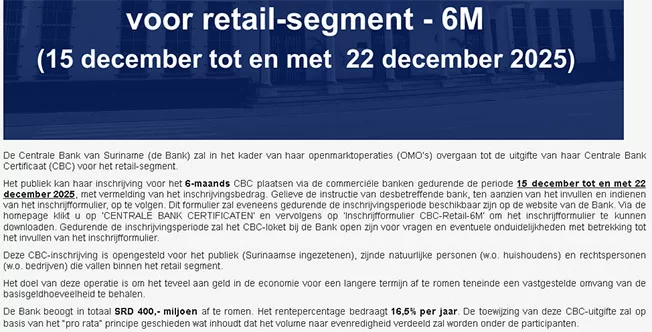
    The Central Bank of Suriname has initiated a new issuance of Central Bank Certificates (CBCs) aimed at temporarily withdrawing SRD 400 million from circulation. This monetary policy intervention seeks to regulate money supply and maintain economic stability by encouraging both individuals and businesses to deposit funds with the central bank, effectively reducing liquidity in the open market.

    The certificate offering, available through commercial banks from December 15 to December 22, carries a 16.5% annual interest rate with a six-month maturity period. In cases of oversubscription, the available amount will be distributed proportionally among all participants. Application forms are available at commercial banks and can also be downloaded from the Central Bank’s official website.

    This move represents a strategic shift in monetary policy following the conclusion of Suriname’s IMF program. The current interest rate of 16.5% is notably lower than rates during the IMF program period, reflecting the central bank’s adjusted approach to economic management. Simultaneously, authorities are developing a new monetary framework and preparing for the issuance of Treasury bills as complementary measures.

    The dual-purpose initiative not only provides a secure investment vehicle for citizens and corporations but also serves as a mechanism for the central bank to better balance economic conditions and stabilize foreign currency demand. By temporarily absorbing excess liquidity, the central bank aims to create a more controlled monetary environment while offering attractive returns to investors.

  • Chamber warns of supply chain risks amid rising Venezuela-US tensions

    Chamber warns of supply chain risks amid rising Venezuela-US tensions

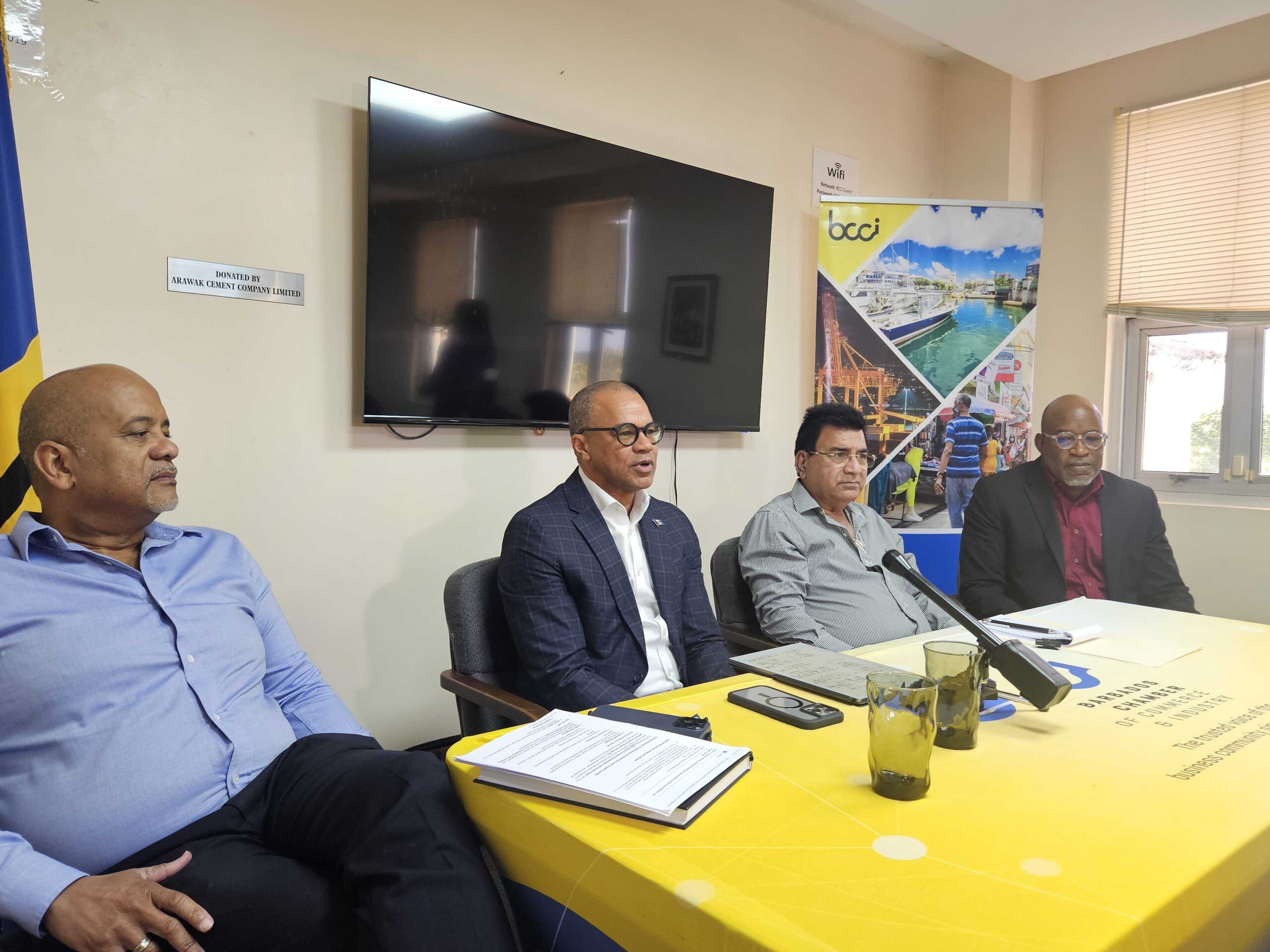
    Business authorities in Barbados are raising alarms about potential regional economic fallout from escalating geopolitical tensions between Venezuela and the United States. The Barbados Chamber of Commerce and Industry (BCCI) has identified this developing situation as a significant threat to Caribbean supply chains, potentially triggering increased costs and operational delays throughout the region.

    BCCI President Paul Inniss expressed particular concern during a recent press briefing at the organization’s Deighton Road headquarters. ‘As a chamber representing business interests, we must view any tension involving our trading partners with serious concern,’ Inniss stated. ‘This represents one of several strategic risks that require careful consideration and contingency planning.’

    The chamber has proactively begun advising its membership on business continuity strategies, highlighting vulnerabilities within current shipping logistics. Inniss revealed an inefficient pattern in regional trade routes: ‘Our analysis indicates many goods originate from South America, travel northward, only to subsequently return south—a circuitous routing that unnecessarily inflates costs.’

    Despite these concerns, officials downplayed immediate impacts on Barbados’ energy sector. ‘Our current import volume from Venezuela remains minimal,’ Inniss clarified, referencing two recent diplomatic engagements with Venezuelan delegations. While acknowledging global oil markets have already reacted to geopolitical announcements, he characterized potential energy impacts as ‘still in early stages.’

    Christopher Sambrano, chair of the chamber’s economic advisory committee, addressed broader implications, including effects on Trinidad’s energy imports and regional tourism. ‘The fundamental concern involves added market uncertainty,’ Sambrano noted. ‘As a business community and society, we’ve demonstrated resilience through previous global challenges and must remain adaptable.’

    Emphasizing Barbados’s identity as a peaceful destination, Sambrano expressed hope for swift resolution: ‘Visitors seek refuge in our region from global tensions. Maintaining our status as a zone of peace remains paramount to our tourism economy.’

    The BCCI continues collaborating with Barbados’ Ministry of International Trade to develop direct sourcing alternatives, aiming to mitigate potential inflationary pressures on imported goods throughout the supply chain.

  • ‘No businesses cut staff hours’ after minimum wage raise

    ‘No businesses cut staff hours’ after minimum wage raise

    Barbados enterprises have successfully absorbed recent minimum wage increases without resorting to workforce hour reductions, though concerns mount over broader economic repercussions including potential inflation acceleration. According to the Barbados Chamber of Commerce and Industry (BCCI), no member businesses have implemented reduced working schedules following the June wage adjustment that elevated national minimum rates from $8.50 to $10.50 hourly.

    BCCI President Paul Inniss confirmed during a Thursday press briefing that while labor costs have risen substantially, businesses are predominantly transferring these expenses to consumers rather than diminishing employee hours. “The feedback has been that additional costs are transferred to clients and customers,” Inniss stated, noting that security services and retail sectors have particularly felt the impact.

    The wage structure continues evolving with scheduled January increases raising national minimum wage to $10.71 (a 21-cent increase) and security guard sector rates to $11.66 hourly (a 23-cent rise). Inniss emphasized that most chamber members already compensate above minimum thresholds, affirming the organization’s commitment to ensuring “every working Barbadian should earn a liveable wage.”

    However, economic experts within the chamber caution against cyclical inflationary dangers. Christopher Sambrano, chairman of BCCI’s economic advisory committee, warned of potential “hyperinflation effect” where rising wages perpetually drive goods costs upward, creating self-sustaining inflation cycles.

    Sambrano proposed enhanced productivity as critical mitigation strategy, advocating for operational efficiencies through improved sourcing, advanced software systems, and AI implementation. “If we can ensure employees receive comfortable compensation while incentivizing productivity, and employers leverage operational improvements, not all costs need transmission to consumers,” he explained.

    Regarding the impending January adjustment, Inniss noted the chamber’s active participation in wage negotiations through the Barbados Private Sector Association, expressing lack of surprise at government decisions while acknowledging the necessity for business evolution toward greater efficiency.

  • DSB stelt SRD 160 miljoen dividend vast na goedkeuring jaarrekening 2024

    DSB stelt SRD 160 miljoen dividend vast na goedkeuring jaarrekening 2024

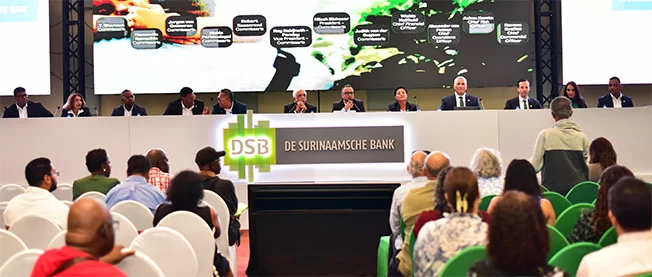
    Suriname’s leading financial institution, De Surinaamsche Bank N.V. (DSB), has announced a substantial dividend distribution of SRD 160 million to shareholders during its recent General Assembly meeting. This decision coincides with the bank’s landmark 160th anniversary celebrations and follows an exceptionally profitable fiscal year in 2024.

    The bank reported impressive financial results, achieving a net profit of SRD 546.3 million for the year ending 2024. DSB’s equity capital demonstrated robust growth, climbing to SRD 3.7 billion, while its solvency ratio strengthened significantly to 27.2%, up from 24.2% recorded in 2023.

    During the assembly, management highlighted substantial improvements in operational frameworks implemented over the past 24 months. The bank has successfully enhanced its supervision protocols, governance structures, risk management systems, compliance measures, and financial reporting capabilities. Notably, DSB has produced four consecutive IFRS-compliant annual financial statements, positioning the institution to achieve its target of reporting within six months after the balance sheet date starting from 2026.

    Corporate governance developments included the reappointment of two members to the Board of Commissioners and the nomination of a new board member, pending regulatory approval from the Central Bank of Suriname. Additionally, shareholders endorsed the nomination of Raveen Koelfat as Director in the capacity of Chief Commercial Officer. Upon central bank approval, this appointment will expand the bank’s directorate team to four members.

    The Board of Commissioners and executive leadership expressed profound appreciation for management and staff contributions while acknowledging the continued trust from shareholders, clients, business partners, and regulatory authorities. DSB reaffirmed its commitment to building upon its solid foundation and clear strategic direction to further strengthen its market position in the coming years.

  • Cane Farmers Call for Tax Cuts After BSI Incentives

    Cane Farmers Call for Tax Cuts After BSI Incentives

    Belize’s sugarcane producers are advocating for expanded fiscal support following the government’s approval of a decade-long incentive package for the Belize Sugar Industries (BSI). While applauding the initiative and improved stakeholder engagement under Dr. Osmond Martinez, the Junior Minister for the sugar industry, farmers contend that assistance must extend beyond the milling operations to ensure the entire sector’s viability.

    The Progressive Sugar Cane Producers Association has formally requested tax exemptions and concessions on essential agricultural inputs. These include fuel, lubricants, tractor components, and truck parts, which have seen dramatic price increases since the COVID-19 pandemic.

    Cosme Hernandez, General Manager of the Association, acknowledged the minister’s successful efforts in unifying the four major farming associations with the mill. However, he emphasized the severe financial strain on producers, noting that production costs have tripled in some cases since the pandemic. Hernandez revealed that the previous break-even point of fifty dollars per ton of cane has been rendered obsolete, pushing many farmers into operational losses despite the new incentives for the milling sector.

    The Association has presented these concerns directly to Minister Martinez, initiating collaborative discussions to develop relief mechanisms that address the critical challenges facing agricultural producers. This development highlights the complex interdependencies within agricultural supply chains and the need for comprehensive policy approaches that support both processing industries and primary producers.

  • New Minsa Plant in Spanish Lookout Promises Jobs

    New Minsa Plant in Spanish Lookout Promises Jobs

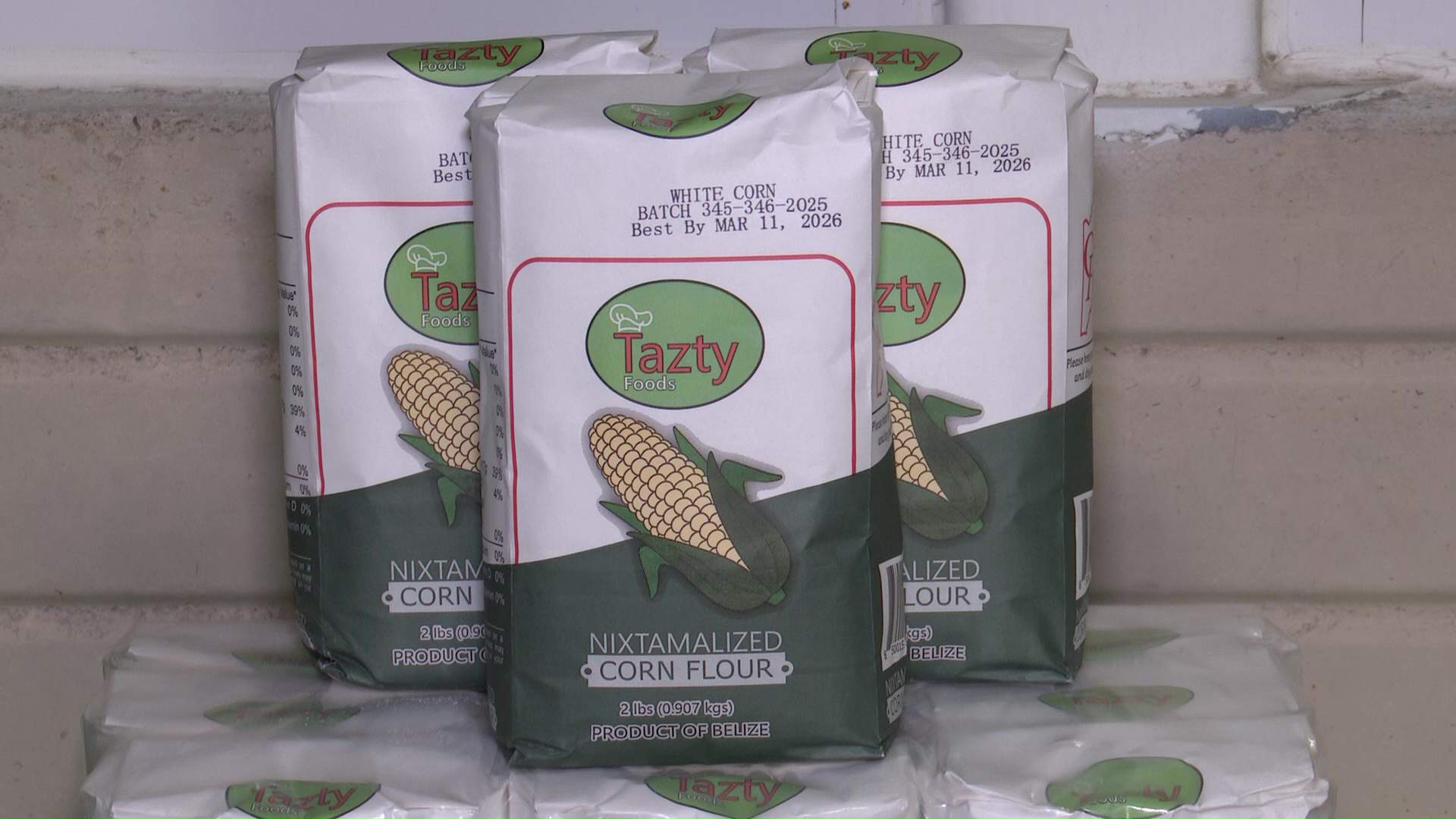
    In a significant stride toward economic self-sufficiency, Country Foods has inaugurated a state-of-the-art Minsa corn flour production facility in Spanish Lookout, Belize. The $2.8 million investment represents a strategic response to pandemic-era supply chain vulnerabilities and rising food costs.

    The new plant, operating under the ‘TAZTY’ brand, boasts an impressive daily production capacity of thirty tons—nearly double Belize’s current national consumption. This substantial output is designed to satisfy domestic demand while simultaneously creating export opportunities for Central American markets.

    Prime Minister John Briceño heralded the opening as a testament to Spanish Lookout’s reputation as an economic trailblazer. “This facility positions us not only to meet local demands but to tap into export markets,” Briceño stated during the grand opening ceremony. “The entire country looks at Spanish Lookout as leaders in manufacturing.”

    The project’s conception emerged during the COVID-19 crisis when food import dependencies became critically apparent. Heinrich Weibe, Chief Executive Officer of Country Foods, emphasized the company’s commitment to quality and local production: “Every step of our journey has been driven by a shared vision to offer a healthy, authentic, locally produced alternative that is one hundred percent corn.”

    Notably, the facility addresses Belize’s substantial import burden—the nation imported over five million pounds of Minsa valued at more than four million dollars in 2024 alone. By localizing production, the operation will conserve foreign exchange reserves while supporting agricultural stakeholders.

    Community leader Norman Reimer praised the investment as a cornerstone of national food security, while Area Representative Orlando Habet highlighted the plant’s advanced manufacturing technologies and sustainable practices. The operation is expected to generate substantial employment opportunities while providing stable demand for local corn producers.

    Consumers can anticipate TAZTY products appearing on retail shelves nationwide imminently, marking a new chapter in Belize’s agricultural industrialization and food sovereignty efforts.

  • HRMAB: Barbadian workers should benefit from Bill

    HRMAB: Barbadian workers should benefit from Bill

    Amid parliamentary deliberations on Barbados’ Economic Diversification and Growth Fund Bill, the Human Resource Management Association of Barbados (HRMAB) has emphasized the critical need for equitable distribution of high-level management positions for local professionals. HRMAB President Tisha Peters, while acknowledging her organization’s ongoing review of the proposed legislation, articulated concerns that workforce implications risk being overshadowed by broader economic and political debates.

    The proposed legislation, which allocates $225 million from the Consolidated Fund over three years, aims to attract qualifying international companies that commit to creating substantial employment opportunities domestically. To qualify, enterprises must demonstrate significant offshore presence while pledging to generate at least 100 sustainable jobs for Barbadians maintained over seven years, alongside compliance with national tax obligations.

    Peters specifically highlighted the association’s focused interest on ensuring that forthcoming hotel developments and investment projects incorporate balanced representation of local and expatriate talent across all organizational tiers. “The focus should prioritize an equitable mix of domestic and international expertise at every employment level,” Peters stated. “We must see Barbadian managers advancing into leadership roles—without these opportunities, we cannot achieve genuine equitable distribution.”

    This position emerges against a backdrop of scholarly and professional skepticism. Notable critics including economist Jeremy Stephen, Professor Troy Lorde, Professor Don Marshall, and attorney Tricia Watson have questioned the bill’s capacity to drive meaningful economic diversification. Watson particularly warned against potential inequities stemming from insufficient oversight mechanisms for local workforce inclusion.

    Prime Minister Mia Mottley has addressed transparency concerns by committing to regulatory requirements mandating ministerial accountability to Parliament when deviating from advisory committee recommendations. This amendment seeks to strengthen governance frameworks while maintaining the bill’s core objective of stimulating foreign exchange earnings and sustainable economic growth through monitored private sector investments.

    The ongoing discourse reflects deeper tensions between foreign investment attraction and domestic capacity building, positioning workforce equity as a pivotal component in Barbados’ economic development strategy.

  • Cuba works on recovering the National Power Grid

    Cuba works on recovering the National Power Grid

    Cuba’s national energy authority has reported a significant yet insufficient recovery in its power generation capacity. Recent efforts have successfully restored 422 megawatts (MW) to the distributed generation network, elevating its total operational capacity beyond the 1,000 MW threshold. Concurrently, an additional 228 MW has been brought back online within the centralized generation system.

    A major stride in renewable integration has been achieved with the synchronization of 778 MW of new capacity from 41 photovoltaic solar parks. These installations are now playing a pivotal role in the national grid, contributing more than 30% of Cuba’s total electricity generation during peak sunlight hours.

    Despite these advancements, government officials acknowledge the persistence of a severe energy crisis. The national power system continues to operate under extreme duress, grappling with an average daily generation deficit ranging between 1,500 and 1,700 MW. The situation has deteriorated further in recent days, with the shortfall exceeding 2,000 MW.

    This critical power deficit has resulted in service disruptions occurring throughout the day and night, creating widespread public dissatisfaction and inflicting substantial damage to economic activity. Authorities attribute the ongoing crisis primarily to generation instability and a critical shortage of fuel supplies for distributed generation units. Approximately 1,000 MW of potential generation capacity remains unavailable due to these fuel constraints, highlighting the deep-rooted challenges facing Cuba’s energy infrastructure.

  • NAGICO Insurances upgraded to A- (Excellent) by AM Best

    NAGICO Insurances upgraded to A- (Excellent) by AM Best

    In a significant development for the Caribbean insurance sector, NAGICO Insurances has received a substantial credit rating upgrade from globally recognized agency AM Best. The Group’s Financial Strength Rating has been elevated from BBB+ to A- (Excellent), positioning the company among the top-tier insurance providers in the region.

    The upgraded rating reflects AM Best’s comprehensive evaluation of NAGICO’s reinforced balance sheet, consistently enhanced operational performance, rigorous risk management protocols, and successful implementation of its strategic vision across diverse Caribbean markets. This assessment acknowledges the insurer’s strengthened financial resilience and disciplined business approach.

    For policyholders, business partners, and regulatory authorities, the A- designation serves as an independent validation of NAGICO’s capacity to honor its commitments, particularly crucial in a geographic area susceptible to natural disasters and economic fluctuations.

    Kyria Ali, Chief Executive Officer of NAGICO Insurances, expressed considerable pride in this achievement, stating: “This AM Best rating upgrade represents an independent endorsement of our financial robustness and strategic management. For our clients throughout the Caribbean and France, it confirms the trust they have placed in our ability to support their families and businesses during critical moments.”

    The A- (Excellent) rating from AM Best, a specialized insurance industry rating agency, signifies exceptional capital strength, sustained financial improvement, prudent underwriting standards, and a viable long-term business strategy. This classification establishes NAGICO as a premier insurance group with demonstrated stability and reliability.

    Operating effectively in the Caribbean demands exceptional resilience and forward-thinking risk management. NAGICO has established its credibility through billions of US dollars in claims payments following natural catastrophes, including hurricanes and volcanic eruptions. Recent strategic investments in reinsurance protection, governance frameworks, and talent acquisition have further strengthened its operational foundation.

    Imran McSood Amjad, Executive Chairman of NAGICO Insurances, emphasized: “Our region faces distinctive challenges from climate vulnerabilities to economic instability. This rating enhancement mirrors the deliberate actions taken by our leadership to fortify the Group’s financial position, governance structures, and risk mitigation capabilities.”

    The rating improvement represents a collective accomplishment involving NAGICO’s employees, partners, and stakeholders throughout its operational network. It highlights the Group’s dedication to sustainable expansion, robust governance, and consistent value delivery to clients and partners.

    Looking forward, NAGICO remains committed to leveraging technological advancements to enhance customer experiences, introducing innovative insurance products, and contributing to regional development initiatives.

    Established in 1982, the NAGICO Group delivers comprehensive property, casualty, life, and health insurance solutions across 32 locations in the Caribbean and Metropolitan France.

  • Six-part finance literacy book series for children launched by Dominican finance company

    Six-part finance literacy book series for children launched by Dominican finance company

    In a significant advancement for early childhood education, Finance Focus Inc. has introduced an innovative financial literacy book series specifically designed for young learners in Dominica and the Eastern Caribbean region. The six-part collection, titled “Making Sense of Dollars – Money Lessons for Little Learners,” represents a pioneering approach to teaching fundamental money management skills through culturally relevant content and engaging storytelling.

    The series made its official debut on December 6, marking what educators are calling a transformative moment in financial education for Caribbean youth. The curriculum addresses the critical need for early financial literacy, positioning money management as an essential life skill comparable in importance to reading and mathematics.

    Currently available are the first two installments: “Earn It – Work, Earn and Play” introduces children to the concept that money is earned through effort, creativity, and responsibility, while “Save It – The Power to Plan” emphasizes the importance of saving, patience, and goal-setting. Both books feature vibrant illustrations, Caribbean-inspired characters, and incorporate actual Eastern Caribbean currency to create practical, familiar learning experiences.

    The comprehensive series will expand with four additional titles releasing progressively: “Spend It” will focus on thoughtful spending choices, “Share It” will teach generosity and community values, “Grow It” will introduce basic investment concepts, and “Borrow It” will cover responsible borrowing practices.

    Created by financial educator Luana Laurent, the series emerged from recognizing that money habits typically form by age seven. Laurent emphasizes proactive financial education, stating: “Financial literacy should not begin after mistakes are made, it should begin before they are possible. These books exist to interrupt that cycle and give our children the clarity, confidence, and calm we wish we had earlier.

    The books are accessible through multiple channels including Amazon Store, Kindle platforms, and locally through ShopDM & Jay’s Bookstore, with availability beginning December 22. Laurent envisions the series becoming an educational staple throughout Dominica and the Eastern Caribbean, ultimately contributing to building a more financially resilient and empowered society.