
After a multi-week suspension triggered by dangerous hostile fire incidents targeting two of its aircraft, Zed Airlines has officially restarted commercial flight operations between Haiti and Brazil, marking a key milestone for the Caribbean nation’s international connectivity. On Monday, April 13, 2026, the carrier’s flight #9710 — operated on behalf of Zed by Aeroregional, with a 160-passenger capacity — departed Port-au-Prince’s Toussaint Louverture International Airport (AITL) en route to Brazil, establishing the first direct air link between the two countries since service was paused. This return to regular operations comes after a period of uncertainty following the attacks that damaged two of Zed Airlines’ planes, prompting the immediate suspension of all cross-border routes. In response to rising passenger demand for the Haiti-Brazil route and a broader push to regularize both migratory movement and commercial trade flows between the two nations, additional flights have already been scheduled to run through the remainder of April. Haitian government officials framed the resumption of service as a deliberate demonstration of the administration’s commitment to preserving Haiti’s access to global transportation networks. The country’s Ministry of Transport and senior leadership at Toussaint Louverture International Airport have confirmed they are maintaining full operational mobilization to deliver a secure, high-quality travel experience for all passengers using the airport’s international services. The restart of flights comes as stakeholders work to balance security concerns with the critical economic and social need for sustained international air connectivity, filling a gap that has disrupted travel and commerce for weeks since the gunfire incidents forced service to halt.
分类: business
-

Barbados, St Lucia forge blue economy ties over fish feed from waste
A senior delegation of fisheries industry stakeholders from Saint Lucia has arrived in Barbados to kick off a six-day peer-to-peer learning exchange centered on a groundbreaking local fish silage initiative that is redefining sustainable blue economic growth across the Caribbean.
The core goal of the visit is for the visiting delegation to gain a full, actionable blueprint to replicate Barbados’ innovative model, which converts discarded fish processing byproducts into two high-value agricultural goods: nutrient-dense animal feed and organic bio-fertilizer. By diverting thousands of tons of organic waste from overcrowded landfills and cutting regional reliance on costly imported feed stocks, the project has been widely recognized as a game-changing foundation for expanding the Caribbean’s sustainable blue economy.
At the official opening ceremony held at UN House in Hastings, Yvette Diei-Ouadi, a fisheries and aquaculture officer with the Food and Agriculture Organization’s (FAO) Subregional Office for the Caribbean, formally welcomed the Saint Lucian team, outlining that the visit is structured around three key priority objectives. While mastering the technical process of turning fish waste into silage remains the central focus, the agenda also dedicates significant time to addressing a pressing market access barrier currently facing Saint Lucia. As Diei-Ouadi explained, Saint Lucia currently holds a ban on exporting fish and fish-based products to the United States, a restriction Barbados successfully overcame after years of targeted work. The island’s accumulated experience in lifting this trade barrier offers critical actionable lessons for Saint Lucia to follow.
Diei-Ouadi emphasized that Barbados’ trade success was not the outcome of a single standalone project, but the result of a coordinated sequence of targeted interventions launched all the way back in 2018. “It was never one single project – it was a whole suite of connected initiatives that brought us to where we are today,” she noted. “We started with very modest seed funding through FAO’s Technical Cooperation Programme (TCP), a small grant delivered at the formal request of the government of Barbados.”
The economic imperatives driving the fish silage model are impossible to ignore for Caribbean nations: imported animal feed makes up more than 70% of total livestock production costs across the region. By scaling local production of fish silage feed, Barbados has built a critical buffer against volatile global commodity market shocks, most notably the dramatic feed price spikes that followed the outbreak of the Russia-Ukraine conflict. Diei-Ouadi pointed out that the timing of the initiative put it in the spotlight exactly when regional actors needed it most. “Our project gained widespread attention when the Russia-Ukraine conflict sent grain and feed prices skyrocketing, and producers across the Caribbean were struggling with cost increases,” she said. “We were able to show that we had already developed a local solution that was completely insulated from global instability halfway across the world.”
Beyond its economic benefits, the project also tackles a pressing environmental challenge facing Barbados. Every day, hundreds of tons of fish waste are dumped in the island’s landfills, where anaerobic decomposition releases methane – a greenhouse gas more than 20 times more potent than carbon dioxide at trapping heat in the atmosphere. Diverting this waste to fish silage production eliminates these harmful emissions while creating economic value from material that would otherwise be discarded.
Wayne Smith, executive director of Barbados Ruminants Farm Services, detailed how a cohort of young agricultural entrepreneurs repurposed an abandoned facility donated by the Ministry of Agriculture into a central production hub for the initiative. A key innovation that makes the model accessible to small local producers is its adoption of a biological silage production process that uses locally sourced molasses from Barbados’ domestic sugar industry, rather than relying on imported chemical acids to preserve the silage.
“It became clear very early that the biological method was the right path for our smallholder farmers,” Smith explained. “The acid-based process required importing key inputs, which drove up costs and created supply chain risks. The biological method gives small producers far more flexibility and control over their production.” Diei-Ouadi added that the choice to adapt the model to use local inputs proved its worth during the COVID-19 pandemic, when global supply chain disruptions made importing any inputs nearly impossible – leaving the local biological pathway as the only viable option to keep the project running.
The learning exchange also addresses a less technical but equally critical challenge: shifting entrenched mindsets within the regional agricultural sector. Discussions during the opening session revealed that some established veterinary services have been slow to embrace locally produced fish silage, continuing to prioritize more expensive imported commercial feed concentrates. Smith noted that multinational feed companies invest heavily in marketing to maintain market share, making it harder for local alternatives to gain traction. “When 70% of your total production cost goes to feed, you have no choice but to build local systems that bring that number down,” he emphasized.
The success of Barbados’ fish silage initiative has already spurred follow-on development, including the launch of the Youth Agribusiness Incubator Centre, which Diei-Ouadi described as a regional center of excellence for sustainable agricultural innovation across the Caribbean. The project has also built lasting community connections: a permanent WhatsApp coordination group created for fishers and producers remains one of the most active professional networks in the sector. Diei-Ouadi added that the initiative is already driving long-term change for fisheries governance: Barbados’ Ministry of Agriculture is now reallocating budget resources that previously covered fish waste removal costs to other high-priority fisheries development activities, since fishers now retain their processing waste to contribute to silage production.
As the Saint Lucian delegation prepares to begin hands-on technical training this week, the cross-island learning mission stands as a powerful example of targeted cooperation within the Caribbean Community (Caricom) as member states work toward the shared goal of cutting extra-regional food imports by 25% by 2030.
-
Republic Bank introduceert online rekening openen via RepublicOnboard
In a major push to modernize retail banking services and enhance customer accessibility, Republic Bank has announced the launch of a groundbreaking end-to-end digital account opening platform named RepublicOnboard, announced in a recent public statement dated April 13.
Unlike traditional account opening processes that require mandatory in-person visits to a bank branch, the new solution empowers customers to complete their entire application from any location, at any time. Every step of the journey, from initial application submission to identity verification, is conducted completely online, cutting out lengthy wait times and paperwork that have long frustrated banking customers.
To complete their application, users simply upload digital copies of required documentation, including government-issued proof of identity, confirmation of residential address, and income information if available. Identity verification is finalized through a secure, encrypted selfie-check process that matches the user’s photo to their official identity document. Republic Bank confirmed that the new platform is directly integrated with its core banking infrastructure, a design choice that guarantees both high-level security for user data and a smooth, efficient onboarding experience. As an added convenience, customers are automatically enrolled in the bank’s existing digital banking services, including online banking and mobile banking apps, immediately after their account is approved.
The platform offers customers a range of account options to suit different needs, including the no-monthly-fee e-free checking account, a standard giro account, and a personal savings account. The e-free option, which charges no recurring monthly maintenance costs, is expected to be particularly popular among consumers who rely almost exclusively on digital banking services and have little need for in-branch support.
Republic Bank also emphasized that its existing ATM services will remain fully operational for customers following the launch. Account holders can still withdraw funds in both Surinamese dollars (SRD) and United States dollars (USD), with a daily withdrawal limit of SRD 20,000 that carries no extra transaction fees.Industry observers note that the launch of RepublicOnboard marks a key milestone in Republic Bank’s broader strategy to expand digital transformation and customer-centric service delivery across the regional banking sector. The move aligns with a global industry trend toward fully digital banking experiences, as financial institutions compete to meet rising consumer expectations for flexible, accessible financial services.
-

Farming Without Chemicals? New $180K Bio Push Targets Sugar Crisis
As the sugar sector, one of Belize’s most economically vital industries, grapples with escalating threats from crop disease and climate-driven stress, stakeholders are shifting away from conventional chemical solutions toward innovative biological agricultural interventions. This week marked a key milestone in that transition, when the Climate Resilient and Sustainable Agriculture Project (CRESAP) distributed the first shipment of specialized biological agents to the Sugar Industry Research and Development Institute (SIRDI).
The delivery, valued at over $181,000, is the first of six planned shipments under the wider initiative, which forms a core part of Belize’s national strategy to safeguard its sugar production. Funding for the full $25 million program comes from the World Bank, marking a major international investment in sustainable agricultural transition for the small Central American nation.
The specific biological agents being rolled out include three well-documented beneficial microbes: Trichoderma harzianum, Bacillus subtilis, and Streptomyces lydicus. These naturally occurring microorganisms are targeted at controlling Fusarium, a widespread fungal disease that has decimated sugar cane yields across many tropical growing regions. Unlike synthetic chemical fungicides, these biological solutions work by leveraging natural microbial interactions to suppress pathogen growth, rather than relying on toxic synthetic compounds.
According to an official statement released by the Belizean government, the beneficial properties of these agents extend beyond disease control. The microbes are expected to stimulate stronger root development in sugar cane plants, boost overall crop resilience, and improve plant health even amid shifting climate conditions that have created more favorable environments for fungal outbreaks. Ultimately, the initiative aims to stabilize and increase sugar yields for Belizean farmers without continuing to rely on chemical inputs that can carry long-term environmental and health costs.
For Belize, where sugar production remains a cornerstone of rural employment and export revenue, the success of this biological push could set a precedent for other agricultural sectors grappling with climate change and disease pressure across the Global South.
-

FIU urgent public advisories: Money Mule and Smishing scams
Grenada’s top financial oversight body, the Financial Intelligence Unit (FIU), has issued two urgent public alerts to warn local residents about two increasingly common financial fraud schemes that have targeted people in the country recently: money mule scams and smishing attacks targeting bank customers.
The first scam, the money mule scheme, preys on people seeking quick, easy side income by exploiting their personal bank accounts to move stolen funds out of Grenada’s borders. Scammers typically initiate contact through a friend or an unexpected online connection, offering a casual job that requires the target to simply allow funds to be deposited into their personal account in exchange for a cut of the money. Once stolen funds are transferred into the target’s account, the scammers instruct the target to withdraw the full sum and forward the majority of it to an overseas account via local money service remittance providers, letting the target keep a small portion as payment for their role. The FIU emphasizes that participating in this scheme is not a harmless side gig—it is a serious criminal offense. Anyone who agrees to let their account be used to receive and transfer these illicit funds can face charges for money laundering and handling proceeds of crime, which carry penalties including heavy fines and imprisonment. To avoid falling victim and facing legal consequences, the FIU urges residents to never share personal bank account details to support unvetted, illegitimate transactions, never withdraw or transfer funds that are not rightfully their own. If approached by scammers, individuals should contact their bank immediately and file a report with the FIU right away.
Alongside the money mule warning, the FIU also issued an alert about a surge in smishing attacks—fraudulent text messaging campaigns that specifically target Grenadian bank customers. These scams use fake text messages sent from local Grenadian phone numbers to trick recipients. The messages typically claim the recipient’s bank account has been suspended or that suspicious unusual activity has been detected, and include a clickable link that claims to let the user fix the issue immediately. While these messages and accompanying fake pages are often designed to look identical to legitimate bank communications, they are entirely fraudulent. If a recipient clicks the link, they are redirected to a convincing fake bank website that mirrors the design of a real local bank portal. When targets enter their full banking credentials—including their full name, account password, authentication codes, and registered email address—the stolen information is immediately sent to the criminals behind the scam. With this access, scammers can take full control of the victim’s bank account and linked email, then transfer all available funds out of the account within hours. Even if the account holds no balance at the time of the attack, the account and personal information remain permanently compromised.
To protect against smishing attacks, the FIU outlines clear safety guidelines that all bank customers should follow. Consumers should never click links included in unsolicited text messages or emails claiming to be from their bank, and should never share personal or banking-sensitive information through SMS links or third-party web portals. One-time passwords and two-factor authentication codes should never be shared with any third party, even someone claiming to be a bank representative. Instead of clicking links from messages, users should always manually type their bank’s official web address into their browser to access their account. Any message claiming account issues should be verified by calling the bank directly through its official publicly listed contact number. If an individual realizes they have already fallen victim to a smishing attack, they are instructed to contact their bank immediately to lock the account, change all passwords for both online banking and linked email accounts, and submit a full report to the FIU for investigation. A key reminder from the FIU: no legitimate bank will ever ask customers to verify or restore their account access via a text message link. The core rule of thumb for consumers to avoid this scam is simple: don’t click, don’t share, don’t send sensitive information.
This public advisory is released by the Financial Intelligence Unit of Grenada, with the outlet NOW Grenada noting that it does not take responsibility for opinions or content shared by contributing official bodies, and provides a channel for users to report abusive content if encountered.
-

GTA targets high-yield growth and MICE Opportunities in Guyana
After four days of targeted industry discussions and collaborative engagements, the Grenada Tourism Authority (GTA) has wrapped up a high-stakes sales mission in Guyana, laying new groundwork for expanded tourism cooperation between the two Caribbean neighbours. The core goal of the mission was to strengthen existing bilateral tourism partnerships and unlock untapped growth pathways that benefit both island nations.
A central priority of the GTA’s outreach centered on the fast-expanding Meetings, Incentives, Conferences, and Events (MICE) sector. During one-on-one and group sessions with Guyanese corporate stakeholders, GTA representatives showcased Grenada’s world-class event infrastructure and proven ability to host everything from small executive retreats to large-scale regional professional forums. These presentations positioned Grenada’s tri-island destination as a flexible, attractive option for the Guyanese business community seeking unique event locations outside traditional markets.
Beyond corporate and MICE-focused travel, the mission also included structured technical briefings with local travel trade partners in Guyana. These sessions updated industry stakeholders on the latest developments across Grenada’s tourism ecosystem, from ongoing upgrades to airlift connectivity between the two countries to the rapid expansion of Grenada’s luxury and boutique accommodation offerings. Representatives also outlined plans for new custom-curated travel experiences tailored to the varied preferences of Guyana’s local population and large expatriate community.
Tornia Charles, Chief Marketing Officer at the GTA, emphasized the strategic logic behind the mission, noting that Guyana’s rapidly evolving economy has driven equally rapid shifts in the travel habits and expectations of its residents. “This mission was designed to align our tourism product with those shifting demands, ensuring that Grenada’s business and experiential offerings directly meet the rising expectations of this maturing market,” Charles explained.
The outcomes of the in-country engagements align closely with the GTA’s broader regional development goals, with insights and feedback collected during the mission set to shape the authority’s future marketing campaigns and trade support initiatives.
Melinda Telesford, Marketing Executive at the GTA, added that the on-the-ground engagement gave the GTA team unparalleled insight into the needs of Guyanese travelers. “This mission allowed us to go beyond the surface and truly understand the pulse of the Guyanese traveller. We found a remarkable alignment between Guyana’s growing professional class and Grenada’s diverse experiential offerings, which will allow us to curate a bespoke marketing roadmap for this market moving forward,” Telesford said.
By targeting both the fast-growing corporate MICE segment and the rising demand for premium leisure travel, the GTA is moving beyond conventional destination promotion to build a long-term, sustainable cross-Caribbean tourism corridor. This strategic positioning ensures that as Guyana’s travel market continues to mature, Grenada is well-prepared to welcome a new wave of discerning, experienced travelers seeking unique Caribbean getaways.
Disclaimer: NOW Grenada does not assume responsibility for opinions or statements shared by contributing parties. Users may report content violations through designated official channels.
-
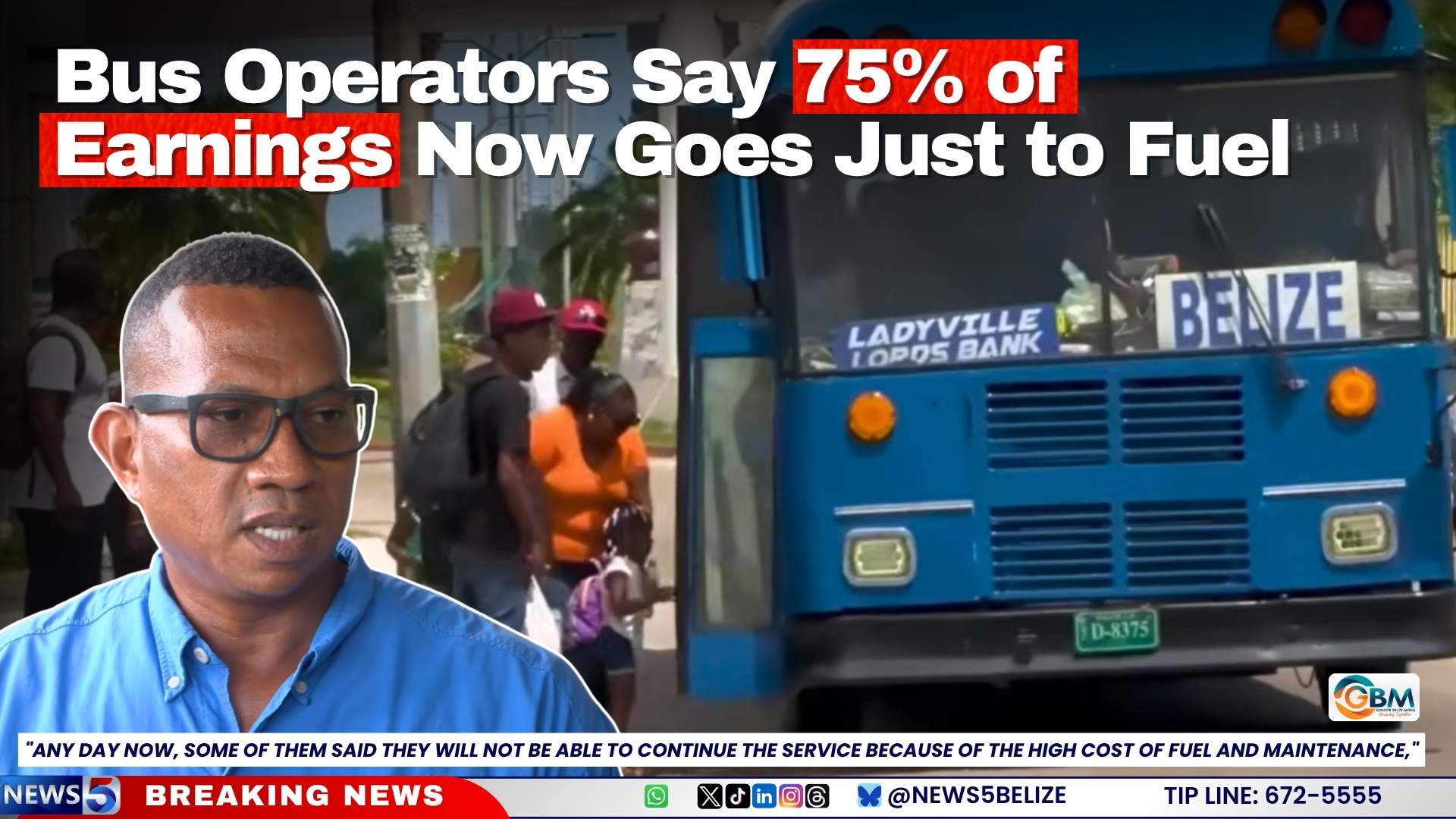
Bus Operators Say 75% of Earnings Now Goes Just to Fuel
A looming public transportation crisis is set to upend daily travel for thousands of Belizeans, with independent bus operators announcing they could suspend all services within days if the national government fails to deliver urgent financial support. The warning, delivered by Philip Jones – president of the Belize Bus Association and a veteran city bus operator – paints a dire picture of an industry pushed to the breaking point by spiraling operational costs and institutional gridlock.
The crisis traces back to a decision from Belize’s Cabinet last Friday, when policymakers delayed acting on two critical demands from the association: a long-requested fare adjustment and a targeted fuel subsidy to offset global price spikes. Jones describes the financial pressure facing association members as “colossal”, a burden that has already made daily route operations unsustainable for dozens of small operators.
Global market volatility driven by ongoing Middle East conflict has sent fuel prices surging across Belize, eating into operator revenues at an unprecedented rate. Jones confirmed that 75% of the average operator’s daily earnings now go exclusively to covering fuel costs – leaving almost no disposable income for mandatory vehicle maintenance, employee wages, or even earnings for the business owners themselves. “Many days we don’t get a salary as owners,” Jones explained, highlighting the cascading impact of rising energy costs across small transportation businesses.
Tensions have also spilled over into long-simmering friction between independent operators and the state-linked National Bus Company (NBC). Jones reports that association members have lost faith in the Minister of Transport to advance their interests, accusing the minister of withholding support to pressure independent operators into aligning with the state-run NBC. The operators have already raised allegations of anti-competitive practices by NBC, including so-called “sniper runs” where state-owned buses cut off independently scheduled routes to pick up passengers first, further eroding already thin profit margins for small businesses.
In a push to break the current deadlock, Jones has begun drafting a formal letter requesting a direct meeting with Prime Minister John Briceño to address the crisis. The association is also renewing a long-standing demand for a representative seat on the national transport board – a position the group has been denied since Jones first formally requested the representation in writing back in September 2025. Without immediate intervention from the prime minister, Jones warns, commuters across the country who rely on independent bus service for work, school, and essential travel could be left stranded without notice.
-
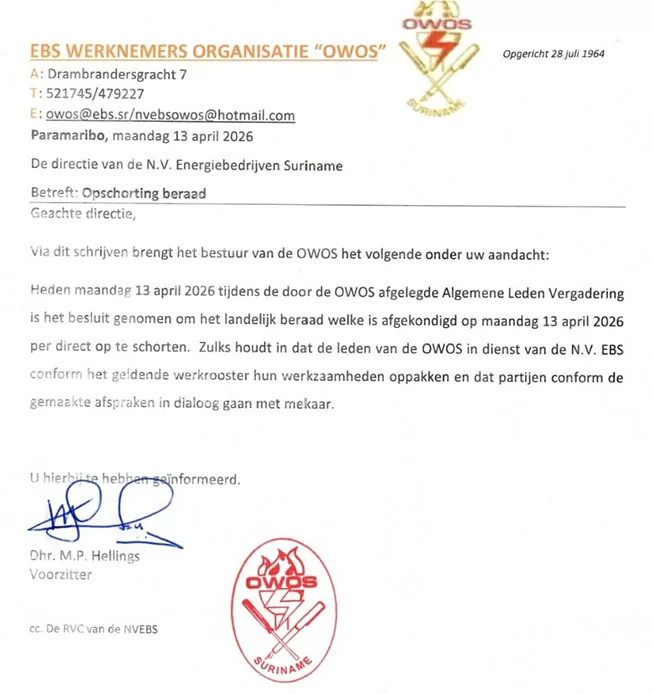
OWOS schort beraad op na constructief overleg met EBS-directie
A major breakthrough has been reached in labor tensions at Suriname’s primary energy provider, De Energie Bedrijven Suriname (EBS), after the company’s recognized employee union, OWOS, announced it would suspend previously announced industrial action. The decision came following a productive round of talks between union leadership and EBS senior management, OWOS chair Marciano Hellings confirmed in an interview with local outlet Starnieuws.
The negotiation session was led by EBS Chief Operating Officer Robert Pancham, with Technical Director Rishidath Mathoera and Chief Financial Officer Felicia Zerp also in attendance. This meeting marked the first constructive dialogue between the two sides after a lengthy period of deadlock, according to Hellings, who emphasized that the tone of the talks marked a positive shift in labor relations at the firm.
Both sides signed off on a clear set of binding agreements during the discussion. A key deadline has been set: by the end of this week (Thursday), the parties are expected to finalize negotiations on the 2025 collective labor agreement, and will immediately launch talks on the 2026 agreement once that milestone is completed.
Another critical commitment reached during the talks requires EBS management to publish an official position on the controversial 40K allowance by April 30, with the principle of pay equity mandated as the core starting point for the stance. The agreement also specifies that all other outstanding personnel issues must either be fully resolved or officially placed on the formal processing track by the same end-of-April deadline.
Following the negotiation, the full set of outcomes was presented to OWOS’s general membership assembly, which voted to approve a temporary suspension of the planned industrial action. Hellings explained that the membership body chose to grant both the union leadership and EBS management sufficient time and space to implement all agreed-upon measures within the set deadlines.
A follow-up general assembly has already been scheduled to convene after April 30 to review progress on all commitments. At that meeting, members will vote on whether to end the industrial action threat permanently or resume the planned work stoppage if the agreed terms are not met.
-

Olieprijs stijgt bijna 8% boven $102 voorafgaand aan Amerikaanse blokkade van Iran
Global crude oil markets swung sharply upward on Monday, with both benchmark contracts jumping more than 7% to push prices above $102 per barrel, after the United States announced it would launch a full naval blockade of commercial shipping to and from Iranian ports via the Strait of Hormuz, a critical global energy chokepoint. The escalation comes after weeks of high-stakes negotiations between Washington and Tehran failed to produce a lasting ceasefire agreement, collapsing a fragile two-week truce and raising fears of wider regional conflict.
Following a minor pullback in the previous trading session, Brent crude futures climbed $7.32, or 7.7%, to settle at $102.52 per barrel on Monday. U.S. West Texas Intermediate (WTI) crude futures followed a similar trajectory, rising $7.65, or 7.9%, to hit $104.22 per barrel.
In a Sunday statement, former U.S. President Donald Trump confirmed the U.S. Navy would move forward with the blockade, marking a major escalation of tensions after marathon talks with Iran broke down. He acknowledged that elevated oil and gasoline prices would likely persist through November’s U.S. midterm elections, a rare admission of the political ramifications of his administration’s decision to launch airstrikes against Iran six weeks prior.
Erik Meyersson, a senior analyst at Swedish bank SEB, noted that the announced blockade confirms that the core ceasefire condition, as interpreted by the U.S. — the full reopening of the Strait of Hormuz — is unachievable for the foreseeable future.
U.S. Central Command (Centcom) later clarified the scope of the operation in a post on X, stating that starting Monday, U.S. forces will intercept all commercial vessels traveling to or from Iranian ports, including all Iranian facilities along the Arabian Gulf and the Gulf of Oman. The operation will apply equally to vessels of all nationalities, Centcom added, while emphasizing that freedom of navigation for ships traveling to and from non-Iranian ports through the strait will remain unimpeded.
Iran has responded with sharp condemnation and threats of retaliation. The Islamic Revolutionary Guard Corps warned Sunday that any military vessel approaching the Strait of Hormuz will be treated as a ceasefire violation and met with forceful action. Iranian military officials have called the planned U.S. blockade, which is set to take place in international waters, an illegal act of piracy, and warned that no Gulf region ports will remain safe if Iranian shipping and facilities are targeted.
The escalating geopolitical turmoil has already rattled global energy markets, even as OPEC has downgraded its 2024 second-quarter global oil demand forecast by 500,000 barrels per day, citing the economic fallout from the ongoing Middle East conflict. In a monthly report published Monday on its official website, OPEC also reported that combined oil production from OPEC+ member nations averaged 35.06 million barrels per day in March, a 7.7 million barrel per day drop from the previous month. Physical crude oil prices are already trading at a steep premium to futures contracts, with some grades reaching record highs near $150 per barrel amid acute supply fears.
Helima Croft, head of commodity strategy at RBC Capital Markets, warned that if Trump follows through on his threat with a full naval deployment, the gap between paper futures markets and tight physical supply could close rapidly, driving prices even higher. Shipping data from LSEG shows that most commercial carriers are already diverting away from the Strait of Hormuz to avoid potential disruption, though three fully loaded supertankers successfully transited the waterway on Saturday, marking the first large crude carriers to exit the Gulf since the partial ceasefire took effect the previous week.
Separately, Saudi Arabia announced Sunday that it has fully restored oil pumping capacity along its critical East-West Pipeline to 7 million barrels per day, after the country’s energy infrastructure suffered damage in attacks amid the conflict with Iran.
The U.S. blockade announcement has injected a new wave of uncertainty into already jittery global oil markets, directly driving the sharp price rally seen on Monday. As the Strait of Hormuz handles roughly 20% of all global oil trade, any sustained disruption to shipping through the waterway translates immediately to higher energy costs for consumers and businesses worldwide.
Elevated oil prices add intense pressure to household budgets and corporate bottom lines, fueling already sticky global inflation and threatening to slow projected economic growth. Net oil-importing nations are particularly vulnerable to this shock, and the price spike could exacerbate existing political tensions in vulnerable economies.
OPEC’s downward revision to global demand forecasts underscores the deep fragility of current market conditions, driven by conflict-related uncertainty. At the same time, the sharp premium on physical crude points to an already tight market and widespread fear of imminent supply shortages.
The standoff has also significantly ramped up geopolitical tensions across the Middle East, with the risk of open military conflict rising sharply. Iran’s retaliatory threats paired with the U.S.’s planned blockade have put global energy security at heightened risk. Over the longer term, sustained high oil prices may shift government policy priorities, accelerating investments in alternative energy sources while also increasing domestic political pressure on leaders to rein in energy costs for consumers.
-

Digicel Business hosts forum on secure digital transformation in financial services
Fresh off Saint Lucia’s 47th Independence Anniversary celebrations, held this year under the national motto “Douvan Ansanm – Nourishing Our People, Strengthening Our Nation”, a landmark high-level gathering organized by Digicel Business has centered on accelerating safe, robust digital evolution across the Caribbean island’s financial services industry.
The summit drew more than 50 top-tier stakeholders, including C-suite leaders from commercial banks, insurance providers, credit unions, and hospitality operators, alongside independent industry analysts and technology experts. Attendees gathered to unpack how the lightning-fast pace of digital innovation is rewiring the financial ecosystem across Saint Lucia and the broader Eastern Caribbean region. Today, as digital banking penetration grows steadily, customers demand frictionless, 24/7 access to financial tools, and regulators have implemented increasingly strict requirements for cybersecurity, data privacy, and regulatory compliance. Against this backdrop, building and retaining public trust in financial institutions has become a more urgent priority than ever before.
Guest speakers at the event stressed that in an era where digital engagement is the default for most consumer and business interactions, trust cannot be an afterthought—it must be intentionally built, continuously maintained, and actively protected from evolving risks. As cybercriminals develop more sophisticated attack strategies and new technologies from cloud computing to open banking reshape industry standards, financial organizations are facing growing pressure to adopt transformation frameworks that prioritize innovation alongside inherent security, operational resilience, and regulatory compliance from the earliest design stages.
As the host of the summit, Digicel Business reaffirmed its position as a core enabling partner for this industry shift, supported by hundreds of millions in regional infrastructure investment that includes the deployment of Saint Lucia’s first purpose-built Fibre-to-the-Business network. These major infrastructure upgrades guarantee that local and regional financial institutions have access to the high-reliability, infinitely scalable connectivity required to support mission-critical daily operations and real-time cross-border financial transactions, even during periods of peak demand.
Through strategic partnerships with cybersecurity specialist Symptai Consulting and digital strategy firm Trend Media, Digicel Business used the summit to demonstrate its end-to-end approach to end-to-end digital transformation. The company’s integrated model combines world-class secure connectivity with expert cybersecurity support, regulatory compliance guidance, comprehensive business continuity planning, and data-powered customer engagement solutions designed to meet the unique needs of financial services providers.
This full-service offering cements Digicel Business’ standing as a unified, trusted partner for institutions looking to streamline operational workflows, boost their cyber resilience, and scale their digital offerings securely amid an increasingly complex global digital threat landscape.
Joel Wallace, Chief Executive Officer of Digicel Saint Lucia, used his opening address to underscore the critical role of trust and resilience in the future of the sector. “At Digicel, we recognize that in today’s financial services environment, connectivity is not just about speed—it’s about stability, security and trust,” Wallace explained. “As institutions across Saint Lucia and the region accelerate their digital transformation, our role is to ensure that this transformation is built on resilient, secure and compliant foundations that protect customers and support long-term, inclusive economic growth.”
Core working sessions throughout the day centered on three high-priority focus areas: updating organizational cybersecurity frameworks to counter modern threats, improving end-to-end business continuity planning to minimize disruption from outages or attacks, and aligning large-scale digital transformation projects with both strict regulatory mandates and core institutional business objectives.
The summit closed by reinforcing a shared, central takeaway for all attendees: the long-term success of the financial sector in Saint Lucia and the wider Eastern Caribbean will not be measured solely by how quickly organizations adopt new technology, but by how responsibly, securely, and intelligently that technology is deployed to serve customers and protect institutional stability.
As Saint Lucia moves forward in line with its independence theme of collective progress “Douvan Ansanm”, Digicel Business has reaffirmed its ongoing commitment to strengthening the digital backbone of the nation’s financial system and supporting local and regional institutions as they build a safer, more resilient financial future for all.