分类: business

  • Seiveright touts Jamaican rum as economic powerhouse

    Seiveright touts Jamaican rum as economic powerhouse

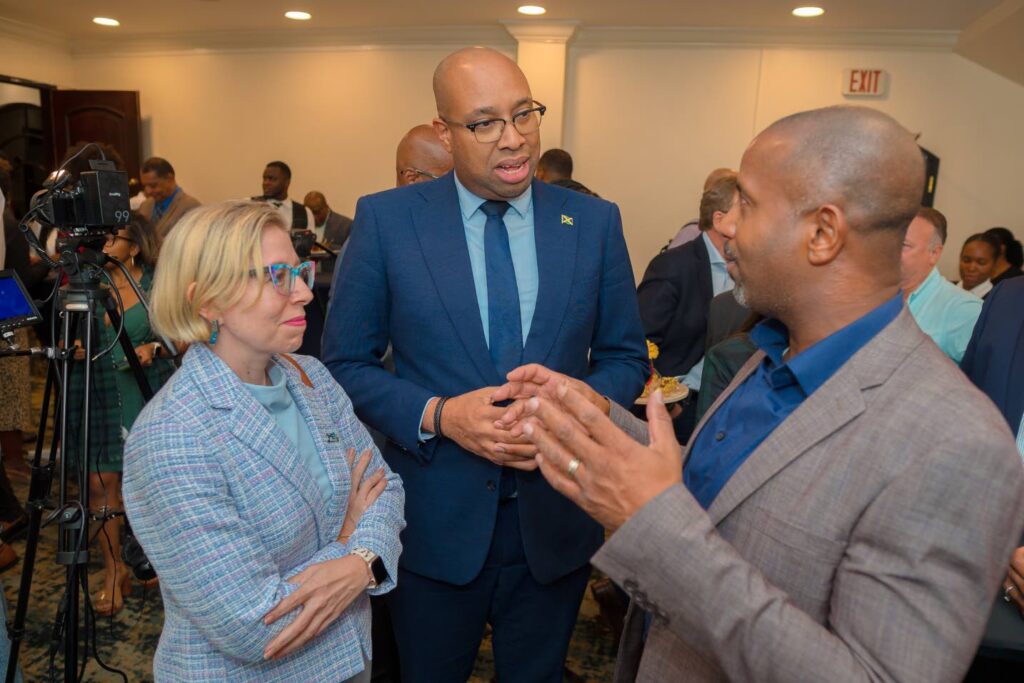
    At a recent industry cocktail reception hosted by the West Indies Rum and Spirits Producers’ Association (WIRSPA) and the Spirits Pool Association (SPA) at Kingston’s Courtleigh Hotel & Suites, a top Jamaican trade official has made a forceful case for elevating the island’s iconic rum sector to its rightful place as a foundational driver of national and regional prosperity.

    Delano Seiveright, Minister of State in Jamaica’s Ministry of Industry, Investment and Commerce, told assembled regional industry leaders that the rum sector is far more than a consumer beverage—it is an interconnected ecosystem that touches every corner of the Jamaican economy, from agricultural production to international tourism. Unlike common public perceptions that frame rum as simply a popular alcoholic drink, Seiveright emphasized that the Jamaican government views the industry as a strategic asset that delivers widespread benefits across agriculture, manufacturing, logistics, export revenue, intellectual property protection, rural employment, and national branding.

    “Rum is one of the few products that tells Jamaica’s story every time it is poured anywhere in the world,” Seiveright told attendees, noting that the sector generated roughly US$57 million in export earnings alone in 2024, cementing its status as one of the country’s top export industries. Beyond trade, he added, the industry creates cascading economic opportunities for thousands of people across the island, supporting small-scale farmers, logistics providers, manufacturing workers, tourism employees, marketing teams, local retailers and entire rural communities.

    A central focus of Seiveright’s remarks was the critical role of geographical indication (GI) protection for Jamaican rum, which he framed not just as an intellectual property measure, but as a core tool for equitable economic development. By enforcing GI rules, Seiveright explained, the country can ensure that key high-value stages of production—including ageing, bottling and quality control—remain anchored in Jamaica, retaining skilled jobs and greater economic value within the country rather than seeing them leak to foreign operators.

    The minister also addressed ongoing industry concerns around taxation and global competitiveness, acknowledging the burdens of regulatory costs while contextualizing the government’s recent fiscal policy choices in the wake of major natural disaster. Hurricane Melissa caused an estimated US$12.2 billion in widespread damage across Jamaica’s critical infrastructure, and the government faces the delicate task of balancing the need for post-disaster reconstruction with support for competitive private enterprise. “Nobody welcomes additional taxes — Government included. But neither can Government ignore the need to rebuild homes, schools, roads, bridges and critical infrastructure, and balancing the books,” Seiveright said, adding that policymakers are working to strike a balance between competitiveness, reconstruction, sustainable growth and long-term fiscal responsibility.

    Opening the event, WIRSPA Chairman Clement “Jimmy” Lawrence echoed Seiveright’s comments on the industry’s regional importance, noting that Caribbean rum is one of the region’s most globally recognized exports and a cultural ambassador for Caribbean heritage worldwide. Lawrence said that WIRSPA’s recent annual general meeting centered heavily on growing challenges facing the sector, from shifting global trade rules and market access barriers to evolving tariffs, supply chain disruptions, and changing regulatory requirements that impact regional exporters.

    He warned that proposed adjustments to regional trade arrangements that affect the cost and availability of critical manufacturing inputs, including glass bottles and product labels, must prioritize export competitiveness and supply chain resilience to avoid undermining the sector. During the event, Lawrence officially launched WIRSPA’s 2024 sustainability report, which outlines the industry’s ongoing progress in embedding environmental stewardship, community investment and responsible business practices across all levels of regional production.

    The highlight of the evening’s program came as organizers presented a lifetime achievement award to Dr. Joy Spence, the world-renowned Jamaican master blender, in recognition of her decades-long contributions to advancing the profile of Jamaican and Caribbean rum globally. Accepting the honor, Spence paid tribute to generations of Caribbean distillers, blenders and product innovators who built the sector’s global reputation for quality and authenticity, and credited WIRSPA with unifying the regional industry to secure international recognition for its products.

    “WIRSPA has ensured that what we produce in this region is recognised and respected worldwide as being authentically Caribbean,” Spence said, adding that Jamaican rum remains inseparable from the country’s national heritage and cultural identity.
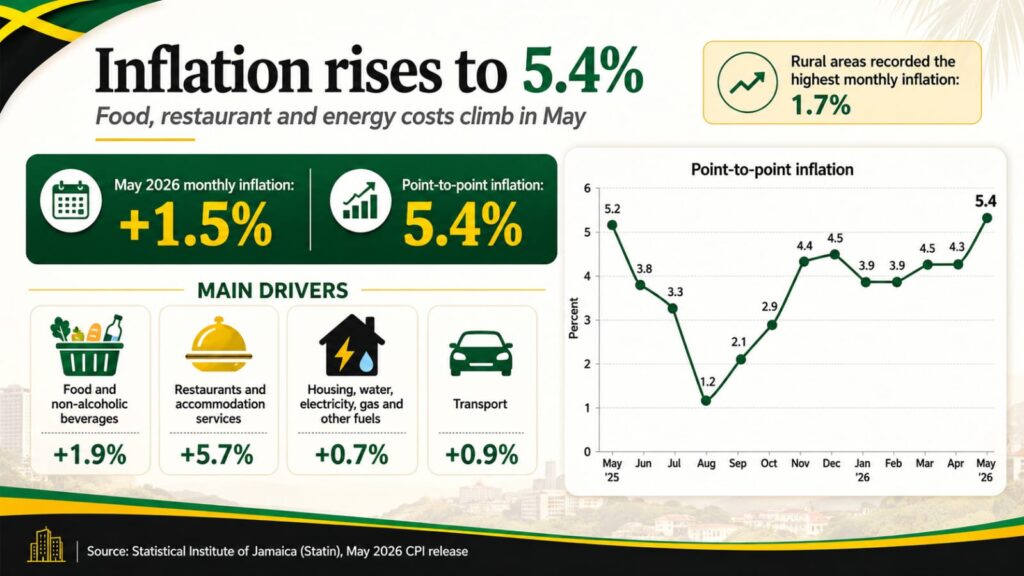

  • Inflation rises to 5.4% as food, restaurant and energy costs climb

    Inflation rises to 5.4% as food, restaurant and energy costs climb

    KINGSTON, Jamaica — Jamaica’s cost of living pressures accelerated sharply in May 2026, pushing the country’s annual inflation rate up to 5.4% as households faced steeper bills for staple groceries, restaurant dining, utility services and transportation, official data released by the Statistical Institute of Jamaica (Statin) shows.

    The month-over-month consumer price jump came in at 1.5% in May, marking a complete reversal of the 0.3% contraction recorded in April and representing the steepest single-month increase in consumer costs since November 2025. This upward shift pushed the 12-month inflation rate — measured between May 2025 and May 2026 — up from the 4.3% reading recorded in April. While the current figure still falls within the Bank of Jamaica’s official target band of 4% to 6%, it now sits uncomfortably close to the upper limit of the central bank’s tolerance range.

    Food inflation emerged as the dominant force behind the overall price increase. The Food and Non-Alcoholic Beverages category registered a 1.9% monthly price jump, fueled almost entirely by sharp increases in locally grown fresh produce. Key staples including tomatoes, cabbage, carrots, ripe bananas and pineapples all saw double-digit proportional increases over the month, pulling the overall index for vegetables, tubers, plantains, cooking bananas and pulses up 4.8%. The fruit and nuts subcategory rose even faster, posting a 4.7% monthly increase. Smaller but still notable increases were recorded for fish and seafood (1.2%) and meat products (0.9%).

    Beyond grocery shelves, Jamaican consumers also faced significant price hikes when dining out. The Restaurants and Accommodation Services segment saw a 5.7% monthly surge, with the overwhelming majority of this increase traced to higher costs for meals purchased away from home.

    Housing and utility costs also contributed to the upward trend. The Housing, Water, Electricity, Gas and Other Fuels division recorded a 0.7% monthly increase, driven largely by elevated electricity rates. This upward pressure was partially offset by a temporary reduction in water supply and sewage service charges across much of the country.

    Transportation costs added another layer of pressure to household budgets, rising 0.9% month-over-month. The increase stemmed from higher retail petrol prices and a 3.1% jump in the ongoing cost of operating private passenger vehicles.

    The inflationary increase impacted all regions of Jamaica, but rural households bore the brunt of the price hikes. Statin data shows rural areas recorded a 1.7% monthly inflation rate, outpacing the 1.5% increase seen in other urban centers and the 1.3% rise in the densely populated Greater Kingston Metropolitan Area.

    Over the 12-month period ending in May 2026, cumulative food price inflation reached 8.7% — far outpacing the overall headline inflation rate of 5.4%. The most dramatic annual increase was recorded in the fruit and nuts category, which has soared 34.3% over the past year. Vegetables, tubers, plantains, cooking bananas and pulses have risen 10.4% year-over-year, while fish and seafood prices are up 11.7% from May 2025. Annual price increases for the Restaurants and Accommodation Services segment hit 6.9%, while transportation costs are up 3.1% over the same period.

    Notwithstanding the sharp May increase, Statin noted that the overall consumer price index remains 0.2% lower than its peak level in December 2025, a residual effect of broader price declines recorded in the first months of 2026. In absolute terms, the All-Jamaica Consumer Price Index rose to 149.6 in May, up from 147.4 in April.

  • Banco Popular to channel US$50 million from ICO into tourism, energy, and strategic sectors

    Banco Popular to channel US$50 million from ICO into tourism, energy, and strategic sectors

    In a move designed to deepen bilateral economic cooperation between the Dominican Republic and Spain, Banco Popular Dominicano has secured a new flexible financing agreement worth up to $50 million from Spain’s state-owned Official Credit Institute (ICO). This collaboration is targeted at empowering business initiatives that strengthen commercial and investment links between the two Iberian-American nations, with core goals including boosting productive capital flows, simplifying cross-border trade operations, and opening up new accessible financing channels for enterprises active in both markets.

    This latest agreement marks the third round of financing that Banco Popular has obtained through ICO’s International Channel Line program. Cumulatively, the Spanish public financial institution has now committed a total of $150 million to the Dominican bank across the three partnership rounds. The ongoing collaboration has already helped hundreds of companies across both nations address working capital gaps, meet urgent liquidity requirements, and scale up bilateral export activities that drive job creation and economic output on both sides.

    The newly allocated $50 million will be channeled to high-priority strategic sectors that underpin both economies. Key target areas include tourism, power generation, infrastructure construction, real estate development, and hospitality – all critical growth drivers for the Dominican Republic. Additional funding will also be directed to forward-looking projects focused on environmental sustainability, improved energy efficiency, technological innovation, and widespread digital transformation across industries. Banco Popular emphasized that this financing framework aligns fully with the institution’s long-standing pledge to advance responsible banking practices and inclusive, sustainable economic development across the Dominican Republic.

    This new agreement builds on Banco Popular’s already robust track record of supporting the country’s productive sector. Official data from the Dominican Superintendency of Banks shows that as of March 2026, the institution’s total business loan portfolio hit RD$395 billion, with nearly 45 percent of that sum – equal to RD$178.3 billion – allocated to micro, small, and medium-sized enterprises (MSMEs), which form the backbone of the Dominican economy. Beyond direct financing, Banco Popular supplements its lending support with a range of auxiliary services, including user-friendly digital banking solutions for businesses, targeted skills training programs for company leaders, and dedicated initiatives to nurture new entrepreneurship across the country.

  • Puerto Plata to host PAMAC Cruise Summit 2026

    Puerto Plata to host PAMAC Cruise Summit 2026

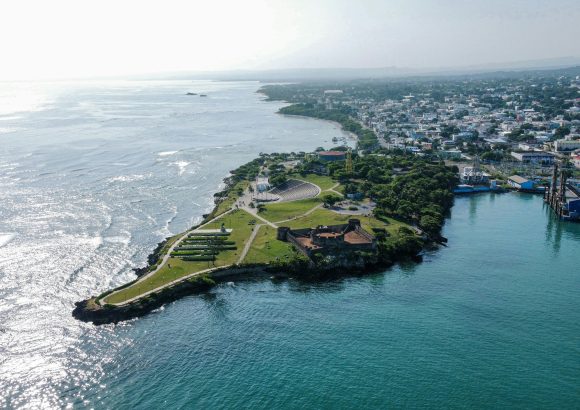
    The Dominican Republic’s coastal city of Puerto Plata has earned the right to host the 2026 PAMAC Cruise Summit, one of the cruise sector’s most high-profile international gatherings organized by the Florida-Caribbean Cruise Association (FCCA). Scheduled to take place from June 22 to 26, 2026, the summit will draw top-level attendees from across the Caribbean and Latin America, including C-suite executives from major cruise lines, senior tourism government officials, infrastructure investors, and other core industry stakeholders.

    The official confirmation of the host selection was delivered by Carlos Atahualpa Paulino, the Dominican Republic’s Regional Tourism Director. Paulino emphasized that this designation marks a transformative milestone for both Puerto Plata and the entire country, noting that the summit will thrust the destination into the global cruise tourism spotlight. This global attention will highlight Puerto Plata’s rapidly expanding reputation as a top-tier Caribbean cruise port and sought-after travel destination.

    Local and national tourism authorities credit the successful bid to coordinated efforts spearheaded by Dominican Tourism Minister David Collado, as well as the longstanding collaborative partnership between the Dominican government and the FCCA. Economists and industry analysts project that the five-day event will deliver substantial tangible economic benefits to the region. These gains include boosted hotel occupancy rates, increased non-resident spending, and expanded revenue streams for local transportation providers, eateries, retail businesses, and tourism-focused service sectors that form the backbone of Puerto Plata’s economy.

    Beyond the immediate economic injection that the summit will bring, industry leaders expect the event to deliver long-term strategic advantages for the destination. It will elevate Puerto Plata’s international brand recognition, draw new foreign and domestic investment in cruise and general tourism infrastructure, and solidify the Dominican Republic’s standing as one of the Caribbean’s dominant cruise tourism hubs. Additionally, the summit will serve as a critical strategic platform to showcase the country’s modern tourism infrastructure to global decision-makers and deepen long-standing commercial ties with the world’s largest cruise operating companies.

  • Air Europa adjusts Havana flights, relocates fuel stop to Punta Cana

    Air Europa adjusts Havana flights, relocates fuel stop to Punta Cana

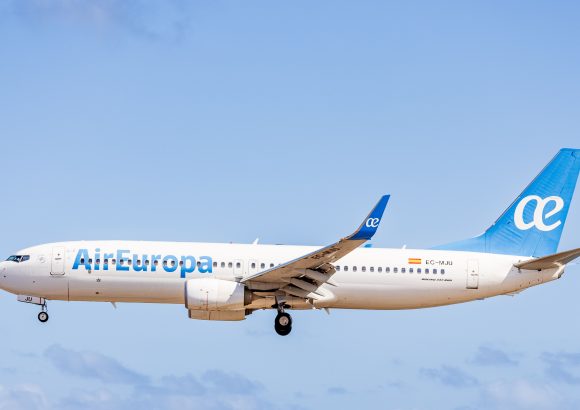
    As persistent fuel supply disruptions continue to roil Cuba’s aviation sector, Spanish airline Air Europa has announced a key operational adjustment: starting June 13, the carrier will move its technical refueling stop for the Madrid-Havana route from the Dominican Republic’s capital Santo Domingo to the popular tourist destination of Punta Cana. The change is a direct response to ongoing energy shortages that have strained fuel access across Cuba.

    This is not the first adjustment Air Europa has made to its Cuba service in 2024. Back in February, the airline first moved its mandatory refueling stop to Santo Domingo after persistent shortages developed at Havana’s José Martí International Airport. The refueling halt is a non-negotiable part of the return leg from Havana to Madrid, necessary to ensure the aircraft carries enough fuel to complete the long transatlantic crossing. Per Air Europa’s published flight schedule, the shift to Punta Cana will remain in effect through at least the end of June, with no immediate plans to revert to the original refueling arrangement.

    Notably, Air Europa is among the few major international carriers still maintaining regular service between Europe and Cuba amid the country’s deepening energy crisis. The airline continues to operate three round-trip flights per week on the Madrid-Havana corridor, a commitment that stands in stark contrast to the actions of multiple competing airlines. Industry peers including Iberia, Cuba’s state-owned flag carrier Cubana de Aviación, and Spanish leisure airline World2Fly have already suspended all their flights to Cuba since fuel and power shortages worsened across the island, disrupting all types of aviation operations.

    Beyond the immediate operational impact for Air Europa, the relocation also underscores a shifting regional dynamic in Caribbean aviation. Punta Cana, long a top destination for international leisure travel, has seen its profile as a strategic regional hub grow in recent years, and this decision by Air Europa further cements that expanding role. At the same time, the adjustment highlights the persistent operational hurdles that airlines face when trying to maintain critical air connectivity between Cuba and the rest of the world, as the island nation grapples with a prolonged period of energy and fuel scarcity that shows no immediate signs of resolution.

  • Kingston Creative bets on Jamaica’s next wave of innovators with ‘Createch Incubator’

    Kingston Creative bets on Jamaica’s next wave of innovators with ‘Createch Incubator’

    In a landmark move to strengthen Jamaica’s fast-growing creative economy and integrate cutting-edge technology into cultural entrepreneurship, Kingston Creative has officially launched the Createch Incubator, a four-month specialized support program tailored for early-stage creative founders. The initiative aims to empower emerging entrepreneurs across Jamaica’s cultural sectors to build purpose-driven, technology-forward businesses by combining hands-on training, expert mentorship, and expanded regional networking opportunities.

    Jamaica’s creative sector already stands as a major pillar of the national economy, contributing an estimated JMD $107 billion annually, equal to 5.1% of the country’s total gross domestic product. Against this backdrop, the Createch Incubator opens its doors to innovators across a wide spectrum of creative fields, including motion picture production, literary arts, visual arts, live performance, fashion design, handmade craft, music, and cultural festivals.

    The program is implemented through Conecta Caribbean, an initiative of the CARIBEquity Facility that receives co-funding from the Inter-American Development Bank (IDB) Lab and the European Union. It forms part of a broader regional collaborative effort that unites entrepreneurship support organizations (ESOs) across 15 Caribbean nations, creating a unified cross-border incubation ecosystem for early-stage ventures.

    Scheduled to run from July through November 2026, the program delivers structured training in core startup fundamentals: from identifying unmet market problems and conducting customer discovery to refining value propositions, designing scalable business models, and building long-term financial sustainability. A key distinguishing feature of Createch is its dedicated practical training in artificial intelligence and other emerging digital tools, equipping creative founders to embed innovative technology into their daily operations and long-term growth strategies.

    The program will conclude with a high-stakes Demo Day pitch competition, where select participating graduates will present their developed ventures to an audience of investors, regional ecosystem partners, and industry stakeholders. Top contenders will win grant funding to accelerate the growth of their businesses.

    Participation is completely free for all selected applicants, with a robust package of benefits included. Successful candidates gain access to one-on-one mentorship from seasoned business and creative professionals, full access to the Bridge for Billions digital entrepreneurship platform, a structured online curriculum, targeted capacity-building workshops, collaborative cohort learning sessions, and exclusive connections to a cross-regional network of fellow founders, investors, and ecosystem leaders.

    Bianca Welds, the newly appointed head of projects and partnerships at Kingston Creative, emphasized the transformative potential of the initiative. “We’re excited to be a part of the Conecta Caribbean initiative, which is helping to standardize startup training across the region,” Welds said. “Createch is the only creative industry incubator in this cohort and Jamaican creatives will benefit tremendously from the regional reach of the programme.”

    Applications for the 2026 Createch Incubator cohort are currently open to eligible early-stage creative entrepreneurs, with all submissions due by June 30, 2026.

  • LISTEN: PM Browne Defends Sandals Overwater Bungalows, Says Antigua Must Expand Luxury Tourism Offerings

    LISTEN: PM Browne Defends Sandals Overwater Bungalows, Says Antigua Must Expand Luxury Tourism Offerings

    Antigua and Barbuda’s Prime Minister Gaston Browne has stepped forward to defend a major planned luxury tourism development at Sandals Grande Antigua, framing the project as a critical investment to keep the island nation competitive in the fast-growing global high-end travel market. During his weekly public radio address Saturday, Browne pushed back against widespread criticism of the proposed overwater bungalows, laying out his case that the expansion will boost national tourism revenue while safeguarding public access to one of the country’s most popular coastal destinations, Dickenson Bay.

    Sandals Resorts international has already announced plans to inject more than $100 million into the expansion project, which will add more than 100 new guest rooms to the Sandals Grande Antigua property. The centerpiece of the upgrade is the addition of approximately 16 exclusive overwater bungalows, a luxury accommodation option that has become a major draw for high-spending travelers worldwide.

    To address widespread public concern over restricted beach access, Browne confirmed the government has placed clear geographic restrictions on where the structures can be constructed. The bungalows will not be sited along the central stretch of Dickenson Bay’s beach, he explained. Instead, development will be shifted south toward the existing groyne, a positioning that ensures the structures will not block public use of the main beach area. Browne emphasized that the bungalows are built over open water, not on the beach itself, so fears of restricted access to Dickenson Bay are unfounded. “These are not going to take up beach,” he said. “Dickenson Bay will still be accessible to all stakeholders.”

    The prime minister pushed back against narrative that the country already has an oversupply of hotel rooms, arguing that turning away high-value investment would be economic folly. He pointed to top global luxury destinations including the Maldives, Bora Bora, and the Seychelles, which have built entire world-renowned tourism economies around premium offerings like overwater villas and bungalows. Currently, Antigua and Barbuda generates roughly $2 billion in annual tourism revenue, a figure Browne said the country can and must grow to strengthen its economy.

    Luxury overwater accommodations command premium nightly rates that far outpace standard hotel rooms, Browne noted. He cited existing overwater units at Antigua’s Royalton resort, which already regularly bring in roughly $3,000 per night and remain consistently popular with travelers seeking ultra-luxury experiences. “These units provide a high yield,” Browne said. “They’re far more exciting. It enhances the product and places us in a more competitive space compared to other regional countries involved in tourism.”

    Browne also addressed two other common points of criticism: environmental risk and structural vulnerability to hurricanes, a persistent threat for Caribbean island nations. He said the project will implement science-backed mitigation measures to limit any negative ecological impacts, and noted that overwater structures have a proven track record of withstanding major storms in hurricane-prone regions across the region. Even in the worst-case scenario that a storm damages the structures, Browne added, the development is fully insured, allowing for full reconstruction after extreme weather events. Existing overwater developments across Antigua have already weathered major hurricanes without catastrophic failure, he said, proving that the bungalows can be built safely and sustainably.

    Sandals Executive Chairman Adam Stewart has told the prime minister the proposed Antigua overwater bungalows could become one of the most attractive luxury offerings in the entire Caribbean, Browne revealed, adding that the new units will feature a unique design that sets them apart from existing overwater accommodations already operating on the island.

    The expansion is part of a broader national strategy by the Antigua and Barbuda government to grow the country’s total room stock and solidify its position as a top-tier global tourism destination. Browne reiterated that attracting high-spending luxury travelers remains one of the most critical priorities for growing the country’s overall economy and expanding revenue from the tourism sector, which is the backbone of Antigua and Barbuda’s national economy.

    “As far as we can build out more of those overwater bungalows and they do not impact other users and stakeholders, I think we should encourage them,” he said. “Because it will help to uplift our product.”

  • Construction Underway on New Residential Development at Willoughby Bay, PM Says

    Construction Underway on New Residential Development at Willoughby Bay, PM Says

    Work is now underway on a high-profile luxury residential-tourism development at Willoughby Bay on the southeast coast of Antigua and Barbuda, Prime Minister Gaston Browne has confirmed, calling the project a key example of the nation’s strategy to drive foreign investment and grow its tourism sector.

    Browne shared the update during his weekly public radio broadcast Saturday, outlining that the scheme is being developed by an investor who participates in the country’s popular Citizenship by Investment Programme (CIP). The international investor was first connected to the Willoughby Bay site years ago, and has since moved through all planning phases to launch active construction, the prime minister explained.

    The Willoughby Bay build forms part of a wave of high-end residential and tourism developments unfolding across Antigua and Barbuda, as national leaders work to diversify the country’s tourism product and draw increasing volumes of foreign direct investment. Browne emphasized that global demand for luxury tourism experiences continues to climb, and projects like this one are critical to broadening the nation’s economic foundation beyond traditional tourism offerings.

    Alongside confirming active construction, Browne used the update to reaffirm the government’s commitment to balancing ambitious economic growth targets with rigorous environmental protection and maintained public access to the country’s treasured coastal landscapes. Environmental impact assessments and sustainable planning remain non-negotiable components of the approval process for all large-scale developments, he stressed.

    The Willoughby Bay announcement came during a broader conversation about the country’s growing pipeline of tourism investment, including the planned expansion of Sandals resort properties and the addition of new overwater bungalows at Dickenson Bay. While Browne did not share full detailed blueprints for the final Willoughby Bay development during the broadcast, he confirmed that construction is moving forward steadily as one of a slate of major projects designed to strengthen both Antigua and Barbuda’s tourism and real estate sectors.

    Situated in one of the island nation’s most picturesque coastal regions, the completed development is projected to deliver widespread economic benefits: it has already created construction jobs, and will support ongoing employment and generate increased visitor spending once it opens to residents and guests. For years, Antigua and Barbuda’s government has identified tourism-linked infrastructure and development as a core engine of national economic activity and a central pillar of its long-term growth strategy.

    Browne noted that the country will continue prioritizing strategic positioning to attract global investors, while expanding the range of accommodation and residential property options available to international visitors and second-home owners. Additional details on the full scope and construction timeline for the Willoughby Bay development are expected to be released as work progresses in the coming months.

  • Sandals to Pay Antigua and Barbuda Government $6.5 Million In Tax Settlement

    Sandals to Pay Antigua and Barbuda Government $6.5 Million In Tax Settlement

    One of the Caribbean’s most prominent resort operators, Sandals Resorts International, has reached a binding agreement to pay the Antiguan government $6.5 million to resolve lingering tax disputes, clearing the path for a $100 million expansion of its flagship Sandals Grande Antigua property. Antigua and Barbuda Prime Minister Gaston Browne confirmed the settlement during his weekly public radio address Saturday, noting that recent talks with the resort’s top leadership were collaborative and productive across a wide range of operational and strategic issues.

    “We had some outstanding issues with taxes and we’ve settled for $6.5 million, so they’ll be paying the government $6.5 million shortly,” Browne told listeners. “From what I understand, the funds have already been placed in an escrow account to finalize the process.”

    The negotiations covered more than just outstanding tax obligations, with discussions spanning resort operations, new capital investment, and worker welfare, according to the prime minister. The centerpiece of the planned growth is a large-scale expansion that will add more than 100 new guest rooms to the existing property, including 16 luxury overwater bungalows targeted at high-net-worth international travelers.

    Antiguan officials have already given the project formal approval, but imposed a key zoning requirement to preserve public access to the island’s popular beaches. Instead of siting the overwater accommodations in the central stretch of the resort’s beachfront, the bungalows will be located at the southern end of the property near an existing groyne, a structural barrier designed to reduce coastal erosion. This zoning adjustment ensures the main beach remains open and accessible to other visitors and local users, Browne explained.

    “What we’ve said to them is that they cannot build those overwater bungalows in the middle of the beach,” the prime minister said. “They’ll be going southwards towards the groyne so that they do not impede the use of the beach by other users.”

    Browne emphasized that the expansion aligns with the government’s broader tourism strategy, which prioritizes growing overall accommodation capacity while upgrading the country’s product offerings to attract higher-spending tourists. He pointed to the proven popularity and profitability of overwater bungalows in iconic luxury destinations such as the Maldives and Bora Bora, where these exclusive accommodations can command nightly rates in the thousands of dollars.

    “These units provide a very high yield,” Browne noted. “They help to enhance the tourism product and place us in a more competitive position in the global luxury travel market.”

    Beyond infrastructure and expansion, talks also centered heavily on improving employee support at the resort. Browne said he raised the issue of working parents with young children, who often face barriers to employment when they lack access to affordable childcare. He proposed that Sandals establish an on-site crèche (daycare facility) to support local and regional staff members, eliminating a major obstacle to consistent work participation.

    To the prime minister’s satisfaction, resort executives responded positively to the proposal. “They have agreed, actually. They see it as a good idea and they say they’ll definitely look into it and see how they can put that in place as part of the infrastructure to facilitate the staff,” Browne reported. He added that the on-site childcare facility would boost local workforce participation and help employees better balance their professional and family responsibilities.

    During the discussions, Sandals leadership also shared details about its current compensation practices for local workers. According to data provided by the company, entry-level employees earn more than $4,000 per month when including gratuities and additional earnings beyond base wages. Browne acknowledged that this figure came directly from the resort, but called the reported pay level “decent” for Antiguan workers.

    Sandals also reported that it contributes more than $50 million annually to Antigua and Barbuda’s local economy through employee wages, local procurement of goods and services, and regular taxes and government fees. As the country continues to see steady growth in international visitor arrivals, the expansion will increase the resort’s contribution to the national tourism sector, which is the backbone of Antigua and Barbuda’s economy, and grow the country’s overall available room stock.

    The project will now move forward with detailed planning and mandatory environmental assessments before construction begins. Browne reiterated that the government is committed to fostering responsible private tourism investment that balances economic growth with two core priorities: protecting public access to the country’s valuable coastal assets and safeguarding the rights and interests of local workers.

  • WATCH: Club Med Among Companies Interested in Acquiring Jolly Beach Resort, PM Says

    WATCH: Club Med Among Companies Interested in Acquiring Jolly Beach Resort, PM Says

    Antigua and Barbuda’s Prime Minister Gaston Browne has confirmed that two major global hospitality players, including France-based Club Med, have formally expressed interest in purchasing Jolly Beach Resort, one of the Caribbean nation’s most high-value tourism assets, as the government navigates decisions over the property’s long-term future.

    In remarks delivered during his weekly public radio program on Saturday, Browne shared new details about ongoing discussions with prospective investors, noting the beachfront resort has rebounded strongly to turn consistent profits since the government took it over amid crippling financial distress years earlier.

    “Club Med has made clear it wants to acquire the property,” Browne stated, adding that European travel giant TUI is also lined up to hold talks with government leadership next week to lay out its own interest in the site.

    Despite the overtures from major international brands, Browne emphasized the government is prioritizing one non-negotiable condition in any potential sale deal: no drastic, long-term reduction to the resort’s current room count. Club Med’s preliminary interest is tied to a full redevelopment of the property, a project that would temporarily take hundreds of rooms offline at once, contracting Antigua and Barbuda’s total tourism accommodation inventory significantly during construction.

    “We cannot afford to lose that many rooms all at once,” Browne explained. “A phased approach, where 100 or 200 rooms are taken offline at a time, works for us because we can maintain overall room capacity through the process.”

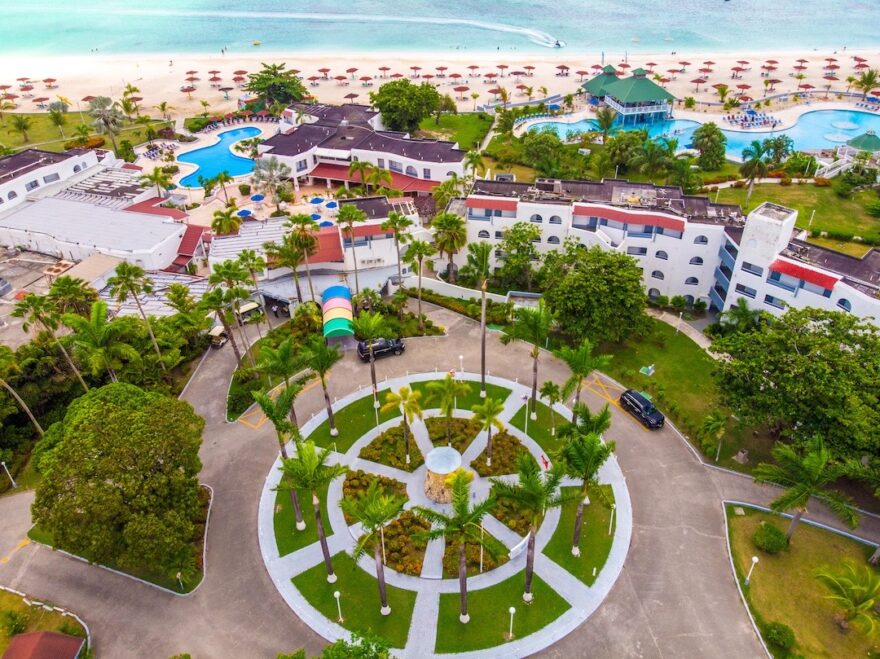
    Jolly Beach Resort ranks among the largest hotel properties in Antigua and Barbuda, drawing roughly 75,000 guests to the island nation each year. Under current government ownership, the site generates approximately $4 million in annual profit, marking a major turnaround from years of mounting debt and operational failure that preceded the state’s takeover.

    The government stepped in to acquire control of the resort when it faced insurmountable debt and operational collapse. A targeted restructuring process, which included selling off a portion of the wider property, allowed the administration to clear all outstanding liabilities and severance payments to former staff while returning the hotel to profitability. It is currently operated under management contract by Elite Island Resorts, which Browne praised for delivering strong performance to date.

    Earlier this year, the government unveiled plans for a $13.5 million standalone upgrade of the resort, including modernized air conditioning, enhanced high-speed internet infrastructure, and a new 500-person conference center designed to expand the property’s appeal to the growing MICE (meetings, incentives, conferences, exhibitions) travel segment.

    Room capacity remains a central pillar of Antigua and Barbuda’s national tourism growth strategy, as the country works to boost annual visitor arrivals and expand its market share in the Caribbean. Government officials have repeatedly framed Jolly Beach Resort as a strategic national asset, thanks to its large footprint, prime beachfront location, and consistent contribution to local tourism revenue and employment.

    As negotiations with Club Med, TUI, and any other prospective bidders move forward, Browne said protecting the resort’s ongoing economic contribution and existing room capacity will remain the government’s top priorities. He added that if a sale that meets the nation’s requirements cannot be reached, the government is fully prepared to retain ownership of the profitable asset.

    “Wherever possible, we will continue to hold Jolly Beach as a critical national asset,” Browne said.