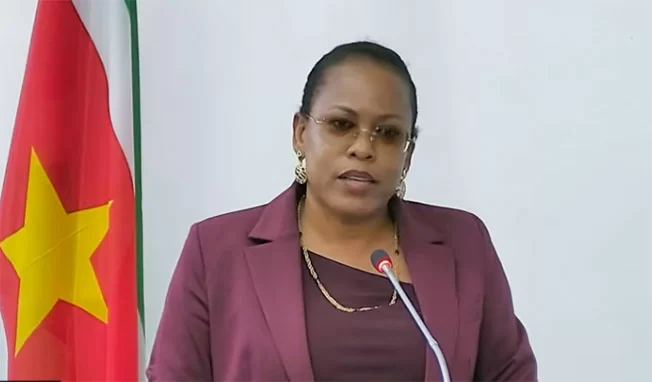
Suriname’s National Assembly Speaker Ashwin Adhin has announced a series of ambitious reforms aimed at making parliamentary work more transparent, modern, and accessible to the general public, with a core priority of opening closed-door committee meetings to public scrutiny. In an exclusive interview with local outlet Starnieuws, Adhin outlined that he will personally push to open the vast majority of committee proceedings, which currently remain out of public view despite forming the backbone of all parliamentary work.
作者: admin
-

Inheemsen eisen grondenrechten en gerechtigheid tijdens protestmars
On May 3, 2026, a wave of unrest swept through central Paramaribo, Suriname, as hundreds of Indigenous demonstrators and their supporters took to the streets to demand long-overdue recognition of their territorial land rights, holding the Surinamese government accountable for years of broken promises and escalating environmental harm to their traditional territories.
The demonstration kicked off early Saturday with a peaceful march through the city’s downtown core, organized by a coalition of Indigenous community leaders and environmental activists. Midway through the march, participants paused to honor the memory of Martinus Wolfjager and Ivanildo Dijksteel, two Indigenous men who were killed during violent 2023 protests in the village of Pikin Saron on May 2 that same year. According to family members and supporters of the two men, Wolfjager and Dijksteel were already in handcuffs when police officers shot them at close range. That 2023 unrest left multiple vehicles and buildings burned, and several people taken hostage amid long-simmering tensions over resource extraction on Indigenous lands.
After concluding the march, the group headed first to Suriname’s National Assembly to deliver a formal petition outlining their core demands. Tensions flared at the assembly when demonstrators rejected statements offered by two sitting legislators, Ivanildo Plein from the National Party of Suriname (NPS) and Jennifer Vreedzaam from the National Democratic Party (NDP). In their petition, Indigenous leaders outlined that the Surinamese government continues to issue commercial resource extraction concessions within their traditional residential and hunting lands, resulting in widespread contamination of rivers and creeks that have left many communities without safe, drinkable water. The petition stressed that the cumulative pressure on Indigenous communities across the country has grown to an unsustainable, unbearable level.
Protest organizers also drew direct attention to the government’s ongoing failure to implement binding international court rulings on Indigenous territorial rights. They added that Indigenous activists now face severe, decades-long prison sentences for their advocacy, creating a pattern of unequal justice that punishes marginalized communities for defending their homelands.
Following the confrontation at the National Assembly, the protest group moved to the Cabinet of the President, where they delivered a second copy of their petition. Chief of Staff Sergio Akiemboto accepted the document on behalf of President Jennifer Simons. Speakers at the site, including prominent environmental activist Erlan Fleur, made clear that the era of empty negotiations is over, calling for immediate, concrete intervention from the national government to address the crisis.
Demonstrators also stopped at Suriname’s Court of Justice, where they called for transparent, equal application of the law, pointing to what they describe as a clear pattern of double standards in the justice system’s handling of the 2023 Pikin Saron events. Five Indigenous men who were arrested in connection to the unrest originally received an 8-year prison sentence in their initial trial on charges including attempted murder, aggravated assault, arson, hostage-taking, and weapons violations. On appeal, prosecutors have increased their requested sentence to 15 years, and the next hearing in the case is scheduled for May 26.
In a parallel case, seven police officers are on trial for their alleged role in the deaths of Wolfjager and Dijksteel. A ruling in this case is expected as soon as May 5, 2026. Prosecutors have requested a 12-month suspended prison sentence with a three-year probation period for the officers on charges of aggravated assault leading to death, while calling for acquittal on the more serious charge of complicity in manslaughter. The discrepancy in sentencing requests between the Indigenous defendants and the accused officers has underscored protesters’ claims of unequal treatment under the law, amplifying calls for systemic change to protect Indigenous rights across Suriname.
-

Official creation of the Youth Football Department in Haiti
The Haitian Football Federation (FHF) has announced the official launch of a dedicated Youth Football Department, a landmark institutional move crafted to align the country’s grassroots football ecosystem with global development guidelines set by FIFA and the Confederation of North, Central American and Caribbean Association Football (CONCACAF).
This new governing body is the centerpiece of FHF’s long-term strategic vision to rebuild and strengthen the foundational structure of Haitian football. By delivering structured, inclusive, and sustainable support to emerging young players across the country, the department aims to nurture a new pipeline of competitive talent that can compete at both the regional and global stages, building a more resilient future for Haitian football.
The Youth Football Department has been assigned five core strategic responsibilities to deliver on its mandate. First, it will roll out a unified national youth football development policy that matches international best practices and regulatory standards. Second, it will build a standardized scouting and training network to identify, register, and track the progress of promising young talent from all regions of Haiti. Third, it will coordinate with local regional and departmental leagues to organize and standardize youth competitions across the country, ensuring all events adhere to official regulatory frameworks. Fourth, the department will oversee the training and deployment of Haiti’s national youth youth teams for all continental and global tournaments hosted by FIFA and CONCACAF. Finally, it will lead the establishment of a new National Youth Football League, identified as a critical pillar for sustained long-term growth of the sport in Haiti.
Alongside the official creation of the department, FHF has announced the full leadership roster for the new entity. Fleurant Antoine will serve as President of the department, with Saint Surin Richard stepping into the role of Vice-President. Ricardo Pierre-Louis has been appointed Department Coordinator, while Vanessa Gabriel Michel Jean will take on the critical post of Safeguarding Officer, focused on athlete protection. Katia Saint-Gilles rounds out the leadership team as a core department member.
In announcing the initiative, FHF emphasized that the new department reaffirms the federation’s commitment to embedding international best practices across all levels of Haitian football. The organization highlighted four core priorities that will guide the new department’s work: ongoing skills training for young players, comprehensive protection of youth athletes, upholding integrity in all operations, and pursuing sustained sporting excellence across all national youth programs.
-

Brandweerwet moet korps meer slagkracht en duidelijke bevoegdheden geven
A critical overhaul of Suriname’s decades-old Fire Service Act is advancing through the country’s National Assembly, with lawmakers aiming to transform the Suriname Fire Corps into a more modern, agile and well-governed emergency response force. Committee chair Dinotha Vorswijk, representing the ABOP party, opened the plenary debate by emphasizing that the nation’s current fire service regulatory framework has not kept pace with modern emergency response needs, calling for urgent clarification on core operational matters including official authority, enforcement protocols, penalty mechanisms and the formal role of district commissioners during fire response operations.
Vorswijk delivered a detailed briefing to the assembly on the proposed amendment, outlining that its overarching objective is to boost both the efficiency and effectiveness of the Suriname Fire Corps. Outdated existing legislation has created operational ambiguities that hinder the corps’ ability to carry out its core public safety mandate, making regulatory modernization a necessity, she told lawmakers.
Prior to bringing the bill to plenary debate, the parliamentary committee responsible for reviewing the legislation held consultations with a wide range of key stakeholders, including the Ministry of Justice and Police, the Suriname Fire Corps itself, the national Legislation Bureau and the fire service union. These consultations surfaced a series of priority concerns that the amendment seeks to address, covering everything from the formal authority of district commissioners to oversight and enforcement protocols, false emergency calls, penalty structures and the working conditions of frontline fire personnel.
A central point of debate in the proposed changes revolves around clarifying the role of district commissioners. The current draft amendment explicitly bars district commissioners from issuing technical directives to on-scene fire response teams, but the committee has called for formal codification of consequences for commissioners who fail to adhere to this restriction.
Lawmakers also emphasized the need to refocus the fire corps’ resources exclusively on emergency missions. Vorswijk noted that the service is often pulled into non-emergency private requests that drain capacity, such as filling private swimming pools or pressure-washing private properties. Under the updated regulatory framework, the fire service will be mandated to prioritize life-threatening emergency situations and core public safety tasks, she explained.
Additionally, Vorswijk pushed for clear statutory penalty powers for offenses that divert fire service resources, including false emergency calls and unauthorized open waste burning. Without formal enforcement penalties, she argued, the fire service effectively remains “a tiger without teeth” unable to address behaviors that put public safety at risk.
During the debate’s interruption period for member comments, multiple assembly representatives drew attention to the poor material conditions facing the Suriname Fire Corps, which extend beyond outdated legislation. Lawmakers highlighted widespread issues including aging and worn fire hoses, outdated uniforms and footwear, outdated response vehicles and a critical shortage of fire stations across the country. The long-unmet need for a new fire station in Meerzorg was also raised again by participants.
Lawmakers also revisited the balance of authority between district commissioners and fire service operational leadership. Multiple members reaffirmed that while district commissioners retain formal responsibility for maintaining public order in their jurisdictions, they must not interfere with the technical operational decisions of fire response commanders during emergency incidents.
Other specific concerns raised during the debate included the operational status of the airport fire service, particularly at the Zorg en Hoop Airport. Lawmakers called for improved inter-ministerial coordination between the Ministry of Justice and Police and the Ministry of Transport, Communication & Tourism to streamline fire service governance and enable faster, more effective responses to large-scale emergencies.
Following the member comment period, Vorswijk clarified that the parliamentary committee is fully aware of the broad range of operational and infrastructure challenges facing the fire corps, but the current legislative process is focused exclusively on advancing the proposed regulatory amendments. Further debate on the revised Fire Service Act will be resumed at a later date, following additional committee work.
-

3 structuring projects in at-risk areas of Haiti
Haiti’s national government and the United Nations Development Programme (UNDP) have advanced a new suite of peacebuilding initiatives aimed at curbing gang violence, strengthening state presence and advancing long-term stability across the country’s most vulnerable regions. During a high-level meeting held on April 30, 2026, Haiti’s Minister of Planning and External Cooperation Sandra Paulemon convened with a UNDP Governance Unit delegation led by unit head Djenanne Félix Désir and Peacebuilding Fund (PBF) project coordinator Juviny Jacques, where the three PBF-funded projects were formally presented for government alignment.
-

FLASH : Resumption of flights between Haiti and the Dom. Republic temporarily suspended
Just weeks after the foreign affairs delegations of Haiti and the Dominican Republic announced a landmark deal to restore cross-border air connectivity between the two Caribbean nations, the planned May 1, 2026 resumption of commercial flights has been put on an indefinite hold. The delay comes as officials from both countries work to wrap up negotiations on a comprehensive new cross-border travel protocol, a framework designed to govern all passenger and cargo movement between Haitian and Dominican airports. The original April 17 agreement between the two ministries of foreign affairs had set May 1 as the official launch date for restored air links, specifically connecting Cap-Haïtien International Airport with multiple airports across the Dominican Republic.
In an official statement released on May 1, the Dominican Republic’s Civil Aviation Authority (Junta de Aviación Civil) confirmed the postponement, noting that the full reopening of shared airspace will now take place sometime in May 2026, though no revised firm date has been set. The authority clarified that the delay is not rooted in diplomatic friction or disagreement, but rather in the need to finalize all components of the new regulatory protocol, which outlines binding operating standards across three critical areas: public health, immigration screening, and general passenger and cargo security.
Work on the framework is currently advancing steadily through joint coordination between relevant regulatory agencies from both Haiti and the Dominican Republic. The overarching goal of the collaborative process is to ensure that when flights do resume, operations launch under the safest possible conditions for all travelers, airline staff, and border officials. The Haitian government has reaffirmed its full commitment to the reopening project, emphasizing that it continues to work in close lockstep with Dominican authorities to deliver a resumption of air services that is rapid, gradual, and fully secure, with a core focus on restoring connectivity through Cap-Haïtien International Airport.
Both national governments have reiterated their shared commitment to reopening the shared airspace, noting that open lines of communication and ongoing bilateral dialogue remain in place, guided by the longstanding principles of mutual respect and good neighborliness between the two neighboring nations. The Haitian Ministry of Foreign Affairs has also committed to providing timely public updates as new developments emerge, ensuring that travelers, airline operators, and local communities stay informed of changes to the timeline for restored air connectivity.
-

Chutney en zuurgoed van vruchtenschillen zorgen voor extra inkomstenkansen
At Suriname’s ongoing Agrarian Trade Fair hosted at the KKF building, the nation’s Ministry of Agriculture, Livestock and Fisheries (LVV) is showcasing a creative new approach to sustainable food production: turning commonly discarded fruit peels into marketable, delicious edible products. Two standout innovations drawing crowds of visitors are tangy passion fruit peel chutney and pickled watermelon rind, part of the ministry’s broader push to eliminate food waste and unlock added value across the local agricultural supply chain.
Speaking at the event, LVV Minister Mike Noersalim emphasized that the project’s core mission is to cut unnecessary food waste by making use of every part of harvested crops. “No product goes to waste here, and we are working aggressively to build new revenue streams by adding value to locally grown produce,” Noersalim stated. To scale this model, the ministry has committed to supporting interested local entrepreneurs through a range of targeted programs, with two key policy goals: boosting domestic agricultural production and reducing Suriname’s long-standing reliance on imported food goods.
The passion fruit chutney concept originated from the Agricultural Marketing and Processing division of the Directorate of Agricultural Research, Marketing and Processing. Junior researcher Romana Matdalim explained that commercial processors have traditionally thrown away passion fruit peels as a valueless byproduct. She and her team developed the idea to repurpose the discarded peels into a unique flavor product, a development she says the team is deeply proud of. The same innovative philosophy applies to the pickled watermelon rind on display, which has surprised fair attendees who sampled the item; many visitors reported mistaking the tangy pickled rind for papaya before learning its true origin.
Wikash Ghisaidoobe, lead researcher for the Agricultural Processing division, noted that the initiative has already drawn overwhelmingly positive feedback from fair guests, with dozens asking for full recipes to replicate the products at home. Ghisaidoobe highlighted that the LVV’s zero-waste model opens new economic opportunities for both emerging young entrepreneurs and established local business owners, turning agricultural waste into an additional source of steady income.
By integrating byproduct processing into the full food supply chain, the project adds tangible economic value while advancing more sustainable agricultural practices across the country, Ghisaidoobe explained. “This approach lets us use our harvested fruit more responsibly, and moves us one step closer to achieving our goal of becoming the regional food hub for the Caribbean,” he added.
Beyond the zero-waste product showcase, Minister Noersalim announced a new capacity-building initiative for Suriname’s agricultural sector: two LVV officials will travel to Indonesia in the coming weeks to complete specialized training on full-supply-chain processing for breadfruit, known locally as bredebon. According to President Jennifer Simons’ prior policy guidance, breadfruit is one of the key local crops targeted for large-scale production expansion. Minister Noersalim noted that international demand for Suriname’s breadfruit already outpaces current supply, with major demand coming from regional markets including Barbados.
The 2026 Agrarian Trade Fair opened earlier this month and will remain open to the public through Sunday, giving agricultural stakeholders and consumers more time to explore the new sustainable innovations on display.
-

SLTA touts benefits from IShowSpeed’s visit
In a groundbreaking move to boost its global tourism profile, the Saint Lucia Tourism Authority (SLTA) has partnered with one of the world’s biggest digital content creators, IShowSpeed, for a branded stop on the influencer’s ongoing Caribbean tour. The high-impact collaboration is already being hailed as one of the most successful destination marketing initiatives the island nation has launched in recent years.
Known officially as Darren Jason Watkins Jr., IShowSpeed is a Cincinnati-born American YouTube giant and live streamer whose audience spans the globe. Boasting more than 53 million subscribers on YouTube alone, and millions of additional followers across Instagram, TikTok, X and other major social platforms, he ranks among the most influential digital creators working today. Famous for his high-octane, unpredictable on-stream energy, he draws massive, engaged viewership for every broadcast he publishes.
IShowSpeed touched down in Saint Lucia late Monday, fresh off a promotional stop in neighboring Barbados. The SLTA hosted the creator in the coastal town of Soufrière for his first full day on the island, before he traveled to the island’s northern region the following day to go live for his global audience. What followed was a multi-hour broadcast that captured the attention of millions of viewers around the world.
During the live stream, IShowSpeed connected with a wide range of local Saint Lucian personalities, from renowned steel pan musician Chaz and former international cricket captain Daren Sammy to content creator Ezra D Fun Machine and beloved local figure Umpa. He also stopped to interact with local artisans at the island’s arcade, interact with local schoolchildren, and meet members of the general public. Beyond highlighting Saint Lucia’s people and culture, the stream also showcased the island’s most iconic natural and cultural attractions, including the powdery shores of Reduit Beach, the historic Pigeon Island, the bustling Castries Market, the central Derek Walcott Square, and the world-famous Pitons, Saint Lucia’s signature volcanic twin peaks.
SLTA CEO Louis Lewis explained in a post-event statement that the partnership with IShowSpeed was intentionally designed to advance the authority’s core strategic goal: dramatically expanding global awareness of Saint Lucia as a top Caribbean travel destination. Lewis emphasized that the collaboration delivered unprecedented access to audiences that traditional tourism marketing campaigns rarely reach, with a return on investment that outpaced nearly all recent initiatives the SLTA has run.
Preliminary estimates put the campaign’s return on investment at an extraordinary 77-to-1 ratio, meaning the value of the global exposure Saint Lucia gained from the stream was 77 times greater than the total amount the authority invested in the partnership. That figure, Lewis noted, is one of the highest ROI marks the SLTA has recorded for any marketing campaign in recent memory.
Lewis added that IShowSpeed’s on-island itinerary was carefully crafted to align with the SLTA’s modern, people-first approach to destination marketing. Instead of focusing solely on luxury resorts and postcard-perfect beaches, the stream highlighted every layer of Saint Lucian life: from the island’s rich local culture and deep history to its world-renowned culinary scene, one-of-a-kind heritage, and vibrant entertainment sector. Most importantly, Lewis said, the broadcast put the warmth and hospitality of the Saint Lucian people front and center, showcasing their adventurous spirit, genuine kindness, and strong sense of community to millions of global viewers.
Early viewership data confirms the overwhelming success of the campaign: the SLTA recorded more than 4.4 million unique viewers for IShowSpeed’s live broadcast from the island. The content resonated particularly strongly with the country’s most valuable source markets, including the United States, Canada, the United Kingdom, and major European tourism markets such as France and Germany. The stream also sparked intense engagement among the large Saint Lucian diaspora spread across North America, Europe and other regions.
Beyond raw viewership, the performance metrics for the campaign exceeded all internal expectations. Audience sentiment analysis of comments, shares and reactions to the stream found overwhelmingly positive responses from viewers. More than 4 million people interacted with content from the tour, clicking through to learn more about Saint Lucia or sharing the stream and related content with their own social networks, a level of organic engagement that Lewis described as phenomenal.
Looking ahead, the SLTA leadership expects the collaboration with IShowSpeed to translate into sustained growth in visitor arrivals to Saint Lucia over the coming months and years. Lewis noted that the campaign delivered a massive boost to the island’s global visibility, and the SLTA’s next step will be to build on that momentum with additional targeted marketing campaigns to convert viewer interest into actual bookings.
Lewis closed by thanking all the stakeholders who made the partnership a success, including the in-house SLTA team, local volunteers, partner organizations such as the Soufriere Regional Development Foundation, local creative professionals, and the Saint Lucian police force that supported the event.