作者: admin

  • 25.5% reduction in serious crimes; 3.7% increase in road deaths in 2025 – police

    25.5% reduction in serious crimes; 3.7% increase in road deaths in 2025 – police

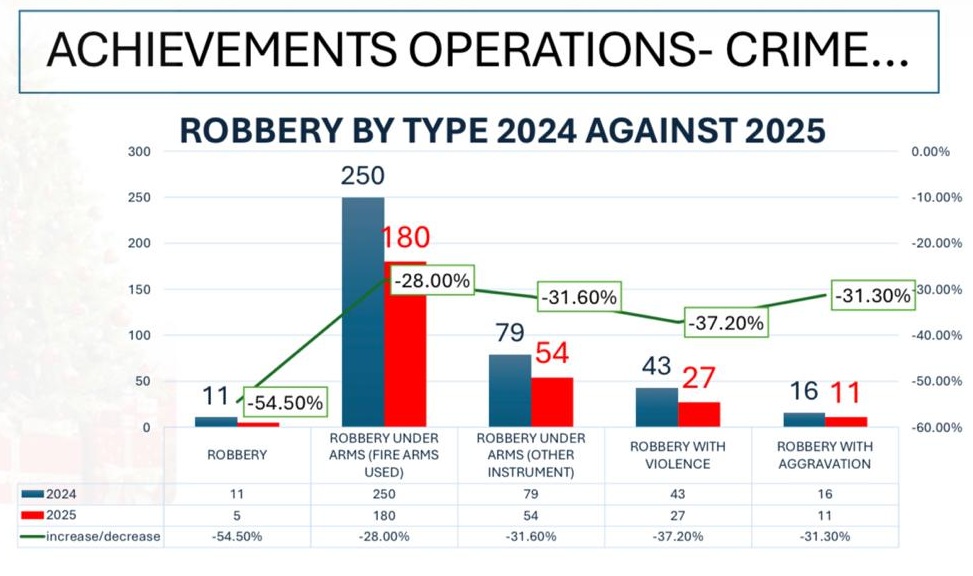
    The Guyana Police Force (GPF) has released its comprehensive annual report revealing contrasting public safety trends for the year 2025. While serious criminal activities witnessed a substantial decline, road traffic fatalities showed a concerning increase compared to previous year’s statistics.

    According to official data compiled from January 1 to December 31, 2025, Guyana experienced a remarkable 25.5% reduction in serious crimes, dropping from 1,235 reported cases in 2024 to 920 cases last year. This significant decrease encompassed multiple major offense categories including robbery, burglary, break-and-enter incidents, larceny, rape, and kidnapping cases, indicating widespread improvement in crime prevention efforts nationwide.

    Conversely, road safety statistics presented a more complex picture. The report documented 124 fatal accidents throughout 2025, resulting in 137 road traffic deaths. This represents a 3.7% increase from the 132 fatalities recorded in 2024 from 117 fatal accidents. Despite this rise in fatal incidents, other accident categories including serious, minor, and damage-only collisions all showed reductions, contributing to an overall decline in total road accidents from 2,405 in 2024 to 2,177 in 2025.

    The GPF addressed previous delays in releasing these statistics, explaining that annual crime and traffic data undergo a rigorous structured process of compilation, verification, and approval before public dissemination. While provisional data had been presented during the Christmas policing briefing in November 2025, the reporting year had not yet been formally closed at that time, and figures required final verification across all divisions.

    Police authorities reaffirmed their commitment to sustained crime-fighting strategies, enhanced community engagement initiatives, and proactive policing measures as they continue working toward ensuring comprehensive safety and security for all citizens.


  • Man, 69, found dead in Park Hill was chopped to death

    Man, 69, found dead in Park Hill was chopped to death

    Authorities in Park Hill have initiated a homicide investigation following the grim discovery of a 69-year-old man’s body inside a derelict two-story residence. The victim, identified as Errol Richards, a local resident, was found in an advanced state of decomposition on Wednesday evening.

    An official autopsy has concluded that Richards succumbed to multiple severe chop wounds. Law enforcement sources, speaking on condition of anonymity, disclosed that the victim sustained catastrophic injuries to his head, which was nearly completely severed from his body. Further evidence of a violent struggle was apparent in defensive wounds on his hands, including the loss of several fingers.

    According to a police statement released Thursday, the discovery was made at approximately 7:02 p.m. on Wednesday after concerned residents of the Park Hill community alerted officers to the scene. The abandoned property, now a active crime scene, is being thoroughly processed by forensic investigators.

    In an appeal to the public, the Royal St. Vincent and the Grenadines Police Force is urging anyone with information pertinent to the case to come forward. Individuals can contact emergency services at 999 or 911, or reach out to specific investigative units at the provided numbers: (784) 457-1211, (784) 456-1810, or (784) 458-6250. The investigation remains ongoing.

  • Dainisha Eusebe secures sponsorship from Kingdom Bank Corporation for Miss Dominica bid

    Dainisha Eusebe secures sponsorship from Kingdom Bank Corporation for Miss Dominica bid

    In a significant corporate-cultural partnership, Kingdom Bank Corporation has announced its inaugural sponsorship of contestant Dainisha Eusebe for Dominica’s 2026 Carnival Queen Pageant. The formal sashing ceremony occurred during this week’s carnival press conference, marking the international banking institution’s first venture into supporting national cultural events.

    Aurelle Joseph, Compliance Executive of Kingdom Bank Corporation, presented the sponsorship while emphasizing the institution’s commitment to Dominica’s development. “While our clients are primarily international, our presence and purpose here always remain connected to the Commonwealth of Dominica,” Joseph stated. “Over the past five years, we have consistently maintained economic investment, professional engagement, and regulatory partnership right here at home.”

    The banking executive utilized the platform to clarify Kingdom Bank Corporation’s operational model as an internationally registered online bank providing private and corporate banking services within Dominica. Joseph characterized the institution as embodying “a forward-looking approach to global banking, while playing a meaningful role in the growth and development of Dominica.”

    Miss Eusebe, representing the Grandbay community, expressed profound gratitude for the corporate endorsement. “To be a contestant in the 2026 National Queen Pageant is already a dream,” she acknowledged, “but to have that dream supported by a corporate partner like the Kingdom Bank Corporation makes this moment even more meaningful.”

    The contestant pledged to represent her sponsor “with excellence, grace, and purpose,” while noting the historical significance of being the first pageant candidate ever sponsored by the financial institution. This partnership signals growing corporate recognition of cultural events as platforms for community engagement and national development.

  • Chef Eric Vasson shares skills with aspiring Saint Lucians

    Chef Eric Vasson shares skills with aspiring Saint Lucians

    Thirteen culinary students at the TVET Institute School of Sustainable Agriculture and Culinary Arts experienced an extraordinary masterclass on January 7th, guided by internationally renowned Chef Eric Vasson. The seasoned professional, whose career includes prestigious positions at five-star establishments and MetLife Stadium where he catered for NFL teams including the New York Giants and Jets, shared his extensive expertise with aspiring chefs.

    The immersive session provided a vital bridge between academic learning and practical application in the culinary arts. Chef Vasson emphasized three fundamental pillars for success in the industry: rigorous discipline, creative innovation, and adaptive flexibility. Through comprehensive demonstrations spanning advanced boning techniques to inventive dessert preparation, he established a foundation for students to apply these principles.

    The curriculum culminated in an unexpected basket challenge, allowing participants to demonstrate their newly acquired skills under pressure. This practical test mirrored real-world kitchen scenarios that professionals encounter regularly.

    A native of La Pointe, Mon Repos, Chef Vasson pursued advanced culinary studies in Spain before building an impressive international career. His professional journey eventually led him to establish Island Wheels, a thriving culinary enterprise in Virginia.

    In an exclusive interview with St. Lucia Times, Vasson expressed his enthusiasm for returning to his homeland: “Having traveled extensively and achieved international experience, I’m passionate about contributing to the next generation of culinary professionals. My goal is to inspire them to surpass even my own accomplishments.”

    Student Leon Malcolm reflected on the practical knowledge gained: “Mastering whole chicken breakdown techniques represented a significant skill development I hadn’t previously acquired.”

    Fellow participant Vernick Fulgence emphasized the mindset required: “Culinary excellence demands open-minded exploration. For adventurous and inquisitive individuals like myself, this training provides exceptional value.”

    Sonia Bispack, the institute’s culinary arts instructor, clarified the program’s advanced nature: “Our curriculum operates at an elevated standard compared to conventional food and nutrition programs. Students achieve mastery through extended developmental periods across diverse culinary disciplines.”

    Program facilitators anticipate that this caliber of industry exposure will significantly advantage students as they progress in their professional culinary journeys.

  • OPEN LETTER to Hon Dr Roosevelt Skerrit- Prime Minister of Dominica, Hon. Dr. Vince Henderson – Minister of Foreign Affairs, International Business, Trade and Energy, Ms Marie Therese-Johnson – Head of Citizen by Investment Unit

    OPEN LETTER to Hon Dr Roosevelt Skerrit- Prime Minister of Dominica, Hon. Dr. Vince Henderson – Minister of Foreign Affairs, International Business, Trade and Energy, Ms Marie Therese-Johnson – Head of Citizen by Investment Unit

    Born citizens of the Commonwealth of Dominica are experiencing significant travel complications and diplomatic stigmatization due to international reactions against the nation’s Citizenship by Investment (CBI) program. Multiple countries including Canada, Ireland, the United Kingdom, Norway, and the United States have imposed stringent visa restrictions and travel bonds specifically targeting Dominican passport holders.

    This situation creates a paradoxical reality where native Dominicans—whose only proof of citizenship is their Dominican passport—face heightened scrutiny, profiling, and suspicion at international borders. The article cites firsthand accounts of travel experiences, including one citizen who was detained for 45 minutes at Amsterdam’s airport after immigration authorities indicated he ‘fit the profile’ of wealthy individuals involved in human trafficking using Dominican passports.

    The core issue stems from the perceived exploitation of Dominica’s CBI program, which critics argue has enabled passport acquisition without genuine ties to the country. This has led to international authorities associating Dominican passports with financial transactions rather than legitimate citizenship, resulting in systemic discrimination against all passport holders regardless of their birth origin.

    Government officials including Prime Minister Roosevelt Skerrit and Immigration Minister Dr. Henderson are being urged to address these diplomatic challenges and protect the travel rights of native citizens who are increasingly finding their passport more a liability than a privilege in international travel.

  • Psychologist: Society can benefit from sustained, equitable law enforcement

    Psychologist: Society can benefit from sustained, equitable law enforcement

    Recent substantial increases in traffic penalties and government service fees have sparked widespread public discontent across Trinidad and Tobago. While authorities justify these measures as necessary to address pervasive road lawlessness, citizens counter that the hikes impose additional burdens on a population already struggling with unemployment, soaring living costs, and economic despair.

    A behavioral psychologist, speaking anonymously, criticized the government’s historical laissez-faire approach to regulation enforcement. “We must recognize that law is law and rules are rules,” the expert stated. “Enforcement doesn’t require harshness but rather firm, consistent application. Our pattern has been enthusiastic crackdowns that gradually fade into neglect—recall the initial enthusiasm with speed guns that ultimately vanished from roads.”

    The psychologist noted that societal behavior often involves risk-taking tendencies, citing last-minute Christmas shopping and event ticket purchases as examples of cultural patterns that influence policy decisions. The specialist predicted citizens would scrutinize whether enforcement would be applied equitably across geographic regions, particularly between areas with different political affiliations.

    University of the West Indies sociologist Dr. Shelene Gomes emphasized that effective societal functioning requires consensus-based rules serving majority interests. “The core issue emerges when legislation and institutions fail most citizens,” Gomes explained. “Simultaneously reducing social protections while increasing fines creates a combustible situation. The working class faces extreme difficulty, and even the middle class has diminished financial cushioning.”

    Dr. Gomes referenced historical parallels from decades past when oil revenue declines and structural adjustments similarly strained citizens, urging authorities to learn from previous experiences.

    Public testimony reveals deep frustration. Tobago taxi driver Sean Guerra acknowledged the need for penalties but condemned the 100% increases: “This will cause societal chaos. People can barely afford groceries—the majority are suffering.” Guerra reported cases where minor vehicle imperfections, including torn seats, were being penalized, questioning their relevance to road safety.

    An anonymous school teacher and single mother of three described the fines as “ridiculous,” noting that even gainfully employed individuals would struggle to pay penalties for minor infractions like windshield chips. She anticipated having to reduce grocery and bill payments if fined.

    The government has proposed amendments allowing motorists 3-7 days to rectify vehicle defects before facing penalties, with legislation expected for parliamentary debate late January. However, the fundamental tension remains between public safety objectives and their economic impact on an already strained population.

  • Media bodies warn of democratic and industry fallout as Newsday winds up operations

    Media bodies warn of democratic and industry fallout as Newsday winds up operations

    The Caribbean media landscape faces a severe crisis as Newsday, Trinidad and Tobago’s prominent daily newspaper, initiates winding-up procedures after 32 years of operation. This development has triggered widespread alarm among media organizations and professionals who warn of significant implications for democratic discourse and media pluralism throughout the region.

    The Trinidad and Tobago Publishers and Broadcasters Association (TTPBA) expressed profound concern over the closure, attributing it to a convergence of economic challenges, technological disruption, and structural pressures reshaping the media industry. The association highlighted how evolving consumption patterns and rapid digital transformation have fundamentally impacted print media worldwide, creating increasingly difficult operating environments for traditional news organizations.

    Regional media watchdog Media Institute of the Caribbean (MIC) characterized the closure as symptomatic of a deeper structural crisis affecting traditional media across the Caribbean. MIC president Kiran Maharaj emphasized that Newsday’s shutdown represents more than an isolated corporate decision—it reflects a regional pattern marked by declining advertising revenue, escalating production costs, and shifting audience behaviors.

    The institute’s research applying UNESCO’s Media Viability Indicators has repeatedly demonstrated the fragility of media ecosystems in small island developing states. Studies conducted across the region reveal that dependence on limited advertising bases, underdeveloped digital revenue strategies, and insufficient policy support have created intense pressure on traditional news organizations.

    MIC vice president Wesley Gibbings described Newsday as “a bastion of quality journalism” established by working journalists over three decades ago. He called for enhanced regional collaboration among media stakeholders to address shared challenges and develop sustainable solutions.

    Former Media Association of Trinidad and Tobago president Ira Mathur characterized the situation as a “perfect storm” threatening journalism’s survival, citing shrinking advertising revenue, overreliance on government spending, social media competition, and chronic underpayment of journalists. Mathur warned these conditions are fostering self-censorship and undermining journalism’s crucial role as the fourth estate in democratic societies.

    Media leaders agree that Newsday’s potential closure represents not merely the end of a newspaper but a critical test for journalism’s resilience throughout the Caribbean region, with profound implications for democratic governance and citizen access to verified information.

  • Ministry: Launch of Carnival village a success

    Ministry: Launch of Carnival village a success

    Trinidad and Tobago’s Carnival 2026 celebrations commenced officially with the inauguration of two dedicated village spaces at Queen’s Park Savannah in Port of Spain, though the launch was met with contrasting public reactions to organizational changes.

    The Ministry of Culture and Community Development, in partnership with the National Carnival Commission (NCC), formally opened the John Cupid Carnival Village on January 9, following the successful debut of the culinary-focused Flava Village the previous day. The dual launch marks the official beginning of the nation’s premier cultural festival.

    High-ranking officials including Minister of Culture and Community Development Michelle Benjamin, Parliamentary Secretary Dr. Narindra Roopnarine, and NCC chairman Peter Kanhai presided over the ceremonies alongside several government ministers and stakeholders. Notably, Minister Benjamin did not deliver a public address during the events.

    The unveiling of the John Cupid Carnival Village proved contentious as NCC chairman Kanhai faced audible public disapproval when explaining the venue’s relocation from the east to the west side of the grandstand. Despite Kanhai’s assurances that the new layout offered improved convenience, accessibility, and spaciousness, attendees responded with loud boos and shouts of disagreement.

    “You will notice right off the bat that we are doing things differently this year,” Kanhai stated during his address, which was immediately met with crowd disapproval. He maintained that both new and returning visitors would recognize the dramatically enhanced quality of the village experience despite the vocal opposition.

    In contrast to the mixed reception of the Carnival Village, the Flava Village culinary component reported exceptional success. The ministry revealed that numerous food vendors completely sold out their inventory before closing time on the inaugural night, with one entrepreneur reporting by 8 PM and subsequently doubling his stock for the second night to meet unprecedented demand.

    Minister Benjamin extended gratitude to the NCC Board of Commissioners and all involved parties for their dedication toward ensuring Carnival 2026’s success. The ministry confirmed that festival events are now fully underway, including the heating Panorama 2026 competitions, the launched Chutney Soca Monarch 2026, and final costume preparations ahead of the main celebrations.

  • Liam Bryden, Victoria Seenath hold on to Brechin Castle Open leads

    Liam Bryden, Victoria Seenath hold on to Brechin Castle Open leads

    Liam Bryden has established a formidable three-stroke advantage following the second round of the Brechin Castle Open Golf Championship at Sevilla Golf Course. The 2022 titleholder, who held a marginal one-shot lead after day one, dramatically expanded his margin as defending champion Ryan Gomez encountered significant difficulties on Couva’s front nine, conceding three critical shots.

    Despite Gomez reclaiming one shot during the back nine, Bryden’s consistent performance secured him a comfortable cushion heading into the championship’s decisive final round. Meanwhile, Marcus Ling delivered an impressive 70-shot round to catapult into third position, trailing the leader by four strokes, while Alex Kangoo matched Ling’s score to claim fourth place.

    In the women’s division, defending champion Victoria Seenath strengthened her position with an 80-stroke round, establishing a five-shot dominance over her closest competitor. Isabella Ramdeen advanced to second place with an 83, as Elise LaBorde slipped to third after carding an 85.

    The First Flight category witnessed a compelling familial rivalry unfold, with Asa Roopchand maintaining a two-shot lead over his teenage son Aba Bally Roopchand. Despite the younger Roopchand firing a superior 77, Asa’s steady 78 preserved his advantage. Amir Ali remains in contention just two strokes back after an 82-round performance.

    Notably, overnight leaders Dr. Solaiman Juman and Shazad Ali experienced dramatic declines, plummeting to 16th and 11th positions respectively. Defending champion Hollis George revitalized his campaign with a flight-best 77, positioning himself for a potential title defense from sixth place.

    The tournament concludes on January 11 with the third and final round determining all championship winners.

  • Rollout of COMS-PAN Programme

    Rollout of COMS-PAN Programme

    The Ministry of Tourism, Creative Economy and Culture is preparing to launch its innovative Community Steelpan Programme (COMS-PAN) across Grenada’s tri-island territory, bringing the distinctive sounds of steelpan music to local communities starting next week. This groundbreaking cultural initiative, formally inaugurated on November 7, 2025, will provide comprehensive training in steelpan fundamentals to at least twenty participants from each parish in its inaugural cohort.

    The program commences with orientation sessions scheduled for St. David on January 12, 2026, at the Corinth Community Centre (5:00 PM), followed by Carriacou on January 16 at the La Resource Community Centre in Mt. Royal (2:00 PM). Regular training sessions will follow, with St. David hosting instruction every Monday and Thursday from 5:00 PM to 7:00 PM at the community center’s pan house, while Carriacou sessions will occur Tuesdays and Thursdays during the same hours at the La Resource facility.

    According to Program Manager Cordel Byam, COMS-PAN specifically targets youth and community members not currently affiliated with established steel bands. The structured curriculum aims to enhance musical literacy, develop performance skills, and build confidence for both solo and ensemble presentations. “Our objective encompasses teaching steelpan fundamentals, introducing basic music theory, and cultivating performance confidence across individual and group settings,” Byam elaborated.

    Successful participants who complete both theoretical and practical components will receive certification and may be selected for community band placements. Chief Cultural Officer Kelvin Jacob emphasized the program’s historical significance, noting it represents Grenada’s first initiative of its kind. Jacob credited Minister for Tourism, Creative Economy and Culture Senator Adrian Thomas with conceptualizing the program, which reflects the ministry’s dedication to innovation, cultural development, and national pride.

    Prospective participants can obtain additional information by contacting the Ministry at 440-0366 or visiting the Division of Culture at Unit 12, Steele’s Commercial Complex in Grand Anse, St. George.