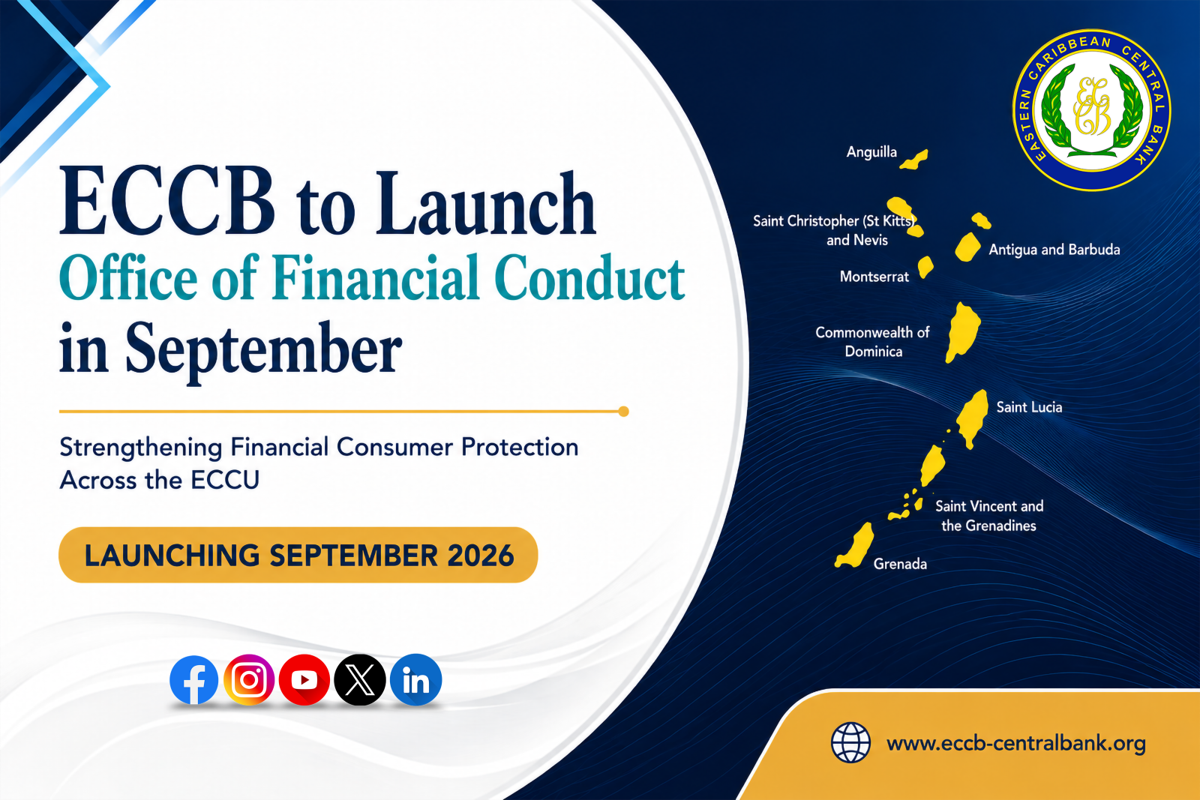
After years of planning, legislative updates and cross-region stakeholder engagement, the Eastern Caribbean Central Bank (ECCB) is preparing to officially launch its dedicated Office of Financial Conduct (OFC) at the end of September 2026, a landmark move to reinforce consumer protection standards across the entire Eastern Caribbean Currency Union (ECCU). Starting October 15 that same year, the new department will begin accepting consumer complaints, opening a free, accessible pathway for customers to resolve disputes with financial service providers.
Operated as an integrated department within the ECCB, the OFC’s core mandate is to oversee market conduct across the region’s financial sector. Its primary focus is holding Licensed Financial Institutions (LFIs) accountable to fair treatment standards, requiring firms to uphold strict benchmarks for transparency, accountability and responsible business practices.
In an advance briefing on the upcoming launch, ECCB Governor Timothy N. J. Antoine emphasized that the OFC will deliver far-reaching value to both consumers and the regional financial system as a whole. “The Office of Financial Conduct is intended to ensure that customers are accorded the dignity and respect they deserve,” Antoine explained. “It will help ensure that financial institutions are held to account for treating customers fairly. This is imperative to strengthen and sustain confidence in our financial system.”
For consumers across the ECCU, the OFC will offer support for a broad range of common financial concerns. These include unfair treatment by financial providers, misleading or incomplete product information, disputes over unexpected fees and charges, issues with banking products and personal accounts, and barriers to accessing core financial services. To remove barriers to seeking help, the OFC accepts complaints through multiple channels: online submission, written correspondence, and in-person visits. The service is completely free for consumers, and no legal representation is required to file a claim. Once a complaint is received, the OFC will conduct thorough, impartial assessments and investigations when appropriate, working to deliver fair, timely resolutions while upholding strict confidentiality for all parties involved.
The creation of the OFC is the culmination of nearly a decade of targeted work by the ECCB to strengthen regional financial regulation and consumer protection frameworks. Initial planning for the office launched back in 2019, and the ECCB Monetary Council formally approved its establishment in February 2024. Following that approval, amendments were made to the 2015 Banking Act to add a new Part VIII focused on Market Conduct Supervision, which lays out the formal legislative foundation for the new office’s operations.
To ensure the OFC’s structure and mandate addressed the real needs of regional stakeholders, the ECCB conducted extensive consultation across all ECCU member states between 2025 and 2026. The process included input from consumer advocacy groups, civil society organizations, youth and community associations, licensed financial institutions, government policymakers, legal practitioners and a wide range of other community stakeholders. These conversations brought key consumer concerns to the forefront, including widespread frustration with opaque fees and charges, persistent difficulties opening personal and business bank accounts, rising fraud and scam risks linked to the growth of digital financial services, and growing concerns about financial exclusion as more financial services move online.
Two specialized supporting bodies will back the OFC’s work: the Financial Conduct Committee and the Financial Dispute Resolution Commission. These bodies will support the review of complex consumer complaints, provide expert guidance on emerging financial conduct issues, and help the OFC deliver independent, well-informed decision-making that aligns with the region’s legislative framework.
As of the latest update, five of the ECCB’s eight member countries have already passed the required domestic legislative amendments to enable the OFC’s operations. Saint Lucia is currently awaiting the second reading of its amendment bill, while Anguilla and the Commonwealth of Dominica have scheduled legislative votes for the bill before the end of the year.
Regional financial leaders frame the upcoming OFC launch as a critical milestone in the ECCB’s long-standing commitment to building a fair, inclusive regional financial system. The office will not only guarantee consumers access to effective, independent complaint resolution mechanisms but also help foster broader public confidence as the regional financial sector continues to evolve with digital innovation.