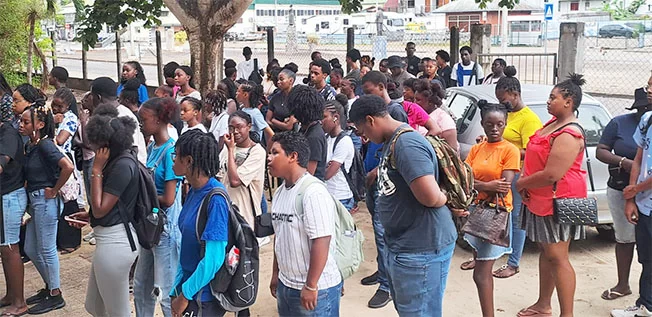
A high-stakes political standoff unfolded in Siparia on Wednesday, when a faction of United National Congress (UNC) party members staged an organized public demonstration to push long-serving alderman Victor Roberts out of his post at the Siparia Borough Corporation (SBC). The demonstrators carried hand-painted placards emblazoned with calls for Roberts’ departure and chanted unified slogans demanding he step down, marching a pre-planned route from Irwin Park past the Siparia Police Station along SS Erin Road before arriving at the SBC compound, ahead of the body’s scheduled statutory monthly meeting. Once at the building, protest organizer and senior UNC member Naresh Maharaj formally submitted a signed petition calling for Roberts’ resignation to Siparia Mayor Doodnath Mayrhoo. Maharaj laid out the core of the UNC’s grievance: Roberts was appointed to his alderman position by former Prime Minister and UNC leader Kamla Persad-Bissessar as a representative of the party, making his recent defection to the opposition People’s National Movement (PNM) a violation of the public trust that came with the role. “You cannot take your chair, a UNC chair, and put it by the PNM and say, I support the PNM … If you decide to take up your things and go, you need to resign,” Maharaj stated in his remarks to the mayor. He further noted that current law prevents Persad-Bissessar from removing Roberts from the post, meaning Roberts legally remains a UNC-appointed alderman even after switching party affiliation. The UNC is demanding that the seat be filled by a party loyalist who will uphold the platform that got him appointed, Maharaj added, confirming the petition would next be sent to Persad-Bissessar for further action. Roberts, who was already present in the SBC building when the protest began, did not back down in the face of the demonstration, and instead doubled down on his refusal to resign in comments to reporters following the protest. He reiterated that he would remain in his role to serve the public, acting as a check on the corporation’s decision-making until the end of his term or until the government calls new municipal elections. The path that led to this public clash began last year, when Roberts stepped down from his official UNC membership, and just two weeks ago he confirmed his open defection to PNM, after he was spotted attending the party’s annual Sports and Family Day. At the time, he told local media he had applied for and received PNM membership earlier in 2024. Even after the switch, he has retained his alderman post, prompting SBC UNC members to not only call for his resignation but also push for amendments to the Municipal Corporations Act to close the loophole that allows defectors to keep their appointed seats. Mayor Mayrhoo, a member of the UNC, has publicly aligned with the protestors, dismissing Roberts as a “frog hopper politician” for his history of switching political allegiances: he previously left the PNM to run as an independent, later joined the UNC, and has now returned to his original party. Mayrhoo also claimed Roberts is planning to run as the PNM candidate for the Erin district in upcoming local government elections, a prediction he says will end in defeat for Roberts. For his part, Roberts has pushed back against the protest and the UNC’s demands, raising multiple pointed questions about the demonstration’s legality amid the ongoing national State of Emergency. He called on the Commissioner of Police to launch a formal investigation into whether the protest, held on government property, received the required official approval, and also called for Mayrhoo to resign over the incident, questioning the mayor’s competence as a leader. The alderman also questioned why he is facing such fierce backlash when other UNC defectors to the PNM have not faced similar public calls for resignation. He raised the controversial question of whether the targeted campaign against him is rooted in racial prejudice, asking reporters: “Is it because I am a proud black man? That is my question … I have also seen the councillor for Siparia West/Fyzabad, Jason Ali, left the UNC and went over to the PNM, I haven’t seen this type of behaviour.” Roberts rejected claims that he has violated political integrity by refusing to resign, arguing he has remained in the post to prioritize public interest over party loyalty, and has pushed back against harmful council decisions that would harm local residents. “I am here to do what I am supposed to do on behalf of the people and that is what I am going to do. That is my role,” he said. Responding to Mayrhoo’s claim that he will contest the upcoming local election for PNM, Roberts said he had no idea where the mayor got that information, and confirmed the PNM has not approached him about running. “I don’t know what the political future holds for me, probably it holds nothing, I don’t know, but that would not stop me from being an advocate for the poor, the oppressed and the downtrodden,” he added.
作者: admin
-

Court Orders JLSC to Pay Up
In a ruling that underscores the importance of procedural accountability for judicial oversight bodies in Belize, the country’s High Court has delivered a decisive judgment against the Judicial and Legal Services Commission (JLSC), ordering the agency to cover all legal costs incurred by activist Jeremy Enriquez, who brought a challenge over the JLSC’s botched handling of his misconduct complaint against a senior justice.
The dispute traces back to the high-stakes redistricting legal battle that has drawn significant public attention across Belize. In that case, Enriquez filed a formal misconduct complaint against Justice Tawanda Hondora, claiming that an accidentally unmuted microphone during a court lunch break captured a problematic conversation between Hondora and another sitting judge. The activist argued that the exposed conversation irreparably eroded his trust in Hondora’s ability to fairly preside over the redistricting proceedings. To support his allegations, Enriquez submitted audio recordings of the exchange to the JLSC, the body legally tasked with investigating judicial misconduct claims in the country, and awaited a substantive response.
Instead of launching a formal review or issuing a detailed reply to the complaint, the JLSC only provided Enriquez with a series of generic, vague single-sentence acknowledgements that provided no clarity on whether the commission would investigate his claims. Frustrated by the months of inaction and stonewalling, Enriquez turned to the High Court to challenge the JLSC’s failure to meet its legal obligations.
In his written judgment delivered on May 28, 2026, Justice Alexander rejected the core defense put forward by the JLSC: that Enriquez had acted prematurely and impatiently in bringing the court challenge. Alexander explicitly found that Enriquez “acted reasonably in filing his application,” noting that the activist had waited an appropriate length of time for a substantive response from the oversight commission before pursuing legal action. The justice further ruled that the JLSC’s non-responsive conduct directly violated the core principles of Belize’s pre-action protocols, which require government and judicial bodies to engage in good-faith processing of public complaints before parties turn to the courts for resolution.
“The matter could have been easily avoided by a more responsive and reasonable conduct of the JLSC,” the judgment noted. Enriquez had not only requested the JLSC be ordered to cover his legal costs but also asked the court to certify the case as sufficiently complex to justify his legal team including both a senior and junior barrister, meaning the JLSC would be required to pay for both legal professionals. Justice Alexander granted this request, emphasizing that the entire court challenge would have been unnecessary if the JLSC had simply followed established procedural rules when handling Enriquez’s original complaint.
While the court has issued a clear ruling on liability, the final total amount of costs that the JLSC will be required to pay is still pending formal calculation, and has not yet been publicly announced.
-

CDB and World Bank launch joint action plan to strengthen Caribbean development and resilience
Small island nations across the Caribbean are set to receive expanded, coordinated development backing after the Caribbean Development Bank (CDB) and World Bank Group moved their landmark collaborative initiative from planning to active implementation during their fourth annual partnership meeting hosted recently at CDB’s Barbados headquarters. This new joint Action Plan targets the Caribbean’s most urgent systemic challenges, from lagging infrastructure to uneven economic growth, with a core mission of boosting regional resilience and driving inclusive, sustainable expansion through aligned institutional action. Against a backdrop of unique structural vulnerabilities that have long held back the region, the partnership marks a deliberate shift away from siloed development efforts toward integrated, resource-efficient problem-solving.
The framework lays out three clear core components to guide the collaboration: joint portfolio reviews for individual country development projects, unified systems to track how initiatives impact local employment outcomes, and a wide-ranging study of regional connectivity and logistics designed to pinpoint long-standing bottlenecks dragging down intra-Caribbean trade and transportation links. In opening remarks at the meeting, Isaac Solomon, CDB Vice-President for Operations, emphasized that the scale of the Caribbean’s challenges far outstrips the capacity of any single development institution to address alone. He framed the joint Action Plan as a critical force multiplier for development impact: by aligning strategic priorities, pooling specialized technical expertise, and coordinating development financing, the two institutions can close gaps in project delivery, deliver results faster and more efficiently, and deliver tangible, transformative improvements for Caribbean communities.
Leaders from both institutions outlined a host of expected benefits that will flow from the coordinated plan. The framework is projected to unlock new co-financing opportunities for high-priority regional projects, expand access to low-cost concessional funding for government initiatives, and strengthen the technical and operational capacity of national governing bodies across the Caribbean. Ultimately, officials project these gains will translate to more robust modern infrastructure, upgraded public services, and broadly improved living standards for residents across the region. During working sessions, attendees centered discussion on the unique, disproportionate vulnerabilities that define Small Island Developing States (SIDS) across the Caribbean, reaching a formal agreement to align their respective development programs more closely to cut down on redundant efforts and maximize the impact of every dollar invested. The meeting also included in-depth reviews of ongoing collaborative projects, brainstorming on new areas for joint action, and reassessment of development priorities that have been identified directly by Caribbean national governments.
To keep implementation on track, senior leaders from both banks agreed to new cross-institutional coordination mechanisms, set clear measurable operational targets, and established a semi-annual reporting schedule to formally monitor progress and adjust tactics as needed. Lilia Burunciuc, the World Bank’s Country Director for the Caribbean, noted that the deepened partnership reflects a shared, long-term commitment to advancing sustainable regional prosperity. “The Caribbean has enormous untapped potential, and our collaboration with CDB is central to how both organizations support the realization of the region’s development goals,” Burunciuc said. “Together, we can help governments build more resilient economies, invest in their people, and seize greater global opportunities. This partnership is a shared commitment to a more prosperous and sustainable region.”
As a final step to formalize the rollout, attendees approved the creation of a dedicated joint working group that will take day-to-day oversight of Action Plan implementation. Over the coming months, the partnership will conduct additional targeted consultations with regional governments, local implementing agencies, and other community and private sector stakeholders to refine project plans and ensure priorities align with local needs. The new initiative also aligns closely with CDB’s newly launched 10-Year Strategic Plan spanning 2026 to 2035, titled “Transforming the Caribbean for Resilience,” which identifies deepened strategic partnerships with leading international development institutions as a core pillar to advance social, economic, and environmental resilience across the entire Caribbean region.
-

Gun ‘accidentally’ fired: Couple charged
A routine traffic enforcement stop in the Trinidadian town of Arima escalated into a chaotic confrontation this week that ended with an accidental firearm discharge, law enforcement officials confirmed in a public briefing Thursday. The incident, which unfolded Wednesday morning involving a couple from Diego Martin, has resulted in multiple criminal charges against the pair, both of whom have made their initial court appearances and been released on bail.
According to official police accounts, patrol officers from the Arima Traffic Department were conducting routine patrols along Sorzano Street when they spotted a dark-tinted Toyota Hilux parked illegally in a clearly marked No Parking Zone. After approaching the vehicle, the female driver, identified as 38-year-old Katrianna Rezende, was informed of two violations: illegal parking and excessively dark window tinting, which violates local motor vehicle regulations governing permitted light transmittance for windscreens and vehicle windows. Officers issued her a fixed penalty notice for the tinting offense and instructed her to move the vehicle out of the restricted parking zone.
Rezende refused both orders: she declined to move the pickup truck and also refused to provide her driving documentation when requested by officers. The situation escalated quickly when Rezende started the vehicle and attempted to drive away from the scene, intentionally striking a female police officer’s right foot with the vehicle in the process.
Fearing that her life was in immediate danger, the injured female officer drew her service weapon from its holster and aimed it in a downward direction. As Rezende reversed the vehicle, the officer attempted to return the gun to its holster. During this movement, her finger accidentally made contact with the trigger, firing a single round off, police explained. No bystanders or other individuals were injured in the accidental discharge.
Following the confrontation, both Katrianna Rezende and her 39-year-old husband Manuel Rezende, who was also involved in the incident, were taken into police custody and charged. Katrianna faces four counts: disorderly behaviour, resisting arrest, dangerous driving, and careless driving, in addition to a separate charge of assaulting a police officer. She entered not guilty pleas to all charges during her appearance before Master Lisa Singh-Phillip in the Arima High Court.
The court granted Katrianna Rezende bail with a $80,000 surety for the assault charge and an additional $60,000 bail for the remaining offenses. As a condition of her release, she was ordered to check in once per month at the Four Roads Police Station between the hours of 6 a.m. and 8 p.m. Her case has been adjourned for further proceedings on June 24.
Manuel Rezende appeared before Magistrate Ali in the Arima Magistrates Court, where he faces charges of disorderly behaviour and using obscene language towards officers. He was granted bail in the amount of $30,000, and his case has been adjourned until November 30.