In a formal statement dated August 30, 2026, the Inter-American Commission on Human Rights (IACHR) — an independent human rights body of the Organization of American States — has voiced deep concern over the grave risks facing thousands of Haitian nationals after the official termination of Temporary Protected Status (TPS) by United States authorities. The alarm comes amid the catastrophic and ongoing humanitarian and human rights collapse that continues to grip Haiti, leaving the country unable to safely absorb returning deportees. First established under U.S. immigration law, TPS offers temporary legal protection and work authorization to foreign nationals already present in the U.S. when their home countries face extraordinary, unsafe conditions that prevent safe return. These qualifying conditions include widespread armed conflict, large-scale environmental disasters, public health emergencies, or other extraordinary temporary crises that leave the national government unable to accommodate returning citizens. The legal path to ending Haiti’s TPS designation cleared key judicial hurdles earlier this year: on June 25, 2026, the U.S. Supreme Court permitted the termination to move forward, and a subsequent August 5 ruling from the U.S. District Court for the District of Columbia confirmed that the Department of Homeland Security had the authority to implement the end of the program. U.S. authorities officially marked the termination as effective July 22, 2026, concluding that conditions in Haiti no longer meet the statutory requirements to maintain the TPS designation. However, the IACHR pushes back against this conclusion, arguing that any assessment of conditions on the ground must reflect the current devastating reality of Haitian insecurity and governance failure. Today, armed gangs exert control over an estimated 80 to 90 percent of Haiti’s capital Port-au-Prince, with their violent influence spreading outward into the Artibonite, Centre, and South-East departments. Data from the United Nations Integrated Office in Haiti (BINUH) lays bare the scale of the ongoing bloodshed: between March 6 and July 31 of 2026, even amid ongoing security operations to reclaim gang-held territory, at least 613 people were killed and 375 injured in gang-related clashes in the La Plaine de Cul-de-Sac region, which includes violence-plagued neighborhoods of Cité de Soleil within the Port-au-Prince metropolitan area. The humanitarian fallout from this widespread violence is equally staggering. As of May 13, 2026, BINUH recorded 1.47 million internally displaced people across Haiti — equal to 12 percent of the country’s total population, a 1 percent increase just since December 2025. Women and girls make up 54 percent of this displaced population, while children account for 51 percent. Between the end of 2025 and mid-2026, authorities recorded 1,880 confirmed cases of gender-based violence, 71 percent of which involved rape and sexual assault. In its 2026 statement, the IACHR recalled its 2021 Resolution No. 02/21, which first recognized the multi-faceted nature of Haiti’s long-running crisis and called on all countries in the Inter-American region to adopt robust protections for Haitians on the move, rooted in core principles of equality, non-discrimination, international solidarity, and shared responsibility. The IACHR acknowledges that all sovereign states retain the authority to set their own immigration policies, establishing rules for entry, residence, and departure from their territory. But under binding international law and Inter-American human rights standards, the U.S. is legally required to uphold the peremptory norm of non-refoulement — a non-derogable rule that prohibits forcing any person to return to a territory where their life, physical integrity, or personal liberty faces a proven risk of severe violation. Beyond this core obligation, the IACHR emphasizes that all deportation and removal decisions must include individual risk assessments, uphold full due process guarantees, and guarantee applicants access to effective legal remedies. The body is calling on U.S. authorities to go further, reiterating that Washington should expand access to formal refugee status procedures and complementary forms of international protection for Haitians at risk. It also urges the creation of permanent, accessible, and affordable pathways to regularized migration status, including targeted humanitarian measures, expedited family reunification, and special amnesty and regularization programs for Haitians who have lived and worked in the U.S. for years under TPS protection. The IACHR is an autonomous, principal organ of the Organization of American States, drawing its mandate from the OAS Charter and the American Convention on Human Rights. Its core mission is to promote and defend human rights across the Inter-American region, operating as an independent consultative body to the OAS. Its seven members are elected in an individual capacity by the OAS General Assembly, and do not act as representatives of their countries of origin or residence.
作者: admin
-

Appeal for volunteer mentors for Chapman Challenge
Barbados is launching a nationwide push to build a new generation of community-focused leaders, as the President’s Trust has opened applications for volunteer mentors to support its upcoming transformative youth initiative, the Chapman Challenge. Scheduled for an official launch on September 23 under the patronage of President Jeffrey Bostic, the program targets young people between the ages of 10 and 24, centering its approach on three core pillars: community engagement, hands-on service, and structured leadership skill-building.
Organizers are actively recruiting committed volunteers from every sector of Barbadian society, ranging from educators, civil servants and skilled tradespeople to retirees and local entrepreneurs. These volunteers will step into the role of “support anchors”, providing consistent, positive guidance to young participants across the island. Captain Tevin Maynard, a spokesperson for the initiative’s Mentorship Task Force, emphasized the irreplaceable role that positive adult role models play in strengthening local communities during the announcement of the recruitment drive.
“Every young person has the right to access encouraging guidance, meaningful encouragement, and life-changing opportunities,” Maynard stated. “When adults choose to serve as mentors, they do more than change the trajectory of individual young lives – they lay the groundwork for more connected, resilient communities across Barbados, and a stronger nation overall. The Chapman Challenge gives every citizen, regardless of which parish they call home or what profession they work in, the chance to build a lasting, positive legacy through dedicated service.”
The initiative operates through a structured, community-rooted matching system: local municipal councillors first identify young people who stand to benefit most from the program, then pair each participant with a trained volunteer support anchor. Mentors take on a range of responsibilities, from offering one-on-one personalized advice and leading interactive group skill-building activities to arranging hands-on workplace exposure and providing ongoing virtual support between in-person sessions.
Unlike many youth development programs that prioritize only academic achievement, the Chapman Challenge centers on holistic growth. Its core goals include fostering strong personal character, building practical life and leadership competencies, cultivating a sense of civic responsibility, and empowering young people to step into active leadership roles within their own communities through sustained service work.
Organizers have underscored that the entire initiative is run on a volunteer basis, and operates under a strict, comprehensive safeguarding framework designed to protect all participants. Every successful volunteer applicant must complete a mandatory background check and undergo thorough training before starting their mentorship role, ensuring the program maintains a safe, supportive environment for every young person involved.
By connecting experienced adults with motivated young people across its early stages, the Chapman Challenge aims to build a long-term, sustainable pipeline of civically engaged leaders who will contribute to Barbados for decades to come. Any resident of Barbados who is interested in volunteering their time, skills, and expertise as a mentor is invited to contact the President’s Trust through its official communication channels to learn more and apply.
-

Haitian gang releases 13 hostages ,including 6 children, following deadly attack and mass kidnapping
A wave of brutal violence that left 47 residents dead and over 50 people abducted in a previously tranquil agricultural settlement on the outskirts of Haiti’s capital Port-au-Prince has ended with the partial release of captives, the United Nations Children’s Fund (UNICEF) has officially confirmed. Thirteen hostages, comprising six children and seven adult women, were freed from gang captivity late Friday in the nearby mountain town of Kenscoff, according to the agency. Among the released children are three toddlers under the age of 2, one 7-year-old minor, and two adolescent girls. Yannig Dussart, UNICEF’s deputy representative in Haiti, called the long-awaited release a “rare moment of hope” for a nation grappling with spiraling gang violence and humanitarian collapse. However, he emphasized that the mass abduction itself serves as a stark, urgent reminder of how widespread and frequent attacks on vulnerable children have become across the entire country. Once a quiet getaway for Port-au-Prince residents and a stable hub for small-scale farming, the targeted community has become the latest site of gang expansion, as armed groups extend their control beyond the capital’s crowded slums into outlying rural areas. Kidnapping for ransom has emerged as one of the Haiti gang’s most profitable criminal activities, with ordinary civilians, including children, increasingly targeted even in areas once considered safe from organized violence.
-

WEATHER (6:00 AM, 30 August) A small craft warning and a high surf advisory are in effect
The northern portion of the Lesser Antilles island chain is currently facing disruptive and potentially dangerous weather conditions, driven by a powerful tropical wave that formed from the remains of former Tropical Storm Dolly. Meteorological assessments indicate that the system is highly unlikely to redevelop into an organized tropical cyclone, but its residual moisture and energy are set to trigger a range of hazardous conditions across the region starting from the end of Tuesday and continuing into the overnight hours and early Wednesday morning.
One of the most significant threats posed by the system is locally intense rainfall, which has the potential to quickly overwhelm drainage systems and trigger flash flooding in low-lying and vulnerable areas. Combined with the heavy rain, the region will see gusty winds and frequent thunderstorms that could further complicate conditions for residents and travelers. Dominica is among the areas that will bear the brunt of this weather event, according to the latest forecasts.
As of Tuesday morning, forecasters note that a formal flood watch or flood warning could be issued for parts of the region by midday if current rainfall projections hold. Officials are urging all residents who live in zones with a history of flooding, landslides and falling rock events to remain vigilant throughout the event, adjust daily plans to account for the hazards, and prepare for potential evacuation if conditions deteriorate rapidly.
Beyond inland weather hazards, marine conditions across the affected coastlines are already worsening and will remain dangerous through the day. Forecasters predict moderate to rough seas across the region, with significant wave height expected to climb to as much as 7 feet along western-facing coastlines and up to 10 feet on eastern coastlines. Strong breaking onshore waves will create particularly risky conditions for anyone in or near the water. Currently, a small craft advisory and a high surf warning are active for all northern and eastern coastlines of the affected island chain. Small vessel operators are instructed to take all necessary safety precautions, including avoiding open water until conditions improve, and recreational swimmers are strongly advised to stay out of the ocean to avoid the risk of being swept away by powerful surf.
-
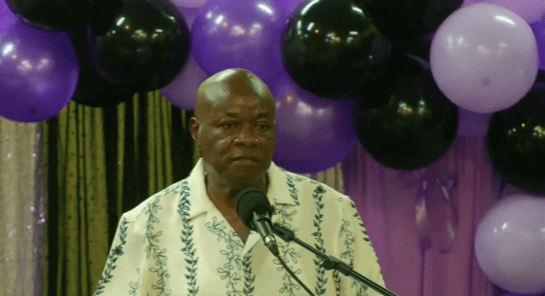
PNCR activates business arm
Guyana’s main historical opposition political party, the People’s National Congress Reform (PNCR), has launched a major overhaul of its operations following a historic defeat in last year’s general and regional elections, party leader Aubrey Norton announced Friday. Speaking at the unveiling of the PNCR’s new diaspora honour wall, Norton confirmed the party has activated a dedicated commercial arm to generate critical sustained revenue, ending the party’s long reliance on small-scale community fundraising events.
Multiple sources close to the party confirm Maikwak Ltd. has been registered as the official corporate vehicle to advance the PNCR’s business and investment agenda. The move comes nearly 12 months after former finance minister Winston Jordan, who served in the previous APNU+Alliance For Change government, publicly urged the party to move beyond low-yield fundraisers like community fish fries and corn house events, instead recommending that the party leverage its existing real estate holdings, launch formal commercial entities and pursue public and private sector contracting opportunities.
The announcement follows a devastating election result that saw PNCR, part of the A Partnership for National Unity (APNU) coalition, lose its decades-long position as Guyana’s official opposition. In last year’s vote, the new political movement We Invest in Nationhood (WIN) secured 16 parliamentary seats, becoming the second-largest party in parliament behind the incumbent People’s Progressive Party Civic (PPPC). Political analysts attribute WIN’s surprise rise in part to its substantial campaign funding and aggressive, well-executed social media strategy — gaps that the PNCR is now moving to address.
Norton, who also serves as chairman of the APNU coalition, acknowledged that the party’s traditional grassroots operating model is no longer sufficient to compete in modern Guyanese politics. He called on party members to bridge the gap between the PNCR’s historical grassroots organizing roots and cutting-edge digital tools, including artificial intelligence, to shape public narrative.
“Facts seem not to matter. Perception! and we have got to work on creating perceptions that we want created,” Norton told attendees, emphasizing that modern information technology has reshaped how political parties connect with voters. The long-term path to rebuilding, he added, centers on combining a reinvigorated on-the-ground volunteer leadership corps — a core structure from the party’s early years — with updated digital engagement strategies.
A longstanding advocate for youth leadership development, Norton has repeatedly pushed for investment in training and preparing young party members to take on senior leadership roles over the coming years. Most recently, the PNCR leader clarified his own political future: he intends to retain his position as head of PNCR, but will step aside to allow a new candidate to stand as the APNU coalition’s presidential nominee in the next election cycle. As of now, two names have emerged as early frontrunners for the nomination: Georgetown-based businessman Dr. Terrence Campbell and Dr. Dexter Todd.
The strategic shift marks one of the most significant internal reforms the PNCR has undertaken in decades, as the party works to rebuild its electoral support and relevance amid a shifting political landscape in Guyana.
-

Republic Bank CPL live stream viewership more than doubles in 2026 season
The 2026 season of the Republic Bank Caribbean Premier League (CPL) has hit a historic digital milestone, with official live stream viewership more than doubling compared to previous cycles of the popular T20 cricket tournament. This explosive growth has been overwhelmingly driven by a surge of new viewers tuning into matches through CPL’s official YouTube and Facebook channels, with the largest segment of this new audience hailing from India.
For years, the Republic Bank CPL has built a loyal following as one of the most exciting short-format cricket leagues on the global stage, known for its high-energy matches and accessible fan experience. This season’s streaming data underscores just how rapidly the tournament’s global popularity is expanding, as cricket fans who cannot access traditional broadcast networks increasingly turn to free, easy-to-access digital streams to follow all the on-field action unfolding across the Caribbean.
Pete Russell, Chief Executive Officer of Republic Bank CPL, emphasized the significance of this growth in a statement released alongside the viewership data. “To see live stream viewership more than double this season, with such strong growth coming from our fans in India, speaks to the growing global appeal of this tournament,” Russell said. “The ‘Biggest Party in Sport’ is now reaching more fans than ever before, and we remain committed to bringing them closer to the action, wherever they are watching from. Our expectation is that this growth will continue over the coming weeks.”
The league’s strategic push to expand its digital presence has become a core part of its mission to bring Caribbean cricket to a worldwide audience. By hosting free live streams on major social platforms that are accessible to anyone with an internet connection, CPL has removed barriers to entry for fans across emerging cricket markets like India, where interest in T20 leagues continues to grow year over year.
As the 2026 season progresses, league organizers say they will keep their focus on expanding the CPL’s global footprint and strengthening connections with cricket fans both in the Caribbean and across every continent. This latest surge in digital viewership confirms that the Republic Bank CPL is well on its way to solidifying its standing as one of the top premier T20 cricket leagues in the world, with a rapidly growing global fanbase that shows no signs of slowing down.
-

Kingsmen claim back to back wins
The 2026 Republic Bank Caribbean Premier League (CPL) delivered another dramatic twist at Port of Spain’s Queen’s Park Oval on August 30, as the Jamaica Kingsmen claimed a hard-fought 7-run victory over hosts Trinbago Knight Riders via the Duckworth-Lewis-Stern (DLS) method, securing consecutive wins and climbing up the tournament rankings. The contest was cut short by persistent rain when the Kingsmen’s chase had not yet reached the 15-over mark, ending what had shaped up to be a thrilling finish for the packed crowd in attendance.
The Trinbago Knight Riders, who had posted a dominant opening partnership win over the Barbados Tridents just 24 hours prior, carried their red-hot form into this fixture. Star openers Colin Munro and Sunil Narine extended their exceptional early-match form, putting together a 101-run opening stand — the pair’s combined total across two back-to-back opening partnerships now stands at 197 runs. Narine notched his second consecutive half-century before falling to Jamaica Kingsmen bowler Keemo Paul shortly after reaching the milestone. Munro went on to hit his first half-century of the tournament, propelling himself to the top of the CPL run-scoring charts, and left the Knight Riders comfortably placed at 120 for 1 after 13 overs.
The momentum of the innings shifted dramatically in the 14th over, when a collapse initiated by the Kingsmen’s Vitel Lawes turned the tide of the match. Munro feathered a thin edge behind to wicketkeeper Usman Khan, departing for a well-made 50-plus. Kieron Pollard, the reliable powerhouse middle-order batter, misread a turning delivery and chipped a straightforward catch to the cover fielder. Matthew Tromp attempted a big hit to lift the innings, but sent a high sky catch that was comfortably secured by Khan. Lawes capped off this devastating sequence with a three-wicket maiden over — a performance that many analysts are already calling the best individual over of the 2026 tournament to date, and one that would ultimately prove decisive to the final DLS calculation.
Nicholas Pooran rescued the Knight Riders’ innings from the collapse, hitting an unbeaten 60 off just 37 deliveries to propel the hosts to a final total of 180 for 6 from their allocated 20 overs, the third half-century of the innings for Trinbago.
The Jamaica Kingsmen got off to a flying start in their chase, with opener Kirk McKenzie leading a confident powerplay that saw the side reach 54 for 1 after the first six overs. McKenzie was dismissed for 30, holing out to long off off the bowling of Jyd Goolie. Just three balls after his wicket, heavy rain forced players off the field for an hour-long delay. When play resumed, the Kingsmen picked up their chase where they left off, with international star Keacy Carty showcasing his class to move the side closer to the DLS target before falling to the impressive Usman Tariq.
Before the Kingsmen could complete 15 overs of their chase, a second rain interruption brought an early end to the match. On review of the DLS par score, officials confirmed the Jamaica Kingsmen had already surpassed the required target, handing the side their fourth win of the tournament and their second consecutive victory. The result also snaps a three-match losing skid for the defending champions, who have bounced back strongly from their rocky start to the 2026 campaign.
For the Trinbago Knight Riders, two home fixtures remain on their current stand: they are next set to face the Guyana Warriors, followed by a match against the Antigua and Barbuda Falcons.
-

Distinguished Educator Mr. Fritzroy Wilkin to Be Honored at the SPBS Dr. Stewart O. Williams Annual Awards Gala in NY
A decades-long career transforming technical and vocational education across St. Kitts and Nevis and the broader Caribbean region will be formally celebrated this fall, as renowned educator Fritzroy Wilkin is set to receive the Distinguished Alumnus and Educator honor at the Sandy Point Benevolent Society (SPBS) Dr. Stewart O. Williams Annual Awards Gala. The ceremony will take place September 5, 2026 at 8 PM at Maestro’s Catering Hall in the Bronx, New York, bringing to light the far-reaching impact of Wilkin’s 40-plus years of service to education and workforce development.
Wilkin launched his professional journey in 1985, returning to his alma mater – then Sandy Point High School, now renamed Charles E. Mills Secondary School – as a teacher of Technical and Vocational Education and Training (TVET). Over his early years in the classroom, he taught a diverse range of practical and academic subjects including woodworking, technical drawing, mathematics, and agricultural science, laying the groundwork for a career centered on expanding accessible, skills-focused learning opportunities.
As his career advanced, Wilkin emerged as a leading architect of TVET infrastructure across St. Kitts and Nevis, spearheading the creation of nearly every core national TVET institution and framework still in use today. His landmark achievements include helping establish the Advanced Vocational Education Centre, the national TVET Teacher Training Programme at Clarence Fitzroy Bryant College, the National Skills Training Programme, and the St. Kitts and Nevis TVET Secretariat. He also played a key role in drafting foundational policy documents, including the national TVET Road Map, the National TVET Policy, the National Qualifications Framework, and the National Skills Registry.
Wilkin built his reputation on designing innovative, inclusive training programs that expand economic opportunity for marginalized groups and strengthen regional workforce development. Among his most impactful initiatives are the UNESCO-funded Youth in Business Project, which supported aspiring small business owners in launching ventures in hairdressing, landscaping, and barbering; the Organization of American States-funded ITrepreneurship Project, which fostered digital entrepreneurship across the country; and the National Skills Training Programme Secondary School Work-Based Project, which created pathways to reengage marginalized students who had dropped out of mainstream education.
His influence extends far beyond St. Kitts and Nevis as a regional leader in education policy. As Chair of the CARICOM Regional Occupational Standards Committee, Wilkin led cross-border efforts to align and standardize occupational qualifications across 15 Caribbean Community member states, removing barriers to labor mobility for skilled workers across the region. He also contributed to the Caribbean Education for Employment Programme, which works to align regional education and training curricula with the evolving needs of Caribbean labor markets.
After retiring from government service in December 2014, where he finished his tenure as Principal TVET Officer in the Ministry of Education, Wilkin has continued his work advancing education innovation. Since 2020, he has served as Curriculum Development Officer at Clarence Fitzroy Bryant College, where he leads the institution’s agenda to expand training and infrastructure for renewable energy. In 2023, he took on the role of Chair of the St. Kitts and Nevis TVET Council, where he continues to steer the development of a world-class national TVET system. He also remains active with the University of the West Indies Joint Board of Teacher Education, where he contributes to developing artificial intelligence policies, curricula, and ethics frameworks for teacher training across the Caribbean.
The scope of Wilkin’s career spans every corner of education: from in-classroom teaching to national policy design, from local program development to regional cross-border collaboration, and from traditional skills training to cutting-edge innovation in renewable energy and artificial intelligence. His work has consistently been defined by intentionality, resilience, creative problem-solving, and measurable, long-lasting impact on communities across the region. To honor his enduring legacy, the Christopher-Wilkin Institute of Technology was named for him, a permanent tribute to his commitment to nurturing skilled, empowered, and capable citizens across St. Kitts and Nevis.
-

All round Narine steals the show
In the 2026 Republic Bank Caribbean Premier League (CPL), defending champions Trinbago Knight Riders delivered a dominant performance at Queen’s Park Oval on Saturday, securing a seven-wicket victory over the Barbados Tridents powered by an unforgettable all-round display from veteran all-rounder Sunil Narine.
TKR captain Nicholas Pooran made a bold tactical call from the first over, electing to put the Tridents into bat and leaning heavily on spin bowlers rather than pace to control the PowerPlay. The decision paid immediate dividends, with the Barbados side restricted to just 31 runs for the loss of one wicket after the opening six overs. Pooran’s aggressive field placing, which saw star all-rounder Kieron Pollard positioned in close catching positions at silly point and short leg, put constant pressure on Tridents batters from the outset.
The turning Trinbago pitch played perfectly into TKR’s strategy, with significant spin from the first over making it incredibly difficult for visiting batters to gain momentum. Usman Tariq delivered a tight, disciplined spell, conceding just 11 runs from his overs and claiming the key wicket of Zachary Carter, who had built a steady start of 28 runs but failed to convert it into a large score.
Pooran stuck to his winning formula, continuing to deploy spin bowlers throughout the middle overs and maintaining aggressive, close-set fields to force mistakes. The hosts’ relentless pressure led to regular wickets, and it was 38-year-old Narine who stole the spotlight with the ball, finishing with outstanding figures of 2 wickets for just 14 runs from his full four-over allocation. Barbados captain Chris Green was the only Tridents batter able to find any rhythm, hitting a quick 27 before falling to a crafty slower ball from Pollard. A late hitting burst from Rivaldo Clarke lifted the Tridents to a final total of 127 for 9 at the close of their innings – a below-par total, but one that still posed a challenge on the spinning pitch.
When TKR began their chase, opening pair Colin Munro and Sunil Narine adapted perfectly to the pitch conditions, negating the Tridents spin attack in a way the visiting bowlers had been unable to do. The pair put on a stunning 96-run opening stand – the highest opening partnership of the 2026 CPL tournament to date – plundering 60 runs without loss in the PowerPlay alone. Narine continued his match-winning form, turning in a pinch-hitting masterclass that had the home crowd roaring, clearing the boundary repeatedly around Queen’s Park Oval before he was eventually dismissed.
The Tridents were hampered by poor luck on the day, with multiple catching chances falling just short or slipping out of fielders’ grasps. While they did claim the wickets of Narine and Pooran to give them a sliver of hope, Kieron Pollard and Jyd Goolie steered TKR across the finish line without further trouble, sealing the comfortable seven-wicket win.
Following the result, Trinbago Knight Riders are set to return to the field just 24 hours later for their next fixture against the CPL Kingsmen, while the Barbados Tridents will next face off against the Patriots on Tuesday.
-
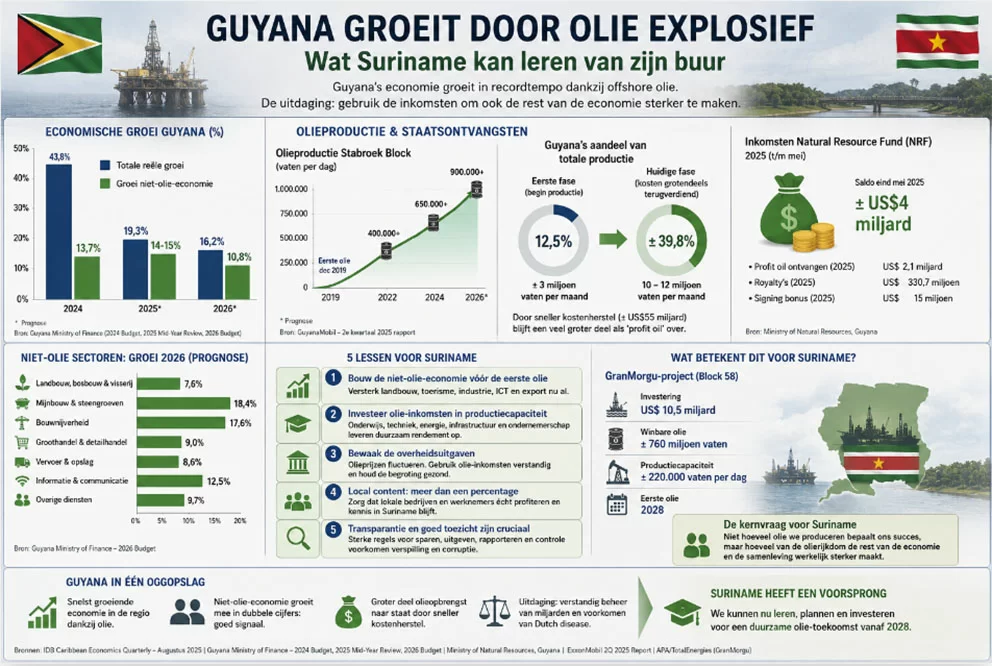
Olie-economie Guyana in nieuwe fase; groei 19,3 % en groter deel productie naar staat
Once a small economy reliant on gold, rice, sugar and bauxite, Guyana has cemented its position as one of the world’s fastest-growing economies following the start of commercial offshore oil production in late 2019. New data from the Inter-American Development Bank (IDB) confirms the country’s gross domestic product expanded by a staggering 19.3% in 2025, following an exceptional 43.8% expansion in 2024. But behind this headline-grabbing growth figure lies a far more consequential shift: the country’s non-oil sectors are also posting double-digit growth, and Guyana has entered a new, far more financially rewarding phase of oil development two years ahead of initial projections. For neighboring Suriname, which is preparing to launch its own first offshore oil production, these developments act as a living economic laboratory, offering clear insights into both the transformative opportunities and significant risks that come with a new oil-driven economy.
What makes Guyana’s recent performance particularly notable for resource-dependent economies is that its growth is no longer concentrated solely in the petroleum sector. The IDB estimates non-oil economic growth accelerated to roughly 15% in 2025, while official Guyanese budget data puts the figure at a still robust 14.3%. Both figures confirm a clear, encouraging trend: key non-oil sectors including agriculture, mining, construction and services are growing in lockstep with oil development. For a new oil-producing nation, this is a critical positive signal, as one of the most common and damaging risks of sudden oil windfalls is the crowding out or stagnation of non-resource sectors.
The expansion of overall oil output has also played a major role in increasing state revenues: monthly production has jumped from 3 million barrels to a peak of 12 million barrels as development of the Stabroek Block, the country’s core offshore oil asset, has progressed. But the most dramatic shift in state earnings comes from an accelerated timeline for cost recovery. When oil production first launched, the vast majority of produced oil was allocated to cost recovery for the billions of dollars in exploration, infrastructure and production investment made by lead operator ExxonMobil and its project partners. Under the original production sharing agreement, up to 75 of every 100 barrels produced could be used to recoup these upfront costs, leaving just 25 barrels as profit oil, half of which went to the Guyanese government – equaling just 12.5 barrels per 100 produced.
The Guyanese government confirms that approximately $55 billion in development costs have now been recouped, roughly two years earlier than initially forecast. This has reshaped the revenue split dramatically: today, only around 20 of every 100 barrels are allocated to cost recovery, leaving 80 barrels as profit oil. With Guyana retaining its 50% share of profit oil (a share set in the original agreement that remains unchanged), the country now claims roughly 39.8 barrels for every 100 produced. Adding a 2% royalty on total production, the country’s monthly entitlement to crude oil has surged from around 3 million barrels to 10 to 12 million barrels. Royalty revenues alone hit $306 million in the first half of 2026, according to the Ministry of Natural Resources.
These growing revenues are already accumulating in Guyana’s Natural Resource Fund (NRF), the sovereign wealth fund that holds all state oil earnings. As of the end of May 2026, the NRF held just under $4 billion in assets, after receiving $2.1 billion in profit oil and more than $330 million in royalty payments in 2025 alone, plus an additional $15 million signing bonus from a new production agreement.
But the rapid influx of oil wealth has also intensified long-simmering debates over transparency, oversight and how best to deploy these revenues for broad-based national development. Opposition leader Aubrey Norton recently called for stricter public and institutional oversight of the NRF, arguing that oversight frameworks must expand in lockstep with growing oil earnings. The national conversation has now shifted from how much oil Guyana holds to the far more challenging question of how to manage massive new wealth effectively.
Against this backdrop, the strong growth of non-oil sectors takes on even greater importance. Official budget data shows agriculture, forestry and fishing grew 11.5% in 2025, with rice production posting notable gains, while construction and services have benefited from the wave of investment sweeping the country. Even so, Guyana has not yet eliminated the risk of over-reliance on petroleum. The IDB warns the country remains vulnerable to “Dutch disease,” a common ailment for resource exporters where large inflows of foreign currency drive up wages, prices and real exchange rates, making non-oil export sectors less competitive globally. Remarkably for one of the world’s fastest-growing oil producers, Guyana also still relies on imported petroleum products for most of its domestic energy needs, leaving it exposed both as a producer and consumer to volatile global oil price swings.
For Suriname, these developments are far more than just regional economic news. Just six and a half years after Guyana launched commercial offshore production, the Stabroek Block produces around 900,000 barrels of oil per day, fundamentally transforming a once commodity-dependent small economy. Suriname is now at the starting line of a similar, albeit smaller-scale trajectory: energy firms TotalEnergies and APA took a final investment decision on the GranMorgu project in Block 59 in October 2024, with first oil production targeted for 2028. As Suriname prepares for large-scale investment, cost recovery, growing state revenues and the eventual challenge of spreading oil wealth across the broader economy, Guyana’s experience offers a direct, actionable case study.
The first clear lesson is that maximum benefit for the producing nation takes time: in the early years of development, nearly all earnings go toward recouping massive upfront investment to extract oil from the seabed. Only once those costs are recovered does the producing nation see a dramatic jump in its share of revenues. But the second, far more important lesson is that the true success of an oil economy is not measured by daily production volumes, but by the performance of non-oil sectors. If other sectors of the economy weaken as oil grows, a country can become technically richer on paper without building a sustainable, broad-based economy that benefits all citizens. That is why Guyana’s 15% non-oil growth may ultimately prove more significant than its 19.3% overall GDP expansion.
Even with Guyana’s stellar performance, the IDB continues to warn of outstanding risks: global oil prices are inherently volatile, government spending has risen sharply, and rapid inflows of oil dollars can trigger inflation and other macroeconomic imbalances. These are lessons Suriname can heed long before its first oil comes ashore. Unlike Guyana, which had to build institutional frameworks for oil management as billions of dollars already flowed in, Suriname has the luxury of time to put key policies in place before production begins: decisions on sovereign wealth fund governance, budget discipline, local content requirements, institutional capacity building, infrastructure investment and non-oil sector development can all be finalized years in advance.
In the end, while Guyana’s 19.3% overall growth is an impressive economic milestone, it is the strong performance of its non-oil sectors that offers the most important takeaway for Suriname. When GranMorgu begins producing oil in 2028, the most critical question will not be how much crude the project extracts – it will be how much of that new oil wealth lifts the rest of Suriname’s economy.