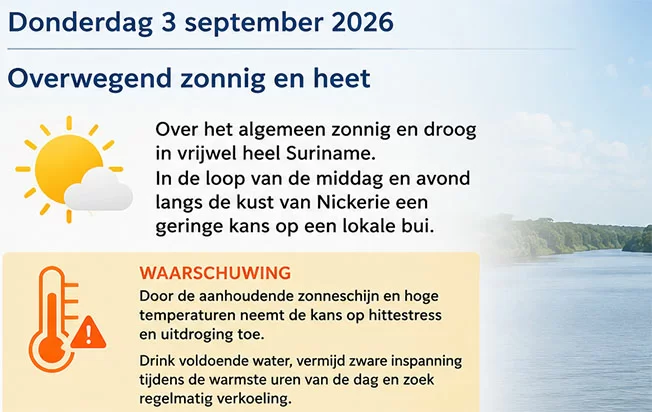
A widespread heatwave is sweeping across nearly all of Suriname, bringing predominantly sunny, dry conditions and record-high apparent temperatures that have prompted official health warnings from the country’s top weather agency. The forecast, issued by the National Meteorological Center early on September 3, confirms that most of the nation will stay clear of significant rainfall through the period, with only a tiny exception for coastal regions in Nickerie. According to the prediction, interior areas of Suriname will remain mostly dry on Thursday, while the rest of the country will continue to see unbroken sunshine and lack of precipitation. Only along the Nickerie coastline is there a low chance of isolated, local rain showers developing through the afternoon and evening hours. Wind conditions across the country will originate from an easterly to northeasterly direction, blowing at a steady speed of 15 to 20 kilometers per hour. As sea breeze influences kick in through the warm afternoon hours, local wind speeds can pick up unexpectedly, with temporary gusts reaching between 25 and 35 kilometers per hour. These stronger gusts are most likely to occur during or near any scattered rain showers that form. The greatest public risk from today’s conditions stems from the combination of prolonged direct sunlight and soaring air temperatures, which has pushed the risk of dangerous heat stress and dehydration sharply higher, according to the Suriname Meteorological Service. To help residents avoid heat-related illness, the agency has issued clear public health guidance: people across the country should drink plenty of water throughout the day, avoid strenuous physical labor and exercise during the peak warmest hours of the day, and take regular breaks in cool, shaded areas to lower their body temperature.
作者: admin
-
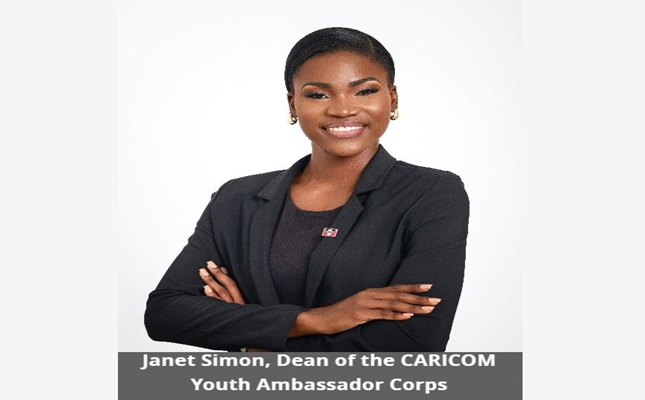
New CARICOM Youth Ambassador Corps Dean Puts Youth Well?Being and Employment at the Forefront
In an official announcement released September 3, 2026, the CARICOM Secretariat confirmed the appointment of Janet Simon, a youth advocate from Antigua and Barbuda, as the new Dean of the CARICOM Youth Ambassador Corps. Her tenure officially launched September 1, 2026, bringing with it a clear, youth-centered agenda focused on addressing the most pressing challenges facing young people across the Caribbean Community.
Simon, a trained educator and veteran youth development leader with the title of Commonwealth Youth Peace Ambassador, brings decades of cross-sector experience to the regional role. Her work has long centered on advancing the United Nations Sustainable Development Goals, with targeted focus on public health, accessible education, climate action, sanitation, and cross-community peacebuilding. At the national level in Antigua and Barbuda, she has earned widespread recognition for two impactful initiatives: a national School Tour that has delivered life skills training to thousands of secondary students, and the innovative “Peace through Art” series that uses creative expression to foster conflict resolution. She also leads capacity-building workshops for local youth organizations, and serves as an active core member of Healthy Caribbean Youth, where she has pushed for systemic changes to school nutrition frameworks and youth mental health support policies. Her advocacy has extended to global policy platforms, including the World Bank and United Nations, where she has consistently centered the unmet needs of Caribbean youth in international discussions.
Outlining her strategic priorities for her tenure, Simon made clear that youth well-being and economic opportunity will sit at the top of her agenda. Her core policy focuses include expanding access to quality nutrition education, advancing prevention efforts for non-communicable diseases, scaling up mental health support systems, strengthening regional peacebuilding, expanding life skills training for young people, and building clear, accessible pathways to sustainable youth employment. Her overarching mission is to equip young people across CARICOM with the knowledge, resources, and agency to act as engaged citizens and drive the future direction of the regional bloc.
In a statement following the appointment announcement, Simon shared her perspective on the role: “I am honoured to serve as Dean of the CARICOM Youth Ambassador Corps. My work with young people across the Region has shown me the urgent unmet need to strengthen youth mental health support and nutrition access. I believe we can fundamentally transform how young people access critical services by empowering their peers to lead the way in outreach and advocacy.”
Michele Small-Bartley, Programme Manager for Youth Development at the CARICOM Secretariat, offered a warm welcome to the new Dean, praising her unique qualifications and vision. “Janet brings to this role a deep, lived passion for youth development, a creative spirit, and a clear, unwavering commitment to public service,” Small-Bartley noted. “I am especially encouraged by her strong focus on mental health advocacy and the fresh, thoughtful approaches she hopes to bring to the regional youth ambassador programme. Her leadership arrives at a pivotal moment, as we continue working to strengthen the voice, visibility, and meaningful participation of CARICOM Youth Ambassadors across every member state.”
Simon’s peer-led approach to expanding service access marks a shift in how regional youth programming will be delivered, with the new dean betting that young-led outreach will bridge gaps in support that have persisted for generations across the Caribbean.
-

Falcons close in on playoffs
In the decisive final regular season match of the 2026 Republic Bank Caribbean Premier League (CPL) hosted at Queen’s Park Oval, the Antigua & Barbuda Falcons secured an eight-run victory over the Trinbago Knight Riders, catapulting themselves back to the top of the league table and putting them on the cusp of playoff qualification. For the Knight Riders, the result extends a damaging three-match losing skid that has left their playoff hopes hanging in the balance, after a disappointing homestand that saw them drop four of five fixtures.
The Falcons got off to a promising start in the mandatory PowerPlay, with opening batters Evin Lewis and Rahkeem Cornwall building a solid 40-run partnership before Cornwall was bowled off an inside chop by Usman Tariq. The wicket extended Tariq’s historic streak, marking the 17th consecutive CPL match in which he has claimed at least one wicket. The Knight Riders missed a critical chance to dismiss Lewis for just 16 runs, when Terrance Hinds dropped a straightforward catch, gifting the Falcons opener a reprieve. Though Trinbago’s spin attack has built a reputation for tight, restrictive bowling in the first six overs, the Falcons batsmen kept the scoreboard ticking freely, ending the PowerPlay at 43 for one wicket.
Dropped catches continued to derail the Knight Riders’ efforts soon after, when Akeal Hosein failed to hold a catch to dismiss Moeen Ali when the batsman had scored just one run. By this stage of the innings, Hasan Nawaz had cemented his control at the crease, emerging as the driving force of the Falcons’ batting campaign. He reached a half-century off just 36 deliveries, with Ali — surviving a second chance to keep batting — providing steady support from the opposite end. Nawaz eventually fell for 76, caught by Alex Hales off the bowling of Lahiru Kumara. The Knights’ Usman Tariq and Sunil Narine delivered economical, tidy bowling spells to limit further damage, but Falcons captain found the boundary on the final ball of the innings, pushing the Falcons’ total to 183 runs for four wickets at the end of 20 overs.
Chasing a competitive target, the Trinbago Knight Riders adopted a high-risk, high-reward strategy for their PowerPlay, and the approach yielded mixed results: they piled on 63 runs but lost four critical wickets in the process. Colin Munro and Nicholas Pooran both got off to solid starts, but both fell to Rahkeem Cornwall, who turned in a dominant opening spell for the Falcons. Cornwall ended the PowerPlay with outstanding figures of three wickets for 17 runs, pulling the chase firmly back in the Falcons’ favor.
Hampered by a pre-existing injury, veteran Kieron Pollard stepped up to anchor the Knight Riders’ innings, building a 55-run partnership with Joshua Da Silva that kept the hosts within striking distance heading into the final five overs. But when Pollard was caught smartly by Jayden Seales off the bowling of Joshua James, the required run rate ballooned into an unmanageable uphill battle. James and Sharmar Springer combined to restrict the batting through the middle overs, setting the Falcons up with a comfortable 25-run cushion heading into the final over, which the paceman executed perfectly to defend the target. Da Silva hit a six off the final ball to bring up an unbeaten half-century of 54, but the milestone proved nothing more than a consolation for the home side.
With the win, the Falcons moved back to the top of the CPL table and are now firmly positioned to secure a playoff spot, following their previous fixture against the Patriots that was called off due to rain. For the Trinbago Knight Riders, the third consecutive defeat has likely eliminated them from playoff contention, bringing a disappointing end to their 2026 CPL campaign.
-

Column: Regional Sport Academy
Years ago, the South American nation of Suriname launched an ambitious regional project: the establishment of a Regional Sport Academy (RSA), designed to train homegrown sports professionals across the Caribbean and South American region. The initiative was rooted in a clear, forward-thinking vision: to build a local pool of skilled, affordable sports expertise that would eliminate regional reliance on foreign specialists and equip local athletes to compete effectively at global sporting events. Initially, the plan promised aspiring sports professionals from across the region access to high-quality training based in Suriname, bringing accessible development opportunities closer to local talent.
-

Historic ‘Ancestral Echoes’ Commemoration Unites Nations in Solemn Reflection and Healing on 400th Anniversary
In late August 2026, centuries of interwoven trauma and survival came to life at a landmark cross-national commemoration on the Caribbean island of Saint Kitts, also known by its indigenous name Liamigua. The event, titled “Ancestral Echoes: Remembering the Blood, Honouring the Resilience,” gathered global and regional stakeholders to observe the 400th anniversary of two interconnected tragedies: the 1626 Kalinago Massacre that killed thousands of indigenous people at the hands of English and French colonizers, and the nearly simultaneous arrival of the first enslaved Africans on the island’s shores.
Hosted at Challengers Football Field, just steps from the iconic Bloody River, the ceremony rooted attendees in the raw geography of history. Oral accounts and historical records have long held that the river ran red with blood for days after the 1626 slaughter of indigenous Kalinago communities, making its banks the ideal setting for a day of solemn reflection, collective mourning, and intentional healing.
Organized by Saint Kitts and Nevis’ Department of Cultural Heritage, the gathering brought together a diverse cross-section of participants: residents of Challengers and neighboring communities, Cultural Heritage Minister Samal Duggins, senior national government officials, foreign diplomatic envoys, and indigenous delegations from across the Caribbean region. For attendees and organizers alike, the ceremony represented more than a remembrance event; it stands as a defining milestone for truth-telling, collective memory-keeping, and historical reconciliation across the Caribbean.
The evening’s programming blended traditional spiritual practice, artistic performance, and political reflection, centering the shared legacies of the Kalinago people and displaced African communities whose labor and blood shaped the island. Libations to honor the dead, traditional Kalinago smoke ceremonies, indigenous drumming and song, spoken word performances, and West African drumming ensembles filled the valley, creating a symbolic reunion of the two lineages that have fundamentally shaped Saint Kitts and Nevis’ national identity.
Representatives from the Kalinago Nation of Dominica joined local indigenous heritage stewards to lead discussions of survival across four centuries. Indigenous community leaders emphasized that the 1626 massacre was not merely a story of destruction: instead, it was the crucible that forged the resilient, unbroken indigenous identity that persists across the Caribbean archipelago today.
Minister Duggins framed the commemoration as a step toward collective progress, rather than a retreat into grief. “We stand today on ground stained by the blood of ancestors whose sacrifice echoes across four centuries,” he said in remarks at the event. “To honour them is not to remain trapped in historical grief, but to claim our sacred duty to preserve their legacy, teach our youth the unvarnished truth of our genesis, and forge a shared future rooted in dignity, sovereignty, and mutual honour.”
UNESCO Secretary General Nerys Dockery also emphasized the event’s global significance, noting that confronting the unedited, often violent reality of colonial history is a necessary foundation for educational transformation and meaningful international heritage preservation. The event comes as Saint Kitts and Nevis advances efforts to nominate the Bloody River site for formal international cultural landmark protection, with officials framing collective memory as the most effective defense against historical amnesia.
Following the ceremony, the Department of Cultural Heritage reaffirmed its commitment to extending the event’s impact far beyond the single gathering, pledging ongoing collaboration with local communities, indigenous leaders, and regional partners to embed the lessons of the commemoration into national education and heritage policy. The department also extended gratitude to the dozens of stakeholders that made the event possible, including the Challengers community, the Kalinago Council, local businesses, health and security services, volunteers, and attendees from across the region and the globe.
In closing, organizers noted that the successful, cross-community gathering demonstrates a core truth: while colonial history left a legacy of unspeakable tragedy, a united, intentional people can shape a legacy of resilience, healing, and shared peace for future generations.
-

BERGER Paints and TDC Home and Building Depots Team Up to Give Customers An Exciting CPL Experience
As the 2026 Caribbean Premier League (CPL) brings top-tier regional cricket talent and high-stakes matches to St. Kitts and Nevis, two leading local brands have partnered to turn customer loyalty into an unforgettable sports experience for local shoppers.
BERGER Paints, a global and regional leader in paint and coating products, has joined forces with TDC Home and Building Depots, the Federation’s prominent home improvement retailer, to launch the “WIN with BERGER and CPL” promotion. Running from August 3 to August 21, 2026, the campaign invited customers purchasing two or more gallons of eligible BERGER Paints products — via cash or credit — at any TDC Home and Building Depot location across St. Kitts and Nevis to automatically enter a drawing for exclusive CPL match access.
Four lucky shoppers were selected as promotion winners, each earning pair of tickets to attend CPL home matches hosted at the iconic Warner Park Sporting Complex. Beyond match entry, each winner also received custom branded promotional merchandise from the two partner brands, letting fans cheer on the home team SKN Patriots or their favorite CPL franchise while showing off their prize.
For attendees, the prize delivers access to the electric, passion-fueled atmosphere that defines top-tier Caribbean cricket, a beloved cultural institution across the region. For the partnering brands, the collaboration is designed to deliver added value to loyal customers while tying into local cultural celebration.
“We are excited to partner with BERGER Paints on this initiative to reward our patrons for their continued business, especially through the excitement of sport,” said Iston Williams, General Manager of TDC’s St. Kitts Home and Building Depot. “We are always looking for ways to create added value for our customers, and this is yet another way for us to combine quality products, great savings and the excitement of Caribbean cricket.”
Ria Mosodeen, BERGER Paints Market Development Manager, echoed the enthusiasm for the cross-sector partnership, noting the deep cultural connection of cricket to communities across the Caribbean. “Cricket is a major part of Caribbean culture, and we are delighted to connect with consumers to celebrate the game while bringing colour and vibrancy to their homes and offices,” Mosodeen said.
The joint promotion highlights how consumer-facing brands can integrate popular local cultural events to create engaging, mutually beneficial experiences for both companies and their customers, reinforcing both brands’ commitments to putting customer experience first in the St. Kitts and Nevis market.
-

Lim A Po: Olie-ontwikkeling vraagt om andere manier van denken
As Suriname prepares for major new offshore oil and gas development, a leading higher education leader is challenging the country’s graduating professionals to reframe their relationship to national development, urging a break from outdated postcolonial mindsets to embrace a modern, globally focused vision centered on inclusion, equality and sustainability. The call came from Hans Lim A Po, rector of the FHR Institute for Higher Education, during the institution’s 2026 Grand Graduation ceremony held at Paramaribo’s Royal Torarica Ballroom, an event that also marked a historic milestone for legal education in the South American nation.
This graduation cycle saw FHR produce its first-ever cohort of Master of Business Law graduates, a program run in partnership with the Netherlands’ Maastricht University. Sixteen students successfully completed the degree, a step that institute leaders describe as a major leap forward for advanced legal education across Suriname. The 2026 ceremony carried the central theme: “Moving into the Future: How Education Contributes to Global Citizenship.”
Lim A Po acknowledged that national expectations for the coming oil and gas sector are overwhelmingly focused on the transformative economic benefits the industry could bring to Suriname, a framing he calls understandable. But he also noted a growing national consensus that the nascent sector carries severe environmental, social and governance risks that will require deliberate, skilled management from the country’s political and civic leaders. Against this backdrop, he argued, the nation’s newly minted highly educated professionals carry a unique responsibility to shape the sector’s trajectory for the public good.
A core part of that responsibility, Lim A Po told graduates, requires leaving behind lingering postcolonial thinking patterns that have fostered social dependency, weak norms of self-governance and an extractive economic culture that prioritizes short-term resource extraction over long-term inclusive prosperity. In place of these outdated frameworks, he urged graduates to adopt a modern, global outlook rooted in the core values of inclusion, equality and sustainability.
Lim A Po grounded his message in the broader framework of global citizenship, drawing on the work of American philosopher Martha Nussbaum, who has argued that modern higher education must prepare students not only for participation in their national or local communities, but also for engagement in an increasingly interconnected and interdependent global society. Contrary to common framing, Lim A Po emphasized that national citizenship and global citizenship are not mutually exclusive concepts. Instead, he described them as mutually reinforcing frameworks: national citizenship provides the formal legal foundation for action, while global citizenship offers a broader ethical direction to guide that action.
The central challenge for modern citizens, he argued, is to “think globally, act locally”: major global challenges around justice, climate change, sustainability and planetary health ultimately must be translated into concrete local and national policy and personal choices within every individual’s own community. This is no simple task: local action can often feel too limited to meaningfully move the needle on large-scale global problems, while even small local decisions can carry ripple effects that extend far beyond national borders.
Beyond environmental and economic sustainability, Lim A Po noted that a global citizenship framework also creates pathways to overcome what he called the “politics of difference,” the deep social divisions that run along ethnic, racial, religious and other identity lines in many societies. A global mindset, he explained, requires openness to diverse ideas and perspectives, and prioritizes values such as empathy, respect for difference and cross-border collaboration. He also issued a warning, however: global citizenship cannot be just a performative posture adopted to earn external recognition. It must grow from deeply held personal conviction and a genuine willingness to take responsibility for collective outcomes.
Lim A Po also addressed the rising tide of youth-led activism across the globe, noting that since the start of the 21st century, Generation Z in particular has organized peaceful mass movements to speak out against socioeconomic inequality, nepotism and systemic corruption. While established institutional actors often frame these movements as a threat to existing social norms, Lim A Po argued that youth activism is better understood as a natural response to institutional and governance failures to uphold shared global values. This, he said, creates a clear mandate for universities and other higher education institutions: global citizenship must be integrated into core academic curricula, so that students gain not only technical professional knowledge, but also learn to think critically about their own choices, their leadership and their broader social responsibility.
Closing his address to the new graduates, Lim A Po quoted Thomas Paine’s 1792 declaration: “My country is the world, and my religion is to do good.” He expressed his hope that this principle would serve as a guiding ethos for the FHR’s newest cohort of alumni as they step into leadership roles across Suriname and beyond.
-

Broki uitgeschakeld voor Carrbbean cup na doelpuntloos gelijkspel tegen Delfines del Este
Suriname’s top domestic football club SV Broki has seen its 2026 Concacaf Caribbean Cup campaign come to an early end, after a hard-fought 0-0 home draw against Dominican Republic side Delfines del Este FC left it unable to qualify for the tournament’s next round. The match was played on Wednesday evening at Paramaribo’s Franklin Essed Stadion, delivering a frustrating result for the Surinamese champions that had fought to keep their qualification hopes alive.
Despite the draw earning SV Broki its first point of the group stage, the single point was not enough to keep the club in contention for a top-two finish that would secure progression. After three completed group matches, Broki holds just one point, meaning even a win in its final remaining group fixture can only push its total to four points. Current group standouts Violette AC and Club Sando FC both sit on six points already, with one match left to play each, locking in Broki’s mathematical elimination from qualification for the next stage.
The most notable talking point of the match was Broki’s dominant run of play that never translated to goals. For most of the 90 minutes, the home side controlled the tempo of the game and carved out multiple clear chances to break the deadlock, but none of their attempts found the back of the net. Official match statistics show Broki claimed 54% of total possession and registered 13 total shots towards goal – but none of those efforts actually tested the opposing goalkeeper, landing on target. For their part, Delfines del Este only put two shots on target all match, and also failed to score, leaving both sides sharing the single point from the goalless stalemate.
A controversial incident in the closing minutes of the match added to Broki’s frustration. Late in the second half, Delfines del Este forward Luis Almonte made contact with Broki goalkeeper Nevon Esperansie’s head with his boot during a challenge, leaving the keeper stunned and grounded on the pitch for several minutes. Referees did not issue a red card for the collision, a decision that drew unspoken frustration from the Broki camp.
Earlier in the fixture, Broki player J. Naana received a yellow card for a foul on an opposing player, and shortly after that incident, Broki manager Sérgio Rodrigues was sent off with a red card. Officials have not yet released an official explanation for the dismissal of the head coach, leaving the specific trigger for the decision unconfirmed to the public.
Broki will still wrap up its group stage commitments next Wednesday, 9 September, with a final home fixture at Franklin Essed Stadion against group leader Violette AC. While the Suriname club can no longer qualify for the knockout stage, the result of the final match could still reshape the final group standings for other contending sides. For Broki, the final match will now be an opportunity to end its Caribbean Cup run on a positive note, after seeing its qualification dream cut short earlier than expected.
-
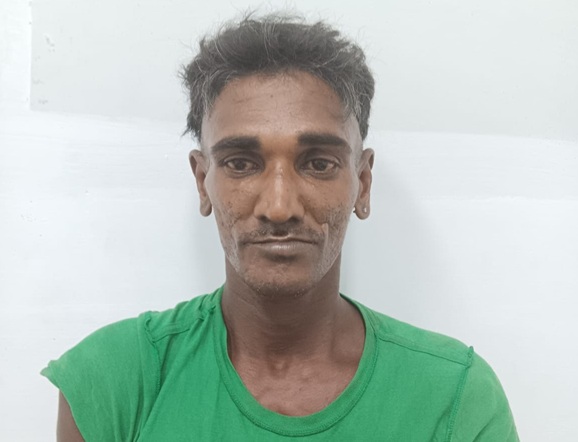
Suspected Demerara River bridge cable thief caught
A major breakthrough in the high-value copper cable theft case at Guyana’s Bharrat Jagdeo Demerara River Bridge has seen the primary suspect arrested Wednesday night, with law enforcement intercepting him as he allegedly prepared to steal more cable infrastructure from the site, according to a senior authoritative source familiar with the investigation.
The arrested individual, a Guyanese national, was found disguised as an authorized bridge maintenance worker when he was detained, the source confirmed. He was wearing a standard industry safety helmet and high-visibility reflective vest to avoid drawing suspicion, and was also in possession of specialized cutting equipment intended to remove additional cable from the bridge structure.
Official confirmation from the Guyana Police Force was not immediately available when the media requested comment on the arrest. However, multiple informed sources told Demerara Waves Online News that after being spotted by bridge staff and responding officers, the suspect attempted to evade capture by hiding in a restricted maintenance zone located on the bridge’s high span.
Wednesday’s arrest unfolded roughly 10 days after police first publicly announced the theft, which took place between midnight on August 23, 2026, and 9 a.m. on September 1, 2026. The stolen infrastructure consists of 90 feet of four-conductor heavy-duty cable, with each conductor rated at 350 thousand circular mils (kcmil). Authorities have valued the stolen cable at a total of 1.62 million Guyanese dollars.
The theft itself was only discovered by bridge management and on-site staff by accident on August 31, when a planned lighting tribute to neighboring CARICOM nation Trinidad and Tobago failed to activate. Bridge crews had attempted to illuminate one side of the crossing in the colors of Trinidad and Tobago’s national flag to mark the country’s independence anniversary, but the outage caused by the stolen cable revealed the crime.
Investigative sources have noted that the operation to remove and transport the extremely heavy copper cable required coordinated logistics, suggesting that additional accomplices are still at large. The suspect is currently in custody as authorities continue their probe to identify and locate other individuals involved in the initial theft.
-

Was Pollard’s Defeat Decided Before Convention Day?
Fresh off a closely contested People’s United Party (PUP) convention held in Belize City on Sunday, August 30, 2026, two major narratives have emerged to unpack the upset victory of Deputy Mayor Eluide Miller over favored candidate Allan Pollard: claims of exorbitant, outcome-determining campaign spending, and growing speculation over a shifting power balance within the party’s influential Eastern Caucus.
Miller’s campaign was backed by senior PUP figure Anthony Mahler, the Pickstock Area Representative and PUP Deputy Leader for the Eastern Caucus, who this week pushed back hard against widespread rumors that millions in unaccounted campaign spending secured Miller’s win before convention delegates ever cast their ballots. In a blunt response to media claims of massive spending, Mahler dismissed the multi-million-dollar narrative as irresponsible nonsense.
Mahler clarified that his own on-the-ground spending on convention day amounted to less than $1,500, a sum he said covered only basic costs like food for campaign volunteers. While he acknowledged that pre-convention organizing incurs unavoidable costs — from branded campaign T-shirts to volunteer mobilization — he rejected assertions that spending reached anywhere close to the seven- or eight-figure sums circulating in public discourse. “If you have one thousand T-shirts out there at twelve dollars, that’s $12,000. How it reach two million dollars? How it reach a million dollars?” Mahler questioned, pushing back on media framing of the race.
Far from being decided by last-minute spending, Mahler emphasized that Miller’s victory was locked in long before convention day, forged through months of relationship-building and solid political alliances that held through the final vote. He also highlighted Miller’s own relentless work ethic, noting the candidate put in 16-hour days on the campaign trail for months leading up to the convention.
The second major talking point following the result is speculation over a growing power rift between Mahler and senior PUP leader Cordel Hyde, who publicly backed Pollard in the contest. Miller’s win has led many political observers to frame Mahler as an emerging power broker in Belize City politics, challenging Hyde’s long-held dominance over the PUP’s Eastern Caucus, widely considered the most powerful voting bloc in the country.
Mahler once again rejected this narrative, emphasizing he has no interest in challenging Hyde’s standing as Belize City’s top political leader. “Honorable Cordel Hyde has won, I believe, five or six times. Jules Vasquez said, I win one and a half times. And that’s fine. He is the boss of the city. I will continue to follow him,” Mahler stated.
He explained that his support for Miller stemmed not from a power grab, but from his formal responsibility as Deputy Leader of the Eastern Caucus: a role he says requires him to support colleagues across the caucus regardless of internal differences. Mahler noted he has campaigned alongside and supported fellow PUP politicians across all Belize City constituencies in the lead-up to the 2025 general elections, framing that work as a core fiduciary and political responsibility, not a power play. He added that his commitment to party teamwork stems from his background in sports, where collective success always takes priority over individual ambition.
Senior PUP figure Francis Fonseca has echoed calls for party unity, saying he expects Hyde to rally behind Miller and the entire PUP ticket ahead of the general election scheduled for March 2027.
This report is based on a transcribed transcript of an evening television newscast from Belize.