作者: admin

  • Unions Protest at SSB Headquarters, Draw Line from Party Politics

    Unions Protest at SSB Headquarters, Draw Line from Party Politics

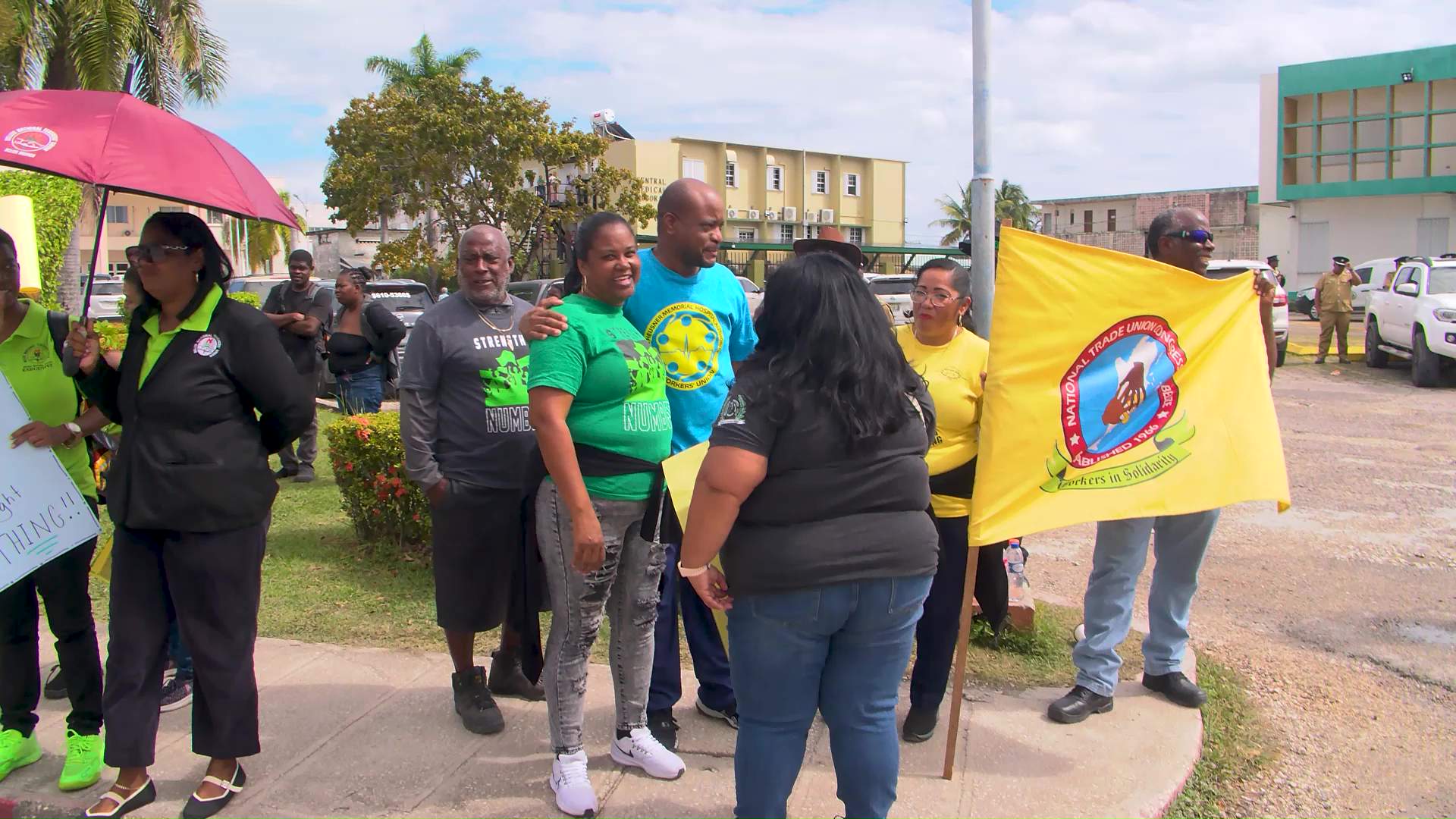
    BELIZE CITY – In a significant display of labor mobilization, Belize’s National Trade Union Congress (NTUCB) staged an unsanctioned protest outside the Social Security Board headquarters on February 4, 2026, despite being denied official permission by authorities. The labor action occurred alongside but deliberately separate from a demonstration organized by the opposition United Democratic Party (UDP), creating a complex tableau of dissent.

    Union leaders emphasized their demonstration focused exclusively on worker rights and transparency regarding management of Social Security funds, explicitly distancing themselves from political party agendas. NTUCB President Ella Waight asserted the protest represented workers’ constitutional rights, stating, “We need to ensure there is public consultation. Citizens must understand the risks and benefits to make sober decisions.”

    The protest gained substantial momentum with participation from multiple influential unions, including the Belize Communications Workers for Justice and the powerful Belize National Teachers’ Union (BNTU). BNTU President Nadia Caliz characterized their involvement as a calculated response to growing discrepancies in Social Security management, noting, “When you know your power you don’t rush. It’s the silence that is deadly.”

    Tensions escalated when UDP supporters moved toward the Social Security Board compound, which union leaders said endangered workers inside the building. Waight condemned this development as unacceptable, stating it prevented Social Security Board employees from joining the protest due to safety concerns.

    The demonstration highlighted broader opposition to the proposed Speednet acquisition and unresolved severance payments for former Belize Telecommunications Limited employees. Emily Turner of the Communications Workers emphasized the connection: “If BTL already owes a debt to its former employees, it needs to settle it before any acquisition.”

    Support extended beyond traditional labor circles, with healthcare workers, youth representatives, and professionals joining the action. Andrew Baird, past president of the Karl Heusner Memorial Hospital Authority Union, called it “a matter of national interest,” while youth representative Ashley Langford emphasized the protest’s significance for future generations of workers.

    Union leaders concluded by reaffirming their commitment to non-political worker advocacy, insisting their demands centered on transparency, consultation, and protection of worker contributions to the Social Security system.


  • Family Alleges Ambush in Fatal La Democracia Shooting

    Family Alleges Ambush in Fatal La Democracia Shooting

    A devastating shooting in La Democracia village has left a family in mourning and raised questions about longstanding internal conflicts. Twenty-one-year-old Paul Smith Jr., a figure previously known to law enforcement, was fatally shot on Tuesday in what relatives describe as a premeditated ambush.

    The incident occurred shortly after Smith engaged in a heated argument with his girlfriend. According to eyewitness accounts, armed assailants emerged from nearby bushes and opened fire. Smith sustained multiple gunshot wounds to his chest, abdomen, and arms. Despite being rushed to Karl Heusner Memorial Hospital alongside his injured companion Tyrece Allen, Smith succumbed to his injuries during treatment.

    Smith’s cousin, Tamara Gillett, provided a harrowing account of the incident: “We heard the gunshots from inside our house. When we rushed outside, we learned our cousin had been shot. Initially we hoped the injuries were minor, but then we received the devastating news that he had died.”

    The deceased had a complex history with the judicial system. Previously charged with offenses ranging from firearms possession to attempted murder, Smith had been acquitted in 2024 for the 2022 killing of La Democracia resident Tyreak August. Following his release from Belize Central Prison less than six months ago, his attorney Ronell Gonzalez had encouraged Smith to pursue a positive path forward.

    Family members acknowledge Smith’s troubled past but maintain that his death resulted from internal family tensions rather than random violence. Gillett revealed: “This was a family issue that escalated unnecessarily. There had been previous attempts on his life—they shot his mother, shot another cousin, and even burned down his sister’s house.”

    Despite his controversial background, relatives remember Smith’s positive qualities. Cousin Angel Estrada reflected: “Regardless of everything, we knew his goodness. We’re not saying he was perfect, but we recognized his value as a person.”

    Law enforcement officials have detained multiple suspects for questioning, though no formal arrests have been made as investigations continue. The case highlights ongoing concerns about violence resolution and the complex social dynamics within communities.

  • Saint Lucia’s Cooper elected Concacaf VP

    Saint Lucia’s Cooper elected Concacaf VP

    In a landmark development for Caribbean football governance, Saint Lucia Football Association President Lyndon Cooper has achieved an unprecedented electoral victory by securing the position of CONCACAF Vice President for the Caribbean region. This historic appointment marks the second consecutive year that Cooper has broken new ground in international football administration, following his groundbreaking election as Caribbean Football Union president in 2023.

    The election occurred during CONCACAF’s 41st Ordinary Congress in Managua, Nicaragua, where Cooper assumed his new role without opposition. The congress convened the confederation’s senior leadership alongside delegates from all 41 member associations, creating a significant gathering of football’s power brokers in North and Central America and the Caribbean.

    The event simultaneously celebrated a decade of leadership under CONCACAF President and FIFA Vice President Victor Montagliani. Addressing the assembly, Montagliani highlighted the confederation’s progress while looking ahead to the 2026 FIFA World Cup, which will be hosted jointly by CONCACAF members Canada, Mexico, and the United States.

    Montagliani extended congratulations to the six CONCACAF nations that have already secured World Cup qualification while offering encouragement to Jamaica and Suriname as they prepare for March’s FIFA Play-Off Tournament. The Canadian leader praised member associations for their role in transforming CONCACAF’s operational foundations and reaffirmed the organization’s commitment to elevating standards across the region.

    During working sessions, member associations approved CONCACAF’s 2026 budget and addressed statutory matters aligned with the confederation’s strategic priorities. Montagliani emphasized that the organization’s rebuilt foundation now enables long-term planning and confident investment, declaring this a pivotal moment to ‘break through ceilings’ while maintaining unity and integrity.

  • Mother And Daughter Charged in Punta Gorda Cocaine Bust

    Mother And Daughter Charged in Punta Gorda Cocaine Bust

    A Punta Gorda mother and her teenage daughter are confronting severe narcotics charges following a targeted police operation that uncovered a significant cache of crack cocaine. Law enforcement officials executed a search warrant at a Cerro Road residence on Tuesday, leading to the apprehension of 47-year-old Cheryl Garbutt and her 18-year-old daughter Kailah Bahadur.

    During the systematic search of the property, investigators discovered substantial evidence of drug distribution activities. The most critical find was a plastic bag containing exactly 100 individually wrapped parcels of crack cocaine, meticulously sealed in foil. The total weight of the confiscated narcotics exceeded 15 grams, indicating potential intent for street-level distribution rather than personal use.

    Police authorities emphasized the gravity of the charges, noting that both women now face accusations of possession of controlled substances with intent to supply—a charge that carries significantly heavier penalties than simple possession. The operation demonstrates law enforcement’s continued focus on disrupting local drug distribution networks.

    Following their arrest, both suspects were processed and remain in custody as the investigation continues. The case has drawn attention to intergenerational drug involvement and the challenges faced by communities combating narcotics trafficking. Legal experts suggest the charges could result in substantial prison sentences if convictions are secured, particularly given the organized nature of the packaging and quantity of drugs involved.

  • Police Intercept Fisherman with Unlicensed Firearm

    Police Intercept Fisherman with Unlicensed Firearm

    Authorities in Belize City have detained a local fisherman following an intercepted attempt to dispose of an unlicensed weapon during a police patrol operation. The incident unfolded on Monday morning around 10:00 AM along Riverside Street, where motorcycle officers observed 24-year-old Kyle Cadle traveling by bicycle. According to official reports, Cadle abruptly altered his course upon noticing the police presence, accelerating into a nearby residential property in an apparent evasion attempt. Law enforcement personnel pursued the suspect and witnessed him discarding an object adjacent to a zinc fence. Subsequent investigation of the area yielded a concealed firearm accompanied by a magazine containing eight 9mm live rounds. Cadle was taken into custody without further incident and now faces formal charges of possessing both an illegal firearm and ammunition without appropriate licensing. The case highlights ongoing efforts by Belizean authorities to combat the circulation of unregistered weapons in urban communities.

  • Rotary Club of Antigua Promotes Healthy Living at Old Road Primary

    Rotary Club of Antigua Promotes Healthy Living at Old Road Primary

    ST. JOHN’S, ANTIGUA – In a proactive move against childhood obesity, the Rotary Club of Antigua executed an impactful awareness initiative at Old Road Primary School on January 29, 2026. Dubbed ‘Healthy Bounce, Happy Bodies,’ the event marked a significant effort within the broader Rotary MOVES campaign to instill healthier habits among the youth.

    The session provided a dual focus on nutritional education and physical activity, addressing core components in combating non-communicable diseases. Renowned nutritionist Ms. Charity Dublin spearheaded an interactive workshop, educating students on the fundamentals of a balanced diet and the critical role of various food groups. In a practical demonstration, she prepared two wholesome smoothies—banana chocolate and banana vanilla—showcasing them as delicious alternatives to sugar-laden snacks. The student body responded with notable enthusiasm to these nutritious samples.

    Complementing the dietary segment, the program emphasized the necessity of consistent physical exercise. Each participant was gifted a bouncing ball and engaged in a guided demonstration of straightforward exercises. The children were advised to incorporate at least five to ten minutes of such active movement into their daily routines, whether at home or within the school environment.

    Further reinforcing these health-centric messages, all students received a copy of the District-published booklet, ‘Eat Well, Move Well,’ designed to serve as a continuing resource. This initiative is a cornerstone of the Rotary District 7030’s Childhood Obesity Prevention (COP) Programme, which mobilizes clubs throughout the Caribbean to enhance awareness, bolster advocacy, and deploy localized interventions for improved community health outcomes.

    The Rotary Club of Antigua has reaffirmed its dedication to equipping the nation’s next generation with the knowledge and tools required to make informed, healthier lifestyle decisions, signaling an ongoing commitment to public health advancement.

  • A Telecom Tug‑of‑War: The Battle Over BTL and Speednet

    A Telecom Tug‑of‑War: The Battle Over BTL and Speednet

    A proposed acquisition that would reshape Belize’s telecommunications landscape has ignited intense national debate. Belize Telemedia Limited (BTL), the nation’s dominant telecom provider, has sought regulatory approval to purchase its primary competitor Speednet in an $80 million deal that would effectively create a market monopoly.

    The controversy emerged when BTL submitted its application to the Public Utilities Commission (PUC) on January 8, 2026, initially targeting four telecom and broadband companies. Public pressure quickly prompted three companies to withdraw from negotiations, leaving Speednet as the sole remaining acquisition target.

    BTL’s Chief Financial Officer Ian Cleverly argues the consolidation would create operational efficiencies in Belize’s small, mature market. “Operating two parallel mobile networks increases costs and limits rural expansion,” Cleverly stated, emphasizing pledged consumer protections including no forced plan changes, maintained services, unchanged phone numbers, and a 36-month price freeze under PUC oversight.

    However, significant obstacles have emerged. BTL’s board, comprising majority shareholder Government of Belize, secondary stakeholder Social Security Board, and an independent member, has repeatedly failed to secure majority support for the acquisition. Growing public resistance has further complicated efforts to convene board meetings.

    The Belize Chamber of Commerce and Industry has expressed consumer protection concerns, citing BTL’s past practices. National Trade Union Congress of Belize President Ella Waight warned that Social Security’s involvement risks pension funds, stating “If we lose in a monopoly at the Social Security Board, it will not allow for certain things to happen when you and I retire.”

    Political opposition has mounted with the United Democratic Party staging multiple public demonstrations. Independent senators, including Church Senator Louis Wade, have called for abandoning the deal over monopoly concerns. Retired BTL employees have joined protests while demanding outstanding severance payments.

    The ultimate decision rests with the PUC, which must evaluate the proposal against eleven statutory objectives under the Belize Telecommunications Act. Internal Legal Counsel Stacy Grinage confirmed the commission must consider service quality, reliability, pricing, and overall consumer impact.

    Prime Minister John Briceño has maintained a neutral stance, emphasizing process integrity: “I have said all along let the process proceed… But as a Cabinet we have said let the process continue.”

    With negotiations at an impasse, the nation awaits the PUC’s ruling that will determine whether Belize maintains competitive telecommunications markets or transitions to a consolidated monopoly structure.

  • Orbtronics launches OPAY to bridge digital gap for SMEs

    Orbtronics launches OPAY to bridge digital gap for SMEs

    In a significant advancement for Caribbean digital commerce, St. Lucian technology innovator Orbtronics has introduced OPAY—a groundbreaking payment solution specifically engineered to empower small and medium enterprises across the region. This strategic launch addresses longstanding barriers that have prevented Caribbean businesses from fully participating in the global e-commerce marketplace.

    OPAY represents a technological breakthrough rather than a financial institution, functioning as an innovative layer that integrates seamlessly with established, regulated payment processors. This architecture simplifies critical processes including merchant onboarding, comprehensive payment management, and real-time transaction visibility without attempting to displace traditional banking partners.

    The development comes as a direct response to systemic challenges identified through extensive regional research. Caribbean enterprises have historically faced prohibitive obstacles including protracted bank approval timelines and payment infrastructure ill-suited to regional market realities. OPAY’s design specifically counteracts these pain points with a streamlined, regionally-optimized approach that significantly accelerates market entry while enhancing operational flexibility.

    Through a strategic partnership with Stripe—the renowned international fintech giant providing payment processing for global e-commerce platforms—Orbtronics has created an ingenious solution to a fundamental regional limitation. Since Stripe mandates U.S. bank accounts for platform access (a requirement typically unattainable for Caribbean businesses), Orbtronics serves as an authorized integration agent, effectively creating a bridge between Caribbean merchants and global payment infrastructure.

    The company has announced an introductory promotion extending through year-end, offering OPAY subscriptions at $50 monthly plus a 5.5% transaction fee. In a innovative customer acquisition strategy, businesses successfully referring new clients to the platform will receive complimentary service for their first full year of operation.

  • Price Caps or Regulation? PUC Explains

    Price Caps or Regulation? PUC Explains

    Amid growing public discourse about potential telecommunications price controls in Belize, the Public Utilities Commission (PUC) has provided crucial clarification regarding its regulatory approach and authority. The commission addressed questions about whether new statutory instruments are necessary for implementing consumer protection measures in the telecom sector.

    Stacy Grinage, Internal Legal Counsel at PUC, referenced Section 26 of the Belize Telecommunications Act, explaining that the commission already possesses regulatory authority to implement rate controls when a sole or dominant provider exists in the market. “What we are doing here is the initial consultation process in determining a dominant provider,” Grinage stated, noting that while multiple licenses exist, the market currently operates with two primary providers.

    Abraham Teck, Director of Regulated Services at PUC, emphasized that market share represents just one factor in their comprehensive assessment. “Our exercise is an independent exercise that looks at market share as one and other areas,” Teck explained, distancing the commission’s technical evaluation from political considerations.

    When questioned about the necessity of additional statutory instruments, Teck indicated that certain regulatory remedies might require specific S.I. implementation, though not in all cases. The commission’s comments suggest a methodical, evidence-based approach to telecommunications regulation rather than immediate price intervention, with the current focus remaining on properly assessing market dominance through established legal frameworks.

  • PUC Says BTL Not Monopoly Across Market

    PUC Says BTL Not Monopoly Across Market

    In a significant regulatory development, Belize’s Public Utilities Commission (PUC) has released preliminary findings regarding BTL’s proposed acquisition of competitor Speednet. The regulatory body acknowledges that BTL currently maintains the strongest position within the telecommunications market but contends this does not equate to complete market domination.

    The central question under examination is whether the acquisition would transform BTL into an absolute monopoly. While critics of the transaction assert this outcome is inevitable, the PUC maintains a more nuanced perspective. The commission’s analysis indicates that while BTL would likely dominate specific market segments, it would not exercise control over the entire telecommunications landscape.

    Stacy Grinage, Internal Legal Counsel for the PUC, emphasized the regulatory process is designed to preserve competition and protect public and consumer interests. “This exercise of declaring dominance and identifying possible remedies aims to limit any abuse of that dominant position,” Grinage stated. “The PUC has initially found that BTL is the dominant provider. If it moves to acquire the shares of the biggest competitor, will that make BTL a monopoly? Only in certain markets. Competition will still continue in other markets.”

    Abraham Teck, Director of Regulated Services at the PUC, further clarified the regulatory approach, noting that “market share is not the only factor that we are required to consider when making an initial determination or a determination,” particularly regarding broadband services.

    The PUC confirmed its comprehensive review remains ongoing, with a final, well-reasoned decision to be issued in due course. This determination will address whether BTL’s proposed acquisition raises substantial competition concerns and what specific safeguards might be necessary to protect consumer interests.