
作者: admin

  • ABEC Demands Retraction, Threatens Legal Action Over Bruce Goodwin Allegations

    ABEC Demands Retraction, Threatens Legal Action Over Bruce Goodwin Allegations

    The Antigua and Barbuda Electoral Commission (ABEC) has issued a firm public rebuke of its former chair Bruce Goodwin, demanding he immediately withdraw a series of incendiary unproven claims that the commission has compromised its institutional independence and cast doubt over the legitimacy of the 2026 April 30 general election. Goodwin made the allegations during a recent appearance on *Eye on the Issues*, a local current affairs program hosted by Louisa Tully, prompting the unusually strongly worded official statement released by ABEC on Tuesday.

    In the statement, ABEC categorically rejected every claim Goodwin put forward, describing his comments as false, reckless, malicious, and completely unsupported by any credible evidence. The commission emphasized that all of its internal policies, operational frameworks, and procedural rules remain fully compliant with national law, and that it has operated with unwavering transparency and institutional independence since its establishment. ABEC flatly denied widespread claims in Goodwin’s remarks that the body has been “captured by the State,” controlled by partisan political interests, or maintains inappropriate improper ties to any government apparatus, calling any assertion to the contrary a scandalous and deeply irresponsible distortion of fact.

    ABEC expressed particular disappointment that these damaging allegations came from a former leader of the organization, noting that Goodwin should be uniquely aware of the critical constitutional role the commission’s independence plays in upholding Antigua and Barbuda’s democratic system. The body warned that unsubstantiated public misinformation of this kind does lasting damage to public trust in core democratic institutions, framing Goodwin’s comments as not just an attack on individual commissioners and staff, but on the integrity of the entire electoral process itself.

    The commission also came out in full defense of all its personnel, including the Supervisor of Elections, appointed commissioners, administrative staff, and election scrutineers, affirming that every team member has consistently carried out their statutory duties with professionalism, integrity, and relentless commitment to fair process. ABEC further clarified that any individual holding credible evidence of actual electoral misconduct should submit that evidence to the appropriate statutory authorities through established channels, rather than airing unproven accusations in public to sow public distrust.

    “The dissemination of serious accusations in the public domain, without proof and in a manner calculated to inflame suspicion and disrepute, is a reckless abuse of public commentary and an affront to responsible democratic engagement,” the commission’s statement read.

    ABEC also highlighted the long-standing practice of inviting local, regional, and international independent observer groups to monitor all stages of its electoral processes, noting that the full transparency of the commission’s operations would be clearly evident to any independent monitoring mission. The body closed by urging the general public to disregard Goodwin’s unsubstantiated claims, and reaffirmed its unwavering commitment to upholding impartiality, full compliance with the law, and radical transparency in all aspects of electoral administration moving forward. It also warned that it is fully prepared to pursue all available legal avenues to defend its reputation, institutional independence, and the integrity of the national electoral process.

  • Leisure : Did you know ? #23

    Leisure : Did you know ? #23

    For casual learners and bird enthusiasts alike, a fun new installment of HaitiLibre’s popular “Did You Know?” trivia series shares a little-known linguistic detail about the vocalizations of large birds of prey, while also announcing a major expansion of the outlet’s free general knowledge quiz platform.

    Most people have heard the sharp, echoing cries of large diurnal raptors, but few know the specific French term for this distinct call: “glides.” This precise label refers to the short, shrill cry these apex avian predators use, not for hunting—golden eagles, for example, hunt in complete silence to ambush unsuspecting prey—but for intra-pair communication and defending critical nesting territories. The high-frequency sound travels exceptionally well across open plains and rugged mountain landscapes, making it perfectly adapted to the raptors’ natural habitats. Beyond golden eagles, buzzards also produce a version of this call, with a high-pitched tone that is often compared to a very shrill cat’s meow.

    This specific terminology showcases the depth and nuance of French ornithological vocabulary, which carefully differentiates vocal terms for raptors, farmyard fowl, and passerine songbirds. Beyond its linguistic precision, the term “glides” evokes the power and constant vigilance that have made these masters of the sky enduring symbols of majesty dating back to ancient civilizations.

    The fun fact originates from answer explanation sheets for the HaitiLibre Quiz platform, a free general knowledge resource that lets users test their knowledge across a wide range of topics, from local Haitian culture and history to global affairs and specialized niche subjects. Open to all audiences without any required registration, the platform offers three difficulty tiers—normal, intermediate, and advanced—for every quiz, and supports both French and English interfaces to accommodate a broad user base.

    As part of the platform’s monthly content update rolled out on May 4, 2026, 30 brand new quizzes were added to the catalog, pushing the total number of available games past the 100 mark to 119 total. New quizzes are added every month to keep content fresh for returning visitors. Users can access the full platform at any time at https://quiz.haitilibre.com, explore past installments of the “Did You Know?” series via HaitiLibre’s main news site, share the resource with friends, and submit feedback to the platform’s team.

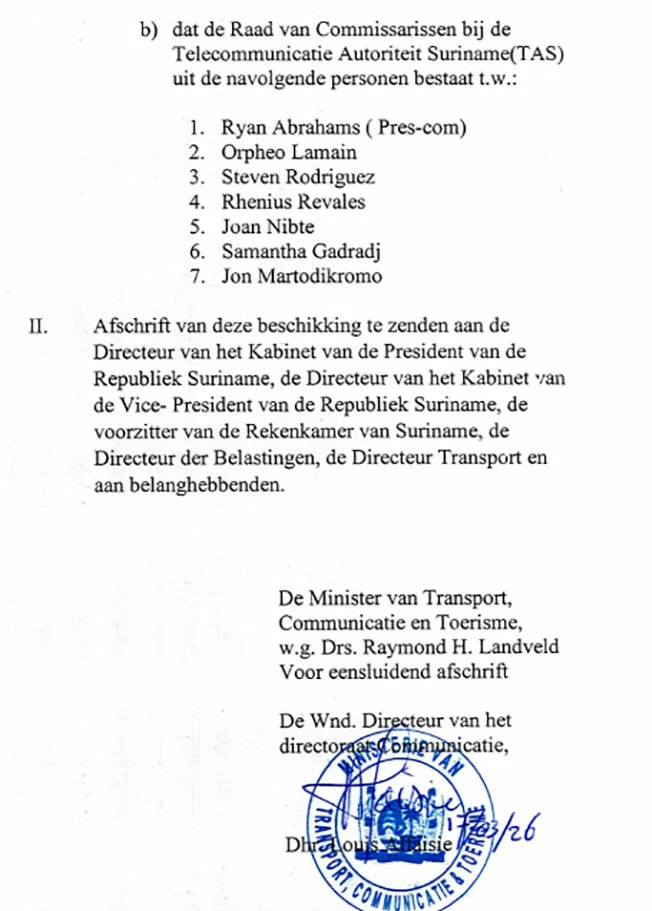
  • Ryan Abrahams officieel benoemd bij TAS, maar functie gaat naar Scheek

    Ryan Abrahams officieel benoemd bij TAS, maar functie gaat naar Scheek

    Political circles in Suriname are abuzz with speculation after conflicting appointments to the key leadership post of the Telecommunicatie Autoriteit Suriname (TAS) created an unprecedented administrative and political controversy.

    In February 2026, an official ministerial decree from Suriname’s Ministry of Transport, Communication and Tourism formally named Ryan Abrahams as the new president-commissioner of the TAS Board of Commissioners, effective February 5. That same order also granted an honorable discharge to the outgoing officeholder, Donaghy Malone, with official gratitude extended for his past service to the regulator. The decree explicitly outlined the full composition of the new board, confirming Abrahams in the top leadership role.

    However, in a sudden and unpublicized shift, Emanuel Scheek has now been installed in the same president-commissioner position. Crucially, no public announcement has been made confirming that the original 2026 ministerial decree appointing Abrahams has been formally revoked, leaving the legal status of both appointments and the TAS board’s leadership in uncertainty.

    The confusion has been amplified by the recent political appointment of Ryan Abrahams’ father, Ramon Abrahams — who also serves as vice-chair of the National Democratic Party (NDP) — as a state advisor just two weeks prior. The elder Abrahams has publicly denied any involvement in building the current ruling coalition, only re-emerging in public political life over the past fortnight after an extended period out of the spotlight.

    Local media outlet Starnieuws has confirmed that Suriname President Jennifer Simons is scheduled to hold a closed-door meeting with Ryan Abrahams on the day of the report. As of press time, no details have been released about what topics will be on the agenda for the discussion. To date, no government official or TAS representative has issued an official statement explaining the sudden leadership change or clarifying the conflicting appointments, intensifying ongoing political speculation across the country.

  • Tribute in Haiti to nurses

    Tribute in Haiti to nurses

    On May 12, 2026, Haiti’s Ministry of Public Health and Population (MSPP) joined national health institutions, international organizations, and government bodies to celebrate International Nurses Day, centering the 2026 observance on the theme “Our nurses. Our future. The power of nurses to act saves lives.” The official commemorative ceremony was held at the MSPP’s nursing directorate, drawing a high-profile guest list that included Public Health Minister Dr. Bertrand Sinal, Minister for the Status of Women Pedrica Saint Jean, top executives from the MSPP and the National Ambulance Center (CAN), and delegated representatives from the Pan American Health Organization/World Health Organization (PAHO/WHO), UNICEF, and the Panos Institute.

    In her opening address to attendees, Carine Reveil Jean Baptiste, Director of the MSPP Nursing Directorate, extended formal congratulations to every nurse practicing across Haiti’s public and private health systems. She highlighted the consistent, often underrecognized work of nursing staff to elevate care standards and advance population well-being, even amid systemic and national challenges.

    Gabriel Timothée, Director General of the MSPP, followed with remarks emphasizing the irreplaceable role nurses hold in keeping the national health system functional. He reminded the audience that nurses remain on call day and night at patient bedsides, delivering consistent care with unwavering professionalism and commitment to their mission.

    Minister Dr. Sinal used the occasion to reaffirm that nursing workforce issues have been a top policy priority since he assumed his role at the head of the public health ministry. He shared tangible progress on this commitment, noting that nearly half of all recent senior and frontline staffing appointments published by the ministry have been for nursing positions, signaling the government’s investment in strengthening the nursing workforce.

    As a key component of the national celebrations, the General Directorate of the Office of Workplace Accident, Sickness and Maternity Insurance (OFATMA) issued a formal statement paying tribute to Haiti’s nurses. The statement acknowledged that nurses carry out their daily work with remarkable professionalism, courage, and humanity while serving OFATMA beneficiaries and the broader Haitian population. It noted that despite severe socioeconomic and security challenges that define Haiti’s current national context, nursing staff continue to fulfill their duties with extraordinary dedication, compassion, and a relentless sense of duty, framing their work not merely as an occupation, but as a life-giving vocation. OFATMA closed its statement by expressing profound gratitude for nurses’ exemplary commitment and their irreplaceable contribution to the country’s social and health protection systems.

    Minister Pedrica Saint Jean, who leads the Ministry for the Status of Women and Women’s Rights, also delivered a formal address honoring Haiti’s nursing workforce, the majority of whom are women. She paid respect to the courage, dedication, and professionalism that nurses demonstrate daily while caring for populations across the country, often working in underresourced, challenging conditions. Saint Jean described nurses as the foundational force holding Haiti’s healthcare system together, noting that they carry out a fundamental human and social mission: to treat, comfort, listen to, and save the lives of Haitian citizens. From major urban hospitals and local clinics to rural maternity wards and isolated remote communities, and in the midst of ongoing public health emergencies, their unwavering commitment stands as a powerful symbol of national solidarity and resilience. Saint Jean closed by reaffirming her solidarity with all Haitian nurses, thanking them for their invaluable contribution to the health, dignity, and well-being of the Haitian people, ending with the tribute: “Honor and Merit to Haitian nurses, guardians of life and human dignity.”

  • Presentation of 308 internship letters to graduating students of the École Normale Supérieure of Haiti

    Presentation of 308 internship letters to graduating students of the École Normale Supérieure of Haiti

    In a formal ceremony held earlier this week, Haiti’s Minister of National Education Vijonet Déméro formally delivered 308 internship placement letters to the leadership board of the École Normale Supérieure (ENS), marking a key step in strengthening the country’s public secondary education workforce. The internship placements are reserved for ENS graduating students who are preparing to complete their final requirements for official teacher certification.

    Addressing attendees at the event, Minister Déméro opened by praising the participating students for their long-standing dedication to Haiti’s education sector and their willingness to pass on their expertise, technical skills, and professional standards to the next generation of learners. He emphasized the critical role the new interns will play in supporting secondary education across the country, urging them to approach their assignments with rigor and serve as thoughtful, effective mentors for high school and secondary students.

    The minister also outlined the clear framework governing the three-month posting, including defining the legal rights and core responsibilities of the interns, as well as the specific oversight roles of three key participating bodies: ENS’s board of directors, local school administrations, and Haiti’s 10 regional Departmental Directorates of Education (DDE). At the conclusion of the 12-week placement, each intern is required to submit a comprehensive final report, which will serve as a mandatory component of their evaluation for earning a fully accredited teacher training diploma.

    Beyond the internship initiative, Déméro used the ceremony as a platform to announce progress on a broader push to formalize Haiti’s public education workforce. To date, he confirmed, he has signed more than 600 official appointment letters for newly hired teachers and school principals across all 10 DDE regions, filling long-vacant roles at national primary and secondary schools. Moving forward, the ministry plans to regularize the employment status of an additional 1,200 under-contract teachers in the coming months, with the pace of the process tied to available government funding for education.

    Dieuseul Prédélus, rector of the State University of Haiti (UEH), which oversees the École Normale Supérieure, praised the Ministry of National Education’s sustained commitment to integrating more qualified, formally certified personnel into Haiti’s public education system, noting that the move will help address long-standing staffing gaps and improve learning outcomes for students across the country.

  • PPP calls US congresswoman’s rebuke of Venezuela’s interim President “forceful”

    PPP calls US congresswoman’s rebuke of Venezuela’s interim President “forceful”

    On Tuesday, May 12, 2026, Guyana’s governing People’s Progressive Party Civic (PPPC) publicly praised a forceful statement from U.S. Republican Congresswoman María Elvira Salazar backing Guyana’s territorial sovereignty amid escalating tensions with Venezuela over a long-running border dispute. Salazar, who chairs the House Foreign Affairs Subcommittee on Western Hemisphere Affairs, made her remarks on the social platform X one day after Venezuelan interim president Delcy Rodriguez delivered a provocative address to the International Court of Justice (ICJ) during oral hearings on the merits of the border case.

    During her Monday appearance before the United Nations’ highest judicial body, Rodriguez doubled down on Venezuela’s rejection of any ICJ ruling on the validity of the 1899 Arbitral Tribunal Award that established the current land boundary between the two South American nations. She insisted that the 1966 Geneva Agreement—signed by Venezuela and the United Kingdom shortly before Guyana gained independence—remains the only legally valid framework for resolving the dispute through bilateral negotiations. Rodriguez warned that any ICJ judgment on the 1899 award would not resolve tensions, stating, “No judgment by this court on the territorial controversy will provide a definitive solution acceptable to both parties. On the contrary, it will exacerbate the differences between the parties, and will lead the parties to entrench themselves in their respective positions, distancing them from the practical, satisfactory and mutually acceptable settlement to which they committed in 1966 by signing the Geneva agreement.”

    Salazar pushed back sharply against Rodriguez’s comments and her repeated threats to Guyana’s territorial integrity in her X post. She argued that Rodriguez mistakenly believes she can manipulate U.S. President Donald Trump the same way she and former ousted Venezuelan president Nicolás Maduro “tricked and destroyed” Venezuela. “Delcy should stop threatening Guyana and start learning from it,” Salazar wrote. She also warned Rodriguez against sending confidential correspondence to President Trump, emphasizing, “You don’t deal with him through secret letters while trying to steal territory from a free and sovereign nation like Guyana.”

    Beyond addressing the border dispute, Salazar commended Guyana’s prudent management of its new oil wealth, noting that in less than a decade, the South American nation has set a stark contrast with Maduro’s regime in Venezuela. “Unlike the Maduro regime, Guyana didn’t rob its people. They managed their oil wealth responsibly, created a sovereign wealth fund, and saw GDP per capita quadruple in just five years,” she added.

    As of Tuesday, Guyana’s national government had not issued an official public response to Salazar’s social media statement. The ICJ is on track to issue its binding ruling on the border dispute by the end of 2026 or in the first quarter of 2027, a decision that will shape the future of regional security and territorial claims in northeastern South America.

  • Religieuze organisaties krijgen grondpapieren voor sociale projecten

    Religieuze organisaties krijgen grondpapieren voor sociale projecten

    After nearly two years of waiting for official approval, Suriname’s Sanatan Dharm religious organization has become the first recipient of land allocation documents from the national government, unlocking the green light for a slate of impact-focused community development projects. The formal handover ceremony took place Tuesday at the Cabinet of the President, where Suriname President Jennifer Simons presented the official land papers to representatives from the organization.

    Sanatan Dharm board chair Sherwankoemar Ramsoedit described the long-awaited approval as a transformative breakthrough for the group, which had seen all planned development work stalled for months without the official land disposition. “In one word: wonderful. It could not have gone any better,” Ramsoedit shared in a statement via Suriname’s Communication Service (CDS).

    The organization has outlined a multi-faceted community service plan for the newly allocated land, including a full vocational training institute, a senior citizen care shelter, and an outpatient polyclinic that will provide routine health screenings and blood testing services for local residents. These facilities are designed to form the core of a broader public welfare initiative that will serve vulnerable communities across the region.

    Ramsoedit emphasized that the approval process had stretched on for between 18 and 24 months, and the absence of official land documentation left the organization unable to move forward with any concrete construction or planning work. On behalf of the Sanatan Dharm board, he extended his gratitude to President Simons and Hanisha Jairam, whom he credited with playing a critical role in facilitating negotiations and moving the application process forward.

    Moving forward, the organization’s leadership will turn its full attention to detailed project planning and the next stages of development. Per Ramsoedit, President Simons has committed that the national government will continue coordinating with relevant ministries and regulatory bodies to support the organization in completing the remaining procedural steps for the project, ensuring the community services can open their doors to residents as soon as possible. This land allocation launch marks the start of a national government program to distribute land disposition approvals to religious groups across the country for public projects including shelters, orphanages, and cemeteries.

  • HPV Vaccine Rollout Sparks Renewed Church-State Clash in Schools

    HPV Vaccine Rollout Sparks Renewed Church-State Clash in Schools

    A decade after Belize first introduced the human papillomavirus (HPV) vaccine into its national public health portfolio, a long-simmering dispute between government health authorities and the country’s Catholic Diocese has reignited, putting life-saving immunization access for thousands of primary school girls at the center of a battle over institutional authority, religious values, and public health priorities.

    HPV, a widespread sexually transmitted infection, is conclusively linked to 70% of all cervical cancer cases as well as multiple other aggressive cancers. In 2016, Belize launched its national school-based HPV vaccination program targeting girls aged 9 to 13, a window recommended by the World Health Organization (WHO) to ensure protection before potential exposure to the virus. The initiative was a direct response to a grim public health reality: Belize has long recorded one of the highest cervical cancer mortality rates in Central America, a statistic public health officials have worked for a decade to reverse.

    Dr. Marvin Manzanero, Belize’s Director of Health Services, explained the program’s design in a 2016 briefing that remains relevant to the current rollout. “The WHO suggest that we should be vaccinating girls nine to thirteen years that is before they start to have sexual life. But we had to establish a cohort as we are introducing this and based on the attendance rate that we have from schools, which is where most of the girls of this age group are, the standard four classrooms are the ones being selected.” The current vaccine used in the program protects against strains 16 and 18 of HPV, the two high-risk variants responsible for the majority of cervical cancer diagnoses, Manzanero confirmed. Health officials note that meaningful reductions in cervical cancer mortality will take decades to emerge, as the disease develops slowly over 10 to 15 years after infection.

    This year’s scheduled nationwide immunization round has brought the long-running conflict back to the forefront. Citing longstanding policy established under former Bishop Dorick Wright, the Catholic Diocese has drawn a hard line against hosting the vaccine program in its schools. The Diocese oversees 110 of Belize’s 314 primary schools, meaning nearly 35% of the country’s primary school-aged girls could be blocked from accessing the free, school-based immunization offered through the national program.

    Not all Catholic-affiliated schools are aligning with the Diocesan directive, however. St. Martin De Porres RC School, a Jesuit institution operating outside Diocesan governance, is moving forward with its scheduled May 27 vaccination clinic for Standard Four students, aligning with the national public health schedule. The split reveals growing internal division within Belize’s Catholic community over how to balance institutional religious values with the health needs of students.

    Public health advocates have repeatedly emphasized the vaccine’s life-saving value. The Office of the Special Envoy for the Development of Families and Children issued a formal statement labeling HPV vaccination a critical intervention to protect children from HPV-related life-threatening diseases, including cervical cancer. Despite the public debate, however, none of the key stakeholders—including the Catholic Mission, Ministry of Health and Wellness, Ministry of Education, and Office of the Special Envoy for Women and Children—agreed to on-the-record interviews or clarification about the long-term impacts of the Diocese’s objection for affected students.

    As the scheduled rollout approaches, the stakes of the standoff have grown increasingly clear. Ten years into the program, public health officials anticipated steady progress toward expanding protection and reducing future cancer rates. Instead, access for thousands of eligible girls remains uncertain, with years of planned public health progress hanging in the balance. What was framed as a disagreement over institutional authority has ultimately placed the health of a generation of young Belizean women at the center of an unresolved church-state divide.

  • Teachers, Students and Parents Fight Back Against Scorching Temperatures

    Teachers, Students and Parents Fight Back Against Scorching Temperatures

    As a punishing heat wave continues to grip Belize in May 2026, K-12 campuses across the country have been pushed to their limits, with educators, families and school leaders banding together to implement urgent heat mitigation strategies to protect student health. At Burrell Boom Methodist School, one of the institutions on the front lines of this climate-driven challenge, sweltering classroom conditions have forced quick, creative adjustments to daily operations, even as the school community refuses to pause learning amid the crisis.

    Lincoln Jones, a teacher at Burrell Boom Methodist School, outlined the extreme conditions students and staff face on a daily basis. “We see that our students are sweating profusely. Even sweat drips off their faces onto their chins and their textbooks and assignment papers,” Jones explained. Despite opening all windows to draw in cross ventilation and being located on the upper floor of the school building, Jones noted that stagnant, hot air circulating through the classrooms leaves temperatures unbearably high, even with basic ventilation measures in place.

    To address the crisis, the school launched an informal “Beat the Heat” initiative centered on accessible, low-cost adjustments. All students are required to carry personal water bottles, and every classroom is equipped with a hot/cold water dispenser, which is now exclusively used to supply cold drinking water throughout the school day. The school has also repurposed its air-conditioned computer lab as a temporary cooling space, with teachers rotating their classes into the lab for scheduled cool-down breaks throughout the week. To reduce the risk of heat exhaustion and heat stroke, the administration has also banned strenuous running and outdoor physical activity on school grounds during peak heat hours.

    Parents have stepped up to support the school’s efforts, making their own adjustments to help children cope with the extreme conditions. Sherie Westby, a parent of a student at the school, shared that she prioritizes constant hydration to keep her child healthy. “A lot of showers before school and lots of water. I add ice to his insulated thermos to keep the water cold for longer, and he drinks continuously throughout the day,” Westby said. When she notices her child’s classroom is running low on supplies, she donates extra money to the school to purchase additional water for students. “It’s unbearably hot out there right now, but we don’t have a choice – they can’t miss out on school, so we do what we have to do,” she added.

    Belize’s Ministry of Education has acknowledged the growing crisis and responded with policy flexibility to support affected schools. The Ministry confirmed that campus administrators have submitted formal requests to adjust uniform policies (to allow looser, cooler clothing) and modify daily class schedules to avoid peak afternoon heat, and officials are encouraging school leadership to implement adaptive changes as needed to protect student well-being.

    This report is a transcribed excerpt from an evening television news broadcast, with Kriol-language dialogue rendered in standardized spelling for the online publication.

  • Basic Items Cost More Than You Think, Depending on the Store

    Basic Items Cost More Than You Think, Depending on the Store

    As persistent grocery inflation pushes household budgets tighter across Belize, consumers are shifting from simple spending cuts to targeted strategic shopping to offset rising costs. A new on-the-ground investigation from News Five’s Paul Lopez set out to answer a critical question that many budget-conscious shoppers overlook: does the choice of where you buy groceries make a meaningful difference to total monthly spending, even when buying the exact same products? To test this, Lopez visited five separate grocery outlets across Dangriga Town, comparing prices for 10 widely used everyday household and grocery items to measure just how large price discrepancies can be. What the investigation uncovered confirms that those differences are far from negligible – and over time, they can add up to hundreds of dollars in extra annual spending for average families.

    Lopez launched the hands-on comparison equipped with a standardized list of common staples, ranging from cleaning supplies to pantry items and baby care products. The full list included Axion dishwashing liquid (400ml bottle), Suavitel laundry detergent (1.9-liter bottle), Fab soap powder, garbage bags, Dak chopped ham, Mazatun canned tuna, aluminum foil, kitchen towel, Heinz baked beans, and double extra-large Huggies diapers. The price variations started emerging immediately with the first product tested.

    For the standard 400ml Axion dishwashing liquid, Family City Imports offered the lowest price at $2.50 per bottle. Neighboring Huang Chen Supermarket and smaller local outlet J Mart both priced the same bottle at $2.95, a 45-cent increase from the lowest option. The Price is Right Supermarket came in at $2.75, while New Hong Store charged the highest rate at $3.50 – a full dollar more than the lowest available price for the identical product.

    When it came to small tins of Dak chopped ham, Huang Chen and J Mart tied for the highest price at $4.50, while New Hong Store surprisingly offered the lowest rate at $4.25, a 25-cent difference. The investigation also found one consistent outlier: Mazatun brand canned tuna held a steady price of $2.75 across all five stores surveyed.

    For 1.9-liter bottles of Suavitel laundry detergent, available at four of the five locations, Huang Chen again posted the highest price at $7.50, with Family City Imports close behind at $7.25. J Mart offered the same bottle for $6.75, marking a 75-cent discount compared to Huang Chen and a 50-cent saving versus Family City.

    The gap grew even wider for a can of Heinz baked beans: New Hong Store charged the highest price at $4.50, while J Mart offered the same can for $3.75 – a 75-cent difference that puts New Hong’s price 20% higher for the identical product. All other surveyed stores landed below the $4.00 mark for this item. For a box of Fans Corn Flakes, Family City Imports priced it at $6.75, while New Hong Store sold the same box for $6.25. For a pack of double XL Huggies diapers, Family City charged $23.75, while The Price is Right sold the identical pack for $22.50, a $1.25 saving.

    The investigation’s core takeaway is clear: while a small number of branded products maintain consistent pricing across retail outlets, most everyday staples see significant price variation from store to store in Dangriga. For households working with tight budgets that require stretching every dollar, these small per-item differences add up to substantial total savings over a full grocery run. By strategically choosing which retailer to visit for different items, local families can cut their monthly grocery costs without changing the products they buy.