作者: admin

  • Two students among three injured in Cas En Bas vehicle-pedestrian collision

    Two students among three injured in Cas En Bas vehicle-pedestrian collision

    A devastating vehicle-pedestrian collision left three people injured, including two child pedestrians, in the coastal community of Cas En Bas, Saint Lucia, on the evening of September 18. Local news outlet St. Lucia Times has obtained first-hand on-scene video footage documenting the immediate aftermath of the tragic incident.

    Emergency response teams from the Saint Lucia Fire Service confirmed that they were dispatched to the accident site and arrived on scene around 5:40 pm that Friday. Preliminary information released by the fire service notes that the three injured individuals include two underage minors and one adult male.

    The on-site footage captured by witnesses clearly shows the two injured minor students — one male and one female — still clad in their school uniforms, lying motionless on the road with obvious, visible injuries from the impact. First responders detailed that the male student suffered severe trauma: a crushing injury to his left leg and noticeable deformity to his right leg. The female student was found to have suspected fractures to both her femur and pelvis. Both injured minors were rapidly airlifted and transported to a local medical facility to receive urgent, advanced emergency care.

    The third victim, the adult male involved in the incident, sustained a minor avulsion wound to the head. While he received on-site first aid, he refused recommendations to be transferred to a hospital for further examination and treatment.

    Following news of the collision breaking, residents of Cas En Bas and surrounding adjacent communities have raised growing concerns about unsafe road and driving practices across the area. Local community members are now issuing urgent calls for all motorists to slow down and exercise far greater caution when traveling through areas with high pedestrian traffic, particularly near school zones.

    As of the latest update, full details surrounding the circumstances leading up to the collision — including potential charges, speed estimates, and contributing factors — have not yet been finalized or released officially by emergency authorities. The Saint Lucia Fire Service has announced that it will publish a full official report with more comprehensive details once its on-scene investigation concludes. This remains a developing story, with new information expected to emerge in the coming days.


  • Cricket West Indies Announces Limited Overs Squads For The Tour Of India

    Cricket West Indies Announces Limited Overs Squads For The Tour Of India

    Cricket West Indies has officially revealed its national squads for an upcoming high-profile international tour against India, which will run from September 27 through October 18 across eight host cities. The tour, comprising three One Day Internationals and five T20 International matches, will see the Caribbean side, led by captain Shai Hope, face off against the top-ranked team in the world in both formats of the sport.

    For the ODI leg of the tour, the selection panel has opted to retain the core group of players that competed in recent home series against Sri Lanka and New Zealand, bringing continuity to the side. One key change sees opener John Campbell return to the roster, having been forced to miss the final two ODIs of the New Zealand series with a hamstring injury. Young batter Ackeem Auguste, who underwent surgery in August, has been ruled out of the tour to continue his post-operative rehabilitation, and his spot has been filled by Jewel Andrew, who provides the side with a flexible batting option capable of featuring in both the top and middle order.

    Fan-favorite Shimron Hetmyer, who featured in the closing two matches of the New Zealand ODI series, has been granted an extended recovery break following his participation in the recent Caribbean Premier League (CPL). He will remain available for selection and join the squad ahead of the start of the T20I segment of the tour.

    The opening two ODIs of the series mark the final matches of the current automatic qualification cycle for the 2025 ICC Men’s 50-Over World Cup. However, Cricket West Indies has already confirmed that regardless of the results against India, the side cannot climb past its competitors in the qualification standings, meaning the Caribbean team will compete in the ICC secondary qualifying tournament early next year to secure a spot in the main event.

    Despite this setback, West Indies head coach Daren Sammy has emphasized the critical value of the series for the team’s ongoing development. “Playing against the top team in the world presents us with a chance to fine tune and improve our performances as an ODI team which has seen quality performances across the cycle,” Sammy explained. “The series also creates a valuable platform to assess players who are stepping into important roles for this series with a long-term target of competing in the World Cup in 2027.”

    Turning to the T20I squad, the selection has been heavily focused on nurturing emerging talent for the 2028 T20 World Cup, with exciting young opening batter Kamil Pooran earning his first ever international call-up. The right-handed batter put in an impressive domestic performance ahead of his selection, scoring 273 runs across eight innings at a striking average of 39 and a blistering strike rate of 159.64. Quentin Sampson, who was part of West Indies’ squad at the 2024 ICC T20 World Cup held in India earlier this year, has also been retained in the squad, while experienced all-rounder Jason Holder has been given a rest for this tour to manage his workload.

    Sammy noted that the T20I squad has been constructed with an explicit long-term vision to build a competitive core for the next T20 World Cup cycle. “We are looking to build on the momentum from our series win against Sri Lanka, with the long-term goal of developing a strong core of players ahead of the next T20 World Cup,” he said. “The challenge of playing against the World Champions will provide valuable preparation, allowing us to continue improving and developing both individually and as a collective unit.”

    The full West Indies traveling party will depart the Caribbean on September 21, and is scheduled to arrive in the Indian city of Trivandrum on September 23, two days ahead of the opening match of the tour.

  • Too “Overworked” to Track a Gun? Matura Questions Police Inaction

    Too “Overworked” to Track a Gun? Matura Questions Police Inaction

    A prominent Belize City attorney is pushing to get a dangerous loose weapon off the streets of Belize after law enforcement failed to follow up on a clear lead, in a case that shines a light on gaps in local police work.

    Audrey Matura, a legal professional based in the nation’s Belize District, is putting up $2,000 in cold cash for the anonymous return of her legally registered firearm, which was stolen from her private residence during a burglary more than a year ago. The theft was carried out by Prince Copious, a handyman Matura had hired to conduct routine maintenance work at her home. When Matura left the country to spend the Easter holiday away from Belize City, Copious broke into her unoccupied property and made off with multiple valuables: the licensed gun, a collection of personal jewelry, her son’s school bag, and a private set of knives owned by the young man.

    Copious was eventually caught and prosecuted for the break-in. He pleaded guilty to the burglary charges and was sentenced to 10 months of incarceration, but none of the stolen property—including the weapon—has ever been recovered by authorities.

    After law enforcement failed to track the firearm, Matura launched her own investigation into where the gun could be. From conversations with Copious, she learned that after stealing the weapon, he transported it to Belmopan and handed it over to an individual known only by the first name “Will.” Matura turned this critical tip over to the Belize Police Department, but she says the lead has never been properly pursued.

    Speaking to local outlet News 5, Matura questioned why police have not prioritized recovering the unregistered loose weapon, suggesting understaffing and overwork may be to blame for the inaction. “I don’t know if they [police] don’t see the importance of tracking every weapon,” she said. “I guess they’re overworked.”

    For Matura, the greatest risk is that the stolen gun remains circulating in public, unaccounted for. “My main concern with the gun is that it is still out there,” she explained. “From my end, I would want to get it off the street. I feel terrible about that. I feel that as a citizen, it was my responsibility to protect that even more. And I would hate to think that that gun is used to hurt other people, to damage and steal from other people.”

    To remove this public safety threat, Matura has announced the $2,000 reward, with a guarantee that anyone with information or possession of the firearm can return it without any legal repercussions or requirement to reveal their identity. “I am offering a reward of $2,000, no questions asked, for the return,” Matura restated. “Return it however you want, and you get paid cash up front, no questions asked. My main thing is to get it off the street and back into the proper system.”

    All other stolen items from the 2025 burglary remain missing, but Matura has made clear that recovering the loaded firearm is her only urgent priority as she works to address the public safety hazard created by police inaction.

  • OECS congratulates St Kitts and Nevis on 43rd Independence Anniversary

    OECS congratulates St Kitts and Nevis on 43rd Independence Anniversary

    The Organisation of Eastern Caribbean States (OECS) has issued a formal message of congratulations to the Government and people of Saint Kitts and Nevis as the Caribbean federation marks its 43rd year of independence. In an official press release, the regional bloc notes that this milestone anniversary offers a meaningful moment for the island nation to take stock of decades of progress as an independent sovereign state, while also exploring new pathways to advance both national development and collective regional growth.

    In his independence address, OECS Director General Dr. Didacus Jules placed central emphasis on the role of unity, shared purpose, and collective action in building a prosperous future for Saint Kitts and Nevis. Echoing a famous quotation from activist and author Helen Keller, Dr. Jules stressed that collective collaboration is foundational to meaningful progress, remarking, “We live by each other and for each other. Alone we can do so little; together we can do so much.”

    This message aligns perfectly with the 43rd Independence theme chosen by Saint Kitts and Nevis this year: “One People, One Vision, Endless Possibility: Independence 43.” Dr. Jules highlighted that the theme perfectly encapsulates the collective spirit needed to write the next chapter of the federation’s development, by placing unity at the core of national advancement and acknowledging the transformative potential that emerges when a community rallies around a common goal.

    Dr. Jules also drew attention to the rich diversity that shapes the national identity of Saint Kitts and Nevis, pointing to the distinct historical trajectories of the two main islands, the varied makeup of local communities, and the enduring connections maintained by the federation’s large diaspora community. “These different experiences form part of a shared national story and demonstrate that diversity, when joined by a common sense of belonging and purpose, can be a source of enduring strength,” he said.

    The anniversary arrives at a critical juncture for Small Island Developing States (SIDS) across the globe, including those in the Eastern Caribbean. Dr. Jules noted that SIDS currently face a cascade of interconnected challenges, ranging from escalating climate impacts and economic volatility to shifting global trade and investment flows, rapid technological change, and growing geopolitical uncertainty. These demanding conditions, he argued, demand strategic foresight and adaptive governance, while also opening new doors for innovative approaches to building sustainable development, strengthening economic resilience, and empowering younger generations to lead.

    The OECS Director General went on to characterize Saint Kitts and Nevis as a valued and dedicated partner to the OECS regional integration movement. He emphasized that the federation’s active participation in collective regional initiatives strengthens the entire Eastern Caribbean, boosting the region’s capacity to address shared transnational challenges, advance sustainable development priorities, and amplify the collective voice of SIDS in global policy spaces.

    Concluding the official release, the OECS reaffirmed its warm congratulations to the government and people of Saint Kitts and Nevis. “May Independence 43 strengthen the bonds that unite Kittians and Nevisians at home and throughout the diaspora, and inspire continued progress, opportunity and prosperity for generations to come,” the statement read.

  • UN Questions Belize on Missing Persons

    UN Questions Belize on Missing Persons

    In a scheduled review of Belize’s compliance with the International Convention for the Protection of All Persons from Enforced Disappearance, the United Nations Committee on Enforced Disappearances has raised pressing questions about the Central American nation’s handling of hundreds of unresolved missing persons cases spanning 2019 to 2023.

    The Committee’s data collation shows that of the 589 missing person reports filed across that five-year window, 304 people were later located alive, 17 were confirmed deceased, leaving exactly 268 cases with no closure to date. In its official presentation to the committee, Belize’s government delegation asserted that the country has no officially recorded cases of enforced disappearance, a framing that has drawn targeted follow-up from the UN oversight body.

    Committee Chairperson Juan Pablo Albán Alencastro has formally requested Belize share up-to-date, disaggregated data on the outstanding 268 cases, including full updates on their investigation status through 2026. Despite the outstanding questions, Albán Alencastro did highlight one notable policy strength: Belize’s rule allowing members of the public to file missing persons reports immediately, with no mandatory waiting period. The chair characterized this policy as “very good” and noted it remains a rare practice among nations worldwide.

    Beyond the unresolved cases, the Committee also pushed Belize to address long-standing gaps in its domestic implementation of the convention. Belize formally acceded to the international treaty in 2015, but more than a decade later, it has yet to codify enforced disappearance as a distinct, standalone criminal offense under national law.

    Addressing this gap, Belize’s Permanent Representative Harold Young told the committee that the country’s cabinet gave formal approval to full domestication of the convention in June 2025, with formal legislative drafting scheduled to launch in June 2026. Young also acknowledged that Belize’s mandatory state report to the Committee was submitted past the deadline, attributing the delay to limited government resource constraints.

    On the topic of law enforcement training, the Belizean delegation confirmed that while regular police officers receive general human rights instruction as part of their standard training, no modules specific to responding to and investigating enforced disappearance cases are currently included. Work is underway to revise the national police training curriculum to add content focused on this specific offense, the delegation added.

    In broader context, Belize has recorded a total of 892 missing persons cases across the past several years. In 2025 alone, 99 people were reported missing across the country: official data shows 45% have been found safe, 4% were located deceased, and 47% remain open and under active investigation.

    The UN Committee is now wrapping up its review of Belize’s compliance and is expected to release official concluding observations, including targeted recommendations, in the coming weeks.

  • Caribbean Airlines Named Best Airline Staff in Central America and Caribbean

    Caribbean Airlines Named Best Airline Staff in Central America and Caribbean

    Trinidad and Tobago-based regional carrier Caribbean Airlines has earned top honors at the 2026 World Airline Awards, taking home the distinction of Best Airline Staff in Central America and the Caribbean. The award, presented by Skytrax, the international air transport rating organization, is determined annually through a global passenger satisfaction survey that gathers input from millions of travelers across the world.

    The carrier publicly celebrated the achievement this Friday, emphasizing that the recognition stands as a testament to the unwavering dedication, genuine warmth, and consistent professionalism of every member of its team. It also highlighted that the award would not have been possible without the trust and long-standing loyalty of its customers. In a heartfelt message to passengers, Caribbean Airlines stated, “This award belongs to you. Thank you for flying with us and for making this recognition possible.”

    Unlike broader airline awards that evaluate overall operational performance, this specific honor focuses exclusively on frontline employees, encompassing cabin crew, ground personnel, and airport staff. It assesses the quality of service delivered to passengers at every touchpoint of their travel journey, from check-in through to disembarkation.

    This latest accolade builds on a growing list of international honors for Caribbean Airlines, which has expanded its operational footprint to become a critical connector across the region. Today, the carrier operates an extensive route network linking popular destinations throughout the Caribbean to major markets in North America and South America. Headquartered in Piarco, Trinidad and Tobago, Caribbean Airlines has solidified its position as the leading regional carrier, bridging dozens of Caribbean island communities with key global travel hubs and supporting both regional tourism and economic connectivity.

  • Three to appear in court on robbery, firearm charges

    Three to appear in court on robbery, firearm charges

    Three men accused of a raft of criminal offences spanning armed robbery, violent assault and multiple driving violations are set to make their first court appearance this Saturday at Barbados’ District ‘A’ Criminal Court. The defendants, whose ages range from 22 to 34, hail from parishes across the country: 22-year-old Nathan Caleb Barker calls Citrus Drive in Workmans, St George home; 23-year-old Akeem Kareem Inniss resides on Bonwell Road, St Joseph; and 34-year-old Racaid Akeil Leroy Holder lists Orange Grove, St Joseph as his address. Court documents outline a string of overlapping allegations tied to two separate days of alleged criminal activity in mid-September. All three men face joint charges stemming from a September 12 incident in District ‘B’, where prosecutors say they brandished a firearm, carried out an armed robbery, and inflicted serious bodily harm on a victim. Just one day earlier, on September 11, Inniss and Holder are accused of working together to commit another armed robbery, again carrying a firearm during the offence. Beyond these joint allegations, Inniss faces an additional slate of five traffic-related charges connected to a separate September 12 incident in Belleplaine, located in District ‘F’. Prosecutors allege Inniss was operating a vehicle without valid insurance coverage, without a legally required driver’s license, and drove without reasonable care for other road users, including failing to exercise proper due care and attention while behind the wheel. He is also accused of failing to pull over and comply when law enforcement activated their emergency beacon and siren to stop him. Saturday’s arraignment will mark the first time all three men formally answer to the charges filed against them, opening the court process that will see the allegations tested in the criminal justice system.

  • The Dominican Republic registers a 2.9% increase in employment, reaching 5.27 million employed.

    The Dominican Republic registers a 2.9% increase in employment, reaching 5.27 million employed.

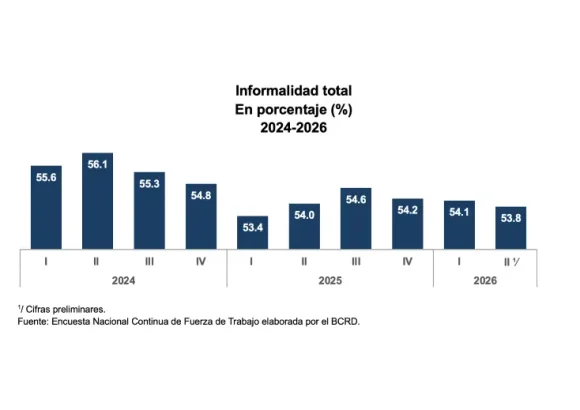
    New data from the Central Bank of the Dominican Republic (BCRD) reveals steady expansion of the country’s labor market in the second quarter of 2026, with key structural improvements showing progress in formalizing work opportunities across the economy. Data collected through the National Continuous Labor Force Survey (ENCFT), the country’s authoritative quarterly labor market tracking survey, puts total employed workers across the Dominican economy at 5,271,005 for the April-June period. This marks a 2.9% year-on-year increase, representing 147,456 net new jobs created compared to the same quarter in 2025.

    Two core labor market metrics, the employment rate (ER) and overall participation rate (OPR), landed at 63.2% and 66.8% respectively. Both figures remain near the survey’s historical highs, signaling that the Dominican economy is currently maintaining a high rate of workforce utilization.

    A breakdown of new job creation shows nearly even contributions from the formal and informal sectors over the 12-month period. Formal employment added 74,794 net new workers, accounting for 50.7% of total net job growth, while informal employment contributed the remaining 72,663 positions, or 49.3% of the overall increase. This balanced growth has pulled the national informality rate down to 53.8% in Q2 2026, which is 2.9 percentage points below the 56.7% historical average recorded across the ENCFT survey series dating back to 2014.

    The BCRD notes that the ENCFT is a rigorously designed probabilistic sampling survey, built to generate nationally representative and regionally disaggregated data on working-age adults’ engagement with the labor market, while also serving as a key data source for tracking national monetary poverty trends. The survey collects continuous data from a quarterly sample of 8,480 households across the country’s four major regions: Ozama (Metropolitan), North (Cibao), South, and East, with a 90% confidence level for all core labor indicator estimates.

    Demographic analysis of the current employed population shows 57% of workers are men and 43% are women. Notably, women accounted for the vast majority of net new job creation over the past year, taking 127,472 new positions, which represents 86.6% of all net jobs added between Q2 2025 and Q2 2026. Men contributed 19,714 net new jobs over the same period.

    On the unemployment side, the open unemployment rate – defined as the share of the active labor force actively searching for work – hit 5.3% in Q2 2026, a small 0.3 percentage point increase from the 5% recorded in the same quarter of 2025. The broader labor force underutilization rate SU3, a metric that includes both unemployed job seekers and workers available for work who are not actively searching (formerly called the expanded unemployment rate), also rose by 0.3 percentage points year-on-year to 8.7%.

    Analysis of labor market transition dynamics between Q2 2025 and Q2 2026 shows high stability for currently employed workers: 92.6% of people holding jobs in the second quarter of 2025 remained employed one year later. 5.9% of employed workers left the labor force to become economically inactive, while just 1.5% transitioned from employment to unemployment over the 12-month period.

    For unemployed workers, 44% successfully transitioned into paid employment within a year, 28.3% remained unemployed, and 27.7% exited the labor force to become inactive. Among the economically inactive population (people outside of the labor force), 81.3% retained their inactive status over the 12-month period, 15.9% transitioned directly into employment, and 2.8% began actively searching for work, driving small growth in the overall size of the country’s active labor force.

  • National Police arrest members of the criminal gang “Los 5.5” in Bajos de Haina

    National Police arrest members of the criminal gang “Los 5.5” in Bajos de Haina

    A major law enforcement operation in the Dominican Republic has resulted in eight alleged members of the violent criminal group “Los 5.5” being taken into custody, authorities confirmed this week. The arrests and voluntary surrenders unfolded in Bajos de Haina, a municipality located in the southern province of San Cristóbal, according to local National Police officials.

    Four of the detainees, identified as 22-year-old Ezequiel Adonis Peguero Méndez, also known by the alias “Chulito”; 24-year-old Richard Velázquez Mercedes, alias “Omar”; 18-year-old Juan David Araujo Martínez, alias “David”; and an underage individual, were already subject to active arrest warrants at the time of their apprehension. Three additional suspects – 24-year-old Luis Felipe Ventura, who goes by the aliases “Chano” and “Piyoyo”; 18-year-old Johnny Peña Castro; and 18-year-old Hostin Joanger Martínez, alias “Hostin” – opted to turn themselves in to law enforcement rather than remain at large.

    The eighth detainee, another teenager whose identity is being withheld to comply with Dominican legal protections for juvenile defendants, was caught red-handed during the commission of an alleged criminal act, investigators from the local police’s Investigations Division reported.

    All eight individuals are currently being held in police detention facilities, and will soon be transferred to the Public Prosecutor’s Office to begin formal legal processing. Law enforcement officials have emphasized that the investigation is far from over: teams are still working to map out the specific role each detained suspect played in alleged criminal activities, and are actively pursuing leads to identify any additional co-conspirators who may have links to the gang’s operations.

  • Are there venomous snakes in the Dominican Republic? Veterinarian explains what to do in case of a bite.

    Are there venomous snakes in the Dominican Republic? Veterinarian explains what to do in case of a bite.

    For most people, stumbling across a snake triggers an immediate instinct to flee, followed quickly by a panic-induced question: is this one poisonous? On the eve of International Snakebite Awareness Day, observed annually on September 19, a leading wildlife veterinarian has cleared up widespread public anxiety for residents and visitors of the Dominican Republic: the country hosts no snake species that pose a fatal threat to human life.

    Dr. Miguel Smith Cardona, a wildlife veterinary specialist, shared the key clarification in an interview with local outlet Hoy. “In the Dominican Republic, we do not have venomous snakes of medical importance to humans,” he explained. “That means we have no true vipers, rattlesnakes, or coral snakes capable of causing potentially deadly envenoming, which is a risk seen in many other countries across the Americas.”

    This official clarification does not mean the island nation is entirely devoid of snakes. In fact, around 25 distinct snake species make their home in the Dominican Republic, Dr. Smith Cardona confirmed. The existing population includes a range of native species, such as the Hispaniolan boa (Chilabothrus striatus), Ford’s boa (Chilabothrus fordii), the graceful boa (Chilabothrus gracilis), and the green vine snake (Uromacer oxyrhynchus), alongside additional species from the Uromacer and Hypsirhynchus genera. Other common native species are the Hispaniolan racer (Haitiophis anomalus), the Hispaniolan dwarf boa (Tropidophis haetianus), and multiple blind snake species belonging to the Typhlops genus. In total, the country is home to boas, racers, vine snakes, small dwarf boas, and subterranean blind snakes, each with unique biological traits and behavioral patterns.

    While none of these species carry life-threatening venom, that does not mean they will never bite, Dr. Smith Cardona cautioned. Most bites occur only when a snake feels threatened, trapped, or cornered, and reactions to bites vary by species.

    “The Hispaniolan, Ford’s, and graceful boas are constrictors, meaning they have no venom at all,” the specialist explained. “A bite from one of these boas would only cause mechanical injury: small wounds, minor bleeding, and localized pain.”

    For other native species, symptoms differ slightly. Some snakes from the Uromacer genus have rear-facing fangs and produce mild secretions that they use to paralyze small prey. In humans, these secretions can trigger mild local reactions including burning, numbness, or swelling, but these effects are never life-threatening and do not qualify as medically significant envenoming. Species like Hispaniolan racers typically prioritize fleeing when they encounter humans, and will only bite if they are picked up or trapped. Dwarf boas are small and reclusive, while Typhlops blind snakes are tiny, live almost exclusively underground, and almost never interact with humans.

    Even without the risk of fatal poisoning, Dr. Smith Cardona emphasized that any snake bite should be treated with proper care. “For bites from boas and other non-venomous species, you will mostly see wounds, pain, bleeding, and local inflammation,” he said. The recommended first step after a bite is to thoroughly clean the wound site, then seek a professional medical evaluation to address any risk of bacterial contamination or secondary infection. It is important to note that reaction severity can vary across species, so medical assessment is always recommended regardless of which snake caused the bite.

    Beyond bite safety, Dr. Smith Cardona also corrected a common misconception about snake behavior toward humans. “Snakes do not chase or attack people unprovoked,” he stated. “In every interaction with humans, the dominant instinct is to flee or defend themselves only when threatened, not to actively pursue or attack.”

    International Snakebite Awareness Day was launched to draw global attention to the public health risks of snake bites, which affect millions of people worldwide each year. Dr. Smith Cardona’s clarification aims to reduce unnecessary fear of snakes in the Dominican Republic while educating the public on appropriate safety protocols for encounters.