作者: admin

  • US to Automatically Register Young Men for Military Draft Starting December

    US to Automatically Register Young Men for Military Draft Starting December

    After decades of operating a manual opt-in system for military conscription registration, the United States is preparing to implement a landmark shift: automatic enrollment for all young male citizens and eligible male permanent residents will begin this coming December.

    For more than four decades, the current Selective Service System has required men between the ages of 18 and 25 to complete registration on their own, typically via mail, online portals, or at local post offices. Failure to complete this step has carried penalties ranging from loss of federal student aid to ineligibility for certain federal government jobs. The new automatic framework will cut through this red tape by pulling identifying information directly from existing government databases, including motor vehicle departments and the federal student aid system, to complete the process without any action required from eligible individuals.

    U.S. defense officials say the change is designed to address long-standing gaps in the current system, where an estimated 10 to 15 percent of eligible men never complete their required registration. In the event of a national emergency requiring a rapid mass mobilization of troops, officials argue that a pre-populated, up-to-date roster of eligible personnel would cut down on delays and streamline the mobilization process.

    The policy shift has sparked debate across political and civil society circles. Advocates of the change frame it as a much-needed modernization of a Cold War-era system that has fallen out of step with 21st-century digital infrastructure. They note that automatic registration will eliminate the risk of penalties for young men who simply forget to complete the process, while ensuring the country maintains a viable conscription infrastructure if it is ever needed.

    Critics, however, have raised multiple concerns. Civil liberties advocates warn that the expanded sharing of personal data across government agencies increases the risk of data breaches and inappropriate government surveillance of young people. Others have pointed to the lingering gender inequality of the policy: currently, only men are required to register for the draft, a disparity that has faced repeated legal challenges in recent years. Some lawmakers have also questioned the necessity of the draft system entirely at a time when the U.S. relies on an all-volunteer professional military, arguing that resources spent on updating the registration system could be allocated to other pressing national security priorities.

    As the December launch date approaches, the Selective Service System is conducting final testing of its new data integration systems and preparing public outreach campaigns to inform eligible young men and their families of the upcoming change. Agency officials have confirmed that men who have already completed their manual registration will not need to take any further action under the new system.

  • Top 3 named for GIMIES People’s Choice

    Top 3 named for GIMIES People’s Choice

    Anticipation continues to grow across Saint Lucia’s vibrant tourism sector as the island prepares for its fourth annual Saint Lucia Tourism Awards, affectionately known as the GIMIES — a celebration designed to honor exceptional professionals who have elevated the island’s world-renowned visitor experience. This week, event organizers have fulfilled one of the industry’s most highly anticipated announcements, revealing the top three finalists for the award’s beloved public-voted People’s Choice category.

    Following weeks of a spirited, island-wide public online voting campaign, the three finalists, listed alphabetically, are Akim Francis, a chef with the popular local dining brand Bursting with Flavors (also known as 5 Star); Elver Descartes, a professional tour guide with adventure tourism operator ATV Direct; and Shervon Charles, owner and stable hand at Unique Stables. Each of these standout professionals earned their spot in the top three by winning over both local residents and international tourists, who praised their unwavering passion for Saint Lucia, consistent dedication to service, and ability to create unforgettable, personalized travel experiences.

    Organizers also highlighted the hard work and meaningful contributions of the six other candidates who advanced to the nomination stage of the award. These contenders include Avelyn Joseph, owner of Happy Nest; Heidi St. Clair, owner of St. Clair’s Sitting Services; Iva La Toya Lewis, celebrity makeup artist behind Glamour Art By Toya; Kirk Elliot, community-based tourism entrepreneur with St Lucia by Kirk; Michel Gaspard, a freelance civil status marriage officer; and Ngugi Lucien, vegan chef at Grassrootz Vegan Cuisine. Each nominee shared their personal career journeys and demonstrated ongoing commitment to lifting up Saint Lucia’s tourism industry, organizers noted.

    The coveted People’s Choice Award winner will be revealed to the public on April 11, 2026, during the official GIMIES gala ceremony. For fans and supporters unable to attend the event in person, the entire ceremony will be streamed live via NTN and all official GIMIES social media channels. Organizers have encouraged community members and tourists alike to join online viewing parties to celebrate the achievements of the island’s top tourism professionals.

    Full details about the GIMIES awards, nomination history, and upcoming event can be found on the official awards website at www.thegimies.org. Updates are also posted regularly to the awards’ Facebook page @thegimies and Instagram page @the_gimies, and inquiries can be sent directly to the organizing committee via email at tourismawards@stlucia.org.

  • Leon Radix outlines reform agenda as GFA election nears

    Leon Radix outlines reform agenda as GFA election nears

    Grenada’s national governing body for soccer, the Grenada Football Association (GFA), has scheduled its upcoming presidential election for May 9, 2026. Three candidates will contest the leadership position: incumbent Marlon Glean, challenger Roger Duncan, a veteran banking professional, and third contender Leon Radix, an academic and long-time football administrator who currently serves as Course Director of the Marine and Wildlife Conservation Department at St George’s University’s School of Arts and Sciences.

    Radix has already formally introduced his full proposed executive slate for the GFA, naming Allan James, Lincoln Elcock, Amanda Scott, Clinton Hamilton, Geverson David, and Denroy Lewis as the team that would join him in leadership should he secure victory at the polls. In outlining his credentials for the role, Radix emphasized his deep, multi-decade roots in football governance across all levels of the sport in Grenada. Beyond his current academic and administrative career, he has previously managed both football and cricket teams for St David’s, held leadership roles with the St David’s Football Club and the St David’s Football League, and advocated for stronger institutional structures and greater accountability in Grenadian football for years. “I’m an educator and administrator with over 20 years of experience in leadership and governance,” Radix noted. “In football, I’ve worked at the club and national level advocating for better structure and accountability. I bring systems thinking and proven leadership to football development.”

    At the core of Radix’s campaign platform is a commitment to building a organized, inclusive, and sustainable football ecosystem across the island, replacing the current instability and inconsistency that he says has held the sport back. His vision calls for a clear, connected development pipeline that supports players from grassroots entry-level play all the way to elite national team competition, paired with robust institutional governance, competitive local leagues, and long-term stable financing. “Structure and sustainability must replace uncertainty and inconsistency,” he said.

    If elected, Radix has laid out three clear priorities for his first 100 days in office to reset the GFA’s operations. First, his administration would launch full financial, technical, and administrative audits of the association to map existing gaps and challenges. Second, it would host widespread engagement sessions with football stakeholders across every region of Grenada to center community input in future planning. Third, it would roll out a standardized national football calendar and a technical development plan aligned with global FIFA and CONCACAF standards. “The priority is restoring order and building confidence in the system,” Radix explained.

    To address longstanding divisions within Grenada’s football community, Radix proposes expanding inclusive decision-making through the creation of a new Football Advisory Council, which would reserve formal seats for representatives from clubs, players, referees, and corporate sponsors to ensure all groups have a voice in shaping the sport’s future. “Inclusion builds trust, and trust builds strong institutions,” he said.

    Grassroots development is another central pillar of Radix’s agenda, with two key focus areas: growing investment in youth player development and expanding access and opportunity for women in football. He plans to upgrade youth academies, increase access to certified professional coaching, and build clear pathways that connect school football programs to club development systems. For women’s football, he pledged consistent sustained investment, organized formal leagues, and equal opportunity for advancement. “Development must be inclusive or it will fail,” he stressed.

    Radix also committed to decentralizing football development to ensure talent in rural communities is not overlooked, saying he will establish regional zonal development hubs, expand national scouting networks, and provide greater support for local community-level competitions. “Talent is everywhere — opportunity must be too,” he noted.

    To scale the GFA’s capacity and secure additional resources, Radix says he will prioritize expanding strategic partnerships with regional and international football governing bodies, the local private sector, and the Grenadian national government. “Partnerships are critical to scaling resources and expertise,” he explained.

    For Grenada’s national teams, Radix argues that improved competitive performance will come from intentional structural reform, not luck. He plans to implement a standardized national talent identification system, reach out to engage Grenadian football talent living in the diaspora, and integrate modern coaching practices, sports science, and performance analytics into national team programming. “Performance is the outcome of good systems — not chance,” he said.

    Radix also made full institutional transparency a non-negotiable part of his platform, promising to publish annual audited financial statements, enforce strict governance policies, and maintain open, consistent communication with all football stakeholders. “Transparency is not optional; it is the foundation of trust,” he said.

    When asked about the most pressing challenges facing Grenadian football today, Radix acknowledged longstanding issues including limited funding gaps, inconsistent institutional systems, and insufficient infrastructure across much of the island. Even so, he expressed confidence that these problems can be resolved with intentional leadership and long-term planning. “But with proper leadership and planning, these are solvable problems,” he said.

    Closing his campaign outline, Radix emphasized that Grenada’s football community holds tremendous untapped potential, and that with the right leadership, structural reform, and accountability, the sport can be transformed to create life-changing opportunities for young Grenadians and benefit the entire nation. “Football in Grenada has tremendous potential. With the right leadership, structure, and accountability, we can transform the game and create opportunities for our youth and our nation. I’m ready to lead that transformation.”

    As candidates prepare for the vote, the 2026 GFA presidential election is expected to draw close attention from across Grenada’s football community, as stakeholders evaluate three competing visions for the future of the sport on the island.


  • “He’s Always There For You” Businessman and Entertainer Endorses Michael Joseph

    “He’s Always There For You” Businessman and Entertainer Endorses Michael Joseph

    A key political figure delivered a firm public endorsement during an Anti-Budget League Party (ABLP) campaign blitz held in a local constituency on Wednesday evening. The event, which brought together party activists and local supporters, served as a platform for the speaker to rally backing ahead of upcoming electoral contests. Organizers reported a strong turnout of engaged attendees, who turned out to hear the speaker’s remarks focused on the party’s policy priorities and local campaign pledges. A recorded video of the full endorsement speech has been made available for public viewing following the event. The campaign blitz forms part of the ABLP’s broader outreach strategy to connect with voters across different constituencies, build momentum, and communicate the party’s vision to the electorate ahead of polling day.

  • LIVE: Interview with Pat Aaron Part 1

    LIVE: Interview with Pat Aaron Part 1

    The submitted content for news processing only includes social media sharing options (Share, Tweet, Pin), a link to a hosted image, and no actual substantive news text. No details of a news event, statement, development, or report are included in the provided input. This means there is no verifiable news content to analyze, fact-check, or restructure into a complete news article. The image link provided is hosted at https://news-minio.triplec.cc/news/2026/04/10/6c40a26e58d9a264e7b55f06a1a77996.jpg, but no accompanying descriptive or factual content about a news story is included in the submission.

  • Bombers FC’s Davonne George nabs European Trial opportunity after standout tournament performance

    Bombers FC’s Davonne George nabs European Trial opportunity after standout tournament performance

    Northern Dominica’s football landscape is marking a major milestone, with the Bombers Football Club confirming that homegrown standout Davonne George has earned a coveted spot at the European Development Tour Trial hosted in Antigua from April 9 to 12.

    George secured this life-changing opportunity after a dominant performance at the recent Possie Cup Invitational tournament, where he walked away with both the tournament’s Most Valuable Player award and the Golden Boot for top goal-scoring. In an official press statement, the club highlighted that George’s consistent, high-impact displays across the tournament cemented his status as the most dominant and influential competitor in the event.

    Beyond being a personal achievement for George, this selection signals that a formal, reliable development pathway for emerging football talent is finally taking root in northern Dominica, the club explained. The Possie Cup Invitational was intentionally launched to create a high-stakes competitive space where local players can display their skills, gain international visibility, and advance to higher levels of the sport. George’s trajectory perfectly embodies the core mission of the tournament, with his consistent goal output, creative playmaking, and calm leadership under intense pressure catching the eye of international talent spotters.

    Organized by Antigua’s Jets Football Club, the upcoming European Development Tour Trial is structured to mirror the rigorous standards of professional European football. Attending players will participate in elite training drills, competitive exhibition matches, and formal assessments led by experienced international scouts and top-level coaches. For participants that exceed expectations, the trial also opens doors to potential contracts and development placements with European professional clubs.

    Bombers FC framed the work that led to George’s selection as part of a long-term regional development strategy, which includes building local competitive platforms like the Possie Cup, scouting and nurturing underrecognized young talent, and creating formal connections that link local players to international trials, athletic scholarships, and cross-border career opportunities. Coming off a strong second-place finish in the recent Under-18 season, the club has ramped up its efforts to help young athletes move from grassroots youth football to tangible professional advancement.

    The club’s football development initiative has also delivered broader benefits to the local Portsmouth community. Regional football events tied to the program have drawn teams, fans, and visitors from across Dominica and the wider Caribbean, boosting local economic activity for small businesses, street vendors, transportation services, and local hospitality operators. The club summed up this community impact in its statement, noting: “Investment in football is investment in community. As the game grows, so does opportunity, not just for players, but for everyone.”

    The development program has received consistent backing from a growing coalition of regional stakeholders, including Fenella Wenham Sheppard and Nicole Andrew of Island Travel, alongside a expanding network of partners dedicated to growing the sport in Northern Dominica. Beyond the immediate win for George, his journey is being held up as an inspiration for young aspiring footballers across northern Dominica, proving that pathways to international football advancement are increasingly accessible for local talent.

  • Heroes’ Welcome: Team Saint Lucia return with record medal haul

    Heroes’ Welcome: Team Saint Lucia return with record medal haul

    On Wednesday, April 8, the young aquatics athletes of Team Saint Lucia touched back down at Port Castries, welcomed by a raucous, heartfelt heroes’ welcome that capped off a history-making performance at the 2025 CARIFTA Aquatics Championships hosted in Martinique. Competing at the Pierre Samot Community Aquatic Centre, the team delivered a stunning new national record, clinching a total of 14 medals across age categories — one more than the 13 medals earned at the 2024 edition of the regional meet.

    Local supporters and senior government officials gathered at the port to cheer on the returning competitors, and celebration quickly turned to reflection at an official post-arrival press conference. Dr. Uralise Delaire, Permanent Secretary in Saint Lucia’s Ministry of Youth Development and Sports, opened remarks by extending sincere gratitude to the athletes, highlighting their relentless work ethic, unwavering commitment to the sport, and exemplary sportsmanship throughout the 10-day competition.

    “You have not only put Saint Lucia firmly on the regional aquatics map, but you have cemented our reputation as a standout competitor in the Caribbean,” Dr. Delaire told the team. “I want to congratulate each of you for your dedication, your resilience, and your discipline that made this historic result possible.”

    One of the meet’s standout stars was 12-year-old Sapphire Parks, who successfully defended her 11-12 girls’ age division title, capping an incredible meet that grew her career medal count from eight to 10 total. Over the course of the competition, Parks claimed gold in the 100m breaststroke with a time of 1:21.23 and silver in the 200m backstroke in 2:38.13. Her total haul for the 2025 championships ended at five gold, four silver, and one bronze, earning 88 overall points to lead the team’s individual rankings.

    Clivus Jules, the Ministry’s Director of Sports, shared a personal anecdote that illustrated the far-reaching impact of the team’s success beyond the medal table. “I had a whole house full of people gathered to watch the competition livestream, and my own kids were so inspired that my six-year-old has already asked to start swimming lessons,” Jules told the room. “You have done more for the growth of this sport than any policy or program could achieve in a decade — your work is already paying off for the next generation.”

    Gleaming with visible pride, Paula James, President of the Saint Lucia Aquatics Federation, called the team’s performance “phenomenal,” saying the personal effort she and other organizers put into the season paled in comparison to what the young athletes delivered for the nation. “For me, this weekend is all pride and joy,” James said. “What you accomplished for Saint Lucia is beyond anything I could have hoped for.”

    What makes the team’s historic achievement even more notable is the context in which it was earned: for years, Saint Lucia’s competitive swimmers have trained exclusively in a 25-meter pool, while CARIFTA and other elite regional meets are almost always held in a standard 50-meter Olympic-length pool. Even with this comparative disadvantage, the team has continued to outperform expectations year after year.

    But that training limitation is set to change in the coming years: work has already broken ground on a new National Aquatics Centre in Beausejour, located in close proximity to the existing Daren Sammy Cricket Ground, Beausejour Indoor Facility and National Tennis Centre. The Olympic-sized 50-meter pool for the new facility has already been delivered to the island, filling a gap that has long held local aquatics back.

    James noted that the purpose-built facility will be a game-changer for Saint Lucian swimming, opening new doors for future generations of competitors. “With this much-needed new home for our sport, the sky is the limit,” she said. While an official completion and opening date has not yet been announced, aquatics leaders across the country are optimistic that the new centre will elevate local competitive swimming to unprecedented new heights in the years to come.

  • Kamla Persad-Bissessar and regionalism

    Kamla Persad-Bissessar and regionalism

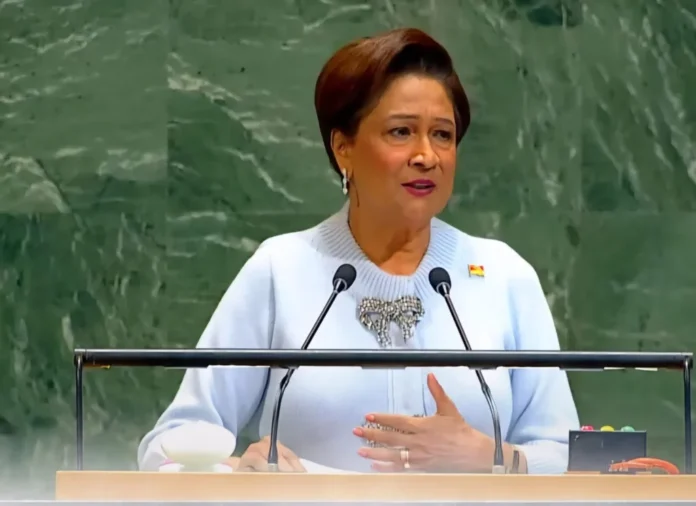
    In recent Caribbean political discourse, opposition leader Kamla Persad-Bissessar’s renewed campaign for Trinidad and Tobago’s exit from the Caribbean Community (CARICOM) – dubbed TREXIT – has sparked fierce debate over the future of regional solidarity. Critics have framed her populist, Trump-aligned approach as a false form of radicalism, arguing that her movement prioritizes alignment with imperial interests over the collective progress of Caribbean nations. As the late reggae icon Bob Marley once asked, who qualifies as a true revolutionary? Contemporary critics argue it is not those who seek to dismantle the Caribbean’s most vital indigenous institution in pursuit of promised material gains from foreign powers at the cost of regional unity.

    True regional radicalism, the argument goes, is not defined by loud, empty rhetoric about the bloc’s flaws. Instead, it centers on a commitment to radically reform CARICOM to better serve the interests of all Caribbean people. This approach requires core skills that Persad-Bissessar and her allied Foreign Minister Sobers are said to lack: thoughtful negotiation, intellectual rigor, and a foundational respect for the regional project that has bound Caribbean nations together for decades.

    Caribbean politics, critics insist, must shift toward a culture of building up regional institutions rather than tearing them down. They compare Persad-Bissessar’s TREXIT push to children in a playground who, unable to understand how their shared toys work, lash out and destroy even the most useful parts. Despite this destructive push, supporters of integration argue that Caribbean nations must continue strengthening their union through a coalition of countries committed to deeper integration. As the late Caribbean scholar George Beckford famously noted, the people of the Caribbean are already integrated – it is only politicians who have yet to recognize this fundamental truth.

    Even so, critics warn that TREXIT would represent a catastrophic policy mistake for Trinidad and Tobago (T&T) and the entire region. The current controversy surrounding the bloc has centered on a petty dispute over the appointment of a new CARICOM Secretary General, a fight made more hollow by reports that Persad-Bissessar was absent from the key meeting to discuss the appointment. Critics point out that her trip had little to do with CARICOM business at all: rather, she served primarily as a diplomatic envoy advancing Washington’s interests in the region.

    Behind the political posturing lies a stark economic reality: no other CARICOM member state, its businesses, or its people benefit more from the bloc and the Caribbean Single Market and Economy (CSME) than T&T. Smaller Organization of Eastern Caribbean States (OECS) nations face far greater structural disadvantages than more developed CARICOM members like T&T. These countries grapple with tiny domestic markets, underdeveloped manufacturing sectors, a lack of oil and mineral reserves, ballooning import bills, fragile financial systems, high exposure to global economic shocks, and limited skilled workforces. It was to address these gaps that the Caribbean Development Fund was created: to facilitate targeted investment, balance economic disparities between member states, and protect domestic and infant industries in smaller nations.

    Critics argue Persad-Bissessar is fully aware of the tradeoffs of her pro-Washington alignment: if she does not align with the agenda of the Trump-aligned political coalition, T&T could face steep new U.S. tariffs that would upend its lucrative bilateral trade relationship. In 2024, total bilateral trade between T&T and the U.S. reached $21.2 billion, driven by soaring demand for energy-related exports, petrochemicals, and refined fuels. Exports to the U.S. account for 43% of T&T’s total export volume, with mineral fuels and oils making up 34% of all exports and generating over 70% of the country’s total export earnings. The U.S. is already T&T’s largest single export partner, absorbing 29.5% of the country’s total outbound goods.

    Even the U.S. partnership, however, is outpaced by T&T’s trade advantage within CARICOM. T&T is the only CARICOM member that maintains a consistent positive trade surplus with the rest of the bloc. Recent data puts this surplus at $1.46 billion, with mineral fuels and oils accounting for 32% of T&T’s regional exports, followed by beverages (10.5%), cereal-based products (8.8%), and a range of other goods including fruits, vegetables, and plastics. Jamaica is T&T’s largest regional export market, taking 16.2% of its regional outbound goods, followed by Barbados (14.3%) and Suriname (8%). In stark contrast, T&T imports only $184 million in goods from other CARICOM members – creating a deeply lopsided trade dynamic that benefits T&T disproportionately.

    While some apologists for T&T’s position argue the imbalance is simply a result of other CARICOM nations’ reliance on T&T goods, critics note the dynamic is rooted in the bloc’s Common External Tariff (CET) arrangement, which requires member states to prioritize imports from community producers over cheaper global suppliers. In 2024 alone, other CARICOM nations collectively foregone an estimated $142.7 million in customs revenue by sourcing goods from T&T rather than cheaper non-regional suppliers under CET protections. This does not mean smaller Caribbean nations should launch an economic war against T&T, critics emphasize. Instead, this massive, decades-long collective sacrifice should inspire T&T’s political leaders to show greater respect for regional integration processes, institutional procedures, and their fellow Caribbean member states.

    If T&T were to exit CARICOM, the Caribbean Court of Justice (CCJ) has repeatedly reaffirmed the strict procedural requirements for member state suspension or withdrawal – a process T&T’s leaders are fully aware of, even as they continue their provocative posturing. A T&T exit would open the door for other Caribbean nations to source goods from cheaper global suppliers, rather than continuing to protect higher-cost regional producers in T&T. For decades, CARICOM’s CET framework has required member states to impose higher tariffs on non-bloc imports, raising overall import costs and forcing governments to give up significant customs revenue to support T&T’s economy.

    A clear example of T&T’s outsized advantages within CARICOM is energy pricing: T&T consumers and businesses pay far less for energy than OECS member states. T&T’s manufacturing sector also benefits from CET protections when importing inputs from non-CARICOM sources, with the exception of arrangements under the PetroCaribe Initiative. Many Jamaican manufacturers have even been forced to relocate production to T&T to access cheaper energy, undermining industrial development in other regional economies. Critics add that Persad-Bissessar’s support for Trump-aligned policy on Venezuela is explicitly designed to help T&T monopolize regional export production and lock in preferential trade access to the U.S. in exchange for political loyalty.

    While this approach may deliver short-term political and economic gains for T&T, it carries severe long-term risks for the country and the entire region. T&T’s current leadership has prioritized immediate political wins, but there is no evidence that this strategy will deliver sustained prosperity, particularly on pressing cross-border challenges like irregular migration and drug trafficking. By chasing quick, narrow gains, T&T is abandoning the long-term collective strength that deep regional integration can deliver for all Caribbean nations.

    Critics warn this is a fundamentally flawed strategy, noting that former President Trump has a well-documented pattern of abandoning his allies once they are no longer politically useful. High-profile former allies including Kristi Noem, Pam Bondi, María Corina Machado, and Mike Pence have all learned this lesson the hard way – and Persad-Bissessar could be next. As Caribbean scholar Justin Robinson correctly observed, the Caribbean’s greatest strength has always been its collective power. Washington does not benefit from a unified CARICOM with a cohesive, independent position on climate change, trade, and national sovereignty; instead, it benefits from a fragmented bloc of individual states that can be pressured and manipulated one by one.

    Compounding these economic and political tensions is a long-running dispute over foreign exchange for agricultural exporters from smaller Caribbean nations. For example, T&T purchases roughly EC$150 million in agricultural goods annually from St. Vincent and the Grenadines (SVG), but only EC$18 million of that sum is paid in U.S. dollars. The remainder is paid in Trinidadian dollars, which cannot be used for international trade outside T&T. Former SVG Prime Minister Dr. Ralph Gonsalves has repeatedly raised the issue, requesting that T&T set aside just EC$20 million in hard currency to resolve the impasse, but has yet to see any progress. Critics also point to T&T’s ongoing control and extraction of profits from regional airspace as another example of the country’s outsized influence within the bloc that goes largely unchallenged.

  • Zero ABST Initiative Begins Today on Food and School Supplies

    Zero ABST Initiative Begins Today on Food and School Supplies

    A targeted two-day government tax relief initiative has kicked off across Antigua and Barbuda, bringing the Antigua and Barbuda Sales Tax (ABST) down to zero for a broad selection of everyday essential goods, including staple food products and a full range of school supplies. Originally greenlit by the national Cabinet, the temporary policy will run exclusively on April 10 and 11, crafted specifically to ease growing household cost of living burdens by cutting retail prices for core necessities that families purchase regularly.

    The Inland Revenue Department has released official guidance outlining exactly which goods qualify for the full tax break. All food products falling under tariff codes 1000 through 2501 are included, with the popular packaged food category of biscuits specifically added to the eligibility list. For students and families preparing for schooling, the comprehensive roster of zero-rated school supplies covers nearly every common classroom need: pencils, markers, erasers, scissors, glue, pencil cases, construction paper, folders, binders, calculators, highlighters, shoes, crayons, coloured pencils, sharpeners, glue sticks, rulers, notebooks, index cards, binder sheets, pens, geometry sets, graph paper, school uniforms, school bags, general art supplies, information technology supplies, and home economics supplies.

    Not all goods are eligible for the tax cut, however. The department explicitly confirmed that several product categories remain excluded from the program and will retain their standard ABST rate. These excluded items include beer and other alcoholic beverages, tobacco products, manufacturing extracts, animal feed, and live plants.

    Regulatory guidance has also been issued to retail businesses participating in the program. Merchants have been directed to log all eligible zero-rated sales under the dedicated zero-rated line on the standard ABST 03 tax form to ensure compliance and accurate record-keeping.

    Economic analysts and local retail groups anticipate that the launch of this temporary relief measure will trigger a noticeable uptick in in-store and online shopping activity, as consumers rush to capitalize on the short window of lower prices for goods they need to purchase anyway.

  • DJ Bravo serves up new single, ‘Table’, on Santa Jamaica Riddim

    DJ Bravo serves up new single, ‘Table’, on Santa Jamaica Riddim

    International cricket legend Dwayne Bravo, who has successfully built a parallel career as a beloved musical entertainer, is breaking new creative ground with his latest musical release. Titled *Table*, the track appears as a standout cut on the energetic, rhythm-driven Santa Jamaica Riddim compilation from independent label Digital1 Muzic.

    Bravo has long been famous for his bold, outgoing personality that lights up both cricket pitches and public appearances off the field. But with *Table*, the multi-talented artist steps into an unexpected, more introspective creative space. The track delivers a playful but pointed critique of modern dating and relationship norms, centered around a simple, probing question that cuts through superficial social norms: What are you really bringing to the table?

    This release marks a clear evolution for Bravo as an artist, as he moves beyond the lighthearted “player” persona that has defined much of his past musical work to embrace a more grounded, thoughtful perspective on love, loyalty, and reciprocal partnership. Though the track carries a playful, upbeat tone that fits seamlessly into contemporary Caribbean playlists, it also digs into a deeper, underdiscussed social reality. In an era where superficial appearances and aesthetic appeal are often prioritized over deeper character in popular culture, *Table* acts as a thoughtful corrective, reminding listeners that women contribute far more to romantic relationships than just physical attractiveness.

    The single highlights the foundational importance of substance, emotional support, shared mindset, and positive energy – qualities that rarely make it into social media highlight reels, but are the core elements that sustain real connection and long-term, healthy partnerships. The track was co-written by Bravo alongside songwriter Tommy Sanchez, with production helmed by Richard “DIGITAL1” Roache and the 47 Productions team. Clendon Auguste handled the mixing and mastering process to polish the track’s sound.

    Recorded at 47 Studios in Bravo’s home country of Trinidad by 47 Ronzy, *Table* preserves the authentic, warm sound of Caribbean island music while crafting a message and rhythm that resonates with global audiences. Alongside the audio release, a full official music video, directed by Christian Burkett and Ian Davis of Audio Rose Productions, has been launched to visualize the track’s core message on screen.

    Released officially under the 47 Productions label, *Table* is designed not just as a song, but as a jumping-off point for important conversations around modern relationship dynamics. The single is available to stream right now on all major global streaming platforms, including Spotify, Apple Music, TIDAL, Amazon Music, and Deezer. The official music video is also available to view for free on YouTube.