作者: admin

  • Wereldhongerrapport waarschuwt voor stijgende ondervoeding en hongerrisico’s

    Wereldhongerrapport waarschuwt voor stijgende ondervoeding en hongerrisico’s

    On the first day of the Islamic holy month of Ramadan, displaced Palestinian families in Khan Younis, Gaza Strip, struggled to access donated food for their daily iftar meal that breaks the fast. The scene, captured in an Associated Press photograph, underscores the devastating reality of a global food crisis that has reached new alarming heights, according to the 2026 edition of the Global Report on Food Crises (GRFC).

    Published by a collaborative coalition of 18 international humanitarian and development organizations, the 2026 GRFC finds that the global count of people facing acute food insecurity remains at disturbingly high levels and continues to rise year over year. In 2025 alone, more than 266 million people across the globe experienced acute hunger, marking a small but concerning increase from 2024 figures and nearly doubling the total recorded in 2016.

    The report confirms that persistent conflict and widespread violence remain the single largest driver of acute hunger worldwide, responsible for pushing nearly 150 million people into food insecurity in 2025. Alongside armed conflict, extreme climate events and destabilizing economic shocks also act as major contributing factors that exacerbate food system vulnerability across low- and middle-income nations.

    In a historic and troubling milestone, 2025 marked the first time since formal global hunger monitoring began that famine was officially declared in two separate regions: parts of the Gaza Strip and Sudan. To meet the official classification of famine, at least 20 percent of households must face extreme food shortages, over 30 percent of the population must suffer from severe acute malnutrition, and hunger-related mortality must cross a critical threshold. In both regions, these grim benchmarks were surpassed in 2025.

    The Gaza Strip bore the worst burden of the crisis, with 640,700 people – 32 percent of its entire population – trapped in famine conditions, the highest proportional share recorded globally. Sudan followed close behind, with 637,200 people classified as facing famine, equal to 1 percent of the country’s total population. Smaller but still severe food crises were also documented in South Sudan, Yemen, Haiti, and Mali, where vulnerable communities face persistent risk of further deterioration.

    Beyond the regions officially declared to be in famine, more than 39 million people across 32 countries were categorized as being in the ’emergency’ phase of food insecurity in 2025, leaving them at sharply elevated risk of sliding into catastrophic famine conditions if current trends hold.

    Compounding this growing crisis, the report reveals that international funding for humanitarian food and development assistance dropped in 2025 to levels not seen since the 2016–2017 period. This funding shortfall creates a critical barrier to addressing expanding food insecurity across the world’s most vulnerable regions.

    Children and expecting or nursing women are among the most severely affected groups. An estimated 35.5 million children across 23 countries suffered from acute malnutrition in 2025, with nearly 10 million facing the most life-threatening form of severe acute malnutrition. Additionally, 9.2 million pregnant and breastfeeding women experienced severe undernutrition, putting both their own health and that of their children at long-term risk.

    The report also highlights the tight link between forced displacement and food crisis. Across 46 affected countries, a total of 85.1 million people were displaced by conflict and crisis in 2025, with 62.6 million displaced internally within their home countries and another 22.5 million fleeing to other nations as refugees or asylum seekers.

    Looking ahead to 2026, the GRFC warns that the global food security situation will remain critical in most high-risk regions. Escalating conflict in the Middle East is identified as a particularly significant threat, as it could disrupt global food and agricultural market systems, driving up prices and worsening access for vulnerable populations worldwide.

    The report concludes with a stark warning: without a coordinated, sustainable approach that addresses the root causes of global hunger, an entire generation of children will face lifelong impacts of chronic undernutrition, and the world’s most fragile nations will bear a disproportionate share of the burden of the worsening global food crisis.

  • Final four to battle for T10 title

    Final four to battle for T10 title

    The TCB Fusionz Boutique T10 Tapeball Tournament is approaching its decisive stage, with four top teams gearing up to battle it out this weekend for a coveted spot in the tournament’s championship final. The semifinal showdowns will all take place at the iconic Glebe Playing Field, kicking off this Saturday evening.

    The first clash of the night will pit Emmerton United against Blazers, with the first ball scheduled to be bowled at 8:00 p.m. Following the conclusion of that opening semifinal, the evening will close out with a second high-stakes match between Youth & Experience and A&A Strikers, as both squads look to secure their place in the final.

    The path to the semifinals was finalized earlier this week with the last round of preliminary round matches, which delivered two entertaining and lopsided results. In the first preliminary fixture, Inch Marlow secured a comfortable 32-run victory over A&S Stars. Batting first at the Glebe, Inch Marlow posted a competitive total of 101 runs for the loss of eight wickets. Jamar Phillips anchored the innings with a blistering knock of 33 runs off just 16 deliveries, while Kofie Hurdle contributed an unbeaten 19 runs off 13 balls to push the total past the 100-run mark. Shaquille Alleyne was the standout performer for A&S Stars with the ball, finishing with impressive figures of three wickets for just 17 runs.

    In response, A&S Stars struggled to keep up with the required run rate, folding for 69 runs for nine wickets. Kirsten Odane top-scored for the losing side with just 20 runs, while Renaldo Bourne delivered a devastating bowling performance for Inch Marlow, taking three wickets for only five runs.

    The second preliminary match, held this past Wednesday also at the Glebe Playing Field, saw A&A Strikers dominate Renegades to secure a massive 90-run win that booked their place in the semifinal lineup. A&A Strikers took the tactic of batting first and set an imposing target of 156 runs for five wickets, thanks to a destructive batting display from their top order. Joshua Morris smashed 39 runs off only 13 deliveries, while Wasim Vankad chipped in with a quickfire 28 runs off 10 balls to accelerate the scoring past 150. Even with the lopsided batting performance, Devaunte Brathwaite put in a valiant effort with the ball for Renegades, claiming three wickets for just 10 runs.

    Chasing a mammoth 157 runs to win, Renegades collapsed quickly against A&A Strikers’ bowling attack, being bowled all out for only 66 runs. Opener Renaldo Gibbons was the top scorer for Renegades with just 11 runs, capping off a disappointing batting performance. Joshua Morris, who starred with the bat earlier, proved equally damaging with the ball, finishing with three wickets for nine runs. Davien Branker and Sajid Hafejee supported the bowling effort by picking up two wickets apiece to seal the dominant victory.

  • MOE Issues Warning: Strangers Approaching Students

    MOE Issues Warning: Strangers Approaching Students

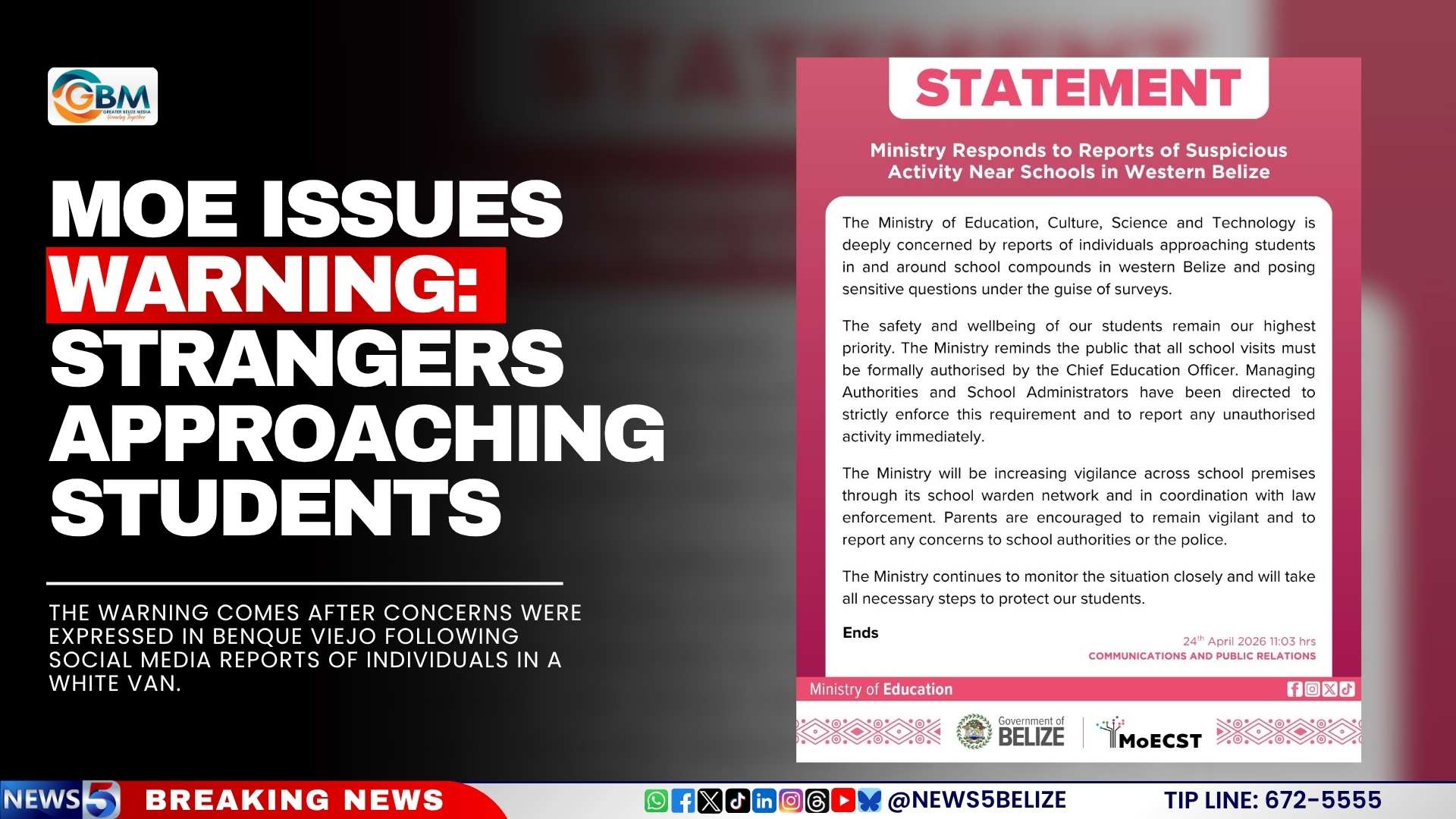
    In a recent public advisory dated April 24, 2026, Belize’s Ministry of Education (MOE) has issued an urgent warning to communities across western Belize following multiple reports of unknown individuals targeting students near school compounds. According to official accounts, these strangers have been approaching minors to ask intrusive, sensitive questions while hiding their true intentions behind the cover of conducting public surveys.

    The alert follows growing public anxiety in the town of Benque Viejo, where unconfirmed social media posts claimed a group of people traveling in a white van, who falsely identified themselves as Christian missionaries, had approached and harassed local children. These social media reports sparked widespread concern among parents and school administrators, prompting the MOE to issue a formal, public clarification and safety notice.

    In its official statement, the Ministry emphasized a clear regulatory rule: no outside individual or organization is permitted to enter or conduct activities on any school property in Belize without formal, written official approval. “All school visits must be formally authorised by the Chief Education Officer,” the statement read. The MOE has already issued formal instructions to all primary and secondary schools across the region to immediately report any unauthorized presence or suspicious activity to district education officials as soon as it is detected.

    To boost campus and surrounding area safety, the Ministry announced it will ramp up proactive monitoring and vigilance across all school premises. This expanded security effort will leverage the existing national network of school wardens, who will work in close coordination with local law enforcement agencies to patrol high-risk areas and respond quickly to reports of suspicious behavior.

    Officials are also urging parents and guardians across the affected region to remain extra vigilant, talk to their children about personal safety protocols, and immediately report any unusual encounters or suspicious behavior to school administrators or local police forces. The MOE has stressed that rapid reporting of potential threats is a critical part of keeping minors safe in school communities.

  • Students urged to rise above 11-plus stereotypes

    Students urged to rise above 11-plus stereotypes

    With just three weeks remaining until thousands of Barbadian students sit the high-stakes Common Entrance Examination, two veteran education experts are challenging deep-rooted generational stereotypes that tie future success exclusively to admission at one of the island’s historic, elite high schools. Their message ahead of the test is clear: individual effort, mindset and ambition—not school placement—shape long-term achievement.

    Dr. Shantelle Armstrong, an accomplished academic and entrepreneur who earned her PhD in management with a concentration in corporate governance via a CIBC scholarship in 2023, is speaking from personal experience to encourage this year’s cohort of test-takers. Speaking exclusively to Barbados TODAY, Armstrong emphasized that students should never allow projected school placement to define their potential. “You can achieve or try to achieve or seek to go to whatever school you choose… don’t let that define you… always do your best,” she said.

    For decades, 11-plus exam school placement has created a rigid social and academic hierarchy in Barbados that shapes how students, parents and even community members perceive ability—a bias that lingers long after students enter secondary school. Armstrong, who now runs her own consulting firm Strategic Governance Advisory Limited and serves as a director at her husband’s company KASA Maintenance Services Inc., has built a career that defies this long-held narrative. Her own academic record, which includes a first-class honors bachelor’s degree and a master’s degree with distinction, alongside peer-reviewed published research, serves as proof that institutional labels do not dictate outcomes.

    “Control over any form of success ultimately lies with the individual, not the institution,” she argued. “We all end up… at the same university, so all control is within… no other person’s hands. It’s really you that has control over your destiny. You define yourself… the school doesn’t define you. It really is not where you go, it’s what you do out there.”

    Armstrong acknowledged that harmful stereotypes still persist, and can erode the confidence of students placed at less celebrated institutions. “People still make them feel uncomfortable and make them feel as if a school defines you,” she said. “But you… have the control over you.” She added that her appeal extends beyond just students concerned about placement: even those who earn a spot at the country’s most prestigious secondary schools must prioritize consistent effort to succeed. “Even if you pass… You still have to do work,” she noted.

    Marcia Best, a retired primary school principal with 12 years of leadership experience at Eagle Hall Primary and Luther Thorne Memorial Primary, echoed Armstrong’s remarks, calling the pervasive ranking of Barbadian schools a “faulty mindset” passed down through generations. Best argued that the quality of education has no connection to a school’s location, physical campus or reputation. “Education has its value, and I don’t think the geographical location, the size, nor the actual building of the school has anything to do with the delivery of education,” she said.

    Drawing on her decades of experience nurturing young learners, Best stressed that every primary school across Barbados equips students with the tools they need to grow into productive, successful citizens, regardless of the institution’s reputation. “Our boys and girls… are nurtured… to be productive citizens of our country. So we see ourselves as mission builders,” she explained.

    She warned that the artificial divide between “prominent” and “ordinary” schools damages student self-perception and reinforces unfair social stratification. “Everyone is equal… but unfortunately this mindset has been fed to parents and the children themselves become a part of a faulty perception.”

    Addressing students who may already feel discouraged about potential placement outcomes, Best emphasized that daily effort and personal responsibility are the true drivers of success. She pointed to a long track record of inconsistent outcomes to back up her claim: some students at elite schools underperform, while many students at less well-known institutions outperform expectations and go on to thrive in higher education and careers. “There are children who will go to what we consider prominent schools and will come out equally qualified with those who would have attended the so-called less prominent schools,” she added.

    The conversation comes as Barbados engages in ongoing national discussions about comprehensive education reform, including proposals to eliminate the 11-plus Common Entrance Examination entirely. Best noted that shifting deep-rooted cultural perceptions will require more than just policy change; broad public outreach and sustained dialogue will be necessary to undo decades of intergenerational bias. “It’s going to be an uphill task… this whole idea has been passed from generation to generation,” she said.

    For the 2024 cohort sitting the exam in just three weeks, however, both Armstrong and Best are calling on students across the island to approach the test with confidence, set aside the pressure of stereotypes, and focus on their own individual potential.

  • $13 Million Worth of Drugs Destroyed

    $13 Million Worth of Drugs Destroyed

    In a major milestone for local anti-narcotics enforcement, law enforcement officials have carried out the destruction of one of the largest drug hauls seized in recent years, with an estimated total street value of $13 million. The operation, carried out in accordance with national drug control regulations, followed weeks of coordinated seizure activity across two key districts earlier this month. Police Commissioner Dr. Richard Rosado confirmed that the destroyed contraband included cocaine intercepted in Neuland, Corozal, and cannabis seized in the Lords Bank area.

    Under the framework of the Misuse of Drugs Act, law enforcement submitted a formal application to the local magistrate’s court to obtain approval for the destruction of the controlled substances. Rosado explained that the court granted the order after verifying that eliminating the narcotics would not compromise any ongoing criminal investigations or pending legal proceedings against suspects connected to the seizure. In total, authorities disposed of approximately 1,215.6 pounds of cocaine and 1,176.5 pounds of cannabis, marking one of the largest single-volume drug destruction operations in the region in recent memory.

    To ensure the operation went off without incident, heavy security protocols were implemented across every stage of the process. Assistant Commissioner Gualberto Garcia noted that uniformed officers were deployed at multiple locations along the transport and destruction route to secure the contraband and prevent any diversion or tampering. Garcia emphasized that large-scale destruction operations are a core part of the police force’s anti-drug strategy, even though this particular haul stood out for its unusually large volume.

    Despite the successful destruction of the narcotics, law enforcement investigations into the smuggling network behind the haul are far from over. Rosado confirmed that the probe is still ongoing and progressing as planned, with investigators now turning their attention to 15 containers of suspected aviation fuel and lighting equipment discovered in the Neuland area. Law enforcement officials suspect the equipment was intended to support cross-border drug smuggling operations, and additional arrests and seizures are expected as the investigation unfolds.

  • Forde stresses public’s child protection role as laws takes effect

    Forde stresses public’s child protection role as laws takes effect

    In a public briefing this week following the passage of new elder abuse legislation in Barbados’ Parliament, Social Services Minister Adrian Forde has issued a urgent, nationwide call for all Barbadians to serve as the frontline “eyes and ears” for child protection, clarifying that mandatory abuse reporting requirements have long been codified in the nation’s laws, and are not a new provision limited to the recently passed elder protection act.

    Speaking exclusively to Barbados TODAY, Forde outlined that the government is currently rolling out three landmark pieces of protection legislation covering vulnerable groups across the island – children, elder adults, and domestic abuse survivors. In the wake of public confusion sparked by the passage of the new elder abuse law this week, the minister took the opportunity to clear up widespread misinformation: similar mandatory reporting obligations already exist in existing child protection and domestic violence statutes, and the responsibility to safeguard at-risk community members does not fall solely on professional caregivers.

    Forde explained that while current law already requires designated professionals, particularly those working in healthcare and child services, to report suspected cases of abuse – with legal penalties for non-compliance – the government is now launching a broad public sensitization campaign to expand awareness of existing obligations among the general population.

    Under Barbados’ current child protection legislation, legal accountability is clearly established for any adult with custody, charge or ongoing care of a child. The law covers both intentional harm and failure to provide the basic care a child needs to thrive, and criminalizes a wide spectrum of abusive or neglectful actions. This includes direct physical or emotional abuse, exposing children to dangerous or harmful environments, failing to shield children from external threats, abandonment, desertion, chronic neglect, and any pattern of mistreatment. In essence, any action or inaction that leaves a child in need of formal state protection qualifies as a criminal offense under the law.

    Legal penalties for violations are intentionally steep to reflect the gravity of child cruelty. Offenders convicted through summary proceedings face a fine of up to $100,000, a 10-year prison sentence, or both. Crucially, the law imposes a proactive duty on caregivers to prioritize child safety, meaning that inaction when a child is in danger carries the same legal consequences as committing an intentional act of abuse.

    To address public concerns about wrongful reports, Forde emphasized that good-faith reports made by community members carry no legal risk. “If you make a report and it turns out your observation was incorrect, there are no repercussions. You will not face legal action,” he confirmed.

    When asked about unaddressed gaps or perceived “grey areas” in the current legal framework for child and vulnerable person protection, Forde acknowledged that no legislation is perfect from its rollout, and committed that the government will remain agile to adjust rules as implementation progresses. After the three landmark protection acts are fully enacted and rolled out, the government will collect on-the-ground data and feedback to identify areas for revision.

    “If additional protections are needed to address unforeseen edge cases or gaps, regulatory adjustments will be made to address those idiosyncrasies,” Forde said. “We are a listening government. We do not claim to be perfect. We will not get everything 100 percent right on the first attempt, but once we identify areas for review after rolling out the legislation, that is exactly what this government will do.”

    Closing his remarks, the minister struck a somber but resolute tone on the necessity of these strengthened protection measures. He acknowledged that the government would prefer to operate in a world where such strict protective legislation is completely unnecessary, but current societal realities require a firm legal foundation to safeguard vulnerable groups.

    “The journey of a thousand miles begins with a single step,” Forde noted. “As a government, we would far prefer not to bring Barbadians to court for violating legislation designed to protect the basic human rights of children. We would welcome a day when we no longer need this legislation at all – because that would be a day when there is no abuse. But we do not live in a perfect world.”

    Once all three protection laws are fully implemented, the government will conduct a full review of the framework based on real-world data and community feedback, and commit to taking targeted action to close any gaps that emerge.

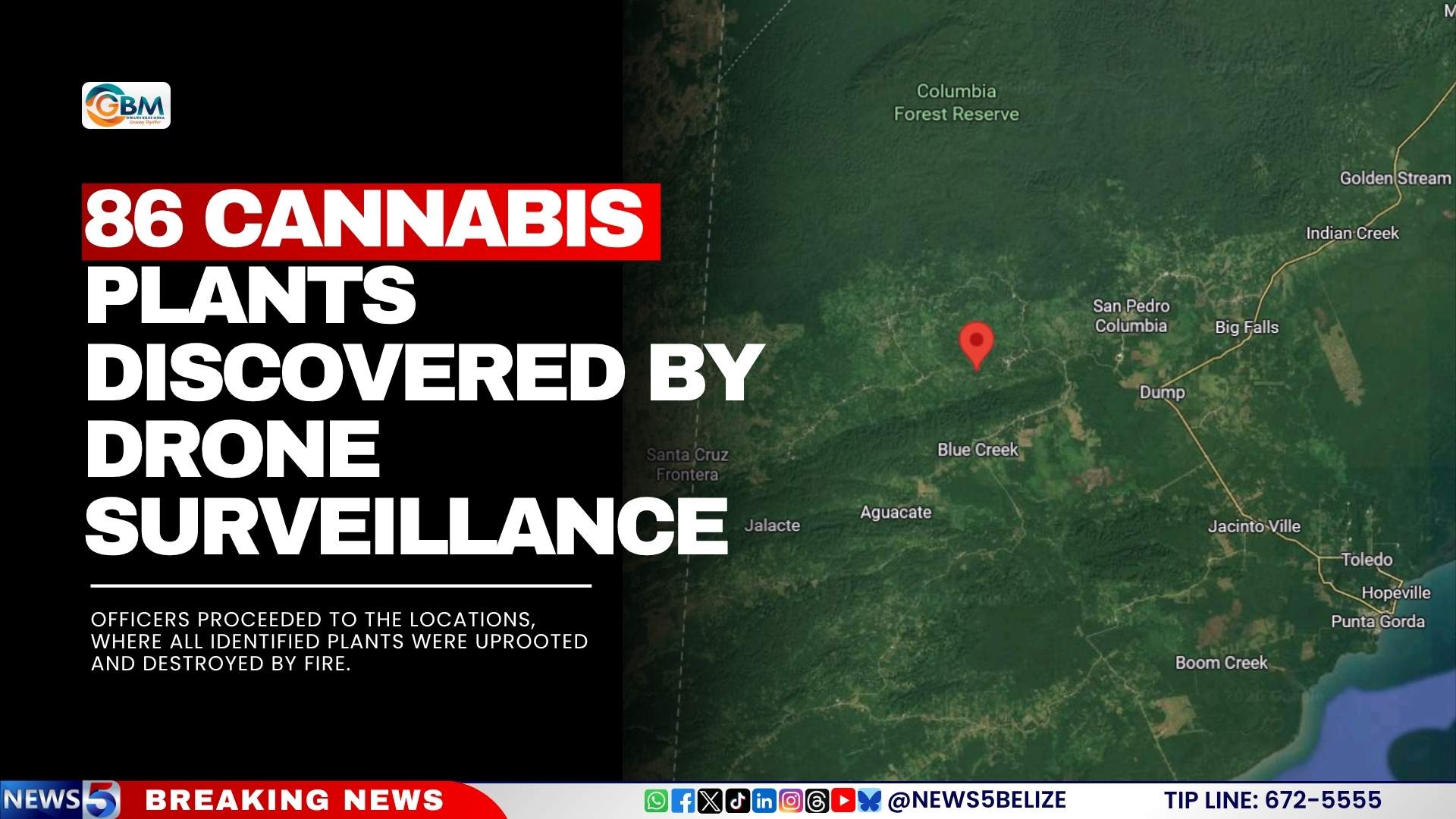
  • Police Destroy 86 Cannabis Plants Discovered by Drone Surveillance

    Police Destroy 86 Cannabis Plants Discovered by Drone Surveillance

    In a targeted anti-narcotics operation carried out in Toledo District, law enforcement agencies have successfully eradicated nearly 90 illegal cannabis plants, thanks to modern aerial surveillance technology.

    The operation, launched by the Special Branch office, relied on drone reconnaissance to scan the remote, hard-to-reach rural areas of the district where unauthorized cannabis cultivation is often hidden from ground patrols. The unmanned aerial device quickly picked up unusual vegetation activity in a privately owned corn field, guiding the on-ground enforcement team to the first site.

    Upon arriving at the location, officers found dozens of harvested cannabis plants hanging to dry under a makeshift zinc-roofed shelter, tucked away out of sight from nearby roads and settlements. A systematic sweep of the surrounding terrain uncovered a second, separate plot where mature cannabis plants were still growing in the ground.

    Following standard operational protocols, officers uprooted all standing plants and removed the stored harvested crop before destroying the entire illegal haul by controlled fire. A post-operation count confirmed that a total of 86 plants were eliminated, with the mature specimens measuring between three and seven feet in height when they were seized.

    The successful operation highlights how integrating drone technology into rural anti-drug enforcement efforts helps law enforcement overcome the challenges of monitoring vast, remote terrain, cracking down on unauthorized cannabis cultivation that often goes undetected by traditional patrol methods.

  • BelCan Bridge Works to Displace Businesses, Mixed Reactions Emerge

    BelCan Bridge Works to Displace Businesses, Mixed Reactions Emerge

    The long-planned replacement project for Belize’s BelCan Bridge is entering its final preparatory phase, and the immediate impacts of the massive infrastructure upgrade are already disrupting commercial activity along the busy Phillip Goldson Highway. Local business owners, vehicle dealership operators, and taxi service providers that have set up operations in the project zone have recently received official eviction notices, requiring them to vacate their current locations to make space for a temporary crossing that project organizers say is indispensable to maintaining traffic flow through Belize City throughout the main construction period.

    Officials from Belize’s Ministry of Infrastructure Development and Housing have publicly confirmed that pre-construction work is now underway, addressing public concerns over potential gridlock once the original bridge is closed for replacement. Chief Engineer Evondale Moody explained that the temporary structure is a carefully planned mitigation measure designed to cut down on crippling traffic congestion that would otherwise paralyze movement within Belize City during the months-long construction window. While the solution addresses longstanding public worries about travel disruptions, it has imposed unplanned costs and uncertainty on the local commercial operators that have built their businesses along the highway corridor.

    Responses to the relocation order have been deeply divided across the affected community. Many operators are already making reluctant preparations to move their operations, while others have openly pushed back against the timeline and the lack of transitional support. Critics warn that the sudden, unplanned relocation could deliver a devastating financial blow to small, local livelihoods that operate on thin profit margins, with many unable to absorb the cost of moving or afford premium rents in alternative commercial locations. Still, the project does not face universal opposition: one long-tenured car dealer operating in the area expressed a pragmatic acceptance of the disruption, noting that “It is fine, there is no issues with that… we will move on.”

    Full construction work on the bridge replacement is scheduled to kick off in early May, and as the start date approaches, lingering questions remain about the long-term outcomes for the most vulnerable affected businesses, as well as potential adjustments to the project timeline that could reshape impacts on the local community. Belize News 5 will air a full in-depth report with additional details, interviews, and official updates during its 6 p.m. live broadcast tonight.

  • Who Will Pay More Under New Bus Fares?

    Who Will Pay More Under New Bus Fares?

    A pending adjustment to Belize’s public bus fare system is set to roll out at the start of next week, with varying impacts on daily commuters across different regions of the country depending on which service provider they rely on for travel.

    Following weeks of advocacy from the Belize Bus Association (BBA) and formal discussions held by the national Cabinet on Tuesday, government officials have given final approval to a new set of maximum allowable fares for intercity highway bus routes. The BBA, which first proposed the regulatory changes to standardize pricing across all bus operators and create fairer competitive conditions, had repeatedly highlighted mounting financial pressure driven by skyrocketing fuel costs that has strained operator budgets in recent months.

    Under the newly approved fare framework, three distinct service tiers will have set per-mile rate caps: regular commuter services will be capped at $0.18 per mile, express services at $0.20 per mile, and a newly introduced premium service tier will be allowed to charge up to $0.22 per mile. Individual operators retain the right to set prices below these caps, but cannot charge more than the approved maximum rates. The new rules are scheduled to go into full effect on Monday, April 27, just three days after the Cabinet signed off on the changes.

    The country’s largest bus operator, the National Bus Company (NBC), has announced it will not implement immediate fare changes in line with the new caps, stating in an official public statement released Friday that “Fares will remain unchanged at this time. Any future adjustments will be phased and carefully managed to reduce the burden on the travelling public.”

    Current route market share data from NBC shows the company dominates national highway commuter services, holding roughly 65% of the total market across the country. Its footprint is heavily concentrated in the southern and western corridors of Belize, where it controls 95% and 85% of the market respectively. By contrast, the NBC only holds 20% of the commuter market in the northern corridor, meaning most daily bus commuters in northern Belize rely on smaller BBA-affiliated operators that have pushed for the higher standardized fares. This lopsided market split means that commuters who rely on daily bus service in the northern region will be far more likely to face higher fares following Monday’s regulatory change, while most commuters in the south and west will see no immediate change to their bus travel costs thanks to NBC’s current freeze on pricing.

    Local outlet News 5 plans to air a full in-depth report on the new fare structure and its projected impacts during its 6 p.m. News 5 Live broadcast Friday evening.

  • Night Roadworks to Disrupt Traffic Between FADI and Fresh and Eazy on All Saints Road

    Night Roadworks to Disrupt Traffic Between FADI and Fresh and Eazy on All Saints Road

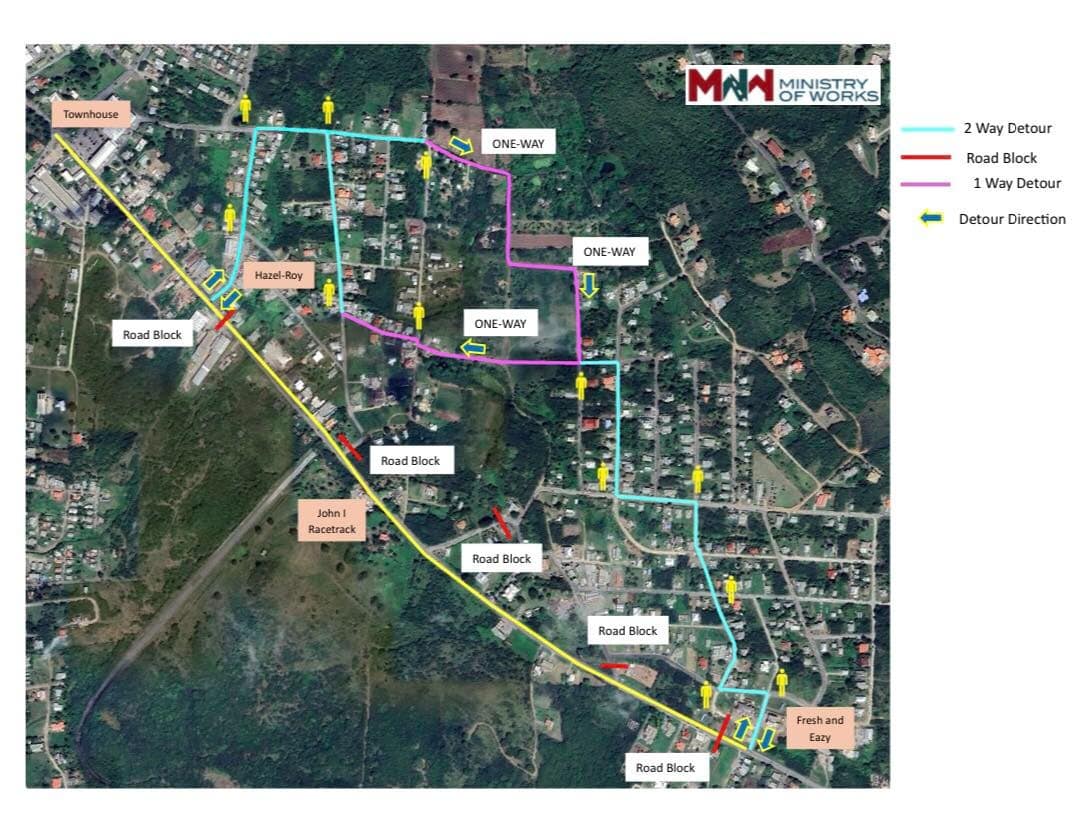
    Residents and commuters in Antigua and Barbuda are being alerted to upcoming overnight infrastructure rehabilitation works on a key stretch of All Saints Road, set to kick off next year. The Ministry of Works has confirmed that construction activities will resume between the FADI Building Supplies and Fresh and Eazy Supermarket junctions, with a formal traffic diversion set to take effect starting at 7:00 pm on Thursday, April 24, 2026, running through to 7:00 am the following day.

    To minimize travel disruption, transportation officials have outlined a clear directional detour for all road users. For motorists traveling out of the city center, the route requires a left turn at the Hazelroy’s intersection on All Saints Road, before following marked signage and the official project map to bypass the work zone. For those heading into town, drivers will turn right at Fresh and Eazy Supermarket and continue along the pre-marked alternative route.

    On-site traffic marshals, also known as flag persons, will be stationed at key points along the detour to help guide vehicle flow and prevent congestion. Officials have emphasized that specific sections of the diversion route will operate as temporary one-way traffic zones, with all restrictions clearly marked on the official project map and physical signage posted along the route to assist commuters traveling in both directions.

    Local residents who live adjacent to the work zone will still be granted access to their properties throughout the construction period. However, authorities are urging all people moving through the area to exercise extra caution when passing near the site, as large heavy-duty construction equipment will be active in the work zone overnight.

    Crucially, all commercial businesses located along the affected stretch of road will remain open for normal operations during the works. This rehabilitation forms part of the broader government-led All Saints Road infrastructure upgrade project, overseen by the Government of Antigua and Barbuda.

    Project stakeholders and regular road users are strongly encouraged to adjust their upcoming travel plans in advance to account for potential delays along the route. Any questions or inquiries about the works or detour can be directed to the Project Implementation Management Unit via phone at 562-9173 during regular operating hours.