作者: admin

  • NAMLAC waarschuwt regering: risico op blacklisting Suriname bij onvoldoende voortgang

    NAMLAC waarschuwt regering: risico op blacklisting Suriname bij onvoldoende voortgang

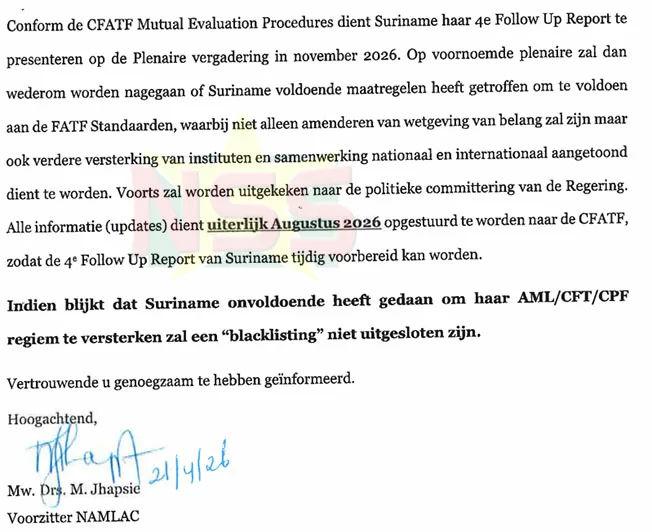
    Suriname is at serious risk of being placed on an international anti-money laundering blacklist unless urgent action is taken to strengthen its regulatory framework, the country’s National Anti-Money Laundering Commission (NAMLAC) has warned in an urgent letter addressed to President Jennifer Simons.

    The warning comes nearly four years after Suriname’s last major international assessment by the Caribbean Financial Action Task Force (CFATF), the regional body that enforces global standards set by the Financial Action Task Force (FATF). In 2022, the CFATF placed Suriname under its Enhanced Follow Up process after the country received low marks for both technical compliance and the practical effectiveness of its anti-money laundering, counter-terrorist financing, and counter-proliferation financing (AML/CFT/CPF) regime. At that time, Suriname was granted a deadline extending to 2027 to address all identified gaps and bring its rules in line with FATF’s 40 core recommendations.

    Between 2023 and 2025, Suriname made measurable progress, securing improved ratings for compliance with 27 of the 40 FATF recommendations. However, the country has hit a critical deadlock over the remaining 13 reforms. According to NAMLAC, Suriname was unable to submit any new progress assessment requests to the CFATF in 2026 because Suriname’s National Assembly has not passed any of the required legislation to address the outstanding gaps. Worse, the CFATF’s submission window for new progress updates has already closed.

    Suriname is scheduled to present its fourth Follow Up Report to the CFATF plenary assembly in November 2026. At that meeting, international assessors will conduct a full review of whether Suriname has implemented sufficient reforms to meet global FATF standards. The review will also evaluate the Suriname government’s political commitment to the reforms, the strengthening of domestic regulatory institutions, and the country’s track record on both national and international collaboration to combat illicit financial activity.

    NAMLAC has stressed that all remaining compliance updates must be submitted by no later than August 2026 to allow for the final report to be prepared in time for the November plenary. The commission has made clear that if insufficient progress is documented by the assessment deadline, blacklisting remains a very real possibility for Suriname.


  • “A Dream Come True for Yabra Fisherfolk”

    “A Dream Come True for Yabra Fisherfolk”

    After years of selling their daily catch unprotected along a roadside adjacent to the Yabra Bridge, local fishing communities in Belize City have marked a historic milestone: the official inauguration of the purpose-built Yabra Fish Market by the Belize City Council on April 28, 2026.

    For long-time local fisherman Joseph Brown, the opening ceremony was more than just the launch of a new public facility—it was the realization of a goal generations of Yabra fishing workers had waited decades to achieve. “This day has finally arrived… A dream come true for the Yabra fishermen folks,” Brown shared with attendees during the morning launch event.

    According to Brown, the newly constructed, permanent market space will accommodate six full-time fishing vendors, protecting them from the harsh Caribbean elements: the blistering midday sun, sweltering heat, and sudden heavy rain showers that have long made roadside vending a grueling, unpredictable trade. Unlike the unregulated roadside setup, the new purpose-built venue offers a structured, hygienic space that streamlines transactions for both sellers and local customers.

    Belize City Councillor Evan Thompson emphasized that the new market represents far more than concrete and infrastructure. In remarks at the launch, Thompson framed the project as a victory for community-centered governance. “Today is a celebration of people; it is a celebration of partnership, of what can happen when a community’s needs are acted upon and heard,” he said.

    Thompson added that the completed market stands as a tangible, visible commitment to supporting small-scale local livelihoods and bolstering collective community pride in Yabra. The project addresses a longstanding unmet need for the area’s fishing community, which forms a core part of Belize City’s coastal cultural and economic identity.

  • Ambulance Delivered to Glanvilles Polyclinic

    Ambulance Delivered to Glanvilles Polyclinic

    As campaign activity ramps up ahead of the upcoming April 30 general election, a critical improvement to local emergency medical care has been rolled out for the St. Philip’s North community. Randy Baltimore, the candidate running for the constituency on the Antigua and Barbuda Labour Party (ABLP) ticket, has confirmed that a new fully operational ambulance has been delivered to Glanvilles Polyclinic, a move designed to strengthen the area’s emergency response infrastructure.

    Baltimore emphasized that the arrival of this new vehicle addresses a longstanding gap in local healthcare access, directly cutting down response times for medical crises. When every minute counts for patients experiencing life-threatening emergencies, faster on-scene assistance can mean the difference between life and death, he noted. For Baltimore and the ABLP, this deployment is more than just an infrastructure upgrade: it represents tangible progress in delivering on promises to constituents. “This is what progress looks like, building systems that protect lives and support our people when it matters most,” Baltimore stated in remarks confirming the new service.

    Healthcare access and quality have emerged as one of the defining issues in this election cycle, with nearly all major candidates prioritizing improvements to public health services on their campaign platforms. Voters across the country have increasingly ranked reliable emergency care and functional primary health facilities among their top concerns heading into the poll, making announcements like this a key part of candidates’ efforts to demonstrate their commitment to addressing community needs.

  • IMF urges SVG not to cut VAT rate

    IMF urges SVG not to cut VAT rate

    Five months after the New Democratic Party (NDP) took power in St. Vincent and the Grenadines (SVG) on a platform of tackling a nationwide cost-of-living crisis, the International Monetary Fund (IMF) has thrown a major wrench into one of the administration’s signature campaign pledges: a planned cut to the country’s standard value-added tax (VAT) rate.

    Appearing at a joint press conference with SVG Prime Minister and Finance Minister Godwin Friday in Kingstown Tuesday, at the close of the IMF’s 2026 Article IV consultation, mission chief Sergei Antoshin made clear that the nation’s dire fiscal position leaves no room for the proposed reduction, which the NDP promised would cut VAT from 16% to 13% within 60 days of taking office. Instead, Antoshin argued, the country should align its discounted preferential VAT rate for the tourism sector with the full standard rate to boost much-needed revenue.

    Antoshin emphasized that safeguarding existing tax revenues and strengthening tax administration are non-negotiable priorities for SVG, which has faced a steady cascade of economic shocks over the past six years that have sent public debt soaring and left persistent large fiscal deficits. He commended the NDP administration’s ongoing efforts to expand VAT coverage to digital and remote services, as well as its planned reform of real property taxation, noting that these reforms would lay the groundwork for a fairer, more growth-oriented tax system.

    The IMF’s assessment lays bare the severity of SVG’s long-building fiscal crisis. Since 2019, the country’s debt-to-GDP ratio has jumped 45 percentage points, with half of that increase coming in just the last two years, pushing debt to 113% of GDP in 2025. SVG has been classified at high risk of debt distress since 2016, and its persistent exposure to catastrophic natural disasters has compounded its fragility. After the COVID-19 pandemic, two major hurricanes, and now the global oil price shock stemming from the Middle East conflict, the fiscal position has deteriorated steadily, hitting low-income and vulnerable households the hardest, Antoshin explained.

    “SVG has shown remarkable economic resilience in the face of repeated blows, but significant fiscal vulnerabilities remain deeply entrenched,” Antoshin said. “Large ongoing deficits and a continuously rising debt load leave no question that decisive policy action is urgently required to reverse this trajectory.”

    For 2026, the SVG government’s February budget projects a deficit equal to 19% of GDP. IMF analysts project a smaller but still unsustainable 12% deficit this year, based on historical trends of under-execution of capital spending. If current policies remain unchanged, Antoshin warned, the debt-to-GDP ratio will surge to 145% by 2031, with annual gross financing needs reaching 26% of GDP – a trajectory that would ultimately lead to a disorderly fiscal collapse without intervention.

    To avoid that outcome, the IMF has put forward an “active policy scenario” designed to reverse the growth of debt within three years and bring it down to a sustainable 60% of GDP over the long term. The plan calls for ambitious urgent fiscal consolidation, requiring an 11 percentage point improvement in the primary balance (the fiscal balance excluding interest payments) between 2027 and 2029. That adjustment would put the country on track to reach a 3% primary surplus by 2029 – a level that is high by SVG’s historical standards, but one that has been achieved by peer nations in the Caribbean region, Antoshin noted.

    Antoshin confirmed that the NDP administration and the IMF agree on the urgent need for consolidation, and that the government has already drafted a comprehensive strategic framework to put debt on a downward path. The next critical step, he said, is to identify and detail specific, concrete policy measures to hit the targets. To that end, the government has requested IMF technical support to conduct a full review of public spending, designed to identify opportunities to streamline outlays while protecting support for vulnerable households.

    Key areas for spending adjustment include the public wage bill, which Antoshin said is high relative to both SVG’s own history and international benchmarks. He proposed gradual adjustments through natural attrition and wage moderation to bring the wage bill into line without sudden disruptions to public services. Antoshin added that while social protection for vulnerable populations must be preserved, the government can improve outcomes by digitizing assistance programs to better target beneficiaries and reduce wasteful leakage of funds.

    The IMF also backed the government’s plans to review national investment policy and strengthen public investment management, urging SVG to prioritize spending on critical infrastructure and natural disaster resilience, while avoiding inefficient investments in marketable assets that can create harmful economic distortions.

    For its part, the NDP government has already signaled it is stepping back from its original VAT campaign promise. When presenting the 2026 budget in February, Prime Minister Friday announced the administration would delay any decision on a VAT cut until later this year, leaving the campaign pledge in limbo amid the IMF’s stark warnings about fiscal sustainability.

  • Muffles College Heads to Global Robotics Stage

    Muffles College Heads to Global Robotics Stage

    A new milestone for STEM education in Belize is set to unfold this week, as 10 talented high school students from Muffles College High School (MCHS) are preparing to carry their nation’s flag at the 2026 FIRST Championship, one of the world’s most prestigious youth robotics competitions, hosted in Houston, Texas’s George R. Brown Convention Center.

    The team, nicknamed the MCHS Bobcats, earned their invitation to the global stage after securing first place at the 2026 Belize National FIRST LEGO League (FLL) competition held this past March. Co-hosted by Belize Elementary School and Belize High School, the national championship drew 10 competing teams from every region of the country. Following the competition’s 2026 theme “Unearthed”, participating students were tasked with developing creative, technology-powered solutions drawing inspiration from the field of archaeology – a challenge that pushed the young innovators to blend historical thinking with cutting-edge technical skill. The MCHS Bobcats outperformed their fellow national competitors to claim the national title and a coveted spot at the global event.

    Organized by the international non-profit organization FIRST, the annual championship runs from April 29 to May 2, bringing together thousands of top youth STEM talent from across the world. The event is designed to showcase young people’s proficiencies in engineering, coding, and critical problem-solving, all within a collaborative, high-energy environment that encourages cross-cultural exchange and innovation. This year’s competition will see the Belizean team go head-to-head with the best young robotics teams from dozens of countries, giving the small Central American nation a rare opportunity to demonstrate its growing STEM capacity on a global platform.

    Sponsored by RF&G, the MCHS Bobcats delegation consists of students Maidie Oliva, Giselie Garcia, Carlos Blanco, Jaevanie De Paz, Aiden Logan, Anais Cruz, Mannat Lalwani, Morgan Chavarria, Zyanie Urbina, and Krystian Krystian, with four faculty coaches Carim Ramirez, Michael Williams, Cecilio Garcia, and William Robinson leading the team in preparation and competition.

  • All Saints Road Detour in Effect Tonight for Infrastructure Works

    All Saints Road Detour in Effect Tonight for Infrastructure Works

    The Antigua and Barbuda Ministry of Works has issued a public notification of upcoming major infrastructure improvements scheduled for a stretch of All Saints Road, located between Bottom Village and the Pentecostal Church. As part of the government-led All Saints Road Project, this overnight construction work will require a full detour of through traffic, with the diversion schedule set to take effect from 7:00 p.m. on Tuesday, April 28, 2026, through to 7:00 a.m. the following morning.

    For motorists traveling outbound from the main urban center toward All Saints, routing adjustments have been clearly mapped. Any driver approaching the Midway Service Station whose destination lies past the construction zone will be redirected onto the main thoroughfare running through Freeman’s Village to bypass the worksite. Inbound travelers heading toward the capital St. John’s face a different diversion: drivers approaching the All Saints Service Station with destinations beyond the closed stretch of road will be rerouted via Jonas Road to continue their journey.

    Notably, local residents who live in the immediate area surrounding the worksite will retain full access to their properties throughout the construction period, and all commercial operations along the affected corridor will remain open for business as usual.

    Officials have stressed that construction crews will be operating large, heavy-duty machinery in close proximity to the work zone, so all road users are strongly encouraged to adhere strictly to posted detour signs and instructions from on-site personnel to maintain maximum safety for everyone traveling through the area. Project stakeholders and regular commuters are asked to proactively adjust their travel timetables ahead of the scheduled work to account for potential minor delays caused by the diversion.

    Members of the public with questions about the road work or detour arrangement can reach out to the Project Implementation Management Unit directly via telephone at 562-9173 for additional information.

  • Septuagenarian Murdered in Orange Walk

    Septuagenarian Murdered in Orange Walk

    A 70-year-old local farmer has become the victim of a brutal homicide in Orange Walk, leaving his community and family reeling from the senseless violence. Francisco Garcia was reported missing before his mutilated body was discovered in a bushy clearing a short distance from his Santa Martha Road bungalow on Monday afternoon.

    The grim discovery was made by Garcia’s son, who grew concerned after multiple attempts to contact his father went unanswered. When he arrived at the property to check on Garcia, the son found clear signs of a forced break-in: the family home had been thoroughly ransacked by intruders.

    Law enforcement officers who responded to the scene found a black-handled machete suspected to be the murder weapon, which was recovered from the property’s yard with apparent blood residue. Investigators also documented broken glass louvres at the residence, confirming that several personal belongings were stolen during the incident. The missing items include an iPhone 11 smartphone, a three-burner cooking stove, two portable gas tanks, and a wheelbarrow.

    News of the murder has sparked grief and frustration among local residents, many of whom have taken to social media to express their reactions. A grieving relative of Garcia shared an emotional post on Facebook, writing, “How could they do this??? They took him away from us! Rest in peace Tio, Granny, Granpa and my dad welcoming you while we are at a loss!” Other community members have voiced growing concern over persistent violent crime in the area, with one Facebook user commenting, “Another Murder, when will all this murders end?”

    As of Tuesday, local law enforcement has launched a full investigation into the killing, working to identify and apprehend the perpetrator or perpetrators responsible for Garcia’s death. No suspects have been named publicly at this stage of the investigation.

  • Call for greater autism awareness in public spaces

    Call for greater autism awareness in public spaces

    Over the last 12 months, families of autistic children in Barbados have reported a sharp uptick in frustrating encounters in public spaces, especially grocery stores, reigniting demands for local businesses to adopt more flexible, compassionate policies and deepen public understanding of autism spectrum needs.

    Chantal Fields, Events and Coordination Chairman of the Autism Association of Barbados, shared these insights with local outlet Barbados TODAY on the sidelines of the organization’s annual Autism Awareness Walk, held Tuesday. While she acknowledged that general public awareness of autism has advanced in recent years, Fields emphasized that countless caregivers still face unnecessary barriers during routine outings.

    “I’ve had so many parents reach out to me with these complaints,” Fields said. “A little grace goes such a long way; people need to understand that not everyone can navigate a supermarket trip the same way.”

    She explained that one of the most common points of friction stems from widespread supermarket rules banning children from riding inside shopping baskets or trolleys — a safety measure many parents rely on to prevent elopement, a common behavior among autistic children that can put kids at severe risk in crowded, busy public spaces.

    “For example, some autistic individuals are prone to wandering off unexpectedly,” Fields explained. “That turns a simple trip to pick up groceries into a constant exercise in keeping your child contained. But when parents try to keep their child safe by placing them in a shopping trolley, many supermarkets now have signs prohibiting the practice, and staff will step in to stop them. For our families, this isn’t a convenience — it’s a safety issue.”

    Fields called on local businesses to adopt a more accommodating approach, noting that small adjustments could drastically reduce the daily burden carried by autism families. She even proposed a simple compromise: allowing children to ride in trolleys if parents can provide formal confirmation of their child’s autism diagnosis, to balance store policies with safety needs.

    “Every person on the autism spectrum functions differently, and some need that extra layer of support, whether that means containing a child who elopes or other small accommodations,” she said. “Just a little flexibility can make a world of difference.”

    Fields did highlight bright spots amid ongoing challenges, pointing to gradual improvements in workplace support for autism parents. A growing number of Barbadian employers have introduced more lenient scheduling policies, allowing caregivers to adjust shift times or step out for therapy appointments without fear of penalty. “A lot of parents have told me their workplaces have been really supportive,” she said.

    When it comes to inclusive education, however, progress remains in early stages. Fields noted that the Barbadian Ministry of Education is currently piloting new inclusive schooling frameworks, but the reforms are not yet fully rolled out. “It hasn’t been launched system-wide yet, it’s still in its pilot phase,” she explained. “It might not benefit families currently navigating the system, but it should create better outcomes for the next generation of autistic people coming through in the next five years.”

    Looking ahead, the Autism Association of Barbados is partnering with the Samuel Jackman Prescod Institute of Technology (SJPIT) to launch new skills-based training programs for autistic adults, covering in-demand vocational areas such as cooking and carpentry. The initiative is designed to help participants build employable skills and access sustainable work opportunities. “Opportunities are starting to open up, and people are becoming more receptive to including autistic individuals in the workforce,” Fields said.

    Overall, Fields assessed that while ongoing autism awareness campaigns have moved the needle on public knowledge, significant gaps in understanding remain. “It’s a mixed picture,” she said. “We’ve been doing consistent outreach and awareness work, and people are learning more, but there are still a lot of areas where understanding just hasn’t caught up.”

    Fields’ comments came during the association’s annual Autism Awareness Walk, which drew more than 300 supporters who gathered as early as 6:30 a.m. to participate. Participants began their route at the Social Empowerment Agency, winding through Lower Collymore Rock, Culloden Road, Beckles Road and Dalkeith Road, circling the Garrison, traveling along Highway 7, and returning to the starting point. The event concluded with a group cool-down session led by Spinny, serving as a visible public push for wider acceptance, awareness and practical support for autistic people and their families across Barbados.

  • Jamaicans encouraged to support local chocolatiers

    Jamaicans encouraged to support local chocolatiers

    KINGSTON, Jamaica — Against the backdrop of a globally renowned fine cocoa sector, Jamaica’s top agricultural commodities regulator is calling on local consumers to prioritize domestic chocolate makers, a move that officials say will drive industry expansion and lift economic fortunes across the island’s cocoa supply chain.

    Chevonne Aschute, acting Senior Director for Cocoa and Coconut at the Jamaica Agricultural Commodities Regulatory Authority (JACRA), laid out the appeal during a recent JIS Think Tank session hosted at the news agency’s television studios in central Kingston. Aschute noted that local cocoa farmers and chocolate producers have significantly scaled up output in recent months, positioning the sector for broader growth if domestic consumer demand matches rising production.

    “At our core, we have a philosophy: we grow what we consume, and we consume what we grow,” Aschute told attendees. “That is why we need to stand behind our local chocolatiers. This collective effort will help our entire nation move forward. Jamaica has a global reputation for producing exceptional, high-quality goods, and our cocoa is no exception — that makes supporting local all the more critical.”

    Jamaica holds a rare, elite status in the global cocoa market: it is one of just a handful of countries globally to earn 100% “fine flavour status” from the International Cocoa Organization (ICCO). This designation is awarded only to cocoa with extraordinary sensory qualities, distinct flavor notes, and superior overall quality that sets it apart from bulk commodity cocoa. As a result, Jamaican cocoa commands a significant price premium over standard bulk cocoa on international markets, creating a built-in competitive advantage for the country’s producers.

    Aschute emphasized that increased local support for domestic chocolate makers will create a ripple benefit throughout the entire supply chain, starting with the smallholder and commercial farmers who grow the cocoa. “When consumers buy from local chocolatiers, producers can pay farmers a higher rate per kilogram or per box of their harvested cocoa,” he explained. “This creates a reciprocal cycle of growth that ultimately improves livelihoods for every person working in the sector, from farm to retail.”

    To maintain the industry’s coveted quality reputation, Aschute confirmed that JACRA continues to partner closely with cocoa farmers across the country. The authority provides guidance, training, and quality control measures to ensure all harvested cocoa pods meet strict international market standards, preserving the fine flavour profile that makes Jamaican cocoa a premium product worldwide.

  • Public urged to avoid non-native monkeys after St Elizabeth sightings

    Public urged to avoid non-native monkeys after St Elizabeth sightings

    KINGSTON, Jamaica — Invasive species have triggered a public safety alert in Jamaica this week, after non-native monkeys were documented and captured in multiple communities across the parish of St Elizabeth, prompting the country’s National Environment and Planning Agency (NEPA) to call for extreme public caution.

    Following confirmation of the sightings, NEPA released an official statement identifying the animals as white-faced capuchin monkeys, a species that is not indigenous to Jamaica’s ecosystems. The agency outlined a range of serious risks tied to the monkeys’ unauthorized presence: the primates can carry zoonotic pathogens capable of spreading to humans and domestic livestock, they disrupt local biodiversity by outcompeting native species for resources, and they pose a direct threat to agricultural crop production that supports local livelihoods.

    To prevent accidental exposure or harm, NEPA has issued a clear directive: the public must not approach, handle, or attempt to capture any of the animals on their own. Early reports of sightings and captures have come from six St Elizabeth communities: Lacovia, Elgin, Mountainside, Newell, Hounslow, and Malvern. Viral clips circulating across Jamaican social media platforms show groups of up to three monkeys, with unconfirmed reports indicating at least one animal has already been captured by local residents and may still be held privately.

    In response to the incident, NEPA has assembled a multi-agency response team that includes Jamaica’s Veterinary Services Division, the Jamaica Constabulary Force, and Hope Zoo. The partnership is working to locate all of the unregistered primates, secure them safely, and transfer the animals to quarantine facilities for mandatory veterinary health assessments. Agency representatives have also collaborated directly with local community leaders to coordinate response efforts and spread public safety messaging.

    Beyond the risks posed by the monkeys themselves, NEPA has issued an additional warning about potential illicit activity linked to the sightings. The agency is urging residents to be wary of individuals who falsely claim to represent government authorities in order to gain access to the captured monkeys for illegal private trade. Under Jamaica’s existing wildlife regulations, the importation, private possession, and unlicensed trade of protected wildlife are criminal offenses, most often tied to transnational illicit wildlife trafficking networks. Violations of the Endangered Species (Protection, Conservation and Regulation of Trade) Act carry maximum fines of up to JMD $2 million for convicted offenders.

    NEPA is asking any member of the public with information about the current location of the monkeys, or about how the animals entered Jamaica, to contact the agency directly, reach out to the Veterinary Services Division, or file a report with their local police station.