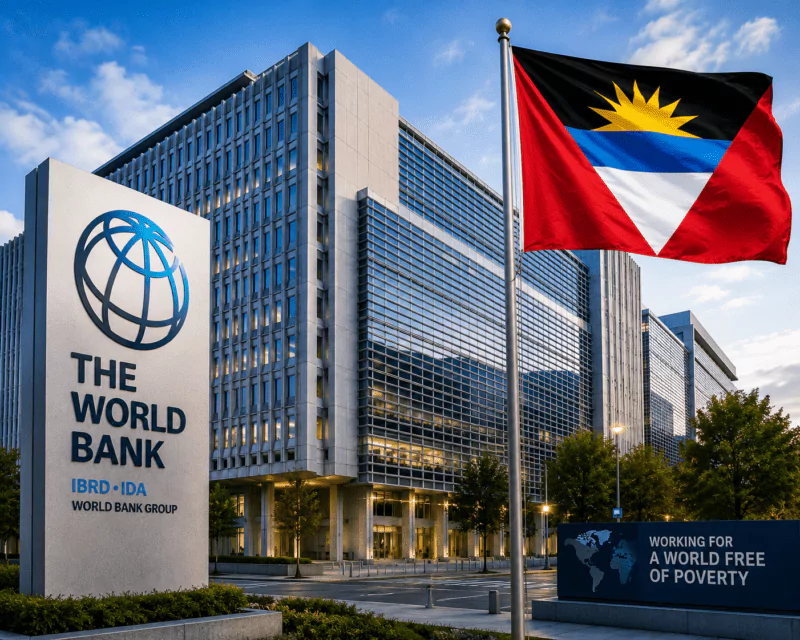
In a landmark economic milestone announced July 1, the World Bank has officially upgraded Antigua and Barbuda to high-income economy status, marking a major win for the small twin-island Caribbean nation’s years of post-pandemic recovery.
The designation forms part of the global lender’s annual Country Income Classification report, which sorts every national economy into one of four tiers: low, lower-middle, upper-middle, and high income, based on the prior year’s Gross National Income (GNI) per capita calculated via the organization’s standardized Atlas Method. For the 2025 classification round, countries needed a GNI per capita above $14,375 to qualify for the high-income bracket. Antigua and Barbuda far outstripped this threshold, clocking in at an estimated $21,380 per capita, per World Bank data.
With the upgrade, Antigua and Barbuda now joins the ranks of 87 high-income economies worldwide, and counts itself among a growing group of Caribbean high-income nations that includes Barbados, Saint Kitts and Nevis, Trinidad and Tobago, and The Bahamas.
To ensure consistent cross-country comparisons and minimize distortion from volatile exchange rate shifts, the World Bank relies on its Atlas Method to convert national GNI data into a common currency. It also clarifies that the income tiers are designed primarily for statistical and analytical use, rather than as a comprehensive measure of overall national development or quality of life. GNI itself, the metric underpinning the classification, captures total income earned by a country’s residents and businesses—including income from overseas assets and operations—divided by the population to get an average per-person figure.
The new classification reflects Antigua and Barbuda’s robust rebound from the deep economic downturn triggered by the COVID-19 pandemic, which devastated the nation’s core tourism sector. Driven by strong growth across tourism, construction, foreign direct investment, and linked supporting industries, the country has steadily rebuilt its economic output and national income over the past several years to hit this new benchmark.
Even as policymakers and industry leaders celebrate the achievement, independent economists have urged perspective on what the label actually means. They emphasize that the high-income designation is based on average national income, and does not account for critical factors such as income inequality, residual pockets of poverty, or the unusually high cost of living that many small island developing states face. That means the classification does not guarantee that all Antigua and Barbuda residents experience a uniformly high standard of living.
Still, the upgrade remains a significant formal international recognition of the Caribbean nation’s long-term economic progress. It marks a key achievement in the country’s development trajectory, cementing its place among the world’s upper tier of economies per the World Bank’s 2025 global assessment.