
A transnational criminal recruitment scheme targeting Panamanian nationals for military service alongside Russian forces in the war in Ukraine has led to the provisional detention of three Dominican citizens in Panama, according to official law enforcement updates from the Central American country. The case, which unfolded through an investigation launched by Panama’s Public Prosecutor’s Office, has revealed a coordinated network that used social media platforms to lure vulnerable people with promises of high payments for work that ultimately tied to active conflict.
作者: admin
-
‘Take down the fence before somebody dies’
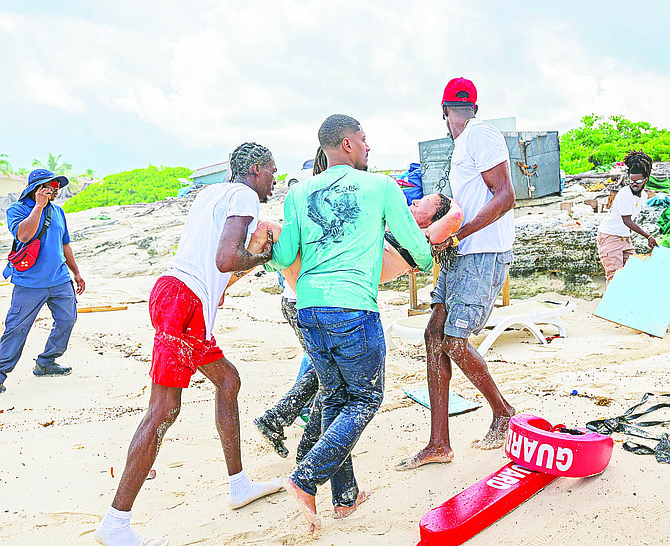
A dramatic high-stakes rescue at Cabbage Beach in the Bahamas has reignited long-simmering tensions over public beach access and unapproved development, prompting swift government action to remove an illegally placed shoreline fence. The incident unfolded yesterday as a 60-year-old American tourist, staying at the nearby Riu resort, was swept into rough Atlantic waters while navigating around the barrier – a structure protesters had warned already forced beachgoers into the surf to pass.
Lincoln Deal, Member of Parliament for Freetown and one of the rescuers who pulled the woman from the waves, described the close call that could have ended in tragedy. “We could’ve lost a life,” Deal said, recalling how powerful currents dragged the woman farther from shore even as lifeguards, protesters, and other bystanders fought to reach her. After the woman was brought back to land, bystanders administered CPR to restore her breathing before an ambulance arrived to transport her for further care. The near-fatal incident comes after weeks of growing unrest over the ongoing construction of the Four Seasons Ocean Club Residences, which has already displaced long-time local vendors and restricted traditional public access to the popular beach.
Footage captured by onlookers shows the woman struggling against churning waves as rescuers worked frantically to pull her to safety. One furious eyewitness called for immediate action, shouting, “Take down the fence before somebody dies. Take down the fence before somebody loses their life.”
Deal emphasized that the fence’s positioning is inherently dangerous, noting that it sits so close to the waterline that walking around it forces pedestrians directly into the surf. “When you’re walking around that fence, you’re basically walking in the water, and so it’s very easy to lose your balance, to fall, to be pulled in, to even be pushed and pressed against the fence,” he explained. Deal added that while the presence of multiple bystanders and lifeguards on scene prevented a fatality this time, there is no guarantee someone will be nearby to intervene in future incidents.
This is not the first controversial fence to spark public outcry at Cabbage Beach. In late August, local vendors discovered a similar barrier being erected near the shore, raising fears that high tides would eliminate the space they have used for decades to operate stalls, rent beach equipment, and run water sports businesses. That first fence was removed on August 30 after government intervention, when officials confirmed the developer had moved forward with construction without required public consultations and inspections.
In the weeks that followed, the government justified new temporary fencing as a necessary safety measure to address severe beach erosion at the site. But Deal and local advocacy group Dis We Beach have pushed back against this explanation, noting that erosion impacts the entire regional coastline, and the development’s own environmental impact assessment acknowledges project-related erosion in the area. The group is also demanding written guarantees that the 27 remaining local vendors, who currently face temporary displacement, will be allowed to return to their traditional spots once construction of the $550 million development is complete.
Last night, the Bahamian government delivered a clear response to the outcry following yesterday’s rescue. Environment Minister Zane Lightbourne announced that the developer will be ordered to remove the fence – and if they refuse, the government will take action to remove it itself. “The Government of The Bahamas has an uncompromising position on Bahamians’ access to their beaches,” Lightbourne stated. “The position applies to every developer operating in our country.” He confirmed that the latest fence was installed without the required advance notice and mandatory public comment period.
Dis We Beach says the core questions about the development’s approval remain unanswered. The group is calling on the government to release the official surveyed fence line, clarify its position relative to the mean high-water mark, and identify who owns the land where the fence was placed. It has also pointed to existing planning law that requires maintaining public beach access as a condition of development approval, and is asking the government to confirm whether such a condition was imposed for the Four Seasons project, and what that condition requires. Beyond that, the group is demanding proof that the government properly assessed the development’s social and economic impact on local vendors, taxi operators, tour providers, and the broader tourism economy that depends on open access to Cabbage Beach.
-
Senior police officer pleads ‘not guilty’ in pike killing
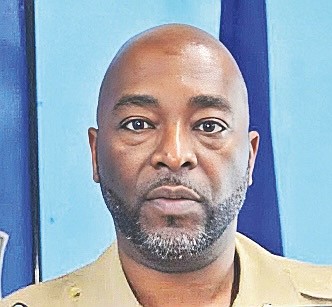
A high-profile case with international ramifications unfolded in the Bahamas Supreme Court on Friday, as a senior police officer pleaded not guilty to the murder of an American utility worker — a shooting that prompted U.S. diplomatic intervention and forced a national review of off-duty officer firearm rules.
Fifty-four-year-old Superintendent Berneil Pinder entered his plea in connection with the March 21 killing of 31-year-old Cody Castillo, a Pike Corporation employee who was shot through the side window of his work truck outside Da Plantation Bar & Grill on West Bay Street, New Providence.
Within days of the incident, the case captured global attention. The U.S. Embassy in the Bahamas quickly issued a public call for prompt justice, and U.S. Ambassador Herschel Walker formally offered FBI investigative support to the Royal Bahamas Police Force. Bahamian Prime Minister Philip “Brave” Davis responded by ordering a full, transparent investigation and launching a review of existing policies governing off-duty officers carrying personal firearms.
Initial police accounts of the shooting claimed that a physical altercation that started inside the bar spilled out into the parking lot, after which a man got into his vehicle and deliberately drove toward Pinder in a threatening manner. Pinder, who was off-duty at the time of the killing just before 6 p.m., reportedly fired his weapon out of fear for his personal safety. However, local newspaper The Tribune later uncovered key details contradicting that narrative, confirming Castillo was never involved in the initial bar fight. He had only driven to the venue to pick up his younger brother, cousin, and another co-worker, all of whom were also employed by Pike.
Castillo was struck in the chest by the bullet fired through the truck’s window. First responders found him lying face-down outside the vehicle in a pool of blood, and he was pronounced dead at the scene. Investigators obtained key evidence from multiple sources, including dash camera footage from Castillo’s work truck and closed-circuit camera footage from nearby businesses, which National Security Minister Wayne Munroe confirmed early in the probe. In a break from standard protocol for police-involved fatalities, which are typically sent directly to the Coroner’s Court, Munroe confirmed investigators treated Castillo’s death as a criminal homicide investigation from the start. Pinder was formally charged with murder just four days after the shooting.
Castillo was a native of Huntsville, Texas, who had been working in the Bahamas on a major project to upgrade New Providence’s electricity grid. At the time of his death, his wife was four months pregnant with the couple’s first child.
The fatal shooting also had tangible economic and project impacts, disrupting the $130 million grid upgrade initiative. In the immediate aftermath of the incident, roughly 40 Pike Corporation employees left New Providence out of safety concerns. Anthony Ferguson, chairman of the Bahamas Grid Company, later confirmed the shooting left many remaining workers deeply fearful, and contributed to a roughly two-month delay to the overall project timeline.
During Friday’s court hearing before Justice Guillimina Archer-Minns, Pinder appeared calm as he entered his not guilty plea. Cassie Bethel is serving as Pinder’s defense counsel, while Eucal Bonaby and Betty Wilson are leading the prosecution. Pinder is scheduled to return to court on October 7 for a formal trial date setting hearing.
-
Sister says worker raised safety concerns before death
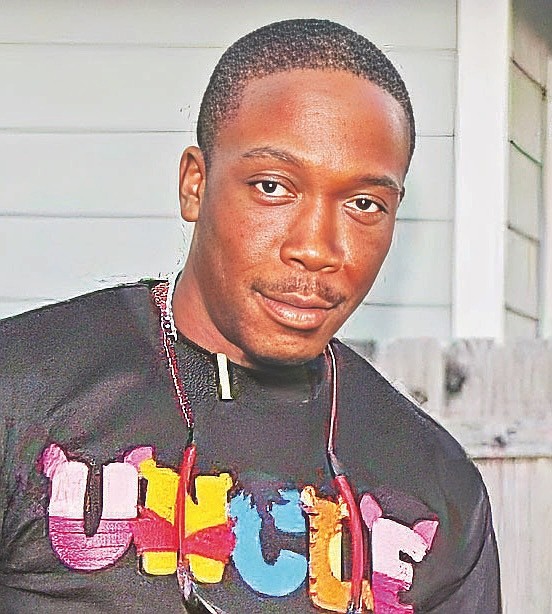
When the ground gave way beneath a Lyford Cay construction site last Wednesday, 38-year-old carpenter Deanko Miller lost his life alongside one other colleague, leaving behind a grieving family that is now calling for a thorough investigation into workplace safety failures at the project. Miller had worked for SMG Construction for close to six years, and in the wake of the tragedy, his sister Deante Miller says he had raised red flags about unsafe working conditions long before the collapse.
Deante Miller, a veteran former combat medic with ties to law enforcement, has chosen to withhold specific details of her brother’s safety concerns while an official investigation is ongoing, but she stressed that all relevant information will be turned over to investigating authorities. For her, this incident is far more than a private family tragedy—it is a critical wake-up call for construction safety standards across The Bahamas.
The family’s core demand is clear: investigators must determine whether proper safety protocols were followed at the site, and whether the ground was sufficiently assessed for stability before work began. Deante Miller has called for outside expertise from bodies like the Occupational Safety and Health Administration (OSHA) to help lead the probe, arguing that preventable on-the-job deaths cannot be allowed to continue. “You go to work and lose your life—that doesn’t make sense,” she said.
The tragedy has carried a particularly heavy weight for the Miller family. Deanko Miller left behind two young children, ages five and seven. The morning after the collapse, Deante Miller—who was celebrating her birthday—traveled with other family members to identify Deanko’s body at the morgue. She described losing her brother as traumatic and unimaginable, and recounted the confusion and delay the family experienced in learning the full details of his death.
Initially, the mother of Deanko’s children, who was listed as his emergency contact, was only informed of his death with no context about the collapse. The family was first directed to report to a local police station, and it took hours before they confirmed Deanko was the worker killed. “I knew that something was wrong when I called the police station and they said that they didn’t have anybody in custody,” Deante Miller recalled. “I thought maybe it might have been just an altercation on the job, maybe a fight, something unusual. It was only later that we confirmed he had passed.”
Publicly released video of rescue efforts to pull the trapped workers from the collapsed soil has added to the family’s pain. Deante Miller said the family first saw the graphic footage on the evening news, and it was devastating to watch. Compounding their grief are new questions about the speed and effectiveness of the emergency response, after the family heard unconfirmed reports that Deanko may have still been alive and breathing in the immediate aftermath of the collapse.
Drawing on her experience as a combat medic, Deante Miller questioned why first responders did not arrive faster to the scene. To date, the family says they have received no outreach or support from SMG Construction, the company behind the project. When reached for comment by media, SMG Construction declined to issue any statement on the tragedy.
For the Miller family, the immediate priority is getting clear answers about what led to Deanko’s death. “We really just need to know what happened around the circumstances,” Deante Miller said. “If SMG is going to reach out to his immediate family members, I think that would be very helpful for the case, and just taking it one step at a time.”
Deante also shared details of her final conversation with her brother the night before the accident. The pair spoke about their grandmother and her well-known sense of humor, before Deanko signed off with a jarring comment that has lingered with her since: “I’ll see you tomorrow evening, well, if I live.” It was the first time he had ever said anything like that to her, she said.
Deanko’s father, Wayde Miller, remembered his oldest son as a kind, family-focused man who doted on his two young children. “Me and him was pretty close,” Wayde said. “He’s my oldest son, my oldest child. I’m saddened the way his life was taken.” Wayde was out on his boat when the accident happened, and could not be reached immediately because of phone service issues. The last time he saw his son was at a family funeral for Deanko’s nephew several weeks before, where they spent hours together and took photos. “That’s a big chip off the block gone,” Wayde said. “So we just got to stay strong and keep him in our hearts and memory.”
Deanko’s aunt, Linda Wallace, said she last spoke to her nephew two days before the collapse. He had called to check on her after she lost her son two months prior, and they spoke together about how much he missed his late cousin.
-
PM: Powerful nations can’t disregard rules
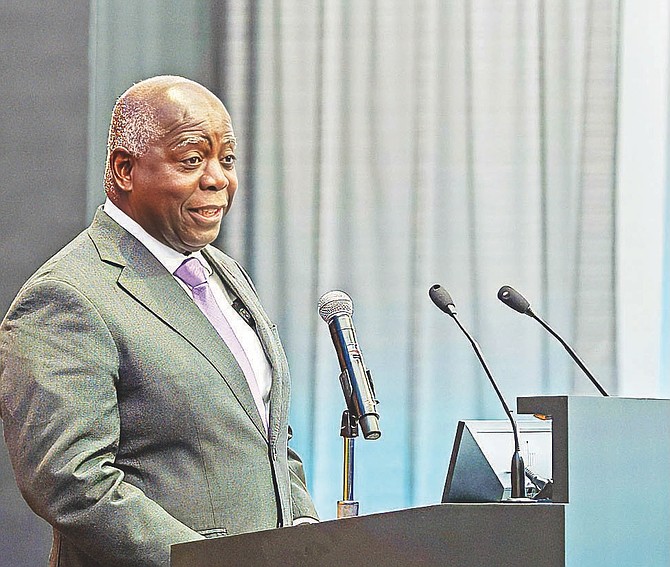
Speaking at the 81st session of the United Nations General Assembly in New York on Friday, Bahamas Prime Minister Philip “Brave” Davis delivered a stark and urgent warning to the global community: the post-WWII international order is sliding toward a hierarchical system where powerful nations can flout rules that small states remain bound by. Davis’s forceful defense of small nation sovereignty comes amid an ongoing, highly public diplomatic dispute between his administration and the United States over unauthorised undercover operations by the US Drug Enforcement Administration (DEA) on Bahamian soil, though he did not directly reference the conflict in his UN address.
The root of the bilateral tension emerged from a three-year US investigation into accused Bahamian drug trafficker Jonathan “Player” Gardiner and his network. US court filings have revealed that DEA operatives, posing as cartel members, conducted undercover activity across The Bahamas, including a 2024 meeting with an unnamed Bahamian politician inside the country’s Parliament to discuss facilitating a cocaine shipment. Last week, Bahamas Ambassador to the US Wendall Jones confirmed that a Bahamian delegation had formally raised complaints with US officials over what the government views as “rogue” DEA operations conducted without explicit local permission, clarifying that the objection relates to investigative conduct, not the prosecution of the suspects.
The dispute quickly escalated: US Ambassador Herschel Walker dismissed the allegations of illegal activity as “fake news”, questioning why Bahamian officials would object to the arrest of a known trafficker. In response, Bahamian Attorney General Wayne Munroe pushed back, noting that US authorities would never accept comparable unauthorised operations by Bahamian law enforcement on American territory.
In his UN address, Davis framed this local dispute as part of a broader, global erosion of the UN’s founding principle of sovereign equality. “International order, where rules apply only to the weak, is not order. It is a hierarchy,” he told the assembled global leaders. He argued that small nations bear no responsibility for the dismantling of the rules-based global system, but will be the first to suffer catastrophic consequences if it collapses.
Davis drew a line from historical colonial exploitation to modern power imbalances, noting “For 500 years, the Caribbean was somebody’s backyard. We did not win our freedom to once again become somebody’s backyard.” He pushed back against the implicit message he says small states receive from major powers: that their sovereignty is only permitted, not inherent. “A sovereignty that must ask permission is not sovereignty. It is a lease. Our ancestors did not break their chains so that their children could become tenants,” he said.
Unlike large powerful nations that can absorb the impact of weakened international frameworks, Davis emphasized that small states like The Bahamas, with a population of just 400,000, rely entirely on multilateralism to stand as equals to nations hundreds of times their size. “When The Bahamas defends multilateralism, we are not defending a bureaucracy. We are defending the only successful arrangement in which a nation of four hundred thousand people can stand at this podium as the sovereign equal of a nation of a billion people,” he said. His proposed solution is not abandoning international rules, but ensuring those rules bind large and small nations equally: “Defending international rules is not a favour to the small; it is an insurance for the strong,” he argued.
Beyond his core argument on sovereignty, Davis laid out a series of key priorities for The Bahamas and the broader Caribbean region. Turning to Haiti, he recalled the nation’s historic legacy as the first country to win independence through a slave revolt, noting that that act of self-liberation led to centuries of punishment, including a 1825 forced compensation payment to former French colonizers that Haiti took more than 150 years to pay off. Davis called on the UN Security Council to renew the mandate for the multinational gang suppression force deployed to Haiti, and ensure the mission receives sufficient resources while upholding Haitian sovereignty.
Davis also reiterated longstanding regional calls for reparatory justice for the transatlantic slave trade, referencing the Caribbean Community (CARICOM) Ten-Point Plan for Reparatory Justice. He urged nations that enriched themselves from slavery to engage in good faith on demands for truth, apology, restorative action and development investment. On Cuba, he repeated The Bahamas’ call for an immediate end to the decades-long US trade embargo, the removal of Cuba from the US list of state sponsors of terrorism, and the lifting of the fuel blockade, calling for the entire Latin America and Caribbean region to be recognized as a zone of peace.
Climate change, an existential threat to low-lying island nations like The Bahamas, also featured heavily in Davis’s address. He warned that The Bahamas cannot confront rising sea levels alone, noting that while the UN’s loss and damage fund for climate-vulnerable nations exists, a fundamental shift in power dynamics is required to make the fund operational and effective. Davis also announced The Bahamas’ formal endorsement of the Declaration on Sea-Level Rise, which enshrines that the country’s statehood, territorial boundaries, and UN membership will never be invalidated by rising ocean waters.
Looking to emerging global challenges, Davis raised alarms about the unequal power dynamics shaping the digital and AI era, warning against a future where small states are reduced to merely supplying raw personal data for systems designed and controlled by wealthy global powers. “The old empires took our lands, plundered them and renamed them. The new ones seek to take our data, and hand us back a picture of ourselves, one we did not paint,” he said. He argued that communities whose data is extracted deserve a voice in how that data is stored, used, and governed, and called for AI systems that respect national laws, understand local languages, and reflect the experiences of people outside wealthy North American and European nations. Davis backed greater small state representation in setting global digital rules, and publicly endorsed Stephen Bereaux’s nomination for Deputy Secretary-General of the International Telecommunication Union.
In a major announcement, Davis confirmed that The Bahamas intends to run for a non-permanent seat on the UN Security Council for the 2032-2033 term, emphasizing that the country seeks to challenge the status quo rather than stay on the sidelines. He called out structural inequities in the UN system, noting that five permanent Security Council members still hold veto power over global peace and security, a framework established decades before most current UN member states gained independence, and one that was never put to a vote of the broader membership. “An institution that cannot reform itself cannot hope to reform the world,” he said.
Davis closed his address by framing the entire debate as a question of legitimate power. “Power without legitimacy is not order. It is control. And a peace kept only by the powerful is not peace. It is permission,” he said.
-
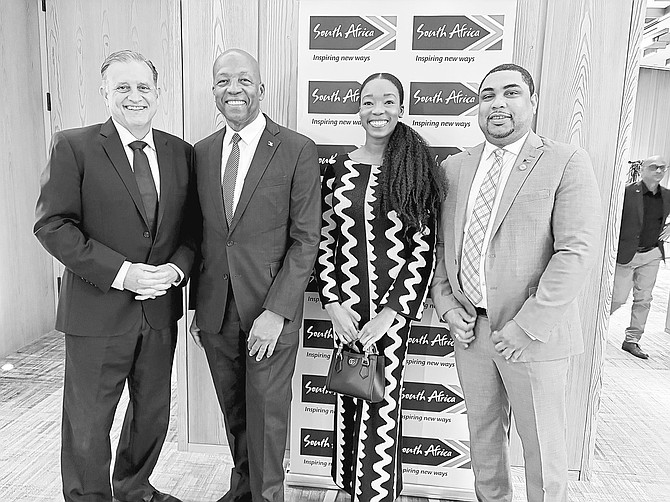
Davis urges stronger Africa-Caribbean economic ties
During the Diaspora and Friends of South Africa Roundtable held in New York, Bahamas Prime Minister Philip “Brave” Davis has issued a clarion call for African and Caribbean nations to take greater ownership of the critical infrastructure that powers the movement of people, capital and data across both regions. Davis argues that self-owned infrastructure is the foundation of long-term economic sovereignty, pushing for targeted investment in cross-regional assets including data centers, digital payment platforms, air connectivity and integrated trade corridors that would link African economies to each other and the Caribbean.
In his address, Davis drew a clear distinction between remittances and strategic investment, noting: “Remittance is love. Investment is power. Love keeps a family alive. Power keeps a nation free.” He went on to position The Bahamas as a strategic hub connecting Africa, the Caribbean and the broader Americas, highlighting untapped investment opportunities across key sectors including food security, renewable energy development, financial technology (fintech), manufacturing and logistics. “Let The Bahamas be your gateway to the Caribbean and the Americas,” he invited attendees.
Davis acknowledged that despite deep shared historical and cultural ties between Africa and the Caribbean, tangible practical and economic connections between the two regions remain woefully underdeveloped. Reflecting on The Bahamas’ own historical economic orientation, he noted: “For most of our life as an independent nation, The Bahamas has looked north. North for our visitors, our capital, our markets and our banks. There were good reasons. But in looking north for so long, we forgot to look east, towards the land our ancestors came from.”
The Prime Minister openly admitted that his administration still faces work to deepen these cross-regional ties, pointing to the significant barriers that currently complicate travel between The Bahamas and South Africa as one clear example. Rather than framing these gaps as insurmountable challenges, Davis reframed them as high-potential economic opportunities for forward-thinking investors.
He outlined key structural inequities holding back both regions: Sub-Saharan Africa remains the most expensive region globally for sending remittances, and cross-border payments between Caribbean and African businesses are almost always routed through third-party financial institutions in other parts of the world. On the digital infrastructure front, he highlighted a staggering gap: Africa is home to nearly 20 percent of the global population but holds less than 1 percent of the world’s total data center capacity.
“Digital sovereignty means deciding where our data lives, who may use it and on what terms,” Davis said. “It means sharing in the value it creates. It means entering the digital age as owners, not only as users.”
Turning to The Bahamas’ own investment landscape, Davis outlined two key priority areas for international partnership: The country currently imports approximately 90 percent of its food supply, creating opening for local agricultural and food processing investment, and it has set a target to generate 30 percent of its total electricity from renewable sources by 2030. He also highlighted The Bahamas’ growing fintech and digital sectors, as well as the competitive advantages offered by Grand Bahama’s free trade zone and deep-water port.
Davis pointed to the growing partnership between The Bahamas government and the African Export-Import Bank (Afreximbank) as a blueprint for future cross-regional collaboration. In February 2025, The Bahamas signed a $200 million framework agreement with Afreximbank to develop climate-resilient infrastructure, and the bank has recently expanded its financing ceiling for the Caribbean Community (CARICOM) from $3 billion to $5 billion. “African capital is building Caribbean resilience, and earning a return doing it,” Davis said. “Solidarity is not a speech. Solidarity is a balance sheet.”
Looking back to historical ties between The Bahamas and anti-apartheid movement, Davis invoked the 1985 Commonwealth Heads of Government Meeting held in Nassau, where global leaders adopted the landmark Nassau Accord calling for coordinated international action against apartheid in South Africa. He also recalled Nelson Mandela’s historic visit to The Bahamas following his release from prison. For the current generation of leaders, Davis argued, the core challenge is advancing economic and digital sovereignty for both regions. “In 1985, The Bahamas chose South Africa’s freedom,” Davis said. “In 2026, let Africa and the Caribbean choose each other.”
-
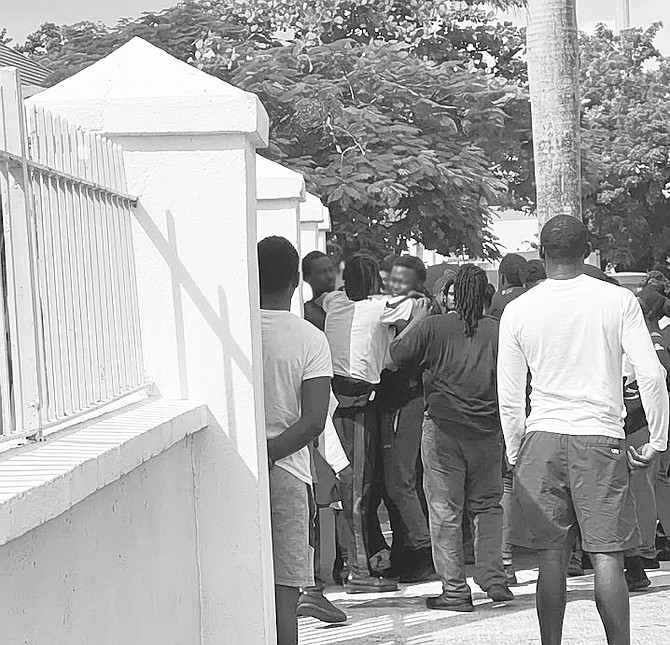
Mother and two daughters charged after school fight
A violent confrontation that started as a dispute between two students at C.C. Sweeting has ended with three arrests — a mother and her two teenage daughters — after the clash spilled over into an assault on an intervening law enforcement officer, police authorities have confirmed. The entire incident was recorded on video, drawing a sizable gathering of onlookers just outside the school’s main entrance gates as chaos unfolded. In the moments after the attack, multiple male students stepped in to physically pull the targeted officer away from the conflict zone to prevent further escalation, before an adult male ultimately intervened to regain control of the situation.
Chief Superintendent Sherri King, the police force’s press liaison, outlined the sequence of events that led to the arrests. The trouble originated from a physical altercation between two female students enrolled at the school. An officer who was assigned to a neighboring campus in the area happened upon the fight and moved in to separate the two combatants and de-escalate the tension. According to official police allegations, however, the mother of one of the student combatants turned on the intervening officer, launching an attack, and her second daughter — also a minor — quickly joined her in the assault.
Following the confrontation, the adult woman and the two underage females were taken into police custody and formally charged in connection with the incident. This outbreak of violence at a school campus comes just weeks after a senior police official announced major progress in curbing school-related violence across the region. Assistant Commissioner of Police Dr. Chaswell Hanna, who oversees the School Based Policing and Training portfolio, recently stated that reported incidents of school violence have dropped by 48% since the school resource officer program was brought back into operation.
In his earlier remarks, Dr. Hanna also noted that multiple parents had already been brought before the courts in the preceding academic year in response to their involvement in school-based incidents. He issued a clear warning at the time that law enforcement would aggressively prosecute any parent who created disturbances on school grounds that target teachers, school administrators, or other school personnel.
-
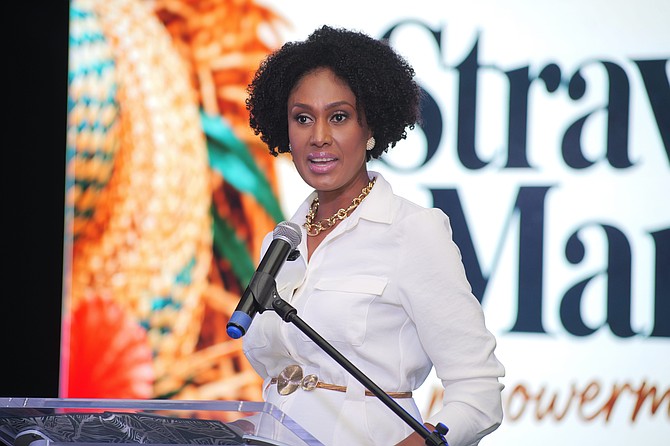
Straw vendors get month’s free rent after closure
Vendors operating out of Nassau’s iconic Bay Street Straw Market are set to receive a full month of rent-free operations, a last-minute expansion of government support after stakeholders raised alarms that a mandatory two-day cleaning shutdown would cut into already scarce revenue amid a sluggish retail season. The policy change was officially unveiled this past Saturday, as the popular downtown tourist hub reopened its doors to shoppers following the deep cleaning initiative. Originally, authorities had only planned to offer a one-week rent waiver to vendors who participated in an empowerment session hosted Friday by the Ministry of Culture, Arts and Heritage — the new 30-day concession is four times the length of that initial proposal.
Culture Minister Leslia Miller-Brice explained that the ministry opted to expand the relief package after directly acknowledging that the temporary closure placed an unplanned extra financial strain on the market’s 470 small-scale vendors. “We recognized from the start that shutting down for two days would impact vendors’ income, and we wanted this cleaning effort to deliver more than just a spruced-up facility,” the minister noted.
The two-day shutdown marked the first full, comprehensive deep cleaning of the public market since 2021. Work crews removed accumulated debris, deep-cleaned floors and overhead fans, and performed critical maintenance on the market’s central cooling system, hauling away at least five full dumpsters of discarded waste over the closure period. Beyond professional maintenance, vendors seized the moment to organize and clean their individual stalls, fostering a strong sense of collective community spirit during the process, according to Miller-Brice. Younger vendors stepped up to assist older colleagues with moving materials and cleaning their spaces, turning the closure into a collaborative effort rather than a disruption.
At Friday’s pre-reopening listening and empowerment session, multiple vendors voiced gratitude for the government’s responsive approach to their concerns. Vendor Manette Maycock praised both the deep cleaning initiative and the expanded rent concession, noting that the local economy has not returned to pre-slowdown levels, making the month of waived rent a vital lifeline for small operators. “We are indeed appreciative of what is taking place today, even including the reduction of our rents,” Maycock said. “because you know the economy is not what it used to be, and we appreciate that month off, and also the empowerment for the straw vendors.”
Fellow vendor Charltaneka Johnson echoed that sentiment, saying the move made long-overlooked vendors feel seen and valued by the government. “Nobody ever done something like this for us,” Johnson said. “We feel seen. We feel loved.” Johnson also used the session to raise a longstanding safety concern: recurring flooding around entryways during heavy downpours, which creates slip and fall hazards for both vendors and tourists navigating the area.
Miller-Brice confirmed that the government is already moving forward to address a slate of ongoing vendor concerns, including persistent high temperatures inside the market, with the long-term goal of drawing more tourist foot traffic to the hub. New cooling units have already been installed and are currently undergoing testing, and the culture ministry plans to hold coordinated talks with the Ministry of Tourism to develop strategies for increasing visitor numbers to the market. Vendors have told the minister that a cooler, more comfortable shopping environment will encourage tourists to stay longer and increase their spending at local craft stalls.
Since taking office in May, Miller-Brice has made regular unscripted visits to the market to meet directly with vendors and hear their concerns firsthand. “I simply just sit there, and I ask them, ‘What is it that we can do better?’” she said. All concerns raised during these sessions are formally forwarded to the Straw Market Authority for review and action, she confirmed. Currently, weekly rent for a stall at the market is set at $37, making the one-month waiver equal to roughly $148 in relief per vendor.
-
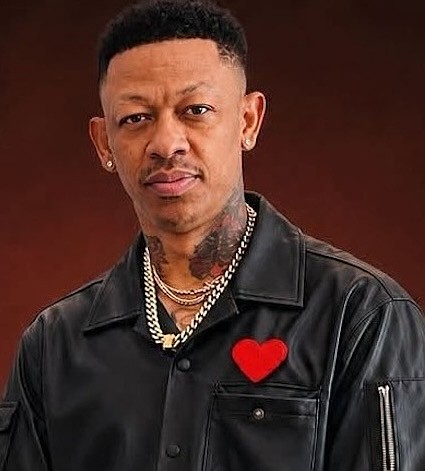
Stefan Davis remembered as artist, father and friend
On a somber Saturday, hundreds of mourners gathered to celebrate the life and legacy of beloved Bahamian artist and entrepreneur Stefan Davis, better known to the community by his professional moniker “Stefan Legend.” Davis died in a tragic car crash in South Florida on September 2, just three days shy of what would have been his birthday, while traveling on what was planned as a celebratory birthday getaway with friends.
The funeral service was a deliberate reflection of the life Davis built: one deeply rooted in Bahamian culture and unapologetically creative. Junkanoo decorations framed the ceremony, chronological portraits of Davis across every stage of his life lined the walls surrounding his casket, and a striking life-size sculpted bust of the artist anchored the front of the service. Many attendees paid quiet tribute by wearing small red pixelated hearts pinned to their chests, a nod to Davis’ iconic artistic style.
As the founder of the popular creative brand Airbrush Junkies and a father of two, Davis left a mark on the art world that stretched far beyond The Bahamas’ borders. Friends and colleagues remembered his relentless work ethic, recalling he would often pour hours into creative projects, working well into the early morning – 4 a.m. or 5 a.m. was not an unusual end to his workday. But for his oldest daughter, Teja Davis, the public acclaim and artistic legacy that made him a local icon paled in comparison to the role he cherished most: being a devoted father and her closest confidant.
“My dad was my best friend, and if you take a look at me, he was quite literally my twin,” Teja told the gathered crowd. She shared that while Davis carried a deep passion for people, art, Junkanoo, and Bahamian culture, family always sat at the top of his priorities. The last time she saw her father alive was at their local church, moments before he departed for his Florida trip.
Teja painted a portrait of a warm, playful parenthood defined by constant connection: daily phone calls, gentle teasing when he arrived late to church with his usual Starbucks order, and lighthearted check-ins when he missed his self-imposed curfew. When Teja chose to build a career in juvenile justice, Davis fully supported her ambition, even as he openly worried about the risks of her night shifts in correctional facilities and rescue operations.
“My dad approached parenthood differently. He did it with humility, love, gentleness, transparency, and a whole lot of jokes,” she said. Davis gave his daughter the space to grow into a bold, ambitious, and resilient person, while instilling a core faith that remained central to her life.
Despite Teja’s calm demeanor throughout the service, she made clear that her composure did not reflect the depth of her loss. “This is an unimaginable loss, as I absolutely adored my daddy,” she said. “I’m mourning not only his passing, but all the future moments we will never share: him walking me down the aisle, watching me raise my children, seeing me hit career milestones, and celebrating many more birthdays together. To many he was an icon, an artistic genius, a creative mastermind – and although it’s all true, to me he was just my daddy, and I was just his baby girl.”
Friend Khari Albury shared intimate insights into Davis’ final days, recalling how the artist personally organized the group birthday trip that would be his last. Albury, who also celebrated a birthday that September, had initially turned down the invitation, struggling with the emotional weight of the milestone birthday. But Davis refused to take no for an answer, sending constant reminders, photos, and encouraging videos until Albury changed his mind and booked a ticket. Davis was the first person waiting to greet him when he arrived, and Albury said he knew immediately he had made the right choice.
On the eve of Albury’s September 2 birthday, Davis reminded his friend that not everyone gets the chance to reach his current age – a line that has taken on haunting new meaning in the wake of Davis’ sudden death. Albury also recalled a near-miss car collision on their drive back to Miami on his birthday, when another vehicle swerved directly into the side of the car where he and Davis were sitting. “Steph looked at us and said, ‘I got you. You all covered,’” Albury remembered. What felt like a quick, casual reassurance between friends that day has stuck with him in the months since.
“I’m still waiting for this reality not to be reality, but I find myself going back to those words over and over,” Albury said. He echoed others in describing Davis as larger than life, with endless energy that allowed him to work on his feet for a full day, finish a project in the early hours of the morning, and still head out to connect with friends afterward.
Childhood friend Leslia Miller Brice shared memories of growing up with Davis on Taylor Street, where the tight-knit neighborhood was built on close community bonds, strong family values, and mutual respect. She remembered Davis as a quiet but unshakable protector, whose love and loyalty showed far more in his actions than in grand speeches. “His love was quiet. His loyalty was unshakable, and those who knew him felt it in ways words will never fully capture,” Miller Brice said.
-
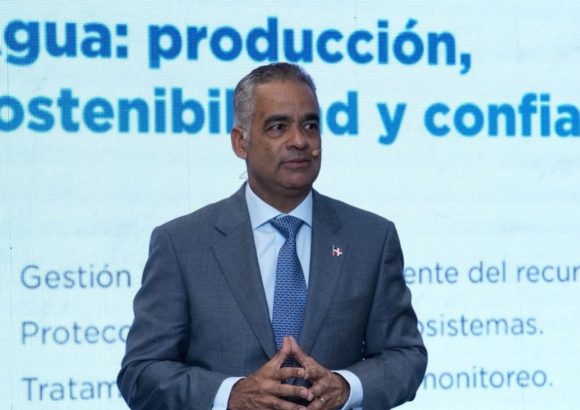
Energy and Mines Minister to address Dominican Republic’s rare earth potential in Washington
As global demand for critical raw materials and cross-border energy connectivity accelerates, Dominican Republic’s Energy and Mines Minister Joel Santos is heading a high-profile delegation to 2026 Dominican Week in Washington, D.C., where he will put the Caribbean nation’s untapped potential in rare earth elements and critical minerals at the center of international dialogue. A core highlight of Santos’ agenda will be his keynote address at the Inter-American Development Bank (IDB) event titled *Rare Earths and Critical Minerals: A Strategic Opportunity for the Dominican Republic*, where he will outline the country’s ongoing work to map and evaluate potential mineral deposits, as well as its policy push to build collaborative, responsible development partnerships with global stakeholders. This engagement comes amid a sharp uptick in global interest in the Dominican Republic’s mineral reserves, a shift driven by the nation’s recent efforts to forge international cooperation frameworks. Just recently, the Dominican government and the United States formalized a joint agreement focused on bolstering resilient critical mineral and rare earth supply chains, attracting private sector investment, and advancing mutually beneficial development projects. Parallel to that, the Dominican Republic and the European Union have also moved forward with a pact to fund and support geological studies of rare earth elements, gallium, and scandium embedded in bauxite reserves located in the Ávila Mining Fiscal Reserve in Pedernales, a project that could unlock significant new resource potential for the region. Beyond mineral development, Santos will also contribute to a high-level panel discussion focused on the transformative Hostos Project, an ambitious infrastructure initiative that plans to build a submarine electricity interconnection between the Dominican Republic and Puerto Rico across the Mona Passage. Developed by the Caribbean Transmission Development Company, the project calls for a high-capacity undersea cable that will be able to transmit up to 700 megawatts of power between the two territories. The panel will unpack the far-reaching implications of the proposed interconnection, including the potential integration of the two regional electricity markets, improvements in cross-border energy security, the expansion of usable generation capacity, and the long-term goal of strengthening holistic energy interconnection across the broader Caribbean region.