作者: admin

  • Rewriting the past to kill the future

    Rewriting the past to kill the future

    On a casual, unplanned observation, author Jorge Enrique Jerez Belisario overheard a striking exchange that laid bare a growing ideological threat facing Cuba today. Two strangers discussing current economic and social hardships slipped into a dangerous revisionist claim: that life under capitalism before the 1959 Cuban Revolution was, at the very least, functional. A bystander quickly pushed back with a sharp, unanswerable truth: under that old order, Black Cubans were barred from sharing sidewalks with white Cubans. That moment of everyday dialogue, Jerez argues, reveals how insidious and effective the global campaign to rewrite Cuban history has become.

    The battle for influence in the 21st century is not fought only on military battlefields or in trade negotiations. Today, the most critical front is collective memory. In this war of narratives, billions are invested in ideological manipulation, and nostalgia for the pre-revolutionary bourgeois republic has emerged as one of foreign powers’ most effective seductive weapons. Rather than presenting an accurate account of Cuba’s past, this campaign cherry-picks details to fit a pre-written narrative: it frames the 1902–1959 republic as an idyllic lost paradise, stolen from the Cuban people by the 1959 Revolution.

    The mechanism of this propaganda is disarmingly simple. Operators take the basic factual truth — that a bourgeois republic existed before 1959 — strip away all its systemic contradictions, polish its superficial glamor, and present it as a sepia-toned mirage for Cubans to yearn for, even if they never lived through it. This is not history; it is carefully packaged propaganda. Scroll through any major social media platform, from Instagram to X to Facebook, and users are flooded with curated posts highlighting the neon-lit streets of mid-century Havana, sleek new cars cruising the Malecón, and grand well-preserved buildings, all packaged to sell the myth of a pre-revolutionary paradise.

    What these posts deliberately omit is the dark underbelly of that old order. That superficial “glamor” was not available to all Cubans, nor was it achieved without exploitation. Pre-1959 Cuba was a de facto playground and testing ground for United States interests: it was dominated by organized crime, large exploitative landholdings, state-regulated prostitution, and a local ruling class that acted as willing collaborators with foreign imperial power. The bright neon signs of 1950s Havana only masked deep, systemic inequality, not widespread collective prosperity.

    The end goal of this campaign is far more subtle than simply turning the public against the current government. Its quiet aim is to erode faith in the very necessity of the Cuban Revolution. By planting the seed of doubt — “What if the old republic wasn’t that bad?” — operatives open a crack for historical amnesia to seep in, ultimately demobilizing popular support for Cuba’s sovereign revolutionary project. The narrative pushes the false claim that the 1902 republic solved Cuba’s core problems, erasing the widespread unrest and systemic injustice that defined the 1930s and 1950s and made revolution inevitable.

    The danger of this selective historical memory extends far beyond distorted accounts of the past. When a Cuban, whether living on the island or abroad, accepts the myth of the perfectible old republic, the manipulators win a decisive ideological victory. Suddenly, the national consensus built around a century-long fight for justice is shattered: the Revolution becomes redefined as an unnecessary mistake that interrupted a supposed golden age. From there, it is a small step to frame the decades-long U.S. blockade as a reasonable sanction, coercive foreign measures as deserved punishment, and national surrender as a pragmatic solution. This entire project is designed to drain over six decades of collective struggle for social justice of all meaning.

    Selective memory does not only lie about history — it amputates a population’s ability to understand the challenges of the present. When people only see the glittering avenues and luxury cars of the old republic, they are conditioned to dismiss systemic inequality as a minor footnote, racial segregation as an unimportant detail, and the national sovereignty shackled by the Platt Amendment as an acceptable tradeoff for consumer goods and superficial order. This is the true poison of cognitive warfare: when collective memory is selectively curated, national historical consciousness atrophies. People stop questioning why the Revolution required mass sacrifice, come to see it as an unnecessary violent interruption of a bourgeois idyll, and become vulnerable to propaganda that frames foreign intervention as humanitarian aid and the blockade as a just penalty.

    This manipulated memory also fractures intergenerational solidarity. Young Cubans who only ever see the curated postcard version of 1950s Cuba grow up without learning the history of popular struggle, never understanding that the old republic was also a system that left peasants landless, workers without basic rights, and Black Cubans systematically excluded. Without that full context, these young people will repeat claims of “lost freedom” without ever grasping what they are actually saying.

    At its core, selective memory is not just deceptive — it is disarming. It robs Cubans of the tools to defend the gains their predecessors won over decades of resistance. It plants doubt in the legacy of national heroes, pushes people to view current hardships through the lens of an invented past, and convinces them to blame the Revolution itself for problems caused by decades of foreign aggression. That is the ultimate goal of this cognitive warfare campaign: to make the Cuban people blame their own shield for the wounds inflicted by an attacking sword.

    Every social media account posting decontextualized “old Havana” content is part of a calculated operation. Every article idealizing the bourgeois republic that ignores its deep structural flaws is backed by significant foreign funding. Every person who repeats the claim “we were better off before” despite having never lived in that era marks a small victory for foreign cognitive warfare. Jerez closes with a call to collective vigilance: Cubans must not allow this induced nostalgia to rob them of their historical clarity, nor let selective memory erase the full truth of the past. Cuba was never built on a lost paradise; it was built on a people’s decision to stop being a colony and claim national dignity. That is the decision these campaigns aim to undermine — and it remains the foundation that keeps Cuba standing today. To build a just future, Cubans must first understand the full truth of their past.

  • Official reopening of the Haitian Embassy in Benin

    Official reopening of the Haitian Embassy in Benin

    In a symbolic event blending national celebration and diplomatic milestone, Haiti officially reopened its embassy in Cotonou, Benin on May 18, 2026, coinciding with the 223rd anniversary of the Haitian national flag. The ceremony opened with heartfelt performances of the Beninese and Haitian national anthems by clarinetist Landry Padonou and vocalist Ayam Sèdjro, as the two national flags were raised side-by-side, a visual testament to the growing bonds between the two nations across diplomatic, historical, cultural and scientific spheres.

    Hosted under the unifying themes of revolutionary memory, mutual fraternity, and cross-cultural exchange, the reopening drew a diverse and high-profile crowd of attendees. Representatives from diplomatic missions across the globe—including France, Cuba, the United States, Japan, the Kingdom of Morocco, the European Union, the Russian Federation, the United Nations, the Apostolic Nunciature, and the Economic Community of West African States (ECOWAS)—joined the gathering. Local attendees included Beninese municipal leaders, members of the Haitian diaspora community based in Benin, embassy partners, working journalists, and multiple crowned traditional authorities from across Benin, whose presence underscored the deep spiritual and historical connections that link the two countries.

    Speaking on behalf of all the traditional monarchs in attendance, His Majesty Guidimadjèdjè, King of Porto-Novo, emphasized the profound kinship between the two populations, stating “Haitians are Beninese and Beninese are Haitians.” He closed his remarks by offering traditional prayers for lasting peace and shared prosperity for the Haitian people, who currently face widespread political and humanitarian instability.

    Dominique Brutus, the Chargé d’affaires a.i. of the Haitian mission in Benin, framed the reopening as a deliberate policy priority for Haiti’s governing bodies. She noted that the move underscores Haiti’s commitment to expanding its diplomatic footprint across the African continent, while reaffirming its commitment to strengthening long-standing historical bonds with African nations and the global Caribbean diaspora. Brutus also reflected on the historical weight of the ceremony’s date: May 18 marks the anniversary of the creation of the Haitian flag in 1803, during the country’s revolutionary fight for independence from colonial rule.

    Marius Loko, Director General of External Relations of Benin and head of the Beninese official delegation, welcomed the renewed diplomatic presence as a new, dynamic chapter in bilateral relations. He reaffirmed Benin’s shared commitment to deepening collaboration across cultural, educational, and scientific domains in the years ahead.

    Following the official diplomatic proceedings, the celebration continued in a warm, fraternal atmosphere, featuring a lineup of artistic and cultural performances that highlighted shared heritage. A standout moment was a slam poetry performance by celebrated Beninese poet Amagbégnon Eklou, which centered Vodou cultural traditions as a vital, living link between communities along the Gulf of Guinea and Caribbean populations, most notably Haiti. The event concluded with a communal gathering of all guests, a symbolic closing that sealed the friendship, solidarity, and mutual cooperation that define the modern relationship between Benin and Haiti.

  • $160K Immigration Scandal: Who Took It, Who Knew?

    $160K Immigration Scandal: Who Took It, Who Knew?

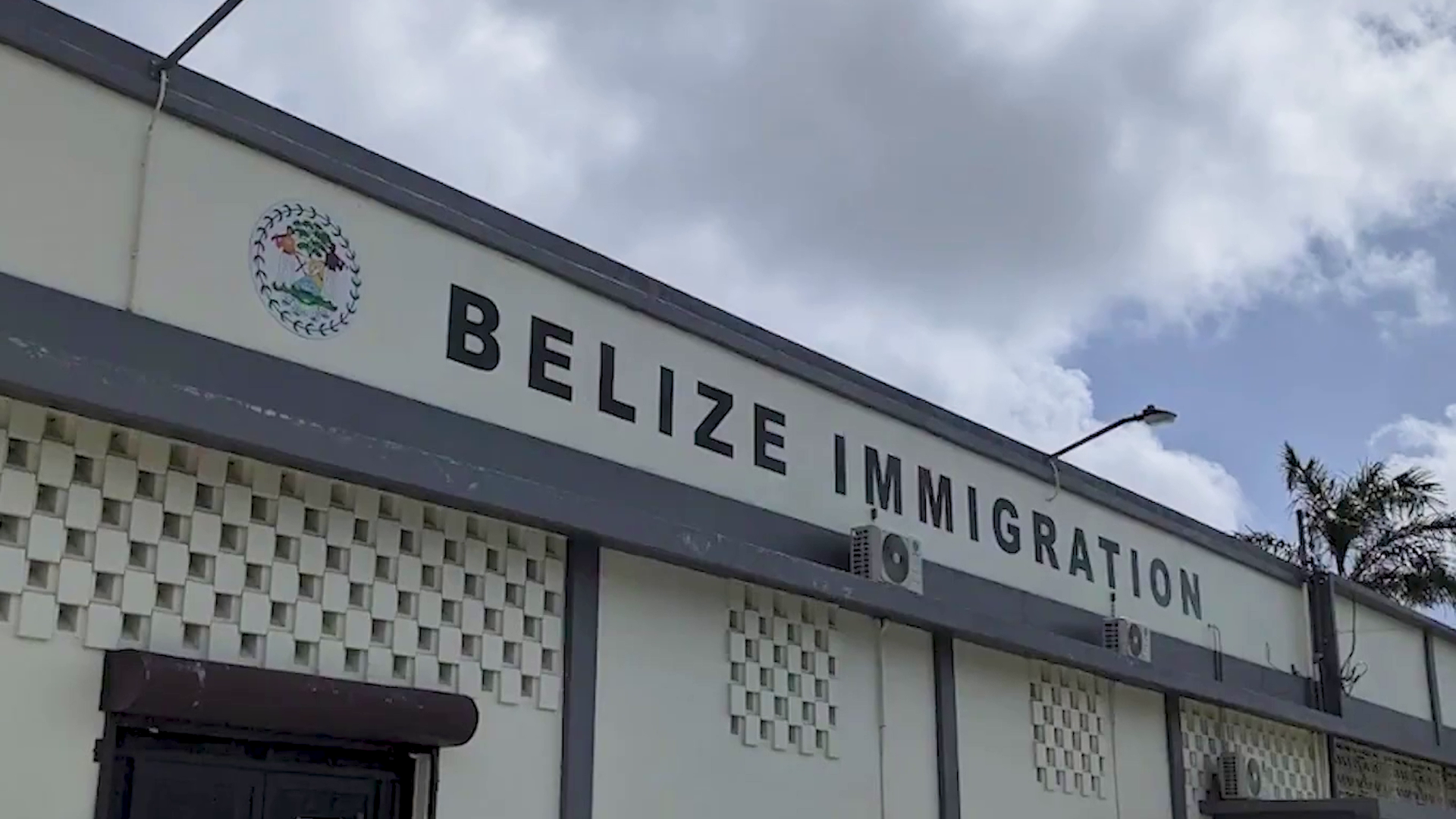
    A deepening public fund misappropriation scandal centering on Belize’s Immigration Ministry has placed the national government under growing public and political pressure, with calls mounting for a full, independent audit of the agency’s financial operations.

    Dated May 19, 2026, the unfolding controversy began when a preliminary investigative report was delivered to Immigration Chief Executive Officer Tanya Santos-Neal, documenting the unauthorized diversion of at least $160,000 in public funds. In an interview with reporters, Santos-Neal confirmed that investigators have already pinpointed one individual linked to the misappropriation, who could soon face formal criminal charges. The bigger question hanging over the case, however, remains how far the misconduct extends.

    Santos-Neal explained that the preliminary probe, which cross-checked financial records through the ministry’s CITO digital system, found no evidence that applicants failed to receive the immigration documentation they paid for. Instead, the embezzlement occurred behind the scenes, through manipulated receipt reversals. Investigators are still working to untangle what exactly took place: whether the scheme involved forged supervisor signatures, simply inadequate oversight from supervisory staff, or active complicity by senior leaders within the department.

    When asked how many people may be involved, Santos-Neal noted that one person with direct access to cash payments has been confirmed as a person of interest. But the ministry’s multi-layered supervision structure means that misconduct could reach either the first or second tier of oversight – or both. As a result, Santos-Neal confirmed the agency will formally recommend a full, in-depth audit to uncover all gaps and wrongdoing in the department’s financial practices.

    Opposition Leader Tracy Panton, head of the United Democratic Party, has seized on the scandal to argue that the misappropriation is not an isolated incident, but evidence of systemic, endemic corruption that permeates multiple branches of the current government. Panton pointed to longstanding allegations of misconduct across other key public agencies, including the Lands Department and Police Department, as well as unaccountable payments from statutory bodies to private marketing firms with no clear justification for the spending.

    “These are not the private purses of government officials,” Panton stated. Citing the common adage that “a fish stinks from the head,” she argued that the spread of corruption across public services stems from a lack of accountability at the highest levels of national leadership. She claimed that when low-level public workers see senior ministers and even the prime minister benefiting from corrupt practices without consequence, they feel justified in seeking illicit gains to support their own families and improve their living standards. The result, Panton said, is corruption that has become embedded in every stage of public service delivery.

    Panton has previously pledged on social media that if the United Democratic Party wins power under her leadership, her administration will launch a sweeping effort to eliminate systemic corruption from Belize’s public sector. As the investigation expands, public attention has shifted from focusing solely on the individual identified in the initial probe to questioning whether broader regulatory and cultural changes are needed to restore public trust in government institutions.

  • After a Decade of Delay, OSH Bill Hits Senate Snag

    After a Decade of Delay, OSH Bill Hits Senate Snag

    More than ten years after it was first drafted, the long-awaited Occupational Safety and Health (OSH) bill has finally advanced to the national Senate — only to become bogged down in procedural and substantive gridlock that has cast new doubt over the future of landmark worker protection legislation. For two full weeks, the proposal has been stuck in Senate committee review, leaving workers and employers across the country waiting without the critical regulatory safeguards the bill is designed to put in place. While public narratives have circulated blaming broad Senate inaction for the delay, sitting Union Senator Glenfield Dennison pushed back against that framing during a joint press appearance with independent colleagues Wednesday, arguing the holdup stems from deep, unresolved flaws embedded in the legislation itself.

    Dennison refuted claims that individual senators were deliberately dragging their feet on the bill, noting that the proposal spent 12 years in preliminary stages before reaching the upper chamber just this spring. “Don’t drop that on me — I don’t want anybody suggesting that it is me holding up the OSH,” Dennison said. “Let’s take that narrative and throw it in the trash.” The most obvious contradiction he highlighted centers on the treatment of domestic workers: the bill’s opening definition section explicitly frames domestic work as a covered employment category, but Section 3 includes a clear exemption that excludes domestic workers from the law’s protections entirely. This direct logical conflict, Dennison argued, is just the most visible of a long list of unresolved issues that have stalled the legislation’s progress.

    The bill’s delay has drawn criticism from across the Senate aisle, with UDP Senator Sheena Pitts doubling down on concerns about the exclusion of domestic workers and pointing blame directly at the Ministry of Labor and its leadership, including Labor Minister Kareem Musa. Pitts emphasized that Senate lawmakers are not intentionally stalling the bill — instead, the executive branch’s team failed to prepare answers for core questions raised during committee review. When senators pressed for clarification on key provisions, Pitts said, ministry representatives “told us, we can’t answer that right now.” Adding to the chaos, Minister Musa was out of the country during the initial review period, leaving no senior official able to resolve outstanding concerns.

    Pitts also tied the exclusion of domestic workers to the country’s international human rights commitments, noting that the nation has ratified the United Nations Convention for the Elimination of Discrimination Against Women, which requires governments to advance gender equity. “You know who domestic workers are — women,” Pitts said. “It is so unfortunate that even the minister does not understand the legislation,” she added, criticizing the lack of preparation from the Labor Ministry’s top administrative team, including the Chief Executive Officer and Labor Commissioner, who attended the committee hearings but could not respond to basic questions about the bill’s text.

    The gridlock comes after more than a decade of legislative back-and-forth on the OSH bill, which was first introduced in 2014 to update outdated occupational safety rules and expand protections to vulnerable worker groups. The current delay has renewed concerns that the legislation will stall indefinitely, leaving millions of workers without improved safety standards and regulatory recourse for workplace hazards. For the time being, committee leaders have not scheduled a new vote or markup, leaving the bill’s fate uncertain as the legislative session progresses.

  • Shyne Barrow Blasts Panton’s UDP Faction as Self-Serving

    Shyne Barrow Blasts Panton’s UDP Faction as Self-Serving

    Internal fractures within Belize’s main opposition United Democratic Party (UDP) have accelerated into open, public conflict, with two of the party’s most prominent senior figures launching blistering attacks on the leadership of current party head Tracy Panton just six months into her tenure.

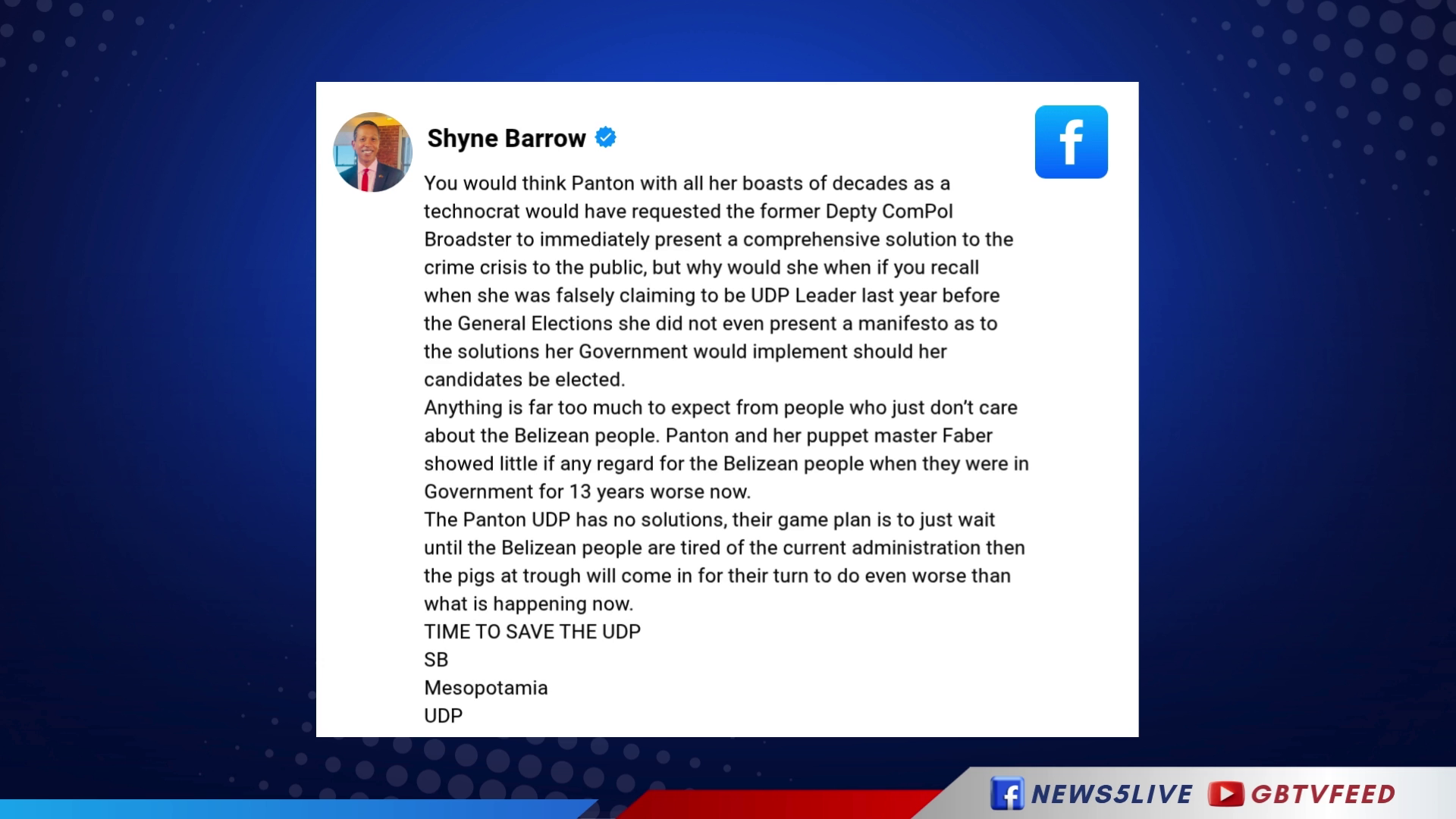
    Former UDP party leader Moses “Shyne” Barrow joined forces with ex-deputy party chairman Alberto August to publicly denounce Panton and her aligned faction, airing long-simmering internal frustrations with unvarnished candor. Barrow, one of the UDP’s most high-profile figures, delivered his rebuke directly to voters via a public Facebook post, arguing that the party currently offers no credible alternative to the ruling government for Belizean voters. He went further to label Panton’s faction as an out-of-touch, self-interested bloc of politicians, who are primarily waiting for their turn to access power and personal gain rather than working to advance the party’s policy goals and reconnect with voters.

    August fully backed Barrow’s criticism, centering his own remarks on Panton’s qualifications to lead the party. He publicly questioned whether Panton has the necessary experience to rebuild the fractured organization, and called on her to step down temporarily, build up political experience over time, and mount a leadership bid again in the future.

    As the wave of internal backlash against Panton grows, political observers have noted that the public infighting has ramped up pressure on the new leader to respond to the criticisms from within her own party. When approached for comment by reporters, Panton pushed back firmly against the calls for her departure, framing her focus as staying committed to the multi-year project of rebuilding the UDP rather than engaging in petty internal squabbles.

    Panton pointed out that she has only served as party leader for less than six months, and inherited a party in complete disarray when she took the top role. She outlined the depth of the challenges she inherited: the party’s bank account was left completely empty, its national headquarters was in a state of ruin, the party’s constitution had been effectively discarded, and previous caretaker leadership had operated without any commitment to fair play, transparency or accountability. Despite these steep challenges, Panton emphasized that the UDP remains a broad, inclusive organization that welcomes all members who want to contribute constructively to rebuilding the party’s credibility and regaining the trust of the Belizean electorate.

    She did not mince words for critics within the party, however, warning that internal dissent that undermines the rebuilding effort will have consequences. “There is also a thing called natural attrition. Not everyone will get on the ship and if you don’t get on the ship you do so at your peril, because one thing I will tell you, this ship will sail,” Panton said, reaffirming her commitment to holding the leadership and moving forward with the party’s rebuilding regardless of internal opposition. She added that the door remains open to any member willing to contribute meaningfully to the party’s progress.

    This report is a transcript of an evening television news broadcast, with all dialogue transcribed accurately per standard transcription conventions.

  • Illegal Dredging Claims Mexico Rock Near Ambergris Caye

    Illegal Dredging Claims Mexico Rock Near Ambergris Caye

    Belize’s coastal ecosystems are facing an urgent, unaddressed threat from unregulated development and illegal dredging, environmental advocates have warned, pushing authorities to tighten enforcement of existing conservation rules and halt harmful activity immediately. In a public joint statement released this May, the Ambergris North Alliance (ANA), a local environmental advocacy group, has named Mexico Rocks near Ambergris Caye as the site of the most recent confirmed violation, where dredging operations have continued long after their original official permits expired.

    ANA President Catherine Paz detailed the most recent incident, which unfolded just one week before the group’s formal announcement, at a newly constructed bulkhead located roughly 600 yards from X’tan Ha Resort, right along the boundary of the Mexico Rocks Marine Reserve. From the moment the bulkhead was built, ANA raised red flags, submitting formal concerns to Belize’s Department of the Environment (DOE), the local mayor, and the area’s elected representative. No action was taken to remove or modify the structure, leaving a persistent problem that has now escalated into illegal activity.

    Paz explained that the bulkhead’s placement causes recurring navigational issues for barges accessing the site: shifting sand frequently traps vessels, forcing crews to dig out the channel again and again. The ANA captured clear video evidence of the most recent unauthorized dredging, which continued illegally until midnight, pausing only briefly for a couple of hours before resuming. Paz confirmed that while the project held valid permits during its initial phase, those approvals have expired, and no new permit has been granted for ongoing work.

    This single incident is not an isolated case, according to ANA. The organization points to a long pattern of unregulated dredging, land reclamation, and quarrying across northern Ambergris Caye and other sensitive coastal zones across Belize, including Hol Chan, Bacalar Chico, Placencia, and Corozal Bay. Cumulative damage from these activities is already putting the region’s unique biodiversity and natural climate resilience at severe risk, Paz says, and the repeated failure of authorities to respond to community concerns has eroded public trust in government environmental oversight.

    The ecological risk of the illegal dredging is particularly acute because of the site’s proximity to the Belize Barrier Reef, one of the world’s most important coral reef systems. Paz noted that the reef sits less than a quarter-mile from the shore at Mexico Rocks, and moves even closer to land further north. Sediment stirred up by dredging (a process called siltation) is carried directly to the reef by natural currents, smothering corals and disrupting the entire marine food web that supports both local wildlife and the coastal tourism and fishing industries that are the backbone of the local economy.

    After years of quiet outreach and repeated requests for meetings with authorities that went unanswered, ANA moved to issue its public call for action. The group is demanding an immediate halt to all development activity in the country’s most sensitive coastal and marine protected areas, alongside much stricter enforcement of existing environmental protection laws.

    In response to inquiries from reporters, Belize’s Department of the Environment and Mining Unit confirmed that they have received ANA’s formal reports of illegal activity, and stated that the incident is now under active investigation.

  • Placencia Lagoon Controversy Exposes Permit Violations

    Placencia Lagoon Controversy Exposes Permit Violations

    Scheduled for publication on May 19, 2026, a simmering dispute over unauthorized sand extraction from Belize’s Placencia Lagoon has erupted into a broader conflict over coastal development governance, pushing environmental accountability and community representation into the national spotlight. What began as local outrage over a private contractor violating the terms of its dredging permit has grown into a coordinated demand from local leaders for a formal voice in critical environmental and resource development decisions.

    After the country’s Department of Environment and national Mining Unit stepped in to address the initial violation, the Placencia Village Council launched an independent investigation that uncovered multiple additional permit breaches. Now, the council is pushing for a permanent seat at the table when government agencies review environmental clearances and mining permits for the peninsula.

    Placencia Village Councilor Kristine Small emphasized that the stakes of the conflict extend far beyond the boundaries of a single local jurisdiction. Any development activity along the Placencia Peninsula, she explained, shapes the economic and environmental well-being of all residents across the region. Small noted that the unregulated dredging has already damaged critical coastal ecosystems, including seagrass beds that serve as core habitat for manatees, commercial fish species and other forms of marine life that form the foundation of the peninsula’s livelihoods. Many local residents, tour guides and artisanal fishers rely on the lagoon’s natural resources for both food and income, she added.

    At the center of the community’s complaint is the lack of local oversight over high-impact coastal development. Small pointed to long-standing government claims that understaffing prevents consistent monitoring of permitted projects, a gap that the Placencia Village Council is ready to fill. “We want to appoint a trusted local representative to carry out consistent oversight to ensure all projects follow the rules moving forward,” Small said, stressing that cross-jurisdictional impacts make local input non-negotiable for projects along the peninsula.

    The controversy in Placencia Lagoon has coincided with growing opposition criticism of the government’s approach to coastal development across Belize. Gabriel Zetina, United Democratic Party caretaker for Belize Rural South, has accused the ruling government of trading long-term environmental sustainability for quick short-term economic gains, amid parallel complaints from residents of Ambergris Caye and the Placencia Peninsula over unregulated dredging operations.

    Zetina said that no level of government has been willing to accept accountability for the flawed permitting process. When questioned, national officials in Belmopan shift blame to local leaders, while local leaders point back to the national Department of Environment (DOE) as the authority responsible for granting permits. The DOE, in turn, claims that permits are only approved when local leaders issue a letter of no objection, creating a circular blame game that leaves no one responsible for monitoring and enforcement.

    “We are killing the goose that lays the golden eggs just to sell the feathers,” Zetina said, noting that Placencia residents have watched for weeks as dredging equipment damages one of the country’s most biologically diverse coastal ecosystems. He added that residents across Belize Rural South will continue pushing for full transparency around dredging and coastal development projects, where critical public information has been largely inaccessible.

    For its part, the Placencia Village Council says it remains optimistic that national authorities will agree to include local stakeholders in future decision-making processes, addressing the governance gap that allowed repeated permit violations to occur.

  • New Health Plan, New Costs? Panton Questions NHI Scheme

    New Health Plan, New Costs? Panton Questions NHI Scheme

    As debate over Belize’s national healthcare overhaul gains momentum ahead of a key parliamentary vote, the country’s main opposition leader is raising urgent red flags about the potential financial burden the proposed framework could place on working families. United Democratic Party (UDP) head Tracy Panton has emerged as a leading critic of the draft National Health Insurance Authority Bill, homing in on a controversial clause that grants the scheme’s governing board — with final approval from the relevant government minister — the power to mandate mandatory financial contributions from enrollees.

    With cost-of-living pressures already stretching household budgets across Belize, Panton argues that the current draft legislation is ill-considered and would exacerbate financial hardship for a population already grappling with rising everyday expenses. In sharp remarks criticizing the government’s legislative approach, Panton emphasized that the opposition cannot back a bill rushed through parliament under the banner of universal healthcare that lacks critical transparency and guardrails.

    Panton points to three core flaws in the current proposal: insufficient accountability mechanisms, vague, underdeveloped language around long-term financing, and a complete lack of clarity about the true out-of-pocket cost the scheme will impose on ordinary Belizeans. Most critically, she warns the legislation creates a pathway for what amounts to a new tax on citizens to fund the national health system. The proposed structure would establish a parallel contribution system to the country’s existing Social Security Board (SSB), requiring working Belizeans to make mandatory payments to both funds simultaneously.

    “This is not National Health Insurance — this is what I call a national hustle insurance,” Panton stated, calling on the government to level with the public about the true terms of the reform. The National Health Insurance Authority Bill is scheduled for its first debate in Belize’s National Assembly in early June, setting the stage for a tense showdown over the future of the country’s healthcare system. This report is adapted from a televised evening news broadcast transcript, with original Kriol-language statements rendered in standard spelling for clarity.

  • Cyberbullying Case Crumbles After Chester Williams’ Absence

    Cyberbullying Case Crumbles After Chester Williams’ Absence

    A high-profile cyberbullying case centered on a former top law enforcement official in Belize has been abruptly dismissed, after the key complainant failed to appear for the scheduled trial. The case, which was set to open on May 19, 2026 at the Belize City Magistrate’s Court, targeted Barry Flowers, a serving police officer based in Orange Walk, who was accused of committing online harassment against ex-Commissioner of Police (COMPOL) Chester Williams.

    Court proceedings never moved past the initial check-in, however, after court officials called Williams’ name three times outside the courtroom and received no answer. Prosecutors confirmed to Magistrate Neeshad Mohammed that Williams had received formal legal notification of the trial date, and that court staff had made repeated attempts to reach him ahead of the hearing to confirm his attendance. All outreach went unanswered.

    Under local judicial rules, a criminal complaint cannot proceed without the attendance of the named complainant to give evidence and answer cross-examination. With no alternative path forward, Magistrate Mohammed formally dismissed the charge against Flowers. In unusually blunt remarks delivered from the bench, the magistrate criticized Williams’ absence as a blatant act of disrespect to the court, noting that the former top cop’s position should have carried an even higher expectation of respect for judicial process. He emphasized that the country’s courts will not be weaponized to advance personal grudges between public officials.

    Flowers left the courthouse as a free man immediately after the ruling, and told reporters following the hearing that he is now exploring his own legal options to pursue action against Williams over the baseless charge. The underlying dispute dates back to 2025, when Flowers allegedly published a Facebook post that was critical of Williams’ tenure as police commissioner. This is not the first time a cyberbullying complaint filed by Williams has ended in dismissal for the same reason: it marks the second such case involving the former COMPOL that has collapsed in court after he failed to appear to support his own complaint.

  • Confronting Grooming to End Child Violence in Belize

    Confronting Grooming to End Child Violence in Belize

    As reports of sexual violence against minors climb steadily in Belize, a growing public outcry has emerged to confront the hidden, predatory tactic of grooming that paves the way for abuse – and to protect the nation’s most vulnerable young population. With community leaders and law enforcement now prioritizing proactive education and awareness, Belizeans are breaking the long-held culture of silence that has allowed these crimes to thrive. News Five journalist Britney Gordon dives into the growing crisis and the collective work underway to keep children safe.

    Grooming, a calculated manipulation strategy used by predators to exploit children, begins with the gradual erosion of boundaries: perpetrators first build trust with a young person to lower their defenses, normalize inappropriate interactions, and ultimately create conditions for sexual abuse. To help frontline officials identify and stop this process before harm occurs, law enforcement officers serving southside Belize City recently completed specialized training focused on recognizing early grooming warning signs and responding more effectively to child sexual abuse cases.

    Carla Alvarez, the lead consultant for the training, emphasized that underage victims never bear responsibility for the harm committed against them. “Children lack the emotional and cognitive capacity of adults, and it is our collective responsibility as grown community members to care for and protect them,” Alvarez explained. She added that predators specifically target children with unmet needs, noting that many victims lack consistent love, care, or attention at home – gaps that predators exploit by stepping in with gifts and focused affection that meets a child’s basic human craving for connection.

    “Predators will shower that isolated child with attention, build a false sense of loyalty, and gradually push boundaries to open the door for severe abuse,” Alvarez said, stressing that even trusted family members cannot be assumed safe. UNICEF data underscores this danger, showing that roughly 90% of child sexual abusers are already known to their victims, with family members accounting for a disproportionately high share of offenses.

    Mental health counselor Aimee Jex pointed out that engaged parents and caregivers are uniquely positioned to spot grooming red flags early. Small, easy-to-miss changes can signal trouble, she explained: “If a child suddenly comes home with an unexpected gift like a candy bar or new toy, that should prompt a conversation. It is our job as adults to notice irregular patterns of interaction that children would never identify as dangerous on their own.”

    Jex added that parents should not limit their vigilance to strangers, advising careful monitoring of all close relationships between children and adults, including teachers, extended family, and friends’ parents. Key warning signs include a child’s uncharacteristic hesitation around a specific person, or a close relationship between an adult and child that a parent knew nothing about.

    Alvarez and Jex both agree that ending child sexual violence in Belize requires more than just individual vigilance: the nation must end the stigma that keeps survivors silent and hold accountable all adults who fail to protect children. Communities that come together to prioritize transparency, education, and collective care can create the safe, protected childhood every young Belizean deserves. Britney Gordon, News Five, Belize.