作者: admin

  • US drone strikes pose ‘zero threat’ to Vincy fishers — COP

    US drone strikes pose ‘zero threat’ to Vincy fishers — COP

    A cloud of uncertainty has hung over Caribbean fishing communities in recent weeks after a series of lethal US military drone strikes on vessels operating in regional waters, including one strike carried out in the exclusive economic zone of St. Vincent and the Grenadines (SVG) back in February. The United States has justified the operations by stating the targeted boats were involved in illicit narcotics trafficking, but the incident has sparked significant backlash after claims emerged that three deceased individuals from St. Lucia were actually legitimate small-scale fishermen, not drug traffickers, according to their family members.

    In the wake of growing public anxiety among SVG’s fishing community, top security officials have moved to address widespread fears, delivering public reassurance that local fishermen can return to their work on the open ocean without fear of accidental targeting. The joint announcement came during a press conference held in Kingstown on Wednesday, April 1, shortly after National Security Minister St. Clair Leacock and Police Commissioner Enville Williams returned from the Regional Security System (RSS) Council of Ministers’ Meeting held in St. Lucia between March 23 and 27.

    During the summit, Leacock formally took over the rotating one-year chairmanship of the eight-member regional security bloc from St. Lucia Prime Minister Phillip Pierre. Addressing reporters’ questions about the February strikes directly, Commissioner Williams delivered a clear, unqualified assurance to local fishing workers. “I want to take the opportunity to say to our fisherfolk that there is no threat to you going to sea to ply your trade; like zero threat to you. None,” Williams stated, emphasizing that US counter-narcotics operations are exclusively focused on criminal actors violating local and international drug trafficking laws. “So, ordinary fishermen and women who are going to sea to ply their trade have nothing to fear, absolutely nothing to fear. And that’s the solemn and honest truth,” he added.

    Williams went on to outline the core mandate and operational structure of the RSS, explaining that the alliance brings together member states to pool shared security resources, align common operating protocols for issues ranging from immigration management to national emergency response, and coordinate action across all areas that impact citizen safety across the Caribbean. “So everything within the member states as it relates to defence and security and response to hazards in case of NEMO (National Emergency Management Organisation) and all of that that touches and concerns citizen security is treated by this alliance as one,” he explained, noting that the bloc operates under a unified security framework to address shared threats.

    Despite the reassurance for fishermen, reporters pressed Williams on critical unanswered questions surrounding the US strikes: why the United States launched operations that destroyed at least three vessels in regional waters, including one in SVG’s EEZ, whether regional authorities granted formal authorization for the US military to operate in these waters, what progress has been made in ongoing investigations into the incident, and what information has been shared with the families of the deceased Caribbean fishermen.

    In response, Williams clarified that inquiries about authorization for the US operations fall outside the scope of law enforcement, framing the issue as a political matter that must be addressed by the country’s political leadership rather than police command. He did confirm, however, that the RSS has opened formal discussions with US counterparts about the incident, and that these talks remain ongoing. Williams added that the head of US Joint Interagency Task Force South (JIATF South), the US military command responsible for counter-narcotics operations in the Caribbean, attended the first two days of the RSS summit in St. Lucia and responded to the same questions raised by local reporters, but that these discussions were held behind closed doors and he could not disclose details of the closed-session exchanges.

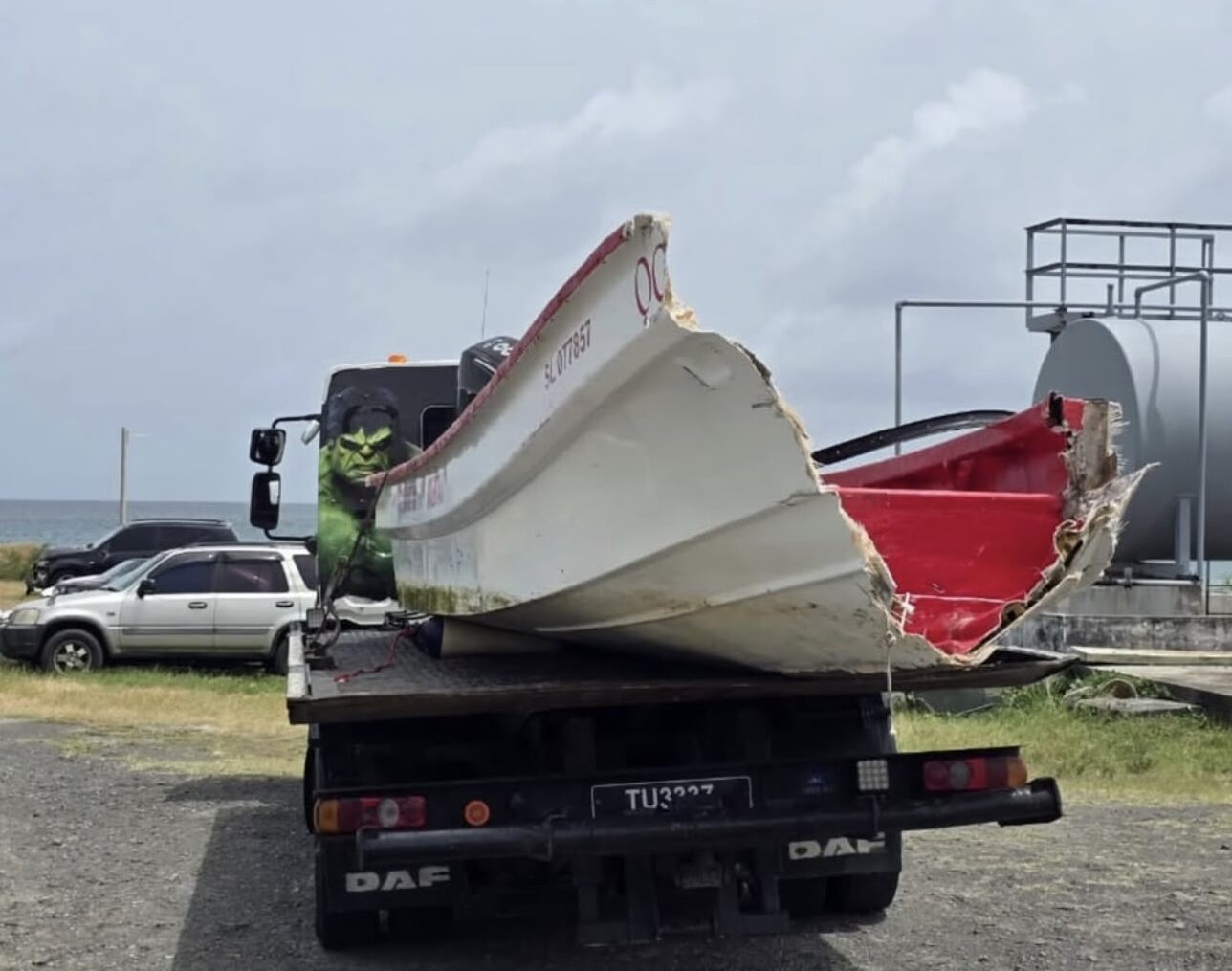
    Reporters continued to press officials, presenting a photograph of one of the destroyed boats to challenge the US narrative that the vessels were carrying large drug shipments. Pointing to the small size of the boat, the reporter noted that the minister had previously referenced a 500-million-dollar cocaine seizure connected to the strike, and observed that many legitimate fishing boats across the Caribbean operate with multiple outboard motors, a characteristic the US has cited as evidence of drug trafficking activity.

    At this juncture, Minister Leacock intervened, noting that political questions about the incident should not be directed to the police commissioner, and provided updated context on the discussions held at the RSS summit. Leacock confirmed that during the meeting, RSS delegates were informed that the US has adjusted its previous position of refusing to provide explanations for prior strikes, and has now softened its stance, agreeing to show greater respect for the national sovereignty of Caribbean nations – a shift that emerged as a central topic of negotiation at the summit.

    “ I believe, through the skilful negotiations of the RSS and heads of government and others who will be involved in this exercise, we can anticipate that over time, there will be an increased level of responsiveness and sensitivity to Caribbean jurisdictions and to that key expression that was used: the Caribbean being a zone of peace,” Leacock said, adding that ongoing negotiations are progressing and that the region expects to achieve the transparent, accountable outcomes that Caribbean governments and communities are entitled to.

  • Labourer charged with cricketer’s murder

    Labourer charged with cricketer’s murder

    A 47-year-old labourer has made his first court appearance following his arrest last week on a charge of murdering a 28-year-old club cricketer in Trinidad. Rakesh Jaggernauth, who also goes by the alternative names Rakesh Lalman and “Bowlin” and resides in Hermitage Village close to San Fernando, was taken into custody by law enforcement in Couva this past Saturday.

    On yesterday’s hearing before San Fernando Master Shabaana Shah, the formal murder charge was formally read out in open court. Court documents allege that between March 16 and 17, Jaggernauth killed Rashme Deoajit at a property on Boodram Trace in Granville, Cedros. The charge was officially filed by police constable La Rode on Wednesday, and Jaggernauth was not required to enter a plea at this early procedural hearing.

    Jaggernauth was represented in court by defense attorney Krysan Rambert, while the case was prosecuted by acting police sergeant Reagan Ramanan. After Shah walked the defendant through his legal rights, bail was denied, and Jaggernauth was ordered to be held in official custody. His next scheduled court appearance is set for April 20.

    Deoajit, the victim, was both an active club-level cricketer and a sales merchandiser. Her body was discovered by concerned relatives, who gained entry to her Granville home through a window after being unable to contact her. They found Deoajit unresponsive and covered in blood in her bedroom; an initial examination confirmed she had suffered multiple stab wounds and a cut to her throat.

  • Appeal Court quashes 50-year sentence

    Appeal Court quashes 50-year sentence

    After more than four and a half decades behind bars for a 1978 high-profile murder, a Caribbean appellate court has overturned a controversial 50-year prison sentence imposed on Peter Matthews, ordering an emergency new sentencing hearing before a senior High Court judge over a critical legal error that undermined decades of judicial proceedings.

    The core of the case dates back to 1978, when four-year-old Roslyn Lucas was found dead at her St James Providence Estate home following a sexual assault. Matthews was ultimately convicted of the child’s murder in 1984, originally handed a death sentence that was commuted to life imprisonment in 1994. In a 2025 resentencing proceeding, High Court Justice Maria Busby Earle-Caddle issued a fresh 50-year term. Calculating the 46 years, eight months and 25 days Matthews had already served in pre-trial and post-conviction custody, the original resentencing left just over three additional years of prison time to complete. Alongside the sentence, the judge mandated psychological evaluation, participation in targeted rehabilitation programs including the cognitive behavioral initiative Thinking for Change and adult literacy courses, and post-release probation supervision.

    But the three-justice appellate panel – led by Justices Nolan Bereaux, Maria Wilson and Geoffrey Henderson – ruled last week that the entire 2025 resentencing process was fundamentally invalid. The fatal flaw? The lower court failed to correctly and conclusively establish Matthews’ age at the time of the 1978 killing, a detail with profound legal consequences for the case.

    In her written ruling, Justice Wilson emphasized that the sentencing judge had a clear obligation to adjourn proceedings to resolve the age question before issuing a new sentence, given how central the detail was to Matthews’ legal classification. “It is very unfortunate that the resentencing judge did not find it appropriate to adjourn her decision until she was able to resolve the age of the appellant,” Wilson wrote, noting that the error carried “very serious” consequences for a man who had already spent most of his life in incarceration.

    New evidence accepted by the appellate court – an official birth certificate – confirms Matthews was born on July 14, 1961, meaning he was only 17 years old when the crime occurred. Under the law in effect in 1978, this classification made him a child offender, a status that carried strict legal protections: people under the age of 18 could not lawfully be sentenced to death. Because his original 1984 death sentence was unlawful on its face, every subsequent legal proceeding that flowed from that sentence – including the 1994 commutation to life imprisonment and the 2025 resentencing – was also legally invalid.

    The appellate court described the case as highly unusual and legally unprecedented in its complexity. “This is a case where the sentence of death was unlawfully imposed on the appellant,” the court’s ruling noted.

    Matthews’ defense team, led by attorneys Joseph Sookoo and Abigail Roach, had long argued that their client should have been sentenced from the start as a minor offender. This classification would drastically lower the applicable sentencing range, require a court to prioritize rehabilitation over punitive sentencing, and mandate regular periodic review of Matthews’ incarceration to assess his readiness for release.

    Representatives of the state, led by attorney Wayne Rajbansie, initially challenged the authenticity of the newly submitted birth certificate in written legal filings. However, during oral arguments before the appellate court, Rajbansie withdrew the challenge and conceded that the birth certificate was valid, confirming that the original 1984 death sentence was indeed unlawful.

  • Missing Owia fisherman presumed dead

    Missing Owia fisherman presumed dead

    A widespread search and rescue operation is underway off the coast of northeastern St. Vincent after a 51-year-old local fisherman and farmer failed to return from a solo fishing trip, leaving his long-term partner convinced he has been lost to the dangerous waters the region is known for. Robert Lavia, widely known to local residents as Robbie, set out from his home in Owia at approximately 5 a.m. Wednesday, heading to a stretch of coastline between Rock Gutter and Cramacou, a fishing spot he had frequented in the past.

    According to Annis “Janice” Hoyte, Lavia’s common-law wife for more than two decades, the experienced outdoorsman prepared for his trip a day in advance. On Tuesday, he traveled to a local river to catch crayfish, which he planned to use as bait for his scheduled fishing excursion. Like almost all of his fishing outings, Lavia embarked on this trip alone, carrying only a bucket, a bag, a cutlass, and his fishing lines.

    As the hours stretched into midday Wednesday with no sign of Lavia’s return, Hoyte began to grow concerned. Unused to him staying out this long without checking in, she alerted Lavia’s brother of her worry before filing an official missing person report with the Owia Police Station. The entire village mobilized quickly to launch an initial ground and shore search for the missing man, but as of Thursday, no trace of Lavia has been found beyond a single recovered fishing reel – details of where and by whom the reel was found remain unconfirmed.

    With no signs of life and the well-documented hazards of the area’s waters, Hoyte says she has abandoned hope of finding Lavia alive. Speaking through tears to reporters from iWitness News on Thursday, she shared her theory of what likely befell her partner: “Lavia was on a rock and a swell knocked him off the rock and he knocked his head and he fell in the water.”

    The coastal waters of northeastern St. Vincent have a long-standing reputation for strong, unpredictable currents and unexpectedly large waves, conditions that have proven dangerous for even experienced local fishermen in the past. Hoyte described Lavia as a quiet, reserved man, and said she is overwhelmed by grief at the prospect of having lost him.

    Local authorities have confirmed they received the missing person report on Wednesday, and official search efforts have expanded in the days since. On Thursday, a vessel from the St. Vincent and the Grenadines Coast Guard was spotted conducting patrols and search operations in the coastal stretch between Owia and Fancy, as authorities continue to comb the area for any sign of the missing man.

  • Authorities issue red flag alert for Puerto Plata beaches

    Authorities issue red flag alert for Puerto Plata beaches

    Puerto Plata, Dominican Republic – Local Civil Defense authorities have activated a full-coastal red alert for the entire Atlantic-facing shoreline of Puerto Plata this Friday, acting on official weather guidance from the national Dominican Institute of Meteorology. The alert, which remains in effect from 6 a.m. local time Friday through 6 a.m. Saturday, warns of life-threatening ocean conditions driven by a rare combination of atmospheric and hydrological systems.

    Meteorological officials explain that a stationary low-pressure trough, paired with persistent east-northeast winds and a strong anticyclonic system positioned across the North Atlantic, has combined to produce unusually large abnormal swells and powerful, unpredictable sea currents. These conditions create severe, immediate risks for anyone entering the water, from casual recreational swimmers to commercial and private maritime operations.

    Under the terms of the active red flag warning, authorities have ordered all operators of small and medium-sized vessels to stay docked in port across the entire affected Atlantic coastal stretch, which runs from the eastern edge of Saona Island all the way west to Monte Cristi. Notably, the Dominican Republic’s Caribbean coastline has not been impacted by the hazardous conditions and remains open to normal activity. For visitors heading to Atlantic-facing beaches, officials issued an urgent warning about an extremely high risk of dangerous rip currents, strongly advising all beachgoers to contact local lifeguard and rescue services before attempting to enter the water.

    With the Easter holiday bringing a surge of domestic and international travelers to Puerto Plata’s popular coastal destinations, the Civil Defense has issued a direct appeal to both local residents and visiting tourists: comply strictly with the red flag warning and avoid all recreational swimming in the Atlantic this weekend. Authorities add that they have deployed additional monitoring personnel to the coast and will maintain 24/7 real-time surveillance of changing ocean and weather conditions, issuing immediate public updates if conditions shift or the alert timeline is adjusted.

  • Government invests over RD$2 billion in Samaná tourism infrastructure

    Government invests over RD$2 billion in Samaná tourism infrastructure

    SANTO DOMINGO – The Dominican Republic is advancing an ambitious push to elevate one of its key coastal tourism hubs, with a multi-million dollar infrastructure overhaul and a refreshed destination branding strategy aimed at attracting more international visitors. Dominican Tourism Minister David Collado has formally unveiled a total investment package worth 2.047 billion Dominican pesos (RD$) dedicated to upgrading public and tourism-focused infrastructure across the Samaná province.

    The scope of the transformation project covers a wide range of critical upgrades, from full paving of existing roadways and modernized drainage infrastructure to complete reconstruction of urban streets and enhancements to shared public spaces and core tourism facilities. A key component of the work is focused on preparing the Arroyo Barril cruise terminal for its official inauguration and the steady flow of cruise ship passengers that will follow. For this segment of the project, an additional 185 million RD$ has been allocated to resurface 29 streets stretching more than six kilometers in the immediate surrounding area of the terminal.

    Alongside the infrastructure investments, the national tourism administration is rolling out a new dedicated tourism brand for Samaná, presented by Vice Minister Tammy Reynoso. The brand was developed through a collaborative process that incorporated expertise from global tourism consultants and input from key local industry stakeholders, including the Samaná Hotel and Tourism Association (AHETSA). Officials say the rebranding initiative is designed to reposition Samaná as a premium, world-class travel destination on the global tourism map, boosting visitor arrivals, extending average tourist stays, and driving long-term economic growth for the province and the wider Dominican tourism sector.

  • Environment Ministry enforces 60-meter beach buffer rule for Easter

    Environment Ministry enforces 60-meter beach buffer rule for Easter

    As the Dominican Republic prepares for the annual Easter holiday rush that draws thousands of visitors to its sun-soaked coastal stretches, the nation’s Ministry of Environment and Natural Resources has announced enhanced enforcement of a critical coastal protection regulation. The updated ruling, codified as Resolution No. 026/2025 and officially signed by Environment Minister Paíno Henríquez, mandates that all vehicle parking on public beaches and coastal dunes must maintain a minimum 60-meter setback from the high tide line.

  • Migration authorities detain over 2,000 undocumented migrants in nationwide operations

    Migration authorities detain over 2,000 undocumented migrants in nationwide operations

    In a major push to strengthen migration management across the Dominican Republic, the nation’s General Directorate of Migration (DGM) has released official figures documenting large-scale enforcement operations carried out over two days in late March and early April 2026.

    Across coordinated operations conducted on March 31 and April 1, DGM officials confirmed that a total of 2,199 undocumented migrants were taken into custody. Of that group, 1,890 have already been processed and deported through official border crossings, according to the agency’s official statement.

    Deportations were distributed across four key border entry points, with the DGM reported: 493 deportees exited through the Dajabón crossing, 983 through Elías Piña, 321 through Jimaní, and 163 through the Pedernales border point. Agency spokespersons emphasized that all detention and deportation procedures strictly followed established due process requirements and official human rights protection protocols throughout every stage of the operations.

    The enforcement actions were a joint effort between multiple Dominican security bodies. Of all detainees, 1,345 were apprehended directly by DGM field agents, while the remaining 854 were arrested by joint security forces that included the Dominican Army, National Police, the Dominican Border Security Corps (CESFRONT), and the National Environmental Protection Service (SENPA).

    Operations were not limited to border regions: enforcement actions stretched across multiple high-population and high-traffic areas of the country, including the Greater Santo Domingo metropolitan area, Santiago, La Altagracia, Samaná, Espaillat, and all key border provinces. The operation targeted undocumented migrants across both urban centers and rural communities, with additional checks concentrated along major travel routes, public transport hubs, and agricultural work sites where unauthorized migration is commonly reported.

  • COE expands green alert to six areas amid trough effects

    COE expands green alert to six areas amid trough effects

    In the Dominican Republic’s capital of Santo Domingo, national emergency officials have broadened a green weather alert to cover five inland provinces and the country’s National District, responding to an unstable weather trough that is disrupting atmospheric conditions across the entire island nation.

    Data collected from satellite monitoring systems and ground-based weather radar confirms that the system has driven a sharp increase in cloud formation across the affected regions. This buildup of cloud cover is expected to produce moderate to intense rainfall through the coming days, paired with scattered isolated thunderstorms and sudden gusty winds that could create hazardous conditions for local communities.

    The areas officially placed under the expanded green alert are the province of Santo Domingo, the National District, San Cristóbal, Monseñor Nouel, La Vega, and San José de Ocoa. Green alerts, the lowest tier of weather warnings in the Dominican Republic’s emergency system, are issued to inform the public of developing dangerous conditions that require heightened awareness and preparation.

    Emergency management authorities have issued clear guidance for residents in all affected zones to mitigate risk. The public has been strongly advised against attempting to cross swollen rivers, fast-flowing streams, and rain-swollen ravines, as rising water levels can create sudden life-threatening hazards. Additionally, residents and visitors have been instructed to avoid all recreational water sites, including beaches and inland swimming spots, across the warning areas until conditions improve.

    Along the Dominican Republic’s Atlantic coastline, stretching from the eastern edge of Saona Island northward to Monte Cristi, additional precautions are in place for maritime traffic. Operators of small, structurally less sturdy vessels have been told to keep their boats docked in port, as sustained strong winds and choppy, dangerous wave conditions put small craft at high risk of capsizing or distress.

  • Inmates join Holy Week safety operations as part of a pilot program

    Inmates join Holy Week safety operations as part of a pilot program

    In a groundbreaking move aimed at reimagining inmate rehabilitation, Dominican Republic authorities have launched an unprecedented pilot initiative that integrates currently incarcerated individuals into official Holy Week preventive operations, a first-of-its-kind collaboration between the country’s Civil Defense and national Penitentiary System.

    The pilot program, centered on advancing meaningful social reintegration for people behind bars, marks a departure from traditional rehabilitation approaches by giving selected inmates a direct chance to contribute to public safety efforts during one of the country’s busiest annual travel and religious observance periods. The Directorate of Community Corrections confirmed that 10 inmates from various correctional facilities across the nation have been tapped for the initial phase of the project, with selections based strictly on consistent exemplary behavior during their incarceration.

    These selected participants will work side-by-side with trained Civil Defense teams throughout Holy Week 2026, supporting a range of prevention and public assistance activities as part of the annual emergency and safety operations for the holiday. Civil Defense director Juan Salas outlined the core vision behind the new framework, noting that the program is intentionally structured to create a tangible, practical pathway for reintegration rather than relying solely on theoretical rehabilitation programs.

    By participating in organized community service that directly benefits the broader public, inmates get the opportunity to rebuild connections with society and demonstrate their commitment to positive change, Salas explained. Government officials overseeing the initiative emphasized that the pilot is designed for gradual, data-driven expansion. Moving forward, authorities will evaluate participant performance and public impact to refine the model, with the long-term goal of creating a scalable platform that supports consistent rehabilitation and lasting social inclusion for incarcerated individuals across the country.