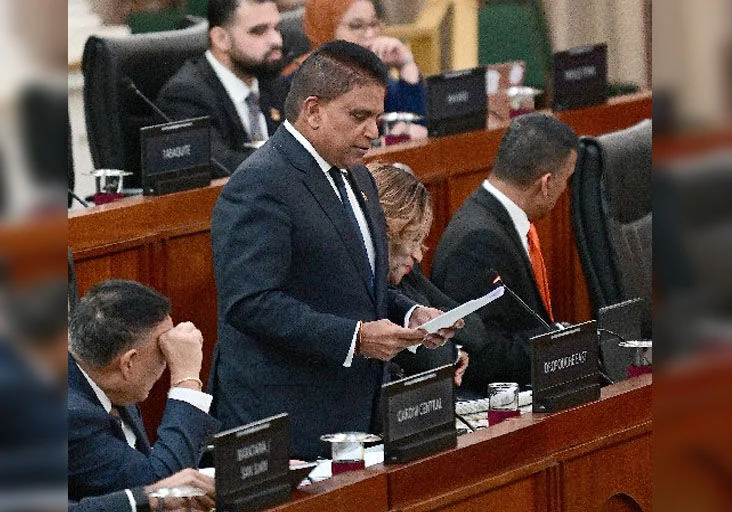
Delivering a landmark update to Trinidad and Tobago’s Parliament yesterday, Energy Minister Dr Roodal Moonilal confirmed that the nation’s Cabinet has formally signed off on a comprehensive restart framework and competitive tender process to resurrect the long-idle Guaracara Refinery in Pointe-a-Pierre. The blueprint had already secured prior approval from the governing boards of Guaracara Refining Company Ltd (GRC) and Trinidad Petroleum Holdings Ltd (TPHL) before receiving full Cabinet endorsement.
The upcoming tender rollout, administered entirely by GRC, will launch in the coming days with formal advertisements circulated across both local and international industry channels. Moonilal emphasized that bringing the 7-year-dormant facility back online is an extraordinarily complex large-scale initiative, requiring rigorous cross-functional technical audits, granular commercial feasibility reviews, and exhaustive due diligence to guarantee the project unfolds along safe, ecologically sustainable, and financially viable pathways.
The Energy Minister openly acknowledged that previous attempts by the prior administration to restart the former Petrotrin refinery ended in failure, and stressed that the current government has adopted a meticulously planned, inclusive, and fully transparent governance structure to avoid the missteps and systemic shortcomings that derailed past efforts. He reminded parliamentary peers that restoring the refinery to operational status was a core 2025 election pledge the ruling party made to the Trinidadian public, and that the administration has taken deliberate, concrete steps since taking office to honour that commitment.
In July 2025, Cabinet first authorized the formation of a 12-member expert task force, composed of veteran energy sector practitioners and cross-disciplinary specialists with complementary industry expertise, to conduct a full top-to-bottom audit of the refinery, its aging physical infrastructure, and connected utility networks. The task force’s final assessment confirmed that despite seven years of non-operation, the facility remains a high-value national strategic asset with clear potential for a safe, cost-effective return to commercial service. The panel also warned that any further unnecessary delays to the restart would drive up required capital investment and erode the project’s long-term economic viability, making prompt action a critical priority.
Acting on the task force’s formal recommendations, Cabinet approved the termination of lingering, inconclusive negotiations between TPHL and Oando Trading DMCC, the previously selected preferred bidder from the failed prior restart attempt; TPHL has since formally closed all discussions with the Dubai-based firm. Cabinet subsequently issued a formal mandate to Moonilal’s ministry to draft a refinery restart plan aligned with the government’s national development agenda. To deliver this plan, the minister assembled a dedicated multi-stakeholder working group chaired by the head of GRC, with representatives drawn from GRC, Heritage Petroleum Company Ltd, Paria Fuel Trading Company, and the Ministry of Energy and Energy Industries.
The working group’s final blueprint enshrines a non-negotiable core principle: the Trinidadian state will retain a direct ownership stake in the refinery, regardless of what commercial operating model is selected for its restart. The team further identified two optimal governance structures – a special purpose joint venture vehicle and a structured lease arrangement – that best align with the government’s strategic goal of preserving public ownership while unlocking external private sector capital, technical expertise, and operational accountability. These two models will form the foundation of the upcoming formal request for proposals (RFP).
To safeguard core national interests, the framework includes non-negotiable guardrails: full protection of the state from unplanned financial liability, permanent retention of public ownership interest, prioritization of local employment for Trinidad and Tobago nationals, and guaranteed long-term security of refined petroleum product supply for the domestic market. Upholding strict transparency and accountability standards, the government has opted for a two-stage tender process split into pre-qualification and detailed bid submission phases. Following the upcoming global call for expressions of interest, all interested firms will be required to pass a rigorous pre-qualification screen proving their proven technical competence, track record of safe large-scale refinery operation, and sufficient financial capacity to deliver on their proposed project structures. Only qualified bidders will be granted access to full project data, following the signing of a binding non-disclosure agreement, and invited to submit non-binding detailed proposals. All submissions will be evaluated by an independent expert review panel, with a final preferred bidder selected only after all required regulatory and governmental approvals are secured.
Moonilal projected that a successfully executed refinery restart will deliver sweeping economic and social benefits for the nation, including thousands of new direct and indirect jobs, a surge in local industrial activity, expanded contract opportunities for domestic small and medium-sized service providers, drastically enhanced domestic fuel security, and substantial new foreign exchange revenue streams. The administration’s explicit goal, he noted, is to unlock these public benefits through a commercially sustainable operating model that prioritizes the long-term interests of Trinidad and Tobago’s population above all other considerations.
During his parliamentary address, Moonilal also unveiled parallel major progress on regional energy cooperation, noting that Trinidad and Tobago is now in active advanced discussions with neighbouring Venezuela to expand bilateral energy collaboration. The recent diplomatic momentum was sparked by high-level engagements including a visit by Foreign and Caricom Affairs Minister Sean Sobers, and a September 23 bilateral meeting between Prime Minister Kamla Persad-Bissessar and Venezuela’s acting President Delcy Rodriguez on the sidelines of the 81st United Nations General Assembly session in New York. The Venezuelan government’s Minister of People’s Power for Hydrocarbons has formally extended an official invitation for a Trinidadian delegation led by Sobers, accompanied by senior energy ministry officials, to visit Caracas in early December 2026 to advance joint hydrocarbon development initiatives that deliver mutual benefits for both nations.
Refinery gets go-ahead