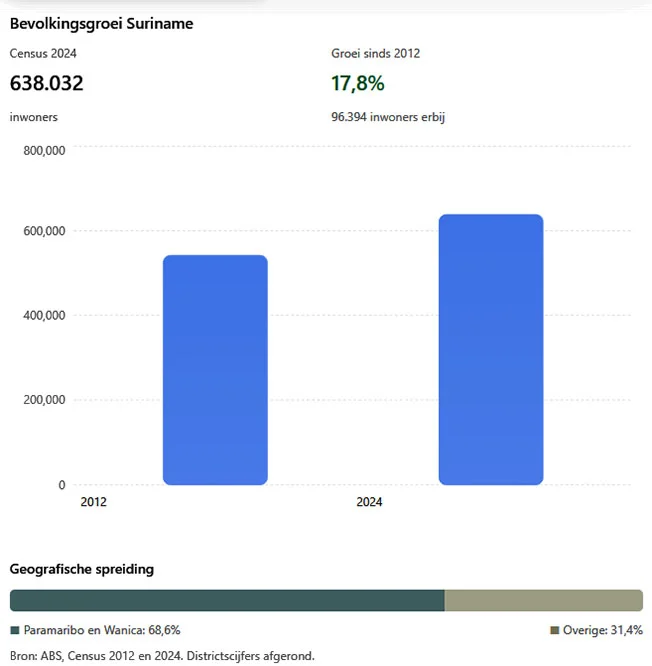
Released on November 28 by Suriname’s national census authorities, the finalized preliminary results of the 9th national population count reveal that the country’s total resident population has climbed to 638,032 as of 2024, representing a 17.8% increase from the 541,638 recorded in the 2012 8th national census. The net gain of more than 96,000 residents over the 12-year inter-census period marks one of the most substantial population growth jumps Suriname has registered in recent decades, though official statisticians note that a formal comprehensive analysis is still pending to adjust for potential undercounting discrepancies recorded during the 2012 enumeration exercise, which may slightly revise the final calculated growth rate. One of the most striking takeaways from the 2024 census dataset is the extreme geographic concentration of Suriname’s population: nearly 438,000 people, equivalent to more than two-thirds of the entire national population, reside in just two adjacent districts, Paramaribo (the capital) and Wanica. The remaining eight out of Suriname’s ten administrative districts collectively account for barely 200,000 residents, a stark demographic imbalance that carries far-reaching implications for national public service and infrastructure planning. This uneven population distribution poses urgent challenges for policymakers tasked with optimizing spatial zoning frameworks, scaling affordable residential construction, upgrading overstretched transportation networks, and ensuring equitable access to education and healthcare services across all regions. The census findings carry amplified relevance amid Suriname’s ongoing rapid economic transformation driven by its fast-expanding oil and gas sector, which has drawn a surge of targeted domestic and foreign investment in recent years. Accurate, granular population data from the 2024 enumeration will now allow the national government to calibrate its long-term development policies, allocate public funding far more strategically, and tailor resource distribution to match the unique demographic profiles and unmet needs of individual districts, rather than relying on outdated, estimated population figures that have guided planning for the past 12 years.