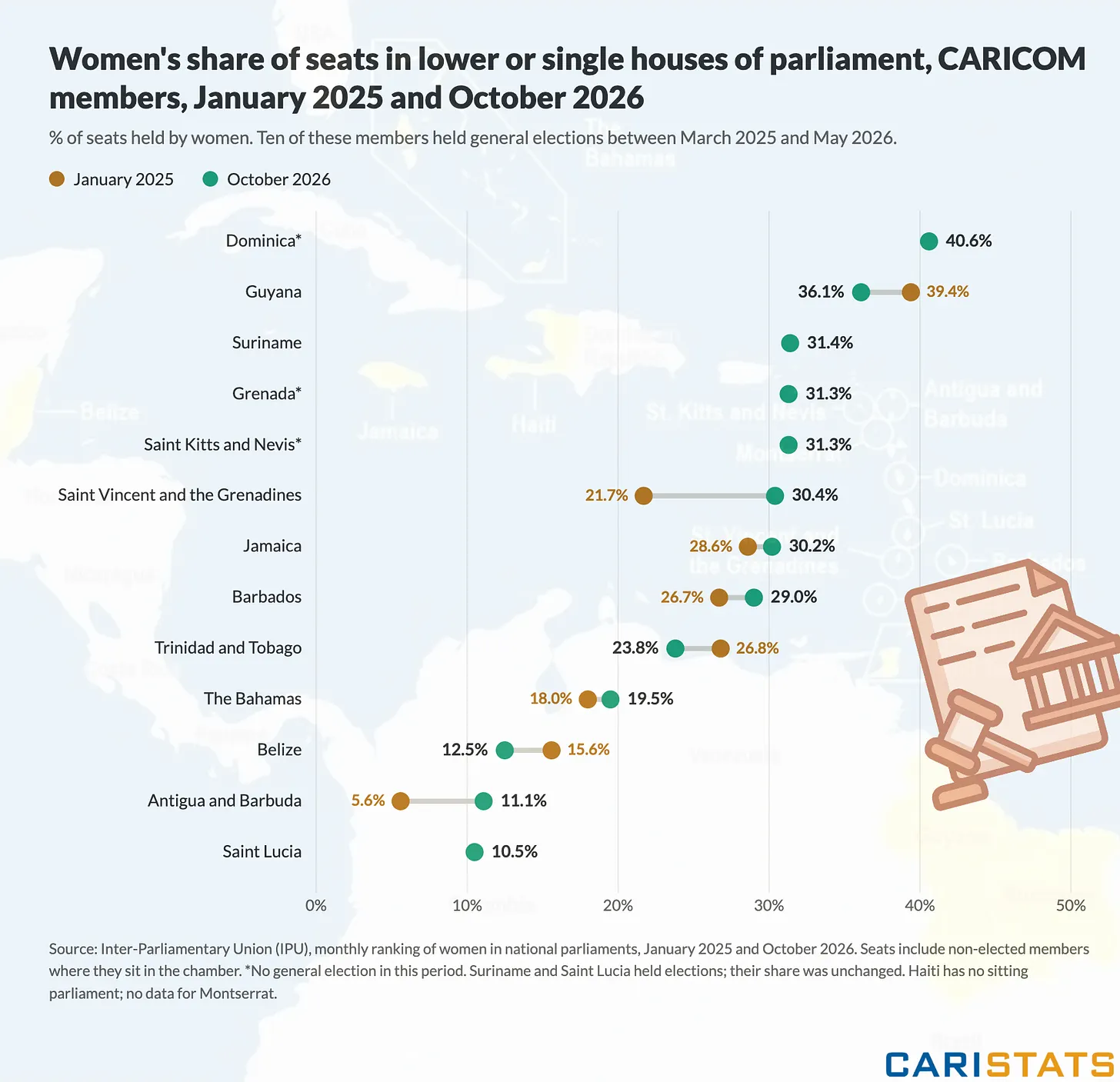
A sweeping review of legislative outcomes across the Caribbean Community (CARICOM) reveals that 10 consecutive general elections held between March 2025 and May 2026 across member nations have delivered virtually no meaningful progress in boosting the share of women holding seats in the region’s primary elected parliamentary chambers. Aggregated data compiled across the 13 CARICOM member states with complete official legislative records shows that as of October 2026, women occupied 126 out of a total 456 lower or unicameral house seats, a marginal uptick of just two seats from the 124 recorded in January 2025, pushing the overall regional share of female representation up a mere 0.1 percentage points from 27.5% to 27.6%. The fragmented trajectory of these modest shifts paints a patchwork regional picture: five participating member states collectively added six women to their elected parliamentary rosters, while Guyana, Trinidad and Tobago, and Belize combined to lose a total of four female elected legislators, erasing nearly two-thirds of those small gains. For smaller legislative bodies with limited seat counts, even a single additional female lawmaker can trigger a dramatic percentage swing: Antigua and Barbuda, for example, saw its share of women in its 18-seat elected lower house double from 5.6% to 11.1% after the latest election cycle, a change driven solely by the addition of one extra female representative. Substantial disparities persist across the broader CARICOM bloc, with national rates of female elected parliamentary representation ranging from a high of 40.6% in Dominica to a low of just 10.5% in Saint Lucia. A striking, underreported contrast emerges when comparing elected legislative chambers to appointed senate bodies across the region: in nations that maintain separate upper senate chambers, female representation rates are drastically higher, hitting 54.6% in Saint Lucia, 43.8% in Antigua and Barbuda, and 35.7% in Belize. For the subset of CARICOM states that combine elected representatives and appointed senators in a single unicameral chamber, including Dominica, Saint Kitts and Nevis, and Saint Vincent and the Grenadines, the gap between the representation levels of appointed and elected female legislators further underscores a core structural barrier: women in the region consistently gain far better access to legislative seats through appointment processes than they do through competitive popular elections at the polls.
Antigua and Barbuda Sees Increase in Women Parliamentarians as Female Representation Stagnates Across CARICOM