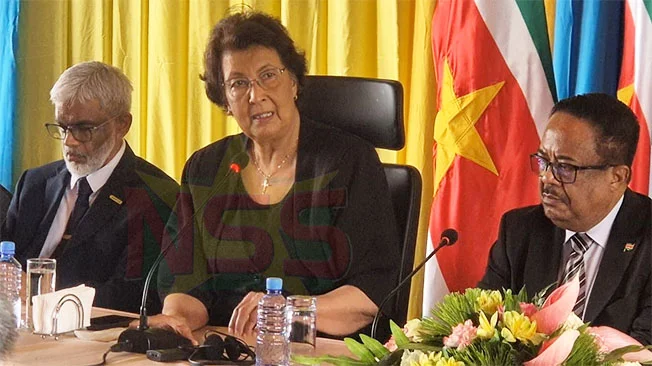
On November 26, Surinamese President Jennifer Simons officially announced at a press conference held at the Presidential Palace that the country’s first offshore natural gas development project, KrakaWi located in Block 52, will draw a total investment of approximately $1.6 billion, marking a landmark step for the South American nation to tap its untapped offshore energy reserves. Flanked by Staatsolie (Suriname’s state-owned oil and gas enterprise) CEO Annand Jagesar and Vice President Gregory Rusland during the announcement, Simons confirmed that Staatsolie will serve as the national participating entity for the KrakaWi project, noting that sustained high global oil prices have created much-needed fiscal headroom for the state energy firm to support the initiative, with full financing details to be released directly by Staatsolie in subsequent disclosures. The final investment decision (FID) for KrakaWi is set to unlock long-term, stable revenue streams for Suriname’s emerging offshore oil and gas sector, and the administration has already initiated structured preparations to manage these incoming revenues responsibly to ensure broad public benefit. To better allocate energy windfalls, the government will revise the existing Savings and Stabilization Fund Act to establish three core operational pillars: a strictly managed long-term savings and macroeconomic stabilization pool, targeted public investment in national development priorities, and dedicated funds for high-impact social services. A portion of the revenue will be channeled into a newly established housing fund, which will offer low-interest loans to local residents to mitigate the risk of sharp housing price spikes driven by the energy sector boom that could price ordinary Surinamese households out of the property market. An additional dedicated health fund will also be created to advance the government’s goal of universal, equitable access to public healthcare. Simons emphasized that Suriname cannot directly replicate Norway’s sovereign wealth fund model, as the country faces far larger pre-existing gaps in critical public infrastructure and social investment that demand immediate targeted spending, unlike Norway which had minimal unmet development needs at the time of its North Sea energy discoveries. Beyond exporting liquefied natural gas (LNG) to global markets, the administration is prioritizing a full Gas-to-Shore initiative that will transport processed natural gas to the Surinamese mainland, a framework Vice President Rusland stressed will act as the foundational driver for the country’s next phase of broad-based industrialization. Simons confirmed that preliminary discussions are ongoing with Guyanese counterpart leaders on cross-border energy sector collaboration that extends beyond oil and gas to other shared economic priorities, but no concrete joint gas development plan has been finalized to date, with full details of the Gas-to-Shore rollout and potential regional partnerships still under active development. To maximize local economic participation, the government has signed formal agreements with Malaysian energy giant PETRONAS to deliver targeted skills training for Surinamese workers and provide support for local domestic enterprises to obtain required international industry certifications, following PETRONAS’ successful track record in other operating regions where local workforce representation in project operations eventually reached 90%. At present, between 900 and 1,200 local residents have received sector-specific training via the national Labor Mobility and Development Foundation (SAO), with the government targeting to expand this trained cohort to 3,000, and overhaul outdated training programs that do not align with actual industry labor demands to ensure participants are directly prepared for available job openings. Patrick Brunings, Minister of Oil, Gas and Environment, disclosed that the administration plans to release a full public report on projected labor demands across the oil and gas sector and other high-growth domestic industries in the first quarter of 2027, to allow education institutions, private enterprises and government agencies to align their planning accordingly. The government is also targeting to submit all required supplementary legislation governing the oil and gas sector to the National Assembly for formal approval in 2027. The newly established Local Content Board is currently finalizing regulatory frameworks to enforce local participation requirements, with a full progress report due to be submitted to President Simons before the end of the calendar year. Additional ongoing regulatory updates include streamlining the visa and work permit approval process for foreign skilled workers brought in to fill temporary critical gaps in the energy sector, and a full revision of the national oil spill emergency response preparedness plan. Vice President Rusland underscored that the administration is taking deliberate steps to avoid the “resource curse” pitfalls that have plagued many resource-rich developing nations, where vast natural wealth fails to deliver tangible improvements for ordinary citizens, while simultaneously prioritizing broad economic diversification to prevent Suriname’s overall national economy from becoming overly reliant on volatile global oil and gas commodity prices.
KrakaWi vergt investering van US$ 1,6 miljard; regering wil ook Gas-to-Shore