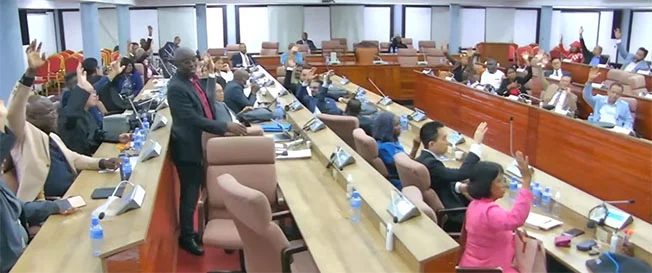
On Tuesday, Suriname’s National Assembly (DNA) concluded a heated parliamentary debate rooted in soaring violent crime rates and a high-profile military weapons controversy, delivering two landmark votes that reshaped the country’s near-term security policy agenda. The first vote, a no-confidence motion tabled against Defense Minister Uraiqit Ramsaran, failed by a margin of 21 votes against dismissal to 17 in favor, after members of the ABOP political faction walked out of the chamber entirely rather than cast a formal ballot.
The ABOP delegation explained their unprecedented move by stating they lacked sufficient verified evidence to confirm whether Ramsaran had provided full, truthful testimony regarding a cache of FAMAS and AK-47 military rifles recovered from former service members in the Sarakreek area. The faction added that the case was already under active judicial review, and they would reserve final judgment until formal investigative findings were released. The National Assembly’s rules of order do not formally allow for abstentions, prompting the group to exit the chamber to avoid registering a for or against position on the no-confidence measure.
The push for the no-confidence motion emerged after an interpellation session on national security, where Ramsaran repeatedly defended his earlier public statements that the seized weapons had not been stolen from military stockpiles. The minister confirmed that after learning ex-servicemen had been deployed in an unpublicized operation linked to the weapons seizure, he had ordered the military intelligence unit G2 to submit a full written report, correcting earlier briefings he had delivered to parliament based on unvetted verbal accounts. Ramsaran emphasized that the ongoing criminal investigation must proceed independently without political interference, and pledged full cooperation from the Defense Ministry if evidence of legal violations emerges, regardless of the rank or affiliation of those implicated.
Critics from both the ruling coalition and opposition grilled Ramsaran over gaps in his testimony: former Defense Minister and VHP parliamentarian Krishna Mathoera demanded clarity on whether Ramsaran had authorized the secret operation, if a formal written command had been issued to military leadership, and if the attorney general had been notified of the off-the-books mission. Fellow VHP lawmaker Rui Wang questioned why Ramsaran had publicly confirmed the operation’s legitimacy to parliament on November 19 before verifying all facts, and pressed him to correct his earlier statements if evidence later disproved his account.
Sponsors of the no-confidence motion, led by faction leader Asis Gajadien, argued that preliminary findings from the Public Prosecutor’s Office directly contradicted Ramsaran’s initial parliamentary testimony, and that claims of military operation secrecy did not absolve the minister of his political and administrative accountability — a responsibility that remained entirely separate from the outcomes of the ongoing criminal probe. The motion had called for President Jennifer Simons to immediately remove Ramsaran from post, and launch a separate independent audit of all military weapons management protocols. It ultimately failed to secure a simple majority.
In a rare display of cross-party unity, all 38 remaining present legislators unanimously approved a second, sweeping security reform motion that set binding, time-bound mandates for the government to address surging violent crime. The 12-point action plan requires the administration to submit a detailed, resourced short-term security action plan to parliament within 30 days, complete with clear assigned responsibilities, allocated funding, strict deadlines, and measurable performance indicators to track progress against violent crime. Within 90 days, the government must table a multi-year integrated national security strategy covering police and investigative unit capacity building, anti-organized crime measures, illegal firearms crackdowns, border security upgrades, youth crime prevention programming, and targeted safety interventions for all rural districts.
The cross-party motion also mandates three separate independent audits: a full forensic review of all 2020–2025 procurement of vehicles, equipment, and support services for national security agencies, with special scrutiny of purchases processed through the President’s Cabinet, to identify any state financial losses and pursue full recovery of misappropriated funds, alongside mandatory referrals of suspected criminal activity to the Public Prosecutor’s Office. A separate independent audit of military weapons stockpile management, registration, distribution, and security protocols, first proposed in the failed no-confidence motion, was also written into the unanimous bill. The government is now required to submit quarterly public written reports to the National Assembly, disclosing full security policy implementation updates, official crime statistics, operational outcomes, and line-item spending for all security-related budgets.
While ABOP parliamentarian Stanley Betterson noted that the motion contained some overly generalized language that would require future regulatory clarification, interim Justice and Security Minister Marinus Bee confirmed that immediate targeted safety measures were already being rolled out to restore public order, and announced a forthcoming full press conference to detail new government security initiatives. Multiple legislators from both coalition and opposition benches emphasized that temporary holiday-season police deployments would not be sufficient to curb persistent violent crime, and demanded permanent, sustained capacity increases for under-resourced security agencies, including guaranteed access to adequate fuel, functional patrol vehicles, and modern communications equipment, with authorization for the government to submit a supplementary emergency budget to parliament if additional funding is required to meet operational needs.
Coalitie en oppositie eens over veiligheidsactieplan, verdeeld over Ramsaran