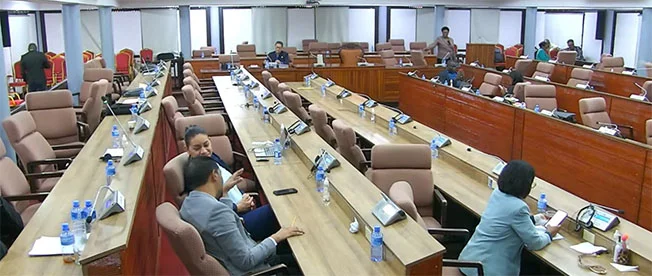
Paramaribo, 24 November – A disastrous parliamentary session last Friday laid bare a deepening institutional crisis in Suriname’s National Assembly (DNA), where systemic absenteeism, deliberate quorum manipulation, and widespread lack of legislative discipline brought an entire scheduled workday to a total standstill. Three formal meetings were on the day’s agenda, but nearly six hours of delays, dozens of forced suspensions and walkouts yielded zero tangible legislative progress, leaving rows of empty seats in the assembly chamber as a stark visual marker of the body’s mounting dysfunction.
Of the 51 democratically elected representatives, only 32 signed the official attendance register at the start of the day, and by the time proceedings were set to formally begin, just 24 lawmakers remained in the chamber – two short of the 26-member quorum required to validate any official parliamentary business. The full day of planned deliberations, complete with supporting administrative preparations, was wasted entirely.
This pattern of chronic disruption has curdled into a toxic new parliamentary norm: meetings routinely kick off hours behind schedule, are suspended repeatedly, or collapse entirely because critical numbers of legislators fail to show up. What was once a logistical hiccup has now evolved into a deliberate political weapon, where competing parties no longer prioritize debating policy merits, but instead weaponize empty seats to grind all legislative work to a halt. The very body mandated to draft national laws and exercise oversight over the executive branch is increasingly expending all its energy on paralyzing its own operations.
The rank hypocrisy of this behavior has not gone unnoticed by Suriname’s public. The same legislators who publicly urge civil servants to boost workplace productivity, demand strict tax compliance from private business owners, and call on ordinary citizens to make shared sacrifices for national progress, are incapable of fulfilling the most basic requirement of their own roles: showing up to their assigned workplace. Mandates that are strictly enforced for the general population appear to be treated as optional, negotiable commitments for elected representatives.
This absenteeism crisis stands in stark, jarring contrast to the fevered lead-up to national elections. Months before voters head to the polls, political parties pour millions of dollars into campaign operations: candidates crisscross every corner of the country, visit residential neighborhoods door to door, host packed community rallies, and promise every voter personalized, dedicated attention. No travel distance is too far, no late hour is too inconvenient, when a vote is on the line. After ballots are counted, newly elected representatives take solemn, public oaths of office, surrounded by religious leaders and sacred texts, pledging to carry out their duties faithfully, prioritize the national interest, and put the needs of the Surinamese people above all else. But once they are sworn into their seats, even the simple act of appearing in the assembly chamber for scheduled critical votes becomes an insurmountable barrier.
The legislative items left stranded on last Friday’s agenda included long-overdue draft laws to crack down on money laundering and terrorist financing. Suriname is currently under intense international regulatory pressure to update its anti-financial-crime legal framework to avoid being added to global financial watchlists that would severely damage its access to international markets. Yet even when core national economic interests are on the line, legislators have proven unwilling to set aside partisan political games to fulfill their basic duties. A nation that is trying to demonstrate to global partners that it takes its international financial obligations seriously cannot afford a representative body that cannot even convene a valid meeting.
The ruling coalition holds a comfortable 34-seat majority in the 51-seat assembly, a number far exceeding the 26 members required to hit quorum. Yet this sizeable majority has repeatedly failed to keep enough of its own legislators present in the chamber to open and sustain official proceedings, a failure that is both administratively unacceptable and politically indefensible. Any political alliance that forms the government must be capable of organizing the basic parliamentary accountability that comes with holding executive power. A coalition that controls 34 seats, but still depends on opposition lawmakers to show up just to get meetings started, is facing a catastrophic internal discipline crisis. The opposition is far from blameless in this breakdown: while the VHP party eventually agreed to participate to help meet quorum last Friday, its members gradually walked out of the chamber one by one later in the session, ensuring that no formal procedural motions could be passed, and the day’s work collapsed as expected. While tactical partisan pushback is a normal part of parliamentary politics, there is a clear line between legitimate opposition oversight and deliberately sabotaging all legislative work to grind the institution to a halt.
Quorum is not a discretionary favor that the opposition grants to the ruling coalition, nor is it the exclusive administrative responsibility of government parties. Every single one of the 51 legislators holds a democratic mandate directly from Suriname’s voters, a public trust that does not disappear just because showing up to work becomes politically inconvenient. The contrast could not be more glaring: parties pull out all stops, spending vast sums of money and devoting endless hours to win political power, but once in office, they lack even the most basic level of personal discipline to exercise that power effectively, revealing themselves to be little more than placeholders for seats, who show up to the chamber whenever it suits their personal partisan interests.
As National Assembly Chair Jennifer Simons noted in recent remarks during the departure ceremony of former minister Harish Monorath, the public’s patience with this five-year elected legislature is rapidly reaching a breaking point. The parliament’s core constitutional roles – to oversee the executive, pass national laws, and represent the public’s interests – are all being undermined by widespread absenteeism, and there is currently no effective mechanism to hold unengaged legislators accountable. There are no meaningful consequences for lawmakers who sign the attendance sheet, then vanish from the chamber the moment their presence is needed to validate a vote. The assembly does not lack seats, meeting schedules, or lofty public statements about democratic governance. What it lacks is basic discipline, a sense of public accountability, and respect for the voters who put them in office. Until these fundamental gaps are addressed, all public speeches about upholding good governance and democratic values will remain entirely unconvincing to the Surinamese public.
In just a few years, the next national election cycle will begin, and the exact same legislators who are currently skipping parliamentary sessions will once again knock on doors, shake hands with constituents, hug children at campaign events, and solemnly promise voters that every single ballot matters. Voters would do well to remember last Friday, November 20: 32 signatures on the attendance register, 24 lawmakers actually present in the chamber, three scheduled meetings, zero tangible results. Any politician who goes to enormous lengths to win a seat, but is not even willing to show up to fulfill their duties when the country needs them, has not earned the public’s trust or the seat they currently occupy.
In a separate recent development, Minister Uraiqit Ramsaran presented a narrative to the National Assembly describing a secret military operation, claiming he had coordinated plans with the armed forces commander, national police chief, and top public prosecutor. However, the Public Prosecutor’s Office has since clarified that FAMAS military-grade weapons were recovered from private security personnel, and an active investigation is still underway to determine how those individuals obtained the army-issued firearms. The National Assembly must prioritize a full inquiry into this matter: any minister who deliberately shares false, misleading information with elected representatives rather than providing accurate, complete facts is not only insulting the parliament, but the entire Surinamese population.
Column: Onverantwoordelijke parlementariërs die hun zetels niet verdienen