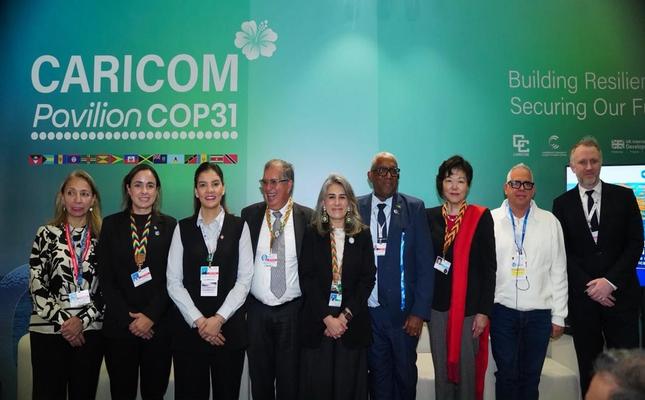
At the 31st UN Climate Change Conference (COP31) hosted in Antalya, Türkiye on November 18, 2026, CAF – Development Bank of Latin America and the Caribbean, in partnership with the Global Environment Facility (GEF), officially launched the SargMarine initiative, a landmark $10 million grant-funded programme designed to tackle the growing transboundary sargassum crisis across the Greater Caribbean. Backed by supplementary endorsements from Mexico and France, the 6-year regional programme will deliver targeted support to seven participating nations: Colombia, Panama, the Dominican Republic, Jamaica, Trinidad and Tobago, Grenada, and Saint Lucia.
Beyond the core $10 million GEF allocation, SargMarine has secured an additional $67.3 million in co-financing to scale on-the-ground impact. CAF will act as the lead implementing agency, with the Organization of American States (OAS) serving as executing partner and the Inter-American Institute for Global Change Research (IAI) providing specialized technical expertise. The initiative’s three core pillars include building harmonized cross-border early warning systems for sargassum influxes, streamlining coordinated emergency response protocols across participating states, and developing market-viable productive use cases for collected sargassum to unlock new local economic opportunities for coastal communities.
The launch comes against a backdrop of rapidly worsening sargassum proliferation across the Atlantic: data from the United Nations Environment Programme confirms that 37.5 million tonnes of the brown macroalgae were recorded in the Atlantic Ocean in May 2025, marking the highest volume ever documented since systematic monitoring began in 2011. Uncontrolled massive sargassum landings have inflicted cascading harm on the region, smothering fragile coral reef and seagrass ecosystems, crippling coastal tourism revenue, disrupting small-scale fisheries, and creating public health risks for shoreline residential communities.
“For too long, sargassum – a challenge that does not respect national borders – has been addressed through fragmented, isolated national actions,” noted Lina Mondragón, CAF’s Climate Action and Positive Biodiversity Manager. “Breaking down these silos means leveraging existing regional institutional capacities and binding cross-country agreements to deliver far more effective joint intervention.”
GEF’s Conventions and Funds Division Manager Chizuru Aoki confirmed that the SargMarine initiative has already received full final approval, clearing the way for immediate on-the-ground deployment. “We are not just announcing a plan – we are ready to turn coordinated regional action into tangible results for vulnerable coastal populations,” Aoki stated during the COP31 launch event.
Senior government representatives from participating nations echoed the urgent call for unified regional action. Colombia’s Minister of Environment and Sustainable Development Fabio Arjona Hincapié emphasized that isolated local solutions are insufficient to address the scale of the crisis, while Jamaica’s Special Envoy for Climate Change, Environment, Oceans and the Blue Economy Matthew Samuda highlighted that enhanced real-time monitoring and forecasting systems will allow communities to pre-emptively deploy shoreline protection resources and plan for consistent, sustainable sargassum harvesting for productive use. The Dominican Republic’s Vice Minister for Climate Change and Sustainability Ana Emilia Pimentel stressed that all intervention frameworks must centre community needs and account for the full socio-economic costs of sargassum landings on vulnerable coastal households.