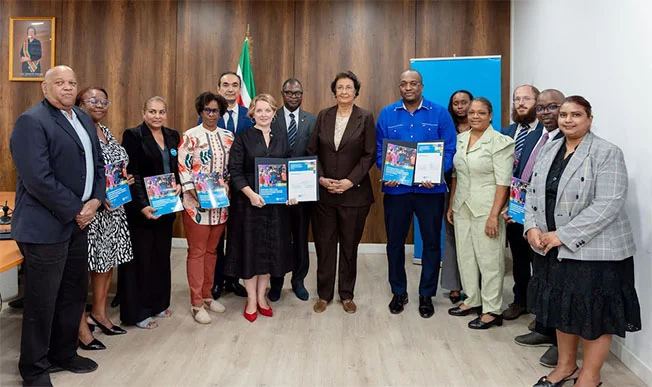
On November 25, 2024, a landmark five-year sustainable development partnership spanning 2027 to 2031 was formally inked between the Republic of Suriname and the United Nations, at a signing ceremony hosted at the Office of the President in Paramaribo. The Multi-Country Sustainable Development Cooperation Framework (MSDCF) was signed by Suriname’s Minister of Foreign Affairs, International Trade and Cooperation Melvin Bouva, and UN Resident Coordinator for Suriname Joanna Kazana, with President Jennifer Simons and senior representatives from 21 participating UN agencies in attendance.
Kazana opened her remarks with a pointed, forward-looking warning tied to Suriname’s burgeoning offshore oil and gas sector: while projected future oil revenues present an unprecedented historic opportunity to lift national living standards, unregulated, poorly planned development carries severe, avoidable risks. These risks include extreme concentration of new wealth in the hands of a small elite, widening structural inequality between Suriname’s densely populated coastal zones and remote interior communities, and irreversible degradation of the country’s fragile ecosystems that local populations depend on for subsistence. She emphasized that resource sector prosperity never automatically trickles down to all segments of society, and proactive, inclusive governance now will prevent long-term harm to marginalized groups, including Indigenous and tribal communities who hold customary rights over vast swathes of the interior.
Suriname, a nation where 93% of total land area remains covered by intact old-growth rainforest, cannot afford to sacrifice its ecological heritage for short-term oil gains, Kazana added, stressing that Indigenous and tribal communities must be granted full, meaningful participation in all decision-making processes that impact their ancestral territories and livelihoods.
President Jennifer Simons echoed this priority, framing the new partnership as a defining turning point for Suriname’s national trajectory. “Economic growth can never be an end in itself,” she stated. “Our goal is not merely to build a larger GDP, but to construct a fair, inclusive society where every citizen, no matter if they live in a coastal urban center or a remote interior village, gains access to high-quality education, affordable healthcare, dignified work, and improved living conditions.” Simons noted that policy decisions made in the current period of pre-oil boom transition will shape outcomes for generations of Surinamese citizens to come, and that national ownership of development priorities remains non-negotiable, with the UN’s role limited to providing technical support and capacity building to advance Suriname’s own national development goals.
The 2027-2031 cooperation framework is structured around two core strategic pillars. The first pillar centers on joint efforts to build dual economic and ecological resilience: partners will work to diversify Suriname’s economy away from over-reliance on oil and gas, provide targeted support to smallholder producers and micro, small and medium-sized enterprises, expand market access for local goods, and enforce robust protections for the country’s rainforests, river systems, and vulnerable coastal zones. The second pillar prioritizes expanded, equitable access to public services: targeted investments will extend quality education, healthcare, and social protection programs to historically underserved interior regions, scale up protections for women, children and youth against all forms of gender-based and interpersonal violence, and strengthen public sector institutional capacity through expanded digitalization, improved data governance, and deepened regional Caribbean cooperation.
Minister Melvin Bouva confirmed that the framework is fully aligned with Suriname’s national development agenda, and that a detailed, country-specific implementation plan will be developed separately to outline clear stakeholder responsibilities, allocated funding, and measurable, verifiable performance targets. Annual progress reviews will be conducted to track implementation success, and while the broader framework covers both English and Dutch-speaking Caribbean nations, all local activities will be tailored exclusively to Suriname’s unique national needs and context.
VN waarschuwt Suriname voor groeiende ongelijkheid door olie-inkomsten